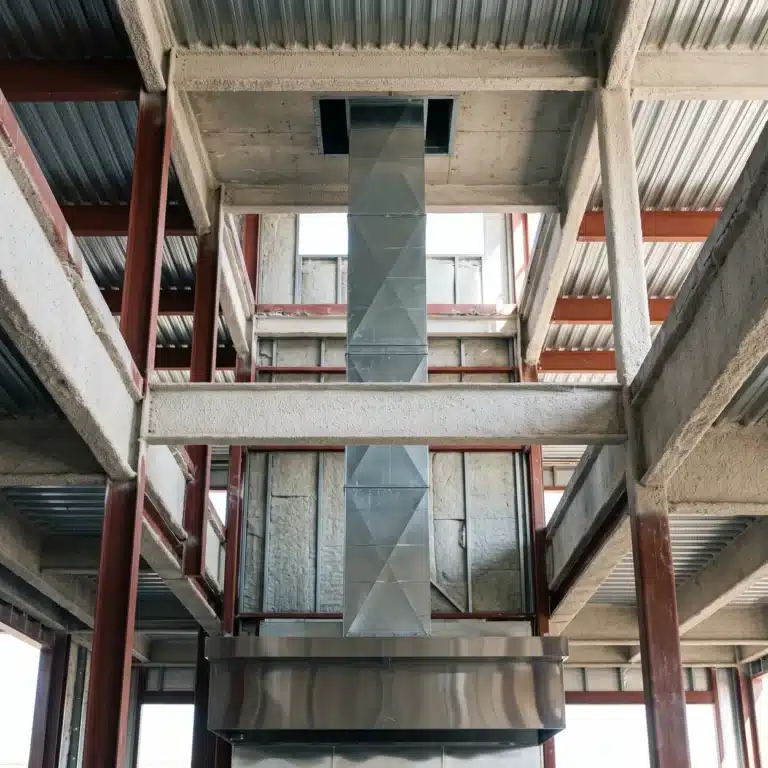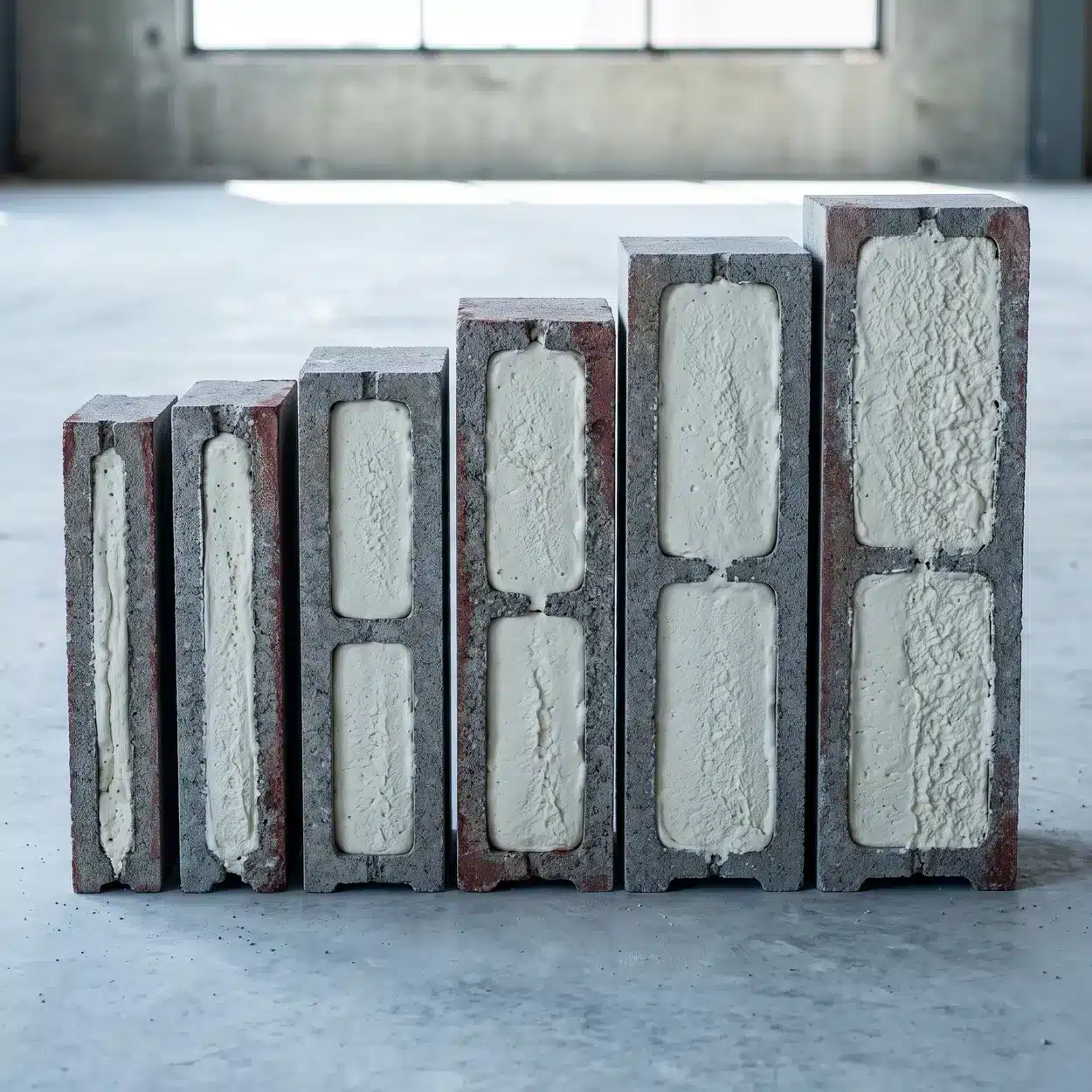
This Core Foam FAQ collects the questions owners, general contractors, and architects actually ask about Core Foam, grouped by subject instead of scattered down a list. It covers what the product is, what the wall numbers mean, what the fire test measured, where the foam does not belong, how the work runs, and what the energy code asks for in Texas, Kansas, and Oklahoma.
Foam injected into the hollow cores of concrete block is commonly referred to as core fill insulation. Core Foam from cfiFOAM is the product our crews install for that work.
TLDR: The foam’s own numbers are short, settled, and easy to state. Almost every Core Foam FAQ that matters is really a question about the wall rather than about the foam, because everything that varies and everything that goes wrong is a property of the assembly the material went into. Same 8-inch block, same fill, and the calculated wall value swings by a factor of about 2.
The Right Answer to the Wrong Question
An owner in Oklahoma City asks one question before he buys: what is the R-value of the foam. He gets an accurate answer, R-4.6 per inch at 75F mean temperature. He then fills the cores of an 8-inch wall built from 135 pound per cubic foot normal weight block. cfiFOAM’s own series-parallel value for that finished wall is R-4.02, lower than the per-inch figure he was quoted for the material inside it. Nobody misled him. The wall was the variable, and it was the one thing he never asked about.
I have been in this trade for over forty years, and the calls follow a pattern I can predict now. People ask about the product. Almost nobody asks about their own wall.
What people assume decides the result is the chemistry. What actually decides it is the assembly: block density, grouted cells, whether the void is a block core or a cavity built to drain, and which code edition the building official enforces. The foam behaves the same on every one of those jobs. The buildings do not. So a useful Core Foam FAQ pairs each question with the one standing behind it.
| What people ask | What actually decides the outcome | Where that answer lives |
|---|---|---|
| What is the R-value of the foam? | What is the density of the block? | The approved masonry submittal |
| Is it fire rated? | Which listed assembly carries your wall’s hours? | The tested or calculated assembly |
| How fast does it set? | What is going to stop the fill before it travels? | The reinforcing and grouting drawings |
| What does it cost per square foot? | How much of that wall is actually hollow? | A marked-up elevation, after a test row |
| Can it go in my cavity wall? | Is the void a block core or the space between wythes? We only fill block cores | The wall section, then weeps and flashing at the base |
Every entry in the middle column is a property of a building, not of a product.
What Is Core Foam and What Is It Made Of?
Core Foam Masonry Foam Insulation is a two-part aminoplast foam manufactured by cfiFOAM, Inc. of Knoxville, Tennessee. One part is a spray-dried resin, the other a foaming catalyst concentrate. The installer mixes them before the job, and the foam is combined with compressed air and pressure-injected into the wall.
The material data is short. cfiFOAM publishes no set time, describes the foam as non-expanding, and normally suggests a 72-hour cure before a filled wall is painted. The ICC-ES listing gives a nominal density of 1.0 pound per cubic foot, and the product sheet reports shrinkage under 0.5 percent, which separates a cured foam from a gravity-dependent loose fill. Thermal performance is measured under ASTM C518, the steady-state thermal transmission test method using a heat flow meter apparatus.
This is not a general-purpose insulation that happens to fit in block. It is masonry foam, cfiFOAM’s published uses are narrow, and the limitations are the more useful half.
Core Foam FAQ: What R-Value Will This Wall Actually Get?
The material figure is R-4.6 per inch at 75F mean temperature per ICC-ES listing ESL-1648, and R-5.0 per inch at 25F mean temperature. United States design R-values are stated at a 75F mean, so 4.6 belongs in a submittal here. The wall figure is a separate calculation, and it answers what people are really asking.
Here is the anchor for this page. Take one 8-inch concrete masonry unit with three 1-inch webs, cores filled with Core Foam. In 85 pound per cubic foot lightweight block cfiFOAM’s series-parallel wall value is R-8.21. In 135 pound per cubic foot normal weight block, the same unit with the same fill calculates to R-4.02, about a 2 times swing driven entirely by the concrete.
The values below come from the second edition of cfiFOAM’s Thermal Properties Data Handbook, May 2025, for ungrouted units with three 1-inch webs, air films included, calculated by the series-parallel method, also called isothermal planes. That method accounts for heat crossing the solid webs, which is why it survives plan review. cfiFOAM publishes 8-inch and 12-inch units only.
| Unit size | 85 pcf | 95 pcf | 105 pcf | 115 pcf | 125 pcf | 135 pcf |
|---|---|---|---|---|---|---|
| 8 inch | R-8.21 | R-7.14 | R-6.19 | R-5.36 | R-4.64 | R-4.02 |
| 12 inch | R-13.44 | R-11.61 | R-9.98 | R-8.50 | R-7.33 | R-6.27 |
Read down a column before you read your own cell. An 8-inch lightweight unit at R-8.21 out-calculates a 12-inch normal weight unit at R-6.27. Density is the bigger lever.
Two qualifiers travel with that table. It assumes three 1-inch webs and no grouted cells: thinner or fewer webs calculate higher, and grouted rebar cells calculate lower. And R per inch times core depth is no substitute, because it ignores thermal bridging through the webs. The full set, including other web configurations and grouting schedules, is in cfiFOAM’s Thermal Properties Data Handbook for Core Foam filled block walls, which uses the series-parallel method laid out in CMHA TEK 06-02C.
Is Core Foam Fireproof, Fire Rated, or Neither?
Neither, and cfiFOAM does not claim otherwise. Tested to the ASTM E84 test method for surface burning characteristics of building materials and UL 723, Core Foam has a flame spread index of 25 or less and a smoke developed index of 450 or less, per ICC-ES listing ESL-1648. That is the listed result, describing flame travel along a sample surface.
Class A is a threshold, not a score. Under Section 803.1.2 of the 2021 IBC, a Class A interior finish is a flame spread index of 0 to 25 together with a smoke developed index of 0 to 450. The listed result sits inside that band. Keep the score and the threshold in separate sentences, because conflating them turns a surface classification into a fire-protection claim nobody can support.
Then the sentence answering the question underneath the question. cfiFOAM states that its masonry foam neither adds to nor detracts from the fire-resistance rating of a CMU wall. A wall’s hours come from a tested and listed assembly, and whether filled cores stay inside that documentation is a call for the licensed architect or engineer of record and the authority having jurisdiction.
One more answer belongs in any Core Foam FAQ, and most pages skip it. The third-party evaluation is ICC-ES listing ESL-1648, reissued April 2026. It covers R-value, surface burning, and federal labeling, so it is the number to hand a plans examiner for those properties, and it says nothing about fire resistance.
Where Core Foam Belongs, and Where It Does Not
cfiFOAM publishes a short list of uses and a short list of limitations. Both matter more than any performance number, because a product used outside its published uses has no data behind it. Every Core Foam FAQ answer above assumes your wall sits on the left of this table.
| Where we install it | Stated limitations |
|---|---|
| Cores of concrete block walls, by pressure injection through drilled holes | Not for horizontal applications |
| Cores of concrete block walls, by top fill during construction | Not for flotation |
| Never between wythes: we do not fill brick veneer or double-wythe cavities, new or existing | Not a waterproofing material |
| Existing block walls, through drilled holes | Never injected into a wet wall |
| Commercial and institutional new construction, the typical use per cfiFOAM | No extended contact with surfaces above 190F, which is 88C |
Two applications get proposed to us that are not on that list. Hollow structural steel tubes and columns are the common one, and cfiFOAM does not publish them as a use, so we will not quote that scope without written support.
The second is the cavity between two wythes, and the air space behind a brick veneer is the common version. Weeps at the base and through-wall flashing above them mean somebody detailed that cavity as a drainage plane, and filling it is a moisture failure waiting on a wet season. We do not fill the cavity behind a brick veneer or between two wythes, in new construction or old. The 190F limit has a similar edge: boiler enclosures, kiln surrounds, and masonry behind cooking equipment can all run past it.
Core Foam FAQ: How Does the Installation Actually Run?
Most commercial elevations fill in a day or less once the wall is ready. Side fill, also called pressure fill, injects through small holes drilled in the bed joints of a standing wall. Top fill drops material down open cores from the top of a lift before the closing course seals it, and only during construction.
cfiFOAM’s guide specification calls for 5/8-inch to 7/8-inch holes roughly every 8 inches on center, starting about 4 feet above the floor and repeating every 10 to 14 feet vertically. Treat that as starting geometry and confirm the layout against unit size, bond pattern, and the grouting drawings. Holes belong in the bed joint, not the face shell, because a joint patches back and reads as a joint.
Placement and cure are different things. cfiFOAM normally suggests a 72-hour cure before a filled wall is painted and says to ventilate well until the foam has fully cured. Hold paint and low-permeance finishes on both faces until it has.
What Does Core Foam Cost, and Why Will Nobody Publish a Number?
No credible published installed price covers commercial Core Foam work in Texas, Kansas, or Oklahoma, and we will not invent one. Every per-square-foot figure circulating as an industry number traces to a lead generation site or a residential estimate. This is the Core Foam FAQ entry where the honest answer is to read a bid instead of a table.
What moves the number is worth knowing first. You are buying core volume rather than wall area, so unit size changes the quantity substantially. Grouted cells and bond beams take no foam and still raise the price, because somebody has to shade them on an elevation, lay a hole row above every bond beam, and verify around them. On a finished architectural face, closing several hundred holes is masonry restoration with matched mortar. Ask each bidder what fillable area they priced and on what drawing.
Can Core Foam Go Into a Building That Is Already Standing?
Yes. We inject it into standing block walls through small drilled holes, one of very few ways to insulate a standing block wall without opening it. The constraint matches new work: the cores have to be open and dry, and on an older building nobody knows which ones are.
So the retrofit half of this Core Foam FAQ has answers that come before the fill. Confirm what is already in the cores, because older masonry sometimes holds loose fill, and historic loose-fill vermiculite can be associated with asbestos contamination, which makes identification a job for a qualified environmental professional. Fix the water first, because efflorescence, spalling, and staining under a sill mean a live water path. Then price the fillable area off a test row and a borescope, since grouted pilasters and undocumented bond beams are normal on a fifty-year-old building.
What Does the Code Require in Texas, Kansas, and Oklahoma?
This is a jurisdiction question before it is a product question. There is no national answer to what your wall owes, and the three states we work in sit most of a decade apart on their adopted energy codes.
Texas enforces the 2015 IECC for commercial construction, effective November 1, 2016 under 34 Texas Administrative Code 19.53(a). Oklahoma is still on the 2006 IECC, with state amendments. Kansas names the 2006 IECC for new commercial and industrial structures under K.S.A. 66-1227, and because Kansas is a home rule state, adoption and enforcement sit locally.
Home rule cities amend upward, and the sharpest example sits inside one Texas metro. Dallas amended up to the 2021 IECC while Fort Worth stayed on the 2015, so the same block wall gets reviewed against two editions twenty miles apart.
One distinction survives every edition. Prescriptive mass wall rows are written in continuous insulation, abbreviated ci, and continuous means uninterrupted by framing or webs. Foam inside block cores is interrupted at every web, so it is cavity insulation, earns no ci credit, and generally will not satisfy a prescriptive row alone. It still contributes through the U-factor path. In the 2021 IECC, Table C402.1.3 is the insulation component R-value method and Table C402.1.4 is the assembly U-factor method, and those tables govern only where a jurisdiction amended up to that edition. Elsewhere, read the row out of the edition your building official enforces.
How to Use This Core Foam FAQ on Your Own Project
Turn the middle column of the first table into a checklist, in this order.
- Pull unit size and block density off the approved masonry submittal, not the specification’s generic call for concrete masonry units.
- Look up the wall value in cfiFOAM’s handbook for that size, density, web configuration, and grouting, and write the source and table into the energy model notes.
- Confirm the wall type. Core Foam goes in block cores only. Weeps and through-wall flashing mean a drainage cavity, and we do not fill cavities between wythes in any wall.
- Mark up the grouting drawings. Shade every grouted cell, bond beam, and lintel, and that elevation becomes the fill plan and the fillable area at once.
- Check the exposure against the stated limitations, including the 190F limit, horizontal applications, and wet walls.
- Keep the fire paperwork in two piles. The surface burning report covers the material; the listed assembly covers the hours.
- Get a project-specific bid, and ask what fillable area, patch standard, and verification practice it assumed.
Related Reading
- Understanding fireproofing versus fire retardant separates a material classification from a fire-resistance rating, the confusion behind more of these questions than any other.
- How to choose a fireproofing contractor covers what to ask an applicator before a specialty scope reaches your job.
- Commercial fireproofing code compliance guide explains why the adopted edition, not the model code, governs.
Fuller treatments of the answers above sit alongside this page: our Core Foam masonry insulation overview, our R-value and fire safety breakdown, our installation guide, our cost guide, and our CMU retrofit guide.
Frequently Asked Questions
Will the foam corrode the metal already inside a masonry wall? Testing under the D.O.E. (e)(3) and H.U.D. 6.2.8 references reported no perforations on aluminum, copper, or steel, no pitting on galvanized steel, and mass loss under 0.1 gram. A block wall is full of metal, so the question is fair.
Does filling the cores make a block wall quieter? cfiFOAM’s product sheet lists STC 54 to 60 in 8-inch block walls and STC 58 to 61 in 12-inch block walls, without naming the test standard. Ask for the report before quoting either, because sound transmission class belongs to an assembly and describes sound passing between two spaces, not sound absorbed inside one room.
Does the cured foam absorb water? cfiFOAM reports an open cell content of 40 percent by volume and vapor transmission of 10.60 perms under ASTM E96, and it states the foam is not a waterproofing material and must not be injected into a wet wall.
Is the cured foam electrically conductive? cfiFOAM does not publish a resistivity figure. Every conduit, box, and knockout still gets sealed before injection, because an open penetration is a path the foam will take.
Who is allowed to install it? cfiFOAM’s guide specification calls for an authorized contract installer trained by the manufacturer. The installer mixes the components, combines the foam with compressed air in the manufacturer’s equipment, and follows the written instructions.
Is this the same thing as the spray foam on a metal building roof? No. Spray foam is applied to a surface and forms a continuous adhered plane. This material is injected into closed block cores and interrupted by the webs of every block, so it does not replace spray foam or sprayed fiber on steel frames.
Key Takeaways
The foam’s numbers are short; the wall’s numbers are the variable.
- R-4.6 per inch at 75F mean temperature, with R-5.0 per inch at 25F mean temperature as the cold test point.
- No published set time, a 72-hour cure before paint, a nominal density of 1.0 pound per cubic foot, and shrinkage under 0.5 percent.
Block density moves the wall more than the fill does.
- The same 8-inch unit with the same fill calculates at R-8.21 in 85 pcf block and R-4.02 in 135 pcf block, per cfiFOAM.
- That 2 times swing is the most useful answer in this Core Foam FAQ, and an 8-inch lightweight unit out-calculates a 12-inch normal weight unit.
A surface burning result is not a fire-resistance rating.
- Listed on ASTM E84: flame spread 25 or less, smoke developed 450 or less, per ICC-ES ESL-1648.
- Class A per Section 803.1.2 of the 2021 IBC is a flame spread index of 0 to 25 with a smoke developed index of 0 to 450.
- cfiFOAM states it neither adds to nor detracts from a masonry wall’s rating, and ESL-1648 does not cover fire resistance.
The exclusions are the specification.
- Nothing horizontal, no flotation, no waterproofing role, no wet walls, and no extended contact above 190F.
- Nothing in the cavity between wythes, new or existing, and hollow structural steel tubes and columns are not a published use.
Code answers come from the jurisdiction, never the state.
- Texas is on the 2015 IECC, Oklahoma on the 2006 IECC, Kansas on the 2006 IECC under home rule, and Dallas amended up to the 2021 while Fort Worth held the 2015.
- Core Foam earns no continuous insulation credit and contributes through the U-factor path.
If you have worked through this Core Foam FAQ and want a crew that reads block density off the submittal before quoting an R-value, checks whether the void is a block core or a cavity between wythes, keeps the surface burning report separate from the listed assembly carrying your wall’s hours, and prices fillable area instead of elevation area, that is the work we do throughout Texas, Oklahoma, Kansas, Nebraska, Minnesota, Wisconsin, Arizona, Missouri, and Iowa. Call me at 512-387-2111 or email ross@bahlfireproofing.com, or Contact Bahl Fireproofing to get a masonry scope reviewed. Our Core Foam masonry insulation page covers the service itself, and our service areas page shows where we work.
This article provides general educational information about masonry insulation, thermal performance, and passive fire protection, and it is not engineering, legal, or code-compliance advice. It does not replace project-specific direction from a licensed architect or engineer. Product specifications including R-value, density, cure time, acoustic ratings, and surface burning results are revised by manufacturers, so confirm current values against the latest data sheet, and product suitability depends on project-specific conditions. Fire-resistance ratings depend on the tested and listed assembly and correct installation and must be confirmed against the applicable listing. Code citations reference a specific edition, the adopted edition varies by the authority having jurisdiction, and installation must follow the manufacturer’s written instructions and be performed by a qualified applicator.