Exposed structure moves the insulation onto the finish schedule. Once a sprayed fiber ceiling is the visible surface of a lobby, a gym, or a sales floor, K-13 color stops being a product attribute and becomes an architectural finish that has to hold across thousands of continuous square feet. This article covers what International Cellulose publishes about color, what it does not, and the submittal language that closes the difference.
TLDR: International Cellulose will match K-13 color to a Sherwin-Williams or RAL reference, and the risk in that is not the match itself. It is that no minimum order quantity, no lead time, and no batch-to-batch tolerance is published anywhere, so consistency across one continuous ceiling has to be bought in the submittal language rather than assumed off a color chart.
The Ceiling That Reads as Two Colors Under a Clerestory
The call comes from the architect, not the owner. The ceiling looks right from the entry, and there is a line across the third bay where the color changes. Nobody sprayed the wrong material. The field went on over two mobilizations from two production runs of the same custom match, and the seam landed under a clerestory where late-day sun crosses the deck at a shallow angle.
That is not a touch-up. Sprayed cellulose cannot be feathered into an adjacent area the way a paint film can, because you are blending texture and thickness along with color. The remedy is reapplying to a natural break in the ceiling plane: a lift, masking over finished floor, and a licensed applicator mobilizing into a nearly finished building. That was not decided in the field. It was decided months earlier, in a submittal that named the color and said nothing about the run.
What International Cellulose Publishes About K-13 Color, and What It Does Not
International Cellulose Corporation publishes five standard colors for K-13: Black, Gray, Light Gray, White, and Tan, plus custom matching, with a light reflectance figure for each. It publishes no minimum order quantity, no lead time, and no batch-to-batch color tolerance. That last gap decides whether a large exposed ceiling reads as one surface.
Custom matching is real and the manufacturer shows it. Published examples reference Sherwin-Williams Positive Red SW 6871 and Gold Coast SW 6376, Benjamin Moore Goldsmith CSP-960 and Plum Perfect 1371, and RAL 6035 and RAL 5005.
The specification side is thinner. The manufacturer’s July 2025 spec guide says only that color shall be from the manufacturer’s standard color chart. No tolerance clause, no delta-E limit, no batch quantity, no lead time. Architects assume those exist because they exist for paint and acoustical tile. The published record does not support it.
Two traps on the way in. An undated International Cellulose commercial product brochure still in circulation claims seven standard colors, and it prints an R-value per inch the dated February 2025 technical data sheet does not support. The dated sheet governs: five standard colors plus custom, and R-3.7 per inch. A metal deck data sheet separately lists a Beige at 71 and above that never appears on the five-color list. One naming note as well: International Cellulose Corporation is abbreviated ICC and is not the International Code Council.
The Pattern I See on Exposed Ceilings
I have been spraying insulation and fire protection for over forty years. A color complaint on a finished K-13 ceiling is usually about a seam or a patch, not about the color. People assume the risk is whether the manufacturer can hit the target. The real risk is whether the whole field came out of one run, and whether anyone approved it under the light it would live in.
The second half matters as much as the first. A color gets picked off a small sample held at arm’s length under 4000K office fluorescent, then installed twenty-eight feet overhead under 3000K pendants with daylight crossing it sideways. Those are two different colors to the human eye and neither is wrong. Both failures are preventable in a submittal and neither is preventable on a lift afterward, which is why the specification section below is worth copying.
Why Sprayed Texture Never Reads Like Painted Gypsum
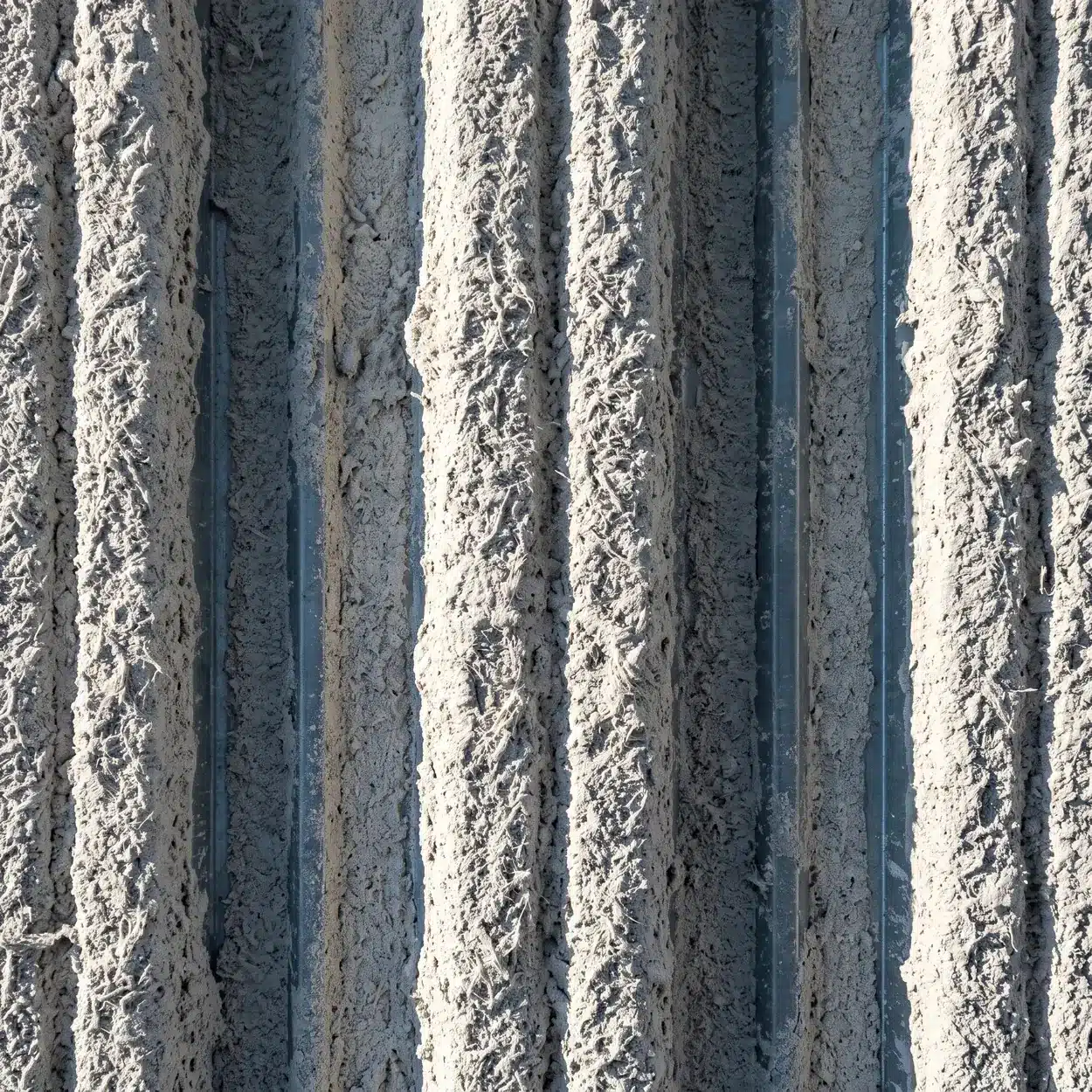
A painted surface is flat and returns light evenly. A sprayed fiber ceiling is three-dimensional and directional, so what your eye reads as color is the average of lit fiber faces and shadowed voids between them. Change the light angle or the view angle and that average changes, on a surface where the pigment never moved.
The material makes this unavoidable. K-13 goes on at a nominal 3.5 pounds per cubic foot. That is an open fiber matrix, not a film, and passes have direction. A nozzle worked north to south lays fiber differently than one worked east to west, and under raking light those areas read as two tones of one color.
Substrate adds a second pattern on the first. On ribbed metal deck the flute walls shadow themselves, so color inside a flute reads darker than color on the rib, and the ceiling carries striping unrelated to the batch. That is normal, and it hides a real run-to-run difference on a shop sample while exposing it overhead. A twelve-inch board viewed at eighteen inches answers a question nobody will ask again.
What K-13 Color Does to Perceived Ceiling Height and Lighting Load
The manufacturer publishes light reflectance for the standard colors: White at 84 and above, Light Gray at 73 and above, Tan at 46 and above, Gray at 45 and above, Black at 17 and above. White returns roughly five times what Black returns to the room below. That ratio drives both halves of the design conversation, because a ceiling that returns light reads higher and brighter, and one that absorbs light recedes and reads lower.
Use the numbers carefully. International Cellulose attributes them to ASTM D2244, the practice for calculating color tolerances and color differences from instrumentally measured color coordinates. That is a color-difference calculation, not a method for measuring light reflectance value. Cite them as manufacturer-published light reflectance figures, and ask how they were obtained before a lighting designer carries them into a photometric model as measured values. An architect will catch the mismatch, and the specification is stronger for naming it first.
| Color | Published light reflectance | Effect on the room | Typical use | Patch risk |
|---|---|---|---|---|
| White | 84 and above | Recedes upward; lowest lighting load | Schools, retail, offices | Low. Dirt shows, seams do not |
| Light Gray | 73 and above | Bright, less glare than white | Gyms, civic lobbies | Low to moderate |
| Beige (metal deck sheet only) | 71 and above | Like Light Gray, warmer | Rare; confirm availability | Unknown; ask the manufacturer |
| Tan | 46 and above | Warm mid-tone; noticeable load | Warehouses, warm palettes | Moderate |
| Gray | 45 and above | Neutral industrial; mid load | Industrial, ductwork match | Moderate |
| Black | 17 and above | Deck disappears; highest load | Theaters, restaurants, retail | High. Seams and patches show |
| Custom paint or RAL match | Not published | Depends on target color | Design-forward retail, civic | High. Depends on run control |
| Any color with Protek-13 | Not published | Changes sheen more than tone | Cleanability required | Moderate; will not match bare |
Two rows decide most projects. Black and near-black custom colors look excellent and are the least forgiving surface in the building, because every seam and change in pass direction shows against a dark field. White is the most forgiving for consistency and the least forgiving for dirt. Give the lighting designer the reflectance figure before the fixture count is fixed, because interreflection off a ceiling that large is part of the calculation.
A K-13 Color Decision Is Also an Acoustic Decision
Here is the number that prices a coating, from the manufacturer’s own published data. Over 1.75 inches of K-13, the Protek-13 coated assembly tests at NRC 0.95, where the same 1.75 inches uncoated tests at 1.00, measured by ASTM C423, the test method for sound absorption and sound absorption coefficients by the reverberation room method. A coating engineered for the product, applied heavy, still costs measurable absorption. Whatever a painting sub sprays on for appearance is not engineered for it.
The mechanism is simple. Absorption comes from an open fiber matrix with air paths through it, and a film-forming coating bridges those paths shut. You cannot pull paint back out of cellulose, so no restoration procedure exists. The manufacturer’s published answer on painting is a warning, not a permission slip: yes, but consult International Cellulose Corporation for the correct practices, or the benefits of the products can be compromised.
That matters most on an exposed architectural ceiling, because absorption is usually why the ceiling exists. Over solid backing, K-13 reads NRC 1.00 at 1.75 inches and holds 1.00 at 2 and 3 inches; on 1.5-inch metal deck, 1.5 inches reads 1.05. A tenant-improvement repaint spends that in a weekend, usually because a general note said to paint all exposed ceilings and structure.
Where an Exposed Sprayed Ceiling Lands in the Building Code
K-13 is not a fireproofing product. The manufacturer describes it as a spray-applied thermal and acoustical insulation used as an exposed ceiling finish, and it carries no fire-resistance rating of its own, so a color or coating decision is an interior finish question.
In the 2024 International Building Code, Section 807 covers insulation and sends insulating materials to Section 720. Section 720.2 addresses concealed installation and Section 720.3 addresses exposed installation. Both impose a flame spread index of not more than 25 and a smoke developed index of not more than 450, so they are not an exception pair; they are the same limits under different conditions. The exception in 720.2 reaches cellulosic loose-fill insulation, which sprayed fiber is not.
The class thresholds sit in Section 803.1.2 of that edition, where Class A is a flame spread index of 0 to 25 and a smoke developed index of 0 to 450. K-13’s tested result is a flame spread index of 5 and a smoke developed index of 5 by ASTM E84, the test method for surface burning characteristics of building materials. Those belong in separate sentences: one is a code threshold, the other a result for the material as tested.
Editions matter for the occupancy table. Interior finish requirements by occupancy live in Table 803.13 in the 2018, 2021, and 2024 editions, and in Table 803.11 in the 2015 edition. Whether a field-applied coating keeps the assembly inside those limits belongs to the licensed architect or engineer and the authority having jurisdiction. Our three states are not on one adoption schedule, so confirm the adopted edition with the AHJ.
Raking Light on Exposed Ceilings Across Texas, Kansas, and Oklahoma
The buildings that get exposed structure here are the ordinary regional stock: big-box retail, distribution and fulfillment, gymnasiums and field houses, schools, and civic buildings. The deck is the ceiling and the sprayed fiber is the finish, across a field enormous enough for a run-to-run difference to show itself.
Daylighting makes it visible. Clerestories and high side glazing put low-angle winter sun across the ceiling late in the day. That is raking light, and raking light is the worst condition for hiding a tone or texture difference. A ceiling that reads uniform under the fixtures at noon can separate visibly at four in the afternoon in January.
Spring weather can then supply the patch. Hail-driven roof repairs are one reason a ceiling gets opened up and reapplied in pieces. That repair happens years after the original order, from whatever material is available then, by a contractor licensed by International Cellulose because nobody else may install it. Attic stock from the original run is what saves the match.
Specification Language That Manages K-13 Color Risk
None of this is exotic. It is standard exposed-finish practice applied to a material most specifiers have handled as insulation rather than as a finish. These six items are recommendations from our field experience, not manufacturer instructions, and the specification should say so.
- One production run per continuous visual field. All material for a ceiling visible as one surface comes from a single run. Where the job is phased, define the break at a soffit, a beam line, or a change of plane, never mid-bay.
- A field mock-up, not a sample board. Meaningful size, on the actual substrate, at the specified thickness, by the applicator who will do the work, approved under the installed lighting from the actual viewing distance and angle. Approve it at the worst hour of the day.
- Confirm the three unpublished items during submittals. Minimum order quantity, lead time, and batch-to-batch tolerance, in writing. None is published, and a long lead time on a custom match can push the ceiling to the wrong point in the schedule.
- Attic stock from the same run. Held by the owner and labeled with color, thickness, substrate, run identification, and date, so a patch years later starts from the right material.
- The no-paint note in two places. On the finish schedule and in the operations and maintenance manual: this ceiling is not to be painted, coated, or exposed to overspray without consulting the manufacturer. Add a painting exclusion room by room so a general note cannot reach it.
- A record of what was installed. Color name and reference, thickness, substrate, applicator, date. Without it, a patch years later starts from a guess, which is why patches rarely match.
Sequencing is the coordination trap under all of it. The deck gets sprayed early, and fixtures, sprinkler drops, duct hangers, and conduit get located late. Each of those penetrations after the fact is a small patch in a field that may no longer have matching material, and on a dark ceiling those patches read from the floor. Finalize the fixture and sprinkler layouts before the spray date where you can. Where you cannot, put a return mobilization in the schedule and the budget on purpose and reserve enough of the original run to cover it. Thickness matters there too, since K-13 is limited to five inches in a single pass without mechanical support.
We will not print a per-square-foot figure here, so get a project bid.
Related Reading
- K-13 Color Options and Aesthetic Applications covers the palette itself, the companion question to the matching work above.
- K-13 Acoustic Performance: NRC Ratings by Thickness works through the thickness and substrate combinations a coating puts at risk.
- Professional K-13 Application Methods for Commercial Projects explains how the material goes on, which is what a mock-up approves.
- Sanctuary Acoustics: The Practical K-13 Ceiling Guide
Frequently Asked Questions
Can K-13 be color matched to a specific paint color? Yes. International Cellulose offers custom matching, and published examples reference Sherwin-Williams, Benjamin Moore, and RAL colors. The minimum order quantity, lead time, and batch tolerance are not published, so confirm all three during submittal review.
What are the standard K-13 colors? Five: Black, Gray, Light Gray, White, and Tan, plus custom matching. An undated brochure still in circulation claims seven, and the dated February 2025 technical data sheet supersedes it. A Beige figure appears in the metal deck sheet but is not standard.
Does lighting change how a K-13 color looks? Substantially. A sprayed fiber surface is directional and three-dimensional, so the color you see is the average of lit faces and shadowed voids, and raking light shifts that average. Approve the mock-up under the installed lighting, at the actual viewing distance and angle.
What is the light reflectance of each color? The manufacturer publishes White at 84 and above, Light Gray at 73 and above, Tan at 46 and above, Gray at 45 and above, Black at 17 and above. These figures are attributed to ASTM D2244, a color-difference practice rather than a light reflectance method.
Can a K-13 ceiling be painted to change color later? The manufacturer’s answer is yes, but only after consulting International Cellulose, or the benefits of the product can be compromised. Practically, do not. Even the purpose-built Protek-13 coating takes 1.75 inches from NRC 1.00 down to 0.95, and no restoration procedure is published.
Does ceiling color affect fire or code compliance? K-13 carries no fire-resistance rating and is not a fireproofing product, so color is an interior finish question. In the 2024 International Building Code, Section 807 routes insulation to Section 720, and an exposed application sits in Section 720.3. Whether a coating stays inside those limits belongs to the licensed architect or engineer and the AHJ.
Key Takeaways
The K-13 color chart is not where the risk sits.
- Five standard colors plus custom matching, and the match itself is reliable.
- No published minimum order quantity, lead time, or batch-to-batch tolerance.
A sprayed ceiling reads by texture and light angle, not by swatch.
- Pass direction and deck flutes create tone differences with no batch difference behind them.
- A twelve-inch sample board cannot answer a question about a thirty-foot ceiling.
Light reflectance drives the lighting design, not just the look.
- White at 84 and above against Black at 17 and above is roughly five times the returned light.
- ASTM D2244 is a color-difference practice, not a light reflectance method.
Finish decisions on this ceiling are acoustic decisions.
- Protek-13 over 1.75 inches tests NRC 0.95 against 1.00 for the same thickness bare.
- A film-forming paint closes the fiber matrix, and no restoration is published.
Consistency gets written into the submittal or it does not happen.
- One run per continuous field, a mock-up approved under installed lighting, attic stock held by the owner.
- Confirm order quantity, lead time, and tolerance in writing, and put the no-paint note on the finish schedule and in the O&M manual.
If you want an applicator who tells you what the manufacturer publishes about K-13 color and what it does not, holds a continuous field to one production run, sprays a mock-up big enough to approve under real raking light, and leaves the owner labeled attic stock for the patch that follows the next hail season, that is the work we do throughout Texas, Oklahoma, Kansas, Nebraska, Minnesota, Wisconsin, Arizona, Missouri, and Iowa. Call me at 512-387-2111 or email ross@bahlfireproofing.com to walk a ceiling plan, or Contact Bahl Fireproofing to get on the schedule. Our K-13 sprayed fiber insulation page covers the application side, and our Texas service area page shows where we work.
This article provides general educational information about spray-applied insulation and exposed-ceiling finishes and is not engineering, legal, or code-compliance advice. It does not replace project-specific direction from a licensed architect or engineer. Color availability, light reflectance figures, NRC values, and R-values are manufacturer-published data subject to revision, and order quantities, lead times, and color tolerances are not published at all, so confirm current values in writing with the manufacturer before specifying. Code citations reference a specific edition and the adopted edition varies by authority having jurisdiction. Installation, coating, and repair must follow the manufacturer’s instructions and be performed by a licensed applicator.