K-13’s sound absorption is often quoted as a single number, but that figure hides the two things that actually determine it: how thick the material is and what it is sprayed on. The substrate matters as much as the thickness, and getting that wrong over-specifies the job. This is a technical reference for K-13 NRC by thickness and substrate, what the numbers mean, and how to specify the right amount for a space.
TLDR: K-13’s noise reduction coefficient runs from about 0.80 to 1.05, and the figure depends on both thickness and substrate. The air cavity behind a metal deck boosts absorption, so K-13 reaches a higher K-13 NRC on metal deck than on solid backing at the same thickness: one inch hits NRC 0.80 on solid backing but 0.95 on a 3-inch metal deck. Specifying thickness from solid-backing data for a metal-deck project over-specifies the material. Match the NRC to the substrate and the room’s target, not to a single number.
Here is the mistake this reference exists to prevent. An architect needs a room to hit NRC 1.00, opens a data sheet, sees that two inches of K-13 reaches NRC 1.00 on solid backing, and specifies two inches. The catch is that the project is metal deck, where the same target is reached at less thickness because of the air cavity behind the deck. The result is an over-specified, over-thick installation that uses more material than the room needed. The NRC number alone, without the substrate behind it, is a trap, and avoiding it starts with reading the numbers correctly.
What Is the K-13 NRC Rating?
K-13’s noise reduction coefficient ranges from about 0.80 to 1.05, depending on the applied thickness and the substrate behind it. On solid backing, one inch reaches NRC 0.80 and two inches reaches NRC 1.00. On a ribbed metal deck, the air cavity behind the deck raises absorption, so 1.5 inches reaches NRC 1.05. The substrate is as important to the result as the thickness, which is why a single quoted number is incomplete without both.
That dual dependence is the central fact for anyone specifying K-13 spray-applied insulation for acoustics. The rest of this reference lays out the tested values, explains why the substrate changes them, and shows how to turn a room’s acoustic target into the right thickness on the right backing.
K-13 NRC by Thickness and Substrate
The values below are tested by the reverberation room method per ASTM C423 and reflect the manufacturer’s February 2025 technical data. Note how the metal deck raises the result at a given thickness.
| Thickness | Substrate | NRC |
|---|---|---|
| 1 inch | Solid backing | 0.80 |
| 1 inch | 3-inch metal deck | 0.95 |
| 1.5 inches | Ribbed metal deck | 1.05 |
| 2 inches | Solid backing | 1.00 |
The takeaway from the table is the gap between the two 1-inch rows. The same material at the same thickness reads NRC 0.80 on solid backing and 0.95 on a metal deck, a difference large enough to change a specification. Reading the wrong row is how projects end up over- or under-specified.
Why the Substrate Changes the NRC
The reason the same thickness gives different results is the air cavity. A corrugated metal deck leaves an air space behind the K-13, and that gap improves the material’s absorption at lower frequencies, so it absorbs more sound on metal deck than on a solid surface. A porous absorber works best at some distance from a reflecting surface, and the deck profile effectively provides that distance, which is why the metal-deck numbers run higher.
In 20 years of applying this insulation across Texas, Kansas, and Oklahoma, one of the most common mistakes I see is an architect specifying thickness from solid-backing NRC data for a metal-deck project. The result is an over-specified, over-thick installation: the room hits its target NRC at a lower thickness on metal deck, but the spec called for the solid-backing thickness, so the job uses more material than it needed. Reading the value for the actual substrate is a small step that prevents a real waste.
NRC Versus STC: Absorption Is Not Transmission
Two acoustic ratings get confused, and they are not interchangeable. NRC is derived from sound absorption coefficients measured per ASTM C423, and describes sound absorbed within a room, which is what reduces reverberation and echo. STC, or sound transmission class, is calculated per ASTM E413 from transmission loss measured per ASTM E90, and describes sound blocked from passing through a building element like a wall or floor. They answer different questions, and a high number in one does not imply the other.
K-13’s strength is absorption, so its NRC is where its acoustic value lives. For transmission, it reaches roughly STC 50 at 3 inches and STC 51 at 4 inches, but it is fundamentally an absorber that controls the sound bouncing around inside a space, not a barrier built to stop sound from passing between spaces. Specifying it to solve a transmission problem between two rooms would be using the wrong tool; specifying it to quiet a loud, echoing room is exactly what it is for.
What the NRC Number Does and Does Not Tell You
NRC is a single-number average of a material’s absorption at the mid-range speech frequencies of 250, 500, 1,000, and 2,000 hertz, rounded to the nearest 0.05. That makes it a good summary for speech-range absorption and a reasonable rating for general-purpose rooms, but it does not describe how the material performs at very low or very high frequencies. For a space with a specific low-frequency problem, such as heavy bass or certain machinery noise, the per-frequency absorption coefficients matter more than the single NRC figure.
A couple of technical points keep the numbers in perspective. NRC values can exceed 1.0 in reverberation-room testing because of edge diffraction and test effects, not because a material absorbs more than 100 percent of the sound, so a figure like 1.05 is real but reflects the test method. And laboratory repeatability is about plus or minus 0.05, which is why the values are reported in 0.05 steps. None of this changes how to use the data, but it explains why the numbers look the way they do.
How to Specify K-13 Thickness for Your Target NRC
Specifying correctly is a three-step process. First, set the room’s NRC target based on its use. Second, identify the actual substrate, solid backing or metal deck, since that determines which column of data applies. Third, read the thickness from the values for that substrate, not from a generic number. On metal deck, that often means hitting the target at less thickness than a solid-backing assumption would suggest, which saves material without sacrificing performance.
The discipline is simply to match the data to the real assembly. Carrying a solid-backing thickness onto a metal-deck job over-specifies it, and assuming metal-deck performance on a solid-backed wall under-specifies it. Because the difference between the two can be the difference between hitting and missing a target, confirming the substrate before fixing the thickness is the step that makes the specification reliable.
Tuning NRC: When More Absorption Is Too Much
Higher NRC is not automatically better. A room with too much absorption sounds dead, stripped of the natural reflections that make speech and music feel normal, and it can even discourage people from speaking at a comfortable volume. The right amount of absorption depends on what the room is for. A call center or a noisy gymnasium wants aggressive absorption for intelligibility, while a multipurpose worship or performance space wants enough to control reverberation without flattening the music.
That is why the NRC target is a design decision, not a maximize-the-number exercise. Pushing every surface to the highest available NRC can overcorrect a room, so the goal is to hit the target the space actually needs, which the thickness-and-substrate data lets you do precisely.
K-13 Acoustic Specification in Texas, Kansas, and Oklahoma
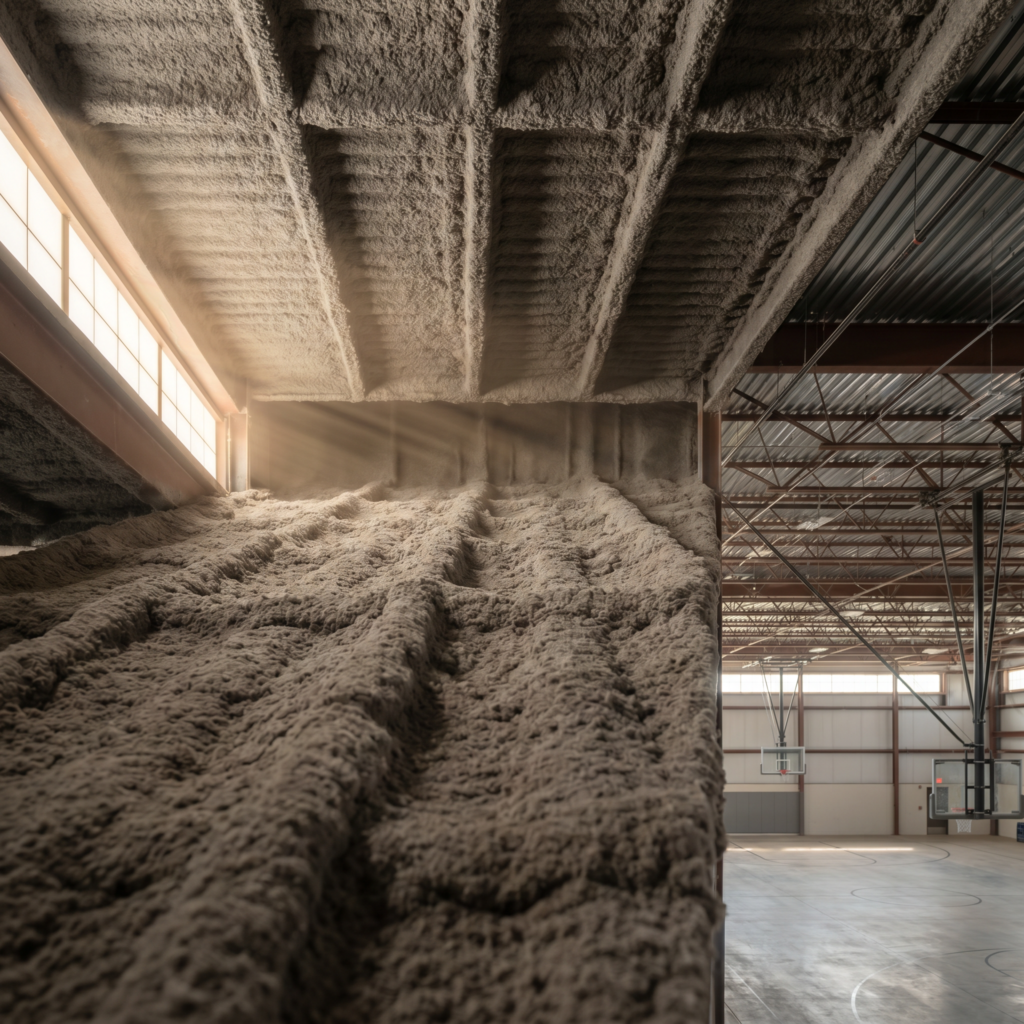
Across the region’s warehouses, distribution centers, gyms, and gathering spaces, the ceiling substrate is usually metal deck, which means the metal-deck NRC values are the ones that apply on most projects, and the air-cavity boost often lets a specification hit its target at a reduced thickness. K-13 is also a Class A material per ASTM E84, with a flame spread and smoke-developed index of 5, and it insulates at about R-3.7 per inch, so the same acoustic ceiling carries fire and thermal performance too. Reading the right NRC data for the real substrate is how we specify acoustic K-13 throughout our service area, so a room hits its target without wasted material.
Frequently Asked Questions
What is the K-13 NRC rating? The K-13 NRC, or noise reduction coefficient, ranges from about 0.80 to 1.05, depending on thickness and substrate. On solid backing, one inch reaches NRC 0.80 and two inches reaches NRC 1.00; on a ribbed metal deck, 1.5 inches reaches NRC 1.05 because of the air cavity behind the deck. The substrate matters as much as the thickness.
Does the K-13 NRC depend on thickness? Yes, and on the substrate. Thicker applications absorb more sound and absorb lower frequencies better, and the backing changes the result as well, so a complete NRC figure always comes with both a stated thickness and a stated substrate rather than as a single number.
Why is the K-13 NRC higher on a metal deck? The corrugated metal deck leaves an air space behind the K-13, and that gap improves absorption at lower frequencies, since a porous absorber performs better at a distance from a reflecting surface. As a result, the same thickness reads a higher NRC on metal deck than on solid backing.
What is the difference between NRC and STC for K-13? NRC is derived from absorption coefficients measured per ASTM C423 and describes sound absorbed within a room to control reverberation and echo, which is K-13’s strength. STC is calculated per ASTM E413 from transmission loss measured per ASTM E90 and describes sound blocked from passing through an element. K-13 is an absorber, reaching about STC 50 at 3 inches, not primarily a barrier between spaces.
Can the K-13 NRC really exceed 1.0? Yes, values up to about 1.05 occur in reverberation-room testing due to edge diffraction and test effects, not because the material absorbs more than 100 percent of the sound. The figure is valid as a tested result, it simply reflects how the standardized test works.
How thick should K-13 be for good acoustics? It depends on the room’s NRC target and the actual substrate. Set the target by the room’s use, identify whether the backing is solid or metal deck, and read the thickness from the data for that substrate. On metal deck, the target is often met at less thickness than a solid-backing assumption would require.
Can a room have too much K-13 absorption? Yes. Too much absorption makes a room sound dead and removes the natural reflections that make speech and music feel normal. The right NRC depends on the room’s purpose, so the goal is to hit the appropriate target rather than to push absorption as high as possible.
Key Takeaways
- NRC depends on thickness and substrate. K-13 runs about 0.80 to 1.05, and both factors have to be stated for the number to mean anything.
- The metal-deck air cavity boosts absorption. One inch reads NRC 0.80 on solid backing but 0.95 on a 3-inch metal deck, a difference big enough to change a spec.
- Read the value for the real substrate. Using solid-backing data on a metal-deck job over-specifies thickness and wastes material.
- NRC is not STC. NRC is absorption within a room; STC is transmission through an element. K-13 is an absorber, reaching about STC 50 at 3 inches.
- NRC summarizes speech frequencies. It averages 250 to 2,000 hertz, so check per-frequency coefficients for low- or high-frequency problems.
- Values above 1.0 are a test artifact. A figure like 1.05 reflects edge effects in the reverberation-room method, not more than total absorption.
- More absorption is not always better. Tune the NRC target to the room’s use so the space does not go acoustically dead.
Related Reading
- New to the material? Start with our K-13 complete contractor guide for the full overview.
- Want the why behind the numbers? Read K-13 insulation soundproofing for how absorption solves real noise problems.
- A specific gathering space? See school acoustic insulation with K-13 for gym and cafeteria applications.
If you are specifying K-13 for acoustics and want to hit your NRC target without over-building the ceiling, the work is setting the target by the room’s use, confirming the substrate, and reading the thickness from the data for that backing. That is how our crew specifies acoustic K-13 throughout Texas, Oklahoma, Kansas, Nebraska, Minnesota, and Wisconsin. Reach me directly at 512-387-2111 or ross@bahlfireproofing.com, or Contact Bahl Fireproofing to match the right thickness and substrate to your space.
This article provides general educational information about the acoustic performance of K-13 spray-applied insulation. It is not engineering or acoustic-design advice and does not replace project-specific direction from a qualified acoustic professional and a licensed architect or engineer. Noise reduction coefficient values depend on thickness, substrate, mounting, and test conditions, and a published NRC should always be tied to a stated thickness and backing. Values are drawn from manufacturer technical data that can change, so verify the current figures and the specific assembly against the manufacturer’s published data and independent testing. Always confirm acoustic targets and product specifications with the manufacturer, a qualified acoustic professional, and a licensed architect or engineer before specifying or installing any system.