Fireproofing vs fire retardant comes down to what each one is tested to do. Fireproofing protects structural steel so it holds its load for a rated number of hours in a fire, while a fire retardant treatment slows how fast flame spreads across the surface of a combustible material such as wood. This guide covers the tests, the IBC chapters and the terms that get mixed up on bids.
TLDR: A fire-resistance rating is measured in hours under ASTM E119 or UL 263. A fire retardant result is a flame spread class from a tunnel test under ASTM E84 or UL 723. They answer different questions, so neither stands in for the other. The trouble starts when a bid uses one word and the drawings mean the other, and this guide shows how to catch that early.
A wrong word on a bid form can put the wrong product on your steel. If the drawings call for a 2-hour column and somebody prices “fire retardant spray,” the number looks cheap until the special inspector arrives and there is no UL design behind it. Then the GC pays for the material twice and the schedule slides.
I have been in this trade for over forty years. The mix-up is rarely a bad product or a careless crew. It is vocabulary: “fire retardant,” “fire resistant,” “flame retardant” and “fireproof” get used as if they mean the same thing, and each points to a different test, code chapter and trade. Bahl Fireproofing applies spray-applied and intumescent fireproofing on structural steel. We do not apply fire retardant treatments, fire-retardant-treated wood or fire-retardant paint.
Fireproofing vs Fire Retardant at a Glance
Read each row as a question your spec should answer.
| Factor | Fireproofing (fire-resistive) | Fire retardant |
|---|---|---|
| What it is | SFRM (spray-applied fire-resistive material) or intumescent coating | Fire-retardant-treated wood, or a fire-retardant coating |
| What it protects | The structural frame: columns, beams, floor and roof assemblies | The surface of a combustible material |
| Question the test answers | How long does the assembly hold up in a standard fire? | How fast does flame travel across the surface? |
| Test standard | ASTM E119 or UL 263 | ASTM E84 or UL 723 |
| Test length | The full rating period, up to 4 hours for common ratings | 10 minutes; 30 minutes for treated wood |
| How the result reads | Hours: 1, 2, 3 or 4 | Flame spread class: A, B or C |
| IBC home | Chapter 7 (Section 703.2), hours set by Table 601 | Chapter 8 (interior finish) and Section 2303.2 (treated wood) |
| What sets the thickness | A UL design for that member and rating | The product’s test report |
| Field check | Special inspection of thickness (2021 IBC 1705.15 and 1705.16) | Labels and test reports against the finish schedule |
| Rates steel for Table 601? | Yes, at the listed thickness | No |
| Bahl’s scope | Yes: SFRM and intumescent | No |
That is fireproofing vs fire retardant in one view: an hourly rating on steel puts you in the left column, and a finish class or treated lumber puts you in the right one.
Is Fire Retardant the Same as Fireproofing?
No. Fireproofing earns an hourly fire-resistance rating for a structural assembly under ASTM E119 or UL 263. A fire retardant earns a flame spread class for a surface under ASTM E84 or UL 723. One measures endurance under load; the other measures surface burning. A product can pass one and have no result at all in the other.
The 2021 IBC keeps them apart. Section 703.2.1 says ratings “shall be determined by the test procedures set forth in ASTM E119 or UL 263.” Section 803 sorts wall and ceiling finishes into Class A, B and C by ASTM E84 or UL 723 results.
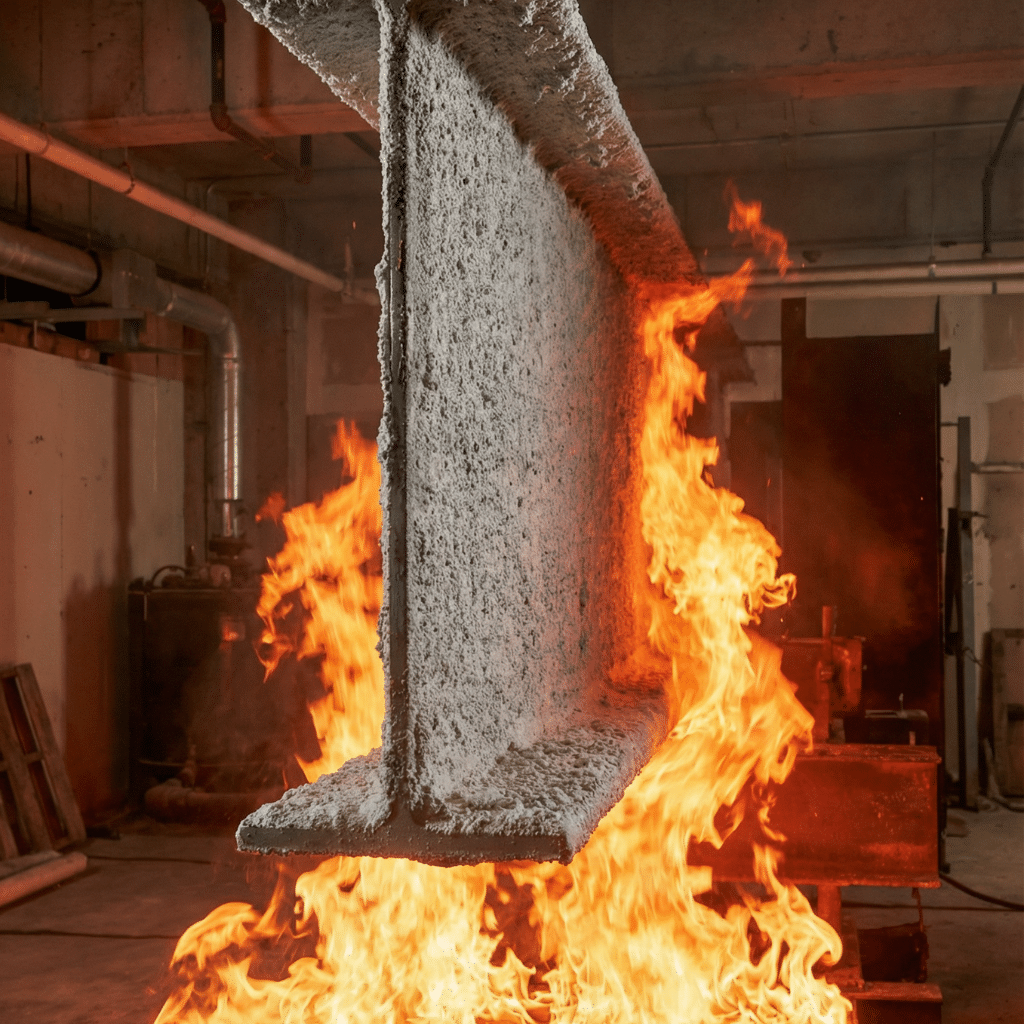
The ASTM E119 standard for fire tests of building construction and materials (current edition E119-26) evaluates “the duration for which the types of building elements … contain a fire,” along with heat transmission and the load-carrying ability of beams and columns. A 2-hour column held for 120 minutes on the standard time-temperature curve.
The ASTM E84 test method for surface burning characteristics of building materials calls itself “a 10-min fire-test response method.” It reports flame spread and smoke-developed indexes, not heat moving through the material or whether a member keeps carrying load.
That is the number to remember. A Class A finish result comes from a 10-minute surface test. A 2-hour steel rating comes from 120 minutes in a furnace. They are not two grades of the same thing.
Fire Retardant vs Fire Resistant: What the Terms Mean
Fire retardant describes a treatment or coating that slows surface flame spread on a combustible material. Fire resistant, in code language “fire-resistance-rated,” describes an assembly that keeps doing its job for a set time in a standard fire. The first is about the surface; the second is about time.
- Combustible: the material will ignite and burn. Treated wood is still combustible; treatment changes how it burns, not what it is.
- Noncombustible: the material passes ASTM E136, per 2021 IBC Section 703.3.1. Steel, concrete and masonry qualify. Noncombustible does not mean rated; bare steel still loses strength as it heats.
- Fire retardant: a treatment or coating that lowers a flame spread index under ASTM E84.
- Fire-resistance-rated: an assembly with an hourly rating from ASTM E119 or UL 263, or another method the code allows.
IBC Table 601 sets hourly ratings for building elements by construction type. In the 2021 IBC, the primary structural frame needs 3 hours in Type IA and 2 hours in Type IB. A rated assembly meets that. A flame spread class never does.
A spec section titled “fire resistant coating” may mean an intumescent with an hourly rating or a coating that only meets a finish class. Ask which test the engineer expects on the submittal.
Flame Retardant vs Fire Retardant
In everyday use, flame retardant names the chemical, and fire retardant names the treated product or coating used in buildings. A third phrase, “flame resistant,” usually refers to fabrics and decorative materials.
The National Institute of Environmental Health Sciences puts it simply: “Flame retardants are chemicals that are applied to materials to prevent the start or slow the growth of fire.” Its list of uses runs from furniture foam and electronics to wire coatings, polystyrene foams and polyurethane spray foam. A flame retardant can be one ingredient inside a product; a fire retardant treatment is the finished coating or process that earns a flame spread result.
Curtains and similar decorative materials fall under IBC Section 806 and the NFPA 701 flame propagation test, a third test with a third result. None of the three gives an hourly rating on steel. If a fireproofing submittal leans on retardant language and shows no UL design number, it isn’t fireproofing.
Fireproof vs Fire Resistant: Nothing Is Fireproof
No building material is fireproof. The IBC does not rate anything as fireproof; it rates fire resistance in hours. “Fireproofing” is the trade name for the materials that buy that time, usually 1 to 4 hours for structural steel under ASTM E119 test conditions.
A 2-hour rating is a measured result in a standard furnace exposure, and a real fire can be hotter or longer. The rating buys time to get out and for firefighters to work.
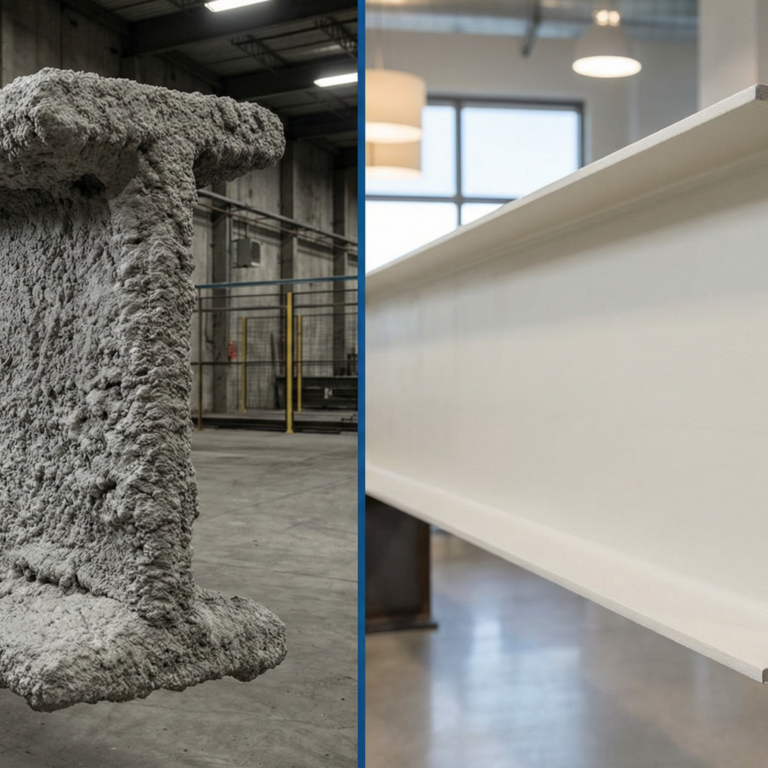
Steel will not burn, but it loses strength as it heats. SFRM insulates it, and an intumescent swells into an insulating char; both slow the temperature rise for the rated period. Fire resistant is the accurate term, and fireproof is shorthand. In a spec, write “fire-resistance rating” and the number of hours.
Fire-Retardant-Treated Wood Under IBC 2303.2
Fire-retardant-treated wood (FRTW) is wood impregnated with chemicals during manufacture, by a pressure process or other means, so it earns a flame spread index of 25 or less under ASTM E84 or UL 723. The code also requires that result to hold when the test runs past the standard 10 minutes.
Under IBC Section 2303.2, the test continues for an additional 20 minutes, 30 minutes in total, and the flame front may not pass 10.5 feet beyond the centerline of the burners at any time during the test.
ASTM E2768 “uses the apparatus and procedure of Test Method E84 with the total test period extended to 30 min.” According to ICC NTA, the 2024 IBC added language in Section 2303.2 that permits E2768 as an alternate. The 2021 edition added a rule that wood structural panels be tested with a ripped or cut 1/8-inch gap.
Three practical points follow:
- Paint is not treatment. Section 2303.2.2 of the 2018 and 2021 IBC (renumbered in the 2024 edition) says “the use of paints, coating, stains or other surface treatments is not an approved method of protection” for FRTW.
- Treated wood is still combustible. It is allowed in some places that otherwise want noncombustible materials. IBC Section 603.1 permits FRTW in Type I and II buildings for nonbearing partitions rated 2 hours or less and for roof construction, with exceptions.
- Exterior use has its own test. Wood labeled for exterior use must keep its classification after ASTM D2898 weathering.
None of this is our scope. Bahl does not supply, treat or install FRTW; treated lumber comes from the lumber supplier and goes in with the framing trade.
Fire Retardant Paint vs Intumescent Fireproofing Paint
Both come in a pail and go on with a sprayer, which is why they get confused. A fire retardant paint earns a flame spread class on the surface it was tested over. An intumescent fireproofing coating can carry an hourly rating on steel, but only at the thickness listed in a UL fire-resistance design for that member.
The data sheets show the difference. Isolatek’s CAFCO SprayFilm WB 4 is a water-based intumescent. Its technical data sheet lists “up to 4-hour fire resistance ratings in accordance with ANSI/UL 263, ASTM E119.” The same sheet reports an ASTM E84 flame spread of 15 and smoke developed of 0, which is Class A.
A good intumescent has both results, and only the hourly one rates the steel. A Class A rating on a can of fire retardant paint says nothing about how long a beam will hold.
For an intumescent, the dry film thickness comes from the UL design and the member size, not the can label. In the 2021 IBC, special inspection for mastic and intumescent coatings is Section 1705.16 and SFRM is Section 1705.15; the 2018 IBC numbered them 1705.15 and 1705.14. Either way, an inspector checks thickness against the approved design. A fire retardant paint has no design to check against.
Some fire-retardant coatings do have a code path, just a different one. International Fire Code Section 803.4 lets existing buildings reach a required flame spread index with fire-retardant coatings that comply with NFPA 703. That is a finish fix in an existing building, not a rating on steel.
Typical Situations Where Fireproofing vs Fire Retardant Gets Crossed
These are typical situations, not specific jobs.
The “fire retardant spray” call
Picture an owner of an older commercial building who wants “fire retardant spray” on the exposed steel, after finding a cheap Class A product online. The first question back is what the drawings or the building official require. If the steel needs a 1-hour or 2-hour rating, the answer is SFRM or an intumescent at a listed thickness. The Class A product, however good on wood, has no hourly rating to offer.
Two bids that are not the same scope
Picture a GC with two numbers for “fireproofing.” One sub priced SFRM to the UL design on the drawings. The other priced a fire retardant coating far below the SFRM number. The cheap number answers a different test. Level the bids on the UL design number and the hourly rating; a bid that cannot name a design is not a fireproofing bid.
A renovation that needs both
Picture a renovation with exposed steel and new wood paneling in the same space. The steel needs SFRM or an intumescent to meet its Chapter 7 rating. The paneling needs a finish class under Chapter 8, and treated blocking may need to be FRTW under Section 2303.2. We handle the steel; the wood scopes go to other trades. Keep them in separate spec sections so nobody prices the wrong one.
Which Code Edition Applies Changes the Wording
The fireproofing vs fire retardant split is steady across recent IBC editions, but section numbers and test options move.
Oklahoma is a current example. The Oklahoma Uniform Building Code Commission adopted the 2024 IBC under OAC 748:20-2-1, effective September 14, 2026, with no state amendment to Chapter 23. On a project permitted under that rule, the 2024 IBC path for ASTM E2768 in Section 2303.2 applies to treated wood. On the steel side nothing basic changes: hours come from E119 or UL 263.
Other states and cities adopt on their own schedules, so confirm the adopted edition with the building department before writing section numbers into a spec.
Frequently Asked Questions
Q: What is the difference between fireproofing and fire retardant?
Fireproofing gives structural steel an hourly fire-resistance rating under ASTM E119 or UL 263, governed by IBC Chapter 7 and Table 601. A fire retardant lowers flame spread on a combustible surface under ASTM E84 or UL 723, governed by IBC Chapter 8 and Section 2303.2. They are different products, tests and trades.
Q: Is fire retardant the same as fireproof?
No. Nothing is fireproof, and the IBC does not use fireproof as a rating. Fire retardant treatment slows surface flame spread; it does not make a material noncombustible or give it an hourly rating.
Q: What does fire retardant mean in construction?
It means a treatment or coating that reduces a material’s flame spread index under ASTM E84. The common example is fire-retardant-treated wood, which must reach a flame spread index of 25 or less in an extended 30-minute test. Fire-retardant coatings on existing interior finishes follow NFPA 703 under the International Fire Code.
Q: Does a fire retardant coating make steel fireproof?
No. It earns a flame spread class, not an hourly rating. Steel that needs a Table 601 rating needs SFRM or an intumescent at the thickness in a UL design. Without a design, the special inspector has nothing to verify.
Q: What is the difference between ASTM E84 and ASTM E119?
ASTM E84 is a 10-minute tunnel test that reports flame spread and smoke-developed indexes for a surface. ASTM E119 exposes walls, floors, beams and columns to a standard furnace fire and reports how long they hold, in hours. UL 723 and UL 263 are the matching UL designations.
Q: Is fire resistant the same as fire retardant?
No. Fire resistant, or fire-resistance-rated, describes an assembly that holds for a rated time in an ASTM E119 or UL 263 fire. Fire retardant describes a treatment that slows surface flame spread under ASTM E84. A good spec names the test or the hours.
Q: What is fire-retardant-treated wood (FRTW)?
FRTW is wood impregnated with fire-retardant chemicals during manufacture, usually by a pressure process. Under IBC Section 2303.2 it needs a flame spread index of 25 or less, with the test extended 20 more minutes and the flame front held within 10.5 feet of the burner centerline. Paints and coatings applied afterward do not qualify.
Q: Is intumescent paint the same as fire retardant paint?
No. An intumescent can carry an hourly rating on steel at the thickness in a UL fire-resistance design. A fire retardant paint has a flame spread result only.
Q: Does Bahl Fireproofing apply fire retardant treatments?
No. Bahl applies SFRM and intumescent fireproofing to structural steel. We do not apply fire retardant treatments, treated wood or fire-retardant paint; those scopes belong to other trades.
Key Takeaways
Two Tests, Two Questions
- ASTM E119 or UL 263 asks how long an assembly holds; the answer is in hours.
- ASTM E84 or UL 723 asks how fast flame spreads across a surface; the answer is a class.
- In fireproofing vs fire retardant terms, a 10-minute surface result never stands in for a 2-hour furnace result.
Two Code Chapters
- Hourly ratings live in IBC Chapter 7, with Table 601 setting hours by construction type.
- Finish classes live in Chapter 8; treated wood lives in Section 2303.2.
Nothing Is Fireproof
- The accurate term is fire-resistance-rated, with a number of hours.
- Noncombustible steel still needs protection to carry a rating.
Three Similar Words
- Flame retardant usually names the chemical.
- Fire retardant names the treated wood or the coating.
- Flame resistant applies to decorative materials tested to NFPA 701.
Treated Wood Has Its Own Rules
- FRTW needs a flame spread index of 25 or less in an extended 30-minute test.
- Paints and coatings do not turn lumber into FRTW.
Paint Versus Intumescent
- An intumescent carries an hourly rating only at the thickness in a UL design.
- Ask every fireproofing bid for the UL design number.
Related Reading
- Choosing between the two fireproofing systems on steel? Our cementitious vs. intumescent fireproofing comparison covers mechanism, cost drivers and inspection.
- For what a 1-hour through 4-hour rating means on a steel member, see fire ratings for structural steel explained.
- For why one fire test carries two names on submittals, read ASTM E119 vs UL 263.
Get the Right System on the Steel
If your drawings call for an hourly rating and you want a crew that reads the UL design, prices the listed thickness and keeps fireproofing separate from fire retardant scopes, I would like to look at your project. Bahl Fireproofing applies cementitious SFRM and intumescent fireproofing throughout Texas, Oklahoma, Kansas, Nebraska, Minnesota, Wisconsin, Arizona, Missouri, and Iowa; see our service areas for where we work. Call 512-387-2111, email ross@bahlfireproofing.com, or contact Bahl Fireproofing to talk through the scope.
Code note: unless otherwise stated, code references on this page are to the 2021 International Building Code. Code adoption is state and local. Some states have no statewide commercial building code. Minnesota and Wisconsin publish state-amended code books whose numbering and requirements differ from the model code. This is general technical information, not a code determination for your project. Confirm the adopted edition and any local amendments with your authority having jurisdiction.
Disclaimer: This article provides general educational information about fireproofing, fire-resistance ratings and fire retardant treatments. It is not engineering, legal or code-compliance advice and does not replace project-specific direction from a licensed architect or engineer. Fire-resistance ratings depend on the tested and listed assembly and correct installation, and must be confirmed against the applicable UL design or code listing. Code sections and test methods change between editions, and the adopted edition varies by jurisdiction; check product data against the manufacturer’s current data sheet before specifying.