If you are specifying, bidding, or inspecting fireproofing on a commercial steel building, you have seen both ASTM E119 and UL 263 stamped on product listings and submittals, and probably wondered which one your project actually needs. The short version is that they are two names for the same test. This is the practical guide to ASTM E119 vs UL 263 for commercial steel construction, and to the fire-exposure distinction that does change how your steel gets protected.
TLDR: ASTM E119 and UL 263 are the same fire-resistance test under two names, and the International Building Code accepts a rating established under either one, so choosing between them is rarely a real decision. The distinction that does change your specification is cellulosic fire (ASTM E119 and UL 263) versus hydrocarbon fire (UL 1709 and ASTM E1529). Read on for how to tell which one your building actually requires.
Here is where this trips up real projects. A general contractor sees “ASTM E119” on one product’s listing and “UL 263” on another, assumes the two are not comparable, and burns a day chasing a difference that does not exist. Or, worse in the other direction, someone specifies a standard fire-resistance assembly for a facility that handles fuel or process chemicals, where the fire behaves nothing like the standard test, and the steel ends up under-protected for the fire it could actually see. The label argument is harmless. The fire-curve question is the one that can leave a building short. Both come from the same root confusion, and both are easy to clear up once you know what each standard is.
What Is the Difference Between ASTM E119 and UL 263?
There is almost no practical difference. ASTM E119 and UL 263 are two designations for the same fire-resistance test, run in the same kind of furnace, against the same time-temperature curve, with the same pass and fail criteria. The IBC accepts a fire-resistance rating established under either standard. The differences that remain are administrative, not performance based.
The two standards come from different organizations. ASTM E119 is maintained by ASTM International’s E05 committee on fire standards. UL 263, published as ANSI/UL 263, is maintained through UL Standards and Engagement. Both carry the same title, Standard Test Methods for Fire Tests of Building Construction and Materials, and both apply to load-bearing and non-load-bearing assemblies and structural members. Testing bodies and code officials treat them as equivalent, and the testing procedures are nearly identical. Canada’s CAN/ULC-S101 is the parallel fire-endurance standard and describes the same kind of test. NFPA 251 covered it in the United States until it was withdrawn in 2010, its content having moved into ASTM E119 and UL 263, which are the two standards the IBC names. For a fuller view of how the code path fits together, our commercial fireproofing services page covers what we actually install against these listings.
What the Fire-Resistance Test Actually Measures
Both standards subject a full assembly, a wall, floor, roof, column, or beam, to a controlled furnace fire and measure how long it holds. The rating is an endurance time: 1, 2, 3, or 4 hours. It is not a property of a single product. It belongs to the tested assembly as a whole, which is why the listed design matters more than any one material in it.
The Standard Time-Temperature Curve
The furnace follows a fixed time-temperature curve. It reaches roughly 1,000 degrees Fahrenheit at 5 minutes, about 1,700 degrees at 1 hour, about 1,850 degrees at 2 hours, and about 2,000 degrees at 4 hours. This is the cellulosic curve, and it models a fire fed by ordinary building contents like wood, paper, and furnishings. That single curve is the reason these two standards are interchangeable and also the reason a third family of standards exists for fuel fires, which we get to below. Remember the shape of this curve. It is the number that carries the rest of this article.
Conditions of Acceptance
An assembly fails the test the moment it crosses any one of the acceptance limits. Both standards use the same three, summarized in this NIST overview of fire-resistance acceptance criteria, plus a hose-stream test for walls:
- Failure to support the applied load, for load-bearing members and assemblies.
- Passage of flame or hot gas sufficient to ignite cotton waste on the unexposed side, for walls, floors, and roofs.
- Temperature rise on the unexposed surface beyond set single-point and average limits.
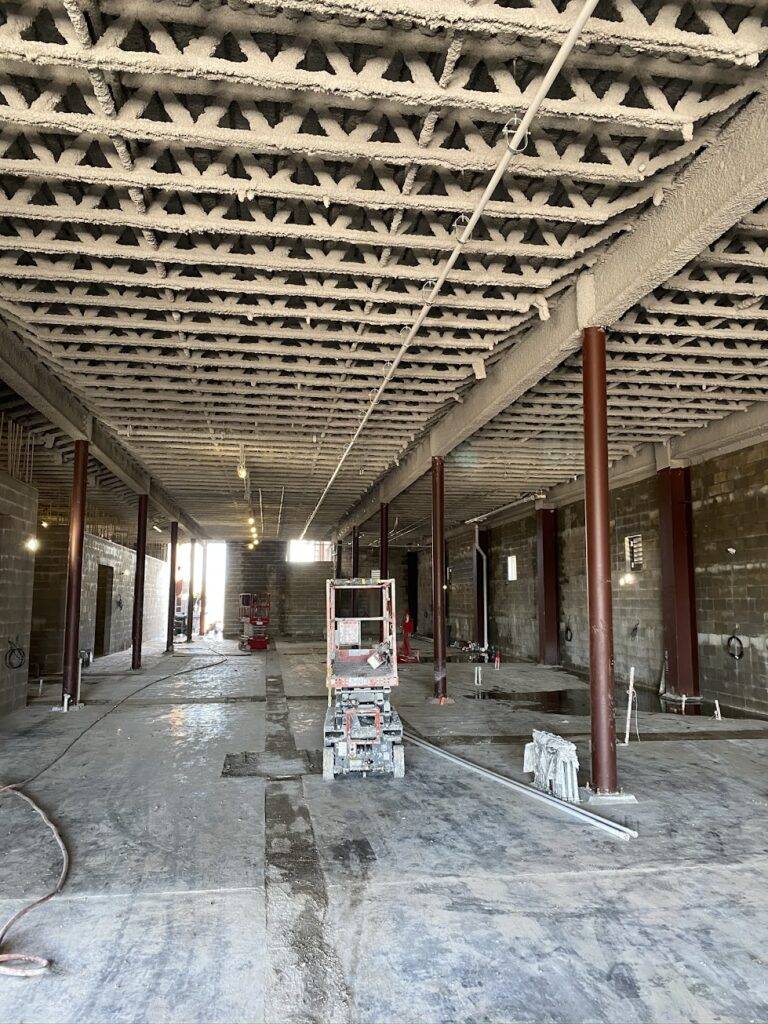
Structural steel loses significant load-bearing capacity as it approaches about 1,000 degrees Fahrenheit (538 degrees Celsius), retaining only about 60 percent of its yield strength near 550 degrees Celsius. Fireproofing exists to keep the steel below that threshold long enough for the rated period. The test simply measures whether it does.
Restrained vs Unrestrained Classification
This is where a real code distinction hides, and people routinely miss it. Under IBC 2021 and 2024 Section 703.2.3, an assembly tested to ASTM E119 or UL 263 is treated as unrestrained unless the project’s licensed architect or engineer furnishes evidence satisfactory to the building official that the construction qualifies as restrained, and the restrained condition must be identified on the construction documents. This matters because a restrained rating can require less fireproofing than an unrestrained rating for the same assembly, and UL Solutions guidance on restrained and unrestrained assemblies lays out how to document the restrained condition. The confusion to avoid: IBC (2021) Section 703.2 is the test method, and IBC (2021) Section 703.2.3 is the restraint classification. They are two separate decisions, and assuming an assembly is restrained without the documentation is a common way to end up out of compliance.
Code note: unless otherwise stated, code references on this page are to the 2021 International Building Code. Code adoption is state and local. Across the states we serve, adopted IBC editions currently range from the 2012 edition to the 2024 edition, some states have no statewide commercial building code, and several enforce NFPA 1 or NFPA 101 rather than the International Fire Code. Minnesota and Wisconsin publish state-amended code books whose numbering and requirements differ from the model code. This is general technical information, not a code determination for your project. Confirm the adopted edition and any local amendments with your authority having jurisdiction.
ASTM E119 vs UL 263: The Real Differences
Side by side, the two standards line up almost completely. The table below covers the factors a specifier or inspector would actually check.
| Factor | ASTM E119 | UL 263 |
|---|---|---|
| Developing body | ASTM International (E05 committee) | UL Standards and Engagement (ANSI/UL 263) |
| Standard title | Fire Tests of Building Construction and Materials | Fire Tests of Building Construction and Materials |
| What it evaluates | Fire endurance of assemblies and structural members | Fire endurance of assemblies and structural members |
| Fire exposure | Standard cellulosic time-temperature curve | Same cellulosic curve |
| Conditions of acceptance | Load, flame passage, temperature rise, hose stream | Same criteria |
| Restrained and unrestrained | Defined | Defined |
| Furnace pressure documentation | Not required for compliance | Recorded and reported (administrative) |
| Where ratings are published | Testing-agency reports | UL Fire Resistance Directory (BXUV designs) |
| IBC status (IBC (2021) Section 703.2) | Accepted | Accepted |
Over the past 20 years specifying and applying spray-applied fire-resistive material across Texas, Kansas, and Oklahoma, I have never once seen the choice between ASTM E119 and UL 263 change a required thickness or the outcome of an inspection. The arguments that actually stall jobs are different ones. A sub reads thickness off a generic table instead of the listed UL design. Someone treats an assembly as restrained without the evidence IBC (2021) Section 703.2.3 requires. Two parties argue over which standard counts when the code plainly accepts both. The standard name on the listing is the last thing I would worry about. The design number, and how the assembly was tested, are the first.
Why the IBC Accepts Either Standard
The IBC accepts both because both produce the same rating the same way. As ICC guidance on IBC fire-resistance test methods explains, IBC Section 703.2, in the 2021 and 2024 editions, states that the fire-resistance rating of building elements, components, and assemblies is determined by the test procedures set forth in ASTM E119 or UL 263. Section 703.3 then allows analytical and calculation methods, but those still rest on the fire exposure and acceptance criteria from the same two standards.
The practical bridge from a code requirement to an installed product is the UL Fire Resistance Directory. Every listed assembly carries a design number, such as a BXUV design, that specifies the exact products, thicknesses, steel sizes, primer requirements, and restrained or unrestrained conditions under which the assembly earned its rating. That listing, not the standard label, is what an inspector verifies in the field.
The Distinction That Actually Changes Your Specification
Here is the comparison that changes how steel is protected, and it is not ASTM E119 vs UL 263. It is the cellulosic standard fire (ASTM E119 and UL 263) versus the hydrocarbon fire (UL 1709 and ASTM E1529). These model two different fires, and they protect against two different threats.
| Factor | Cellulosic: ASTM E119 / UL 263 | Hydrocarbon: UL 1709 / ASTM E1529 |
|---|---|---|
| Fire modeled | Ordinary building contents | Pool or jet fuel fire |
| Time to about 2,000 degrees F | About 4 hours | About 5 minutes |
| Typical buildings | Offices, schools, warehouses, hospitals, most commercial | Refineries, petrochemical, process, offshore |
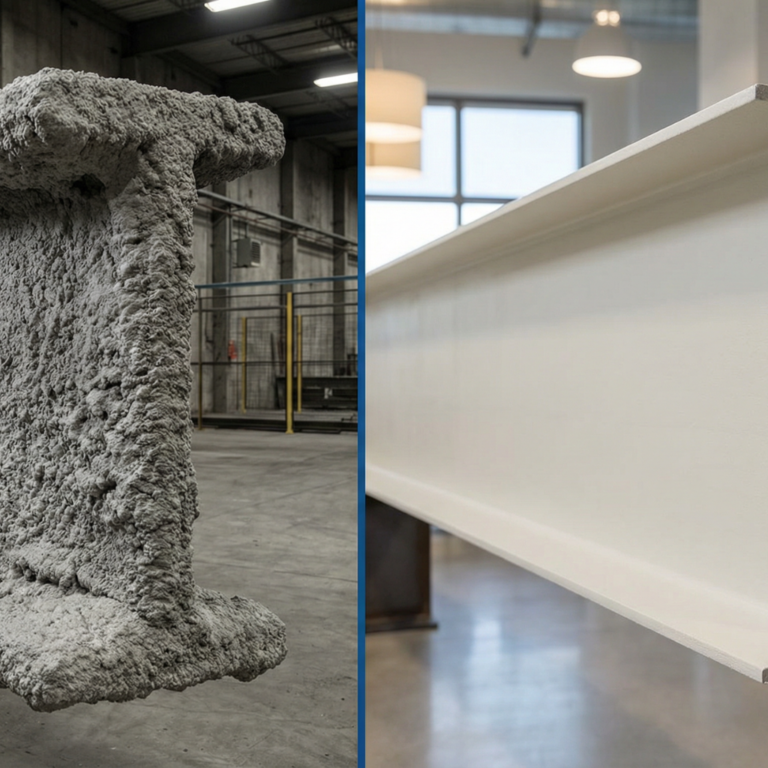
| Typical fireproofing | Cementitious SFRM, thin-film intumescent | High-density SFRM (40+ pcf) or epoxy intumescent |
| Are the two standards in the pair equivalent | ASTM E119 and UL 263 are effectively interchangeable | UL 1709 and ASTM E1529 are not equivalent |
The gap in that table is the whole point. The standard cellulosic curve takes about 4 hours to reach 2,000 degrees Fahrenheit. The UL 1709 hydrocarbon curve reaches roughly 2,000 degrees within about 5 minutes and holds there. A structure that could see a fuel fire cannot be protected with a standard fire-resistance assembly, because the heat arrives far faster than that assembly was tested for. This is why petrochemical and process facilities specify high-density SFRM or epoxy intumescent rated to UL 1709, not the products used in a standard office building.
There is one more asymmetry worth knowing. Within the cellulosic pair, ASTM E119 and UL 263 are interchangeable. Within the hydrocarbon pair, UL 1709 and ASTM E1529 are not equivalent. The heat-flux exposure between them differs by roughly 30 percent, so for hydrocarbon work the standard you reference genuinely matters in a way it never does for standard commercial construction.
What This Means on a Texas, Kansas, or Oklahoma Project
In our service area, the fire-curve question is not academic, because the region is full of facilities where it actually applies. The Gulf Coast and the broader Texas and Oklahoma industrial corridor carry a large concentration of petrochemical, refining, and process plants. On a Houston-area process unit, UL 1709 hydrocarbon protection can be the real requirement, while a Dallas office tower a few hundred miles away is a straightforward ASTM E119 or UL 263 job. Specifying a standard fire assembly on a hydrocarbon-exposure structure is a genuine protection gap here, not a paperwork nuance, and it is worth confirming early on any industrial or energy project. We see this play out on commercial projects across Texas more than in most parts of the country.
There is also a code-edition wrinkle that surprises people. Texas is a home-rule state, so municipalities adopt IBC editions on their own schedules, and the edition governing a job in one city may differ from the one next door. But the part that matters for this topic stays constant: the ASTM E119 or UL 263 reference in Section 703.2 reads the same across the 2018, 2021, and 2024 editions of the IBC. The standard is not the variable that changes between editions. The Table 601 rating values and any local amendments are. A Texas fire code for commercial construction differs from neighboring states mostly in adoption and amendment, not in which fire test defines a rating.
Common Mistakes Specifiers and GCs Make
Most of the trouble around these standards comes from a handful of repeat errors. Treating the standard name as a compatibility issue, when ASTM E119 and UL 263 are interchangeable. Confusing the test-method section (703.2) with the restraint classification (703.2.3). Assuming UL 1709 and ASTM E1529 are interchangeable the way the cellulosic pair is, when they are not. Reading required thickness from a general reference table instead of the listed UL design for the specific member and rating. And skipping ahead to product selection before confirming whether the structure even faces a standard fire or a hydrocarbon fire. The special inspections for spray-applied fireproofing under IBC Chapter 17 are designed to catch the thickness and assembly errors, but the fire-curve decision happens long before an inspector ever shows up.
Frequently Asked Questions About ASTM E119 vs UL 263
Is ASTM E119 vs UL 263 a choice you actually have to make? Usually not. The two are the same fire-resistance test under different names, and the IBC accepts a rating established under either. Choose the listed assembly that fits your member and required rating, and the standard reference follows from the listing rather than the other way around.
Does the IBC require ASTM E119 or UL 263? Yes. IBC (2021) Section 703.2 states that fire-resistance ratings are determined by the test procedures in ASTM E119 or UL 263. Either one satisfies the code. IBC (2021) Section 703.3 also permits analytical and calculation methods based on the same acceptance criteria.
Are ASTM E119 and UL 263 results interchangeable? For practical purposes, yes. The procedures are nearly identical, the fire exposure is the same curve, and the pass and fail criteria match. The remaining differences are administrative, such as how furnace pressure is documented, not differences in the rating an assembly earns.
What is the difference between UL 263 and UL 1709? UL 263 uses the standard cellulosic fire that models ordinary building contents and takes about 4 hours to reach 2,000 degrees Fahrenheit. UL 1709 uses a rapid-rise hydrocarbon fire that reaches roughly 2,000 degrees in about 5 minutes, modeling a fuel fire. They are for different buildings and different products.
What is ASTM E1529? ASTM E1529 is the ASTM hydrocarbon fire-test standard, the rough counterpart to UL 1709 for fuel-fire exposure. Unlike ASTM E119 and UL 263, which are interchangeable, UL 1709 and ASTM E1529 are not equivalent, because their heat-flux exposures differ by roughly 30 percent.
What is a restrained versus unrestrained rating? It describes whether the surrounding construction restrains the assembly’s thermal expansion during a fire. Under IBC (2021) Section 703.2.3, an assembly is treated as unrestrained unless a licensed architect or engineer documents that it qualifies as restrained. Restrained ratings can require less fireproofing for the same assembly.
Where do I find which standard a fireproofing assembly was tested to? In the listing. Every assembly in the UL Fire Resistance Directory has a design number that names the test standard, the products, thicknesses, steel sizes, and restraint condition. That design number is the document an inspector checks, so it is the one to confirm before installation.
Does NFPA use a different fire-resistance test? NFPA 251 (now withdrawn) and Canada’s CAN/ULC-S101 are parallel fire-endurance standards that describe the same kind of furnace test. For projects under the IBC, the code names ASTM E119 or UL 263, so those are the references you will see on commercial listings in Texas, Kansas, and Oklahoma.
Key Takeaways
- They are the same test. ASTM E119 and UL 263 use the same furnace, the same cellulosic time-temperature curve, and the same acceptance criteria. The IBC accepts either.
- The code says so directly. IBC Section 703.2 (2021 and 2024) determines fire-resistance ratings by ASTM E119 or UL 263, and Section 703.3 allows analytical methods on the same basis.
- The listing is what matters, not the label. A UL Fire Resistance Directory design number defines the products, thicknesses, steel sizes, and restraint condition that earned the rating. Confirm the design, not the standard name.
- Restrained is not automatic. IBC (2021) Section 703.2.3 treats assemblies as unrestrained unless a licensed architect or engineer documents otherwise. Do not assume the lower-protection condition.
- The real fork is the fire curve. Cellulosic (ASTM E119 and UL 263) versus hydrocarbon (UL 1709 and ASTM E1529) is the distinction that changes products and protection.
- The hydrocarbon pair is not interchangeable. UL 1709 and ASTM E1529 differ in heat flux by roughly 30 percent, so for fuel-fire exposure the standard reference genuinely matters.
- In this region it is a live question. The Texas and Oklahoma industrial corridor means hydrocarbon exposure is common, and a standard fire assembly on a hydrocarbon structure is a real gap.
Related Reading
- Working through the full IBC requirements for a commercial steel project? Start with our commercial fireproofing code compliance guide.
- Need to see how construction type sets the required rating in the first place? The IBC (2021) Table 601 fire-resistance ratings guide breaks down every row.
- Deciding which protection system fits exposed or high-exposure steel? Our cementitious vs. intumescent fireproofing comparison covers the tradeoffs.
If your next project has you sorting out which fire test applies, whether an assembly qualifies as restrained, what the listed UL design calls for, or whether your structure faces a standard or a hydrocarbon fire, that is the kind of call our crew handles every week throughout Texas, Oklahoma, Kansas, Nebraska, Minnesota, and Wisconsin. Reach me directly at 512-387-2111 or ross@bahlfireproofing.com, or Contact Bahl Fireproofing to talk through the specification before it costs you a change order.
This article provides general educational information about commercial fireproofing, fire-resistance testing, and passive fire protection. It is not engineering, legal, or code-compliance advice and does not replace project-specific direction from a licensed architect or engineer. Code citations reference specific IBC editions, and the adopted edition and any amendments vary by the authority having jurisdiction, so confirm them locally. Fire-resistance ratings depend on the specific tested and listed assembly and on correct installation, and must be verified against the applicable UL design or code listing. Always confirm current requirements with your local building department and a licensed architect or engineer before specifying or installing any system.