Dry film thickness is the number everyone asks about with intumescent coatings, but it is not a single number you can pull off a chart. It comes from the UL design for each specific steel section. Cure time is the variable that quietly wrecks schedules when a crew treats “dry to touch” as “ready to inspect.” And behind both sit four environmental conditions that the applicator manages and the general contractor owns. This guide explains all three so you can specify, schedule, and inspect intumescent work without surprises.
TLDR: There is no universal DFT for a fire rating. The required thickness changes with each steel member’s section factor and must match the approved UL design. Cure time is longer than it looks because air-dry is not full cure, and temperature, humidity, ventilation, and substrate condition shift every milestone. Plan the DFT inspection for several days after the final coat, before concealment.
I have spent more than twenty years on commercial fire protection across Texas, Kansas, and Oklahoma, and the intumescent jobs that go sideways almost never fail because of the coating chemistry. They fail because someone read a thickness off a general table instead of the UL design, or scheduled the inspection the day after the last coat, or let the humidity climb during cure. Those are avoidable. Here is how the three variables that matter actually work.
What Is Dry Film Thickness in Intumescent Coatings?
Dry film thickness, or DFT, is the measured thickness of an intumescent coating after it has fully cured, expressed in mils (thousandths of an inch) or millimeters. Unlike sprayed cementitious fireproofing, there is no single correct DFT for a given fire rating. The required DFT varies with the section factor of each individual steel member and must match the approved UL design for that exact member.
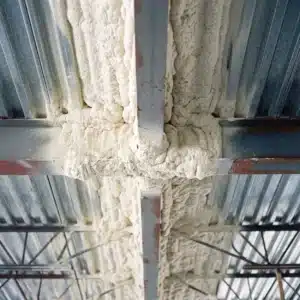
That is the whole concept in one paragraph, and it is the point most thickness charts get wrong. A intumescent coating does not protect by mass the way cementitious material does. It protects by reacting to heat and swelling into an insulating char, which is what makes intumescent fireproofing a thin-film alternative to sprayed cementitious material. When it reaches roughly 250 degrees Celsius (about 480 degrees Fahrenheit), the coating begins to react, though the exact onset temperature varies by product. Thin-film products swell to many times their original thickness, with figures commonly cited from around 15 up to about 50 times the dry film thickness depending on the product and test conditions. Thick-film epoxy products expand far less, on the order of 5 times. That char buys time before the steel reaches the temperature where it loses meaningful strength, which for structural steel is around 550 degrees Celsius, where it retains only about half of its room-temperature yield strength.
How DFT Is Determined: Section Factor, Not a Fixed Number
The required DFT is driven by the steel member’s section factor, which describes how fast that member heats in a fire relative to its mass. Two ratios express it. The W/D ratio applies to wide-flange and I-beam sections, where W is the weight per foot and D is the heated perimeter in inches. The A/P ratio applies to hollow structural sections such as square or round tubes, where A is the cross-sectional area and P is the heated perimeter.
The relationship is the part to remember. A larger section factor means the member heats more slowly and needs less coating, so a thinner DFT. A smaller section factor means the member heats faster and needs more coating, so a thicker DFT. This is why a heavy column and a light beam, both needing the same fire rating, can require very different thicknesses.
It goes deeper than member size. The same steel section can require different DFT depending on its orientation and profile, because those change the heated perimeter. The Construction Specifier published a clear illustration of this using UL data: a W10x39 used as a beam with one face against a concrete slab needed about 161 mils for a 2-hour rating, the same W10x39 used as a fully exposed column needed about 198 mils, and a 10 by 10 by quarter-inch HSS column of comparable weight needed about 309 mils for that same 2-hour rating. Same rating, three very different thicknesses, driven entirely by section and exposure.
For a sense of scale only, thin-film intumescent DFT generally runs from well under a millimeter for short-duration ratings up to several millimeters for 2-hour work. But treat any general range as orientation only. The specification-ready number always comes from the UL design for the actual section, orientation, and product. A general table is never a substitute for that.
The UL No-Extrapolation Rule You Cannot Ignore
When a steel section is not listed in the applicable UL design, you cannot interpolate a thickness from neighboring sizes. UL has been explicit and has tightened its language over the years. Its guidance treats extrapolation of member size or material thickness beyond what the individual designs show as outside the scope of certification, meaning an extrapolated thickness is not recognized and can void the certified assembly.
The reason is safety, not paperwork. An extrapolated thickness can underestimate the coating needed, leaving a member that reaches its critical temperature faster than the design intends. When you hit a section that is not in the design, you have two legitimate paths: select an alternate steel size or profile that is listed in the design, or engage structural fire engineering analysis under the appropriate engineering standard. Guessing from the neighboring row is not one of the options. This is exactly the kind of decision that belongs in the approved submittal and the project’s code compliance documentation.
Multi-Coat Application: WFT Versus DFT
Thin-film intumescent coatings are built up in multiple coats to reach the required DFT, and each coat has a maximum wet film thickness, or WFT, that cannot be exceeded. WFT is what you measure with a wet film gauge during application. DFT is what you measure with an electronic gauge after the coating has cured. They are different numbers because the coating loses volume as its liquids evaporate.
Maximum WFT per coat is product-specific. As an illustration, one common water-based product family lists a maximum wet film around 40 to 66 mils per coat depending on the formulation, applied by airless spray with the gun held at least 18 inches from the substrate. Always pull the actual number from the product data sheet for the coating you are using.
Two practical rules hold across products. Two thinner coats generally outperform one heavy coat, because you get better thickness control and faster, more reliable drying between passes. And applying the next coat too soon is a real failure mode: rushing a coat before the prior one has set can cause blistering, which means rework. The minimum time between coats is set by the manufacturer and depends heavily on temperature, air movement, and humidity.
Cure Time: The Schedule Variable Nobody Plans For
The single most expensive misunderstanding on intumescent jobs is treating “dry to touch” as “cured.” Water-based intumescent coatings skin over and feel dry within hours, but they are not fully cured until all the water and solvents have evaporated, which takes far longer. Reading DFT or applying a topcoat on a coating that is only surface-dry produces bad readings and trapped moisture.
The milestones below are illustrative of the type of schedule to expect from a typical water-based product. Every one of these is product-specific, so verify against the data sheet for your coating:
- Initial set, dry to touch: a matter of hours under moderate conditions, roughly 6 hours at 20 degrees Celsius and 50 percent relative humidity for some products.
- Minimum time between coats: commonly on the order of 8 hours for some water-based products, longer in cold or humid conditions.
- Final DFT measurement: typically a minimum of 3 to 5 days after the last coat for some products, once the coating has cured enough to read accurately.
- Topcoat application, where one is specified: typically a minimum of 3 to 5 days after the last coat for some products.
Temperature, humidity, and air movement push every one of these milestones in the same direction: colder and more humid conditions lengthen them. The scheduling takeaway is simple and worth building into the project plan from the start. Do not schedule the DFT inspection for the day after the last coat. Plan it for several days out, after the coating has cured, and before any topcoat or concealment work begins.
The Four Performance Factors That Control DFT and Cure
Four conditions govern both whether the coating goes on correctly and whether it cures to its rated performance. They are codified in manufacturer data sheets and industry application guidance, and they are where the general contractor’s coordination actually matters.
Temperature
Most thin-film intumescent coatings carry a minimum application and cure temperature around 50 degrees Fahrenheit, with an ideal window roughly between the low 60s and about 90 degrees Fahrenheit. Below the minimum, do not apply. If a space is too cold, heat it with indirect or electric forced-air equipment. Do not use open-flame combustion heaters such as propane or kerosene salamanders, because they release moisture as a combustion byproduct and drive up humidity, which is the last thing a curing intumescent coating needs. Lower temperatures stretch drying and cure times; higher temperatures speed drying but call for closer wet film monitoring.
Relative Humidity
Manufacturers set a maximum relative humidity for application and cure, typically somewhere between 75 and 85 percent depending on the product, so verify the limit against the data sheet rather than assuming a single industry number. As humidity climbs, fans become necessary to keep air moving, and above the product maximum you need mechanical dehumidification. High humidity lengthens drying, reduces the maximum wet film you can apply per coat, and raises the risk of blistering. Measure humidity with a handheld hygrometer throughout application and for several days afterward, and record the readings on the daily work reports, because the special inspector will want them.
Ventilation
Intumescent coatings need consistent air movement to cure, but notably less than cementitious fireproofing. Industry application guidance commonly calls for a minimum of about 0.3 air changes per hour in the application area for the first 48 to 72 hours after application. The air should cross the coated area rather than blast directly at it. This is a meaningful contrast with sprayed cementitious material, which commonly requires around 4 air changes per hour. So do not assume the SFRM ventilation plan carries over; intumescent needs steady, gentle exchange, not high-volume airflow. In unconditioned spaces, high-humidity areas, or cold storage environments, get product-specific instructions from the manufacturer.
Substrate Condition and Primer Compatibility
Before any coating goes on, the substrate must be clean, dry, and free of contaminants, with moisture controlled to the level the product specifies. Then there is the factor that catches teams off guard. Unlike cementitious fireproofing, intumescent coatings usually require a primer and may require a topcoat, and all the layers have to be a tested, compatible, approved system. An incompatible primer or topcoat is not a cosmetic problem. It can shorten the service life of the system or, in the worst case, interfere with the coating’s fire performance and void the listing. Coordinate primer selection with the fireproofing contractor before the steel is primed, the same lesson that governs substrate preparation for any fireproofing system.
One more coordination note that architects and GCs miss: the char needs room to expand. Because a thin-film coating can swell to roughly 50 millimeters of char, a member boxed into a tight ceiling void or jammed against adjacent construction may not have the clearance for the char to form fully, which can reduce the protection it delivers. Check expansion clearance during design coordination, not after the steel is up.
A Texas Summer Field Note
Heat changes how intumescent goes on, the same way it changes cementitious work. When ambient temperatures run past 90 degrees on a job site across our service areas in Texas, Oklahoma, Kansas, Nebraska, Minnesota, and Wisconsin, the surface of the coating skins over fast. That rapid skinning can trap moisture under the next coat if the crew is not paying attention, which leads to blistering and failed DFT readings. The fix is to apply thinner individual passes, monitor wet film thickness more frequently, and manage ventilation to keep relative humidity inside the product’s range rather than fighting it. Hot and dry is workable; hot and rushed is not.
The Special Inspection Path Under IBC 2021 Section 1705.16
Here is a distinction that trips up even experienced teams. In the 2021 International Building Code, intumescent and mastic fire-resistant coatings are inspected under Section 1705.16, not Section 1705.15. In the 2021 edition, Section 1705.15 governs sprayed fire-resistant materials (cementitious SFRM) and Section 1705.16 governs mastic and intumescent coatings. Prior editions, including 2018 and 2015, combined both under Section 1705.15, so any reference to that older number for intumescent work is out of date for the 2021 code. Always confirm the edition adopted by your local authority having jurisdiction, since Texas, Kansas, and Oklahoma jurisdictions adopt and amend on different schedules.
Under IBC (2021) Section 1705.16 (Section 1705.15 in the 2018 and earlier editions), inspections follow AWCI Technical Manual 12-B, the standard practice for testing and inspecting field-applied thin-film intumescent fire-resistive materials. The intumescent special inspector verifies more than just thickness: substrate cleanliness, site conditions, product designation, application procedures, and the applied dry film thickness against the approved UL design. Worth noting, density testing of the sort used for cementitious material under ASTM E605 does not apply to thin-film intumescent coatings, because they are not applied at thicknesses where a density measurement is meaningful. The focus is correct DFT in the right conditions on a compatible system.
The testing frequency under TM 12-B is defined. Inspectors test at least one bay per floor, or one per 10,000 square feet of floor area, and within each selected bay they test a column, a primary beam, a secondary beam, and a truss where one is present. On a beam, measurements are taken at a minimum of two locations 12 inches apart along the member, per AWCI TM 12-B. Have your documentation assembled before the inspector arrives: the approved submittal with the UL design, the temperature and humidity logs, the wet and dry film readings, and the daily work reports.
Related Reading
- For the full picture of how intumescent fits among fire protection systems, see our complete guide to intumescent fireproofing.
- For how the code path and special inspections work across systems, read our commercial fireproofing code compliance guide.
- For the substrate side of any coating job, see why surface preparation matters in commercial fireproofing.
Frequently Asked Questions
Q: What is dry film thickness in intumescent coatings? A: Dry film thickness, or DFT, is the measured thickness of the coating after it has fully cured, in mils or millimeters. There is no single correct DFT for a fire rating. The required DFT varies with the section factor of each steel member and must match the approved UL design for that member.
Q: How long does intumescent coating take to cure? A: Longer than it feels. Water-based products are dry to touch within hours but are not fully cured until all liquids evaporate, which can take days. Final DFT readings and any topcoat are typically taken several days after the last coat. Exact timing is product-specific and shifts with temperature and humidity, so verify against the data sheet.
Q: What factors affect intumescent coating performance? A: Four conditions control application and cure: temperature, relative humidity, ventilation, and substrate condition including primer compatibility. Each one shifts drying time and final quality. Getting all four inside the product’s specified ranges is what produces a coating that performs to its rating.
Q: Can you apply intumescent coating over any primer? A: No. The primer must be part of the coating’s tested, approved system. An incompatible primer can shorten service life or interfere with fire performance and void the listing. Confirm primer compatibility with the fireproofing contractor before the steel is primed.
Q: How is intumescent coating thickness measured? A: Wet film thickness is checked with a wet film gauge during application. Final dry film thickness is measured with an electronic gauge after the coating has cured, typically several days after the last coat, following AWCI Technical Manual 12-B procedures.
Q: What happens if intumescent coating is applied too thick per coat? A: Exceeding the maximum wet film per coat, or applying the next coat before the prior one has set, can cause blistering. That means rework and schedule loss. Two thinner coats with proper time between them outperform one heavy coat.
Q: What is the IBC code section for intumescent coating special inspection? A: In the 2021 International Building Code, it is Section 1705.16, with inspections per AWCI Technical Manual 12-B. Note that the 2018 and 2015 editions used Section 1705.15. Sprayed cementitious fireproofing is the material under 1705.15 in the 2021 code. Confirm the adopted edition with your local authority having jurisdiction.
Q: How many coats does a 2-hour intumescent rating need? A: It depends entirely on the product, the steel section factor, and the maximum wet film per coat. There is no universal answer. The number of coats is whatever it takes to reach the DFT specified in the approved UL design for that member without exceeding the per-coat wet film limit.
Key Takeaways
DFT is not a fixed number. The required thickness comes from each member’s section factor and the approved UL design, not from a general table. Orientation and profile change it even for the same steel size.
Never extrapolate beyond the UL design. If a section is not listed, switch to a listed size or profile or engage engineering analysis. Extrapolated thickness is outside UL certification and can leave steel under-protected.
Air-dry is not cured. Water-based intumescent coatings cure over days, not hours. Schedule DFT inspection several days after the last coat, before any topcoat or concealment.
Four factors govern performance. Temperature, humidity, ventilation, and substrate condition each shift cure and final quality. Keep all four inside the product’s ranges, and never use combustion heaters during cure.
Primer compatibility is a listing issue, not a cosmetic one. Coordinate primer selection before the steel is primed, because an incompatible layer can void the fire-resistance system.
Intumescent is inspected under IBC 1705.16, not 1705.15. In the 2021 code, intumescent and mastic coatings fall under 1705.16 and AWCI Technical Manual 12-B, with DFT as the focus. Confirm the adopted edition with the AHJ.
If you are specifying or scheduling intumescent coating on a commercial steel project and want it done by a crew that reads the UL design, manages the cure conditions, and times the DFT inspection right the first time, let’s talk. Contact Bahl Fireproofing throughout Texas, Oklahoma, Kansas, Nebraska, Minnesota, and Wisconsin at 512-387-2111 or ross@bahlfireproofing.com to schedule a consultation or request a bid.
This article provides general educational information about fireproofing and passive fire protection. It is not a substitute for project-specific guidance from a licensed architect or engineer, the manufacturer’s published installation instructions, or the requirements of your local authority having jurisdiction. Code references reflect the 2021 International Building Code; verify the edition and amendments adopted in your jurisdiction. Product specifications and UL listings change over time and should be confirmed against current manufacturer documentation before use.