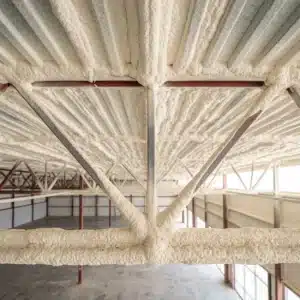
You are not the fireproofing expert on your project, and you do not need to be. But the schedule, the substrate, and the coordination between trades are yours to manage, and getting those wrong is what turns a routine spray-applied fireproofing scope into a failed inspection and a blown Certificate of Occupancy date. This guide covers the code path, the product categories, what to ask when you vet a bid, and what you need ready before the spray rig shows up.
TLDR: Spray-applied fireproofing is triggered by your building’s construction type, not by the fact that it is built of steel. The fireproofing contractor picks the product and thickness from the UL design, but you own the substrate condition, the schedule, and the special inspection coordination. Most GC fireproofing problems trace back to those three things, not to the spray itself.
I have spent more than twenty years applying fireproofing on commercial steel jobs across Texas, Kansas, and Oklahoma. The pattern I see most often is a good general contractor treating SFRM as the sub’s problem entirely, then losing weeks on the back end because the steel got primed wrong, the schedule put ceilings before inspection, or the submittal showed up too late to drive the special inspection program. None of that is hard to avoid once you understand how the pieces fit. That is what this guide is for.
Why GCs Need to Understand Spray Fireproofing, Even When a Sub Handles It
The application itself belongs to the fireproofing contractor. The conditions that determine whether that application succeeds belong to you. Substrate cleanliness, ambient temperature, work sequencing, and special inspection notification are all general contractor responsibilities under the code and under a standard project specification.
When a GC treats SFRM as entirely outside their lane, predictable problems follow. Steel gets primed with a coating the spray will not bond to. Other trades damage fresh material before it is inspected. Ceilings go in before the code-required walkthrough, then come back out. Each of these is a schedule and budget hit, and each is preventable with coordination you control.
The rest of this guide walks through what you actually need to know: when the code requires SFRM, how the product categories work, how to vet a contractor, and the specific coordination steps that keep your inspection walkthrough clean. The six most common GC mistakes are pulled together at the end so you can hand that section to your project team directly.
When Is Spray-Applied Fireproofing Required?
Spray-applied fireproofing is required when your building’s construction type demands a fire-resistance rating for the primary structural frame. IBC (2021) Table 601 sets these ratings by construction type. Type I-A requires 3 hours for the structural frame, Type I-B requires 2 hours, Types II-A, III-A, and V-A require 1 hour, and Types II-B, III-B, and V-B require zero, meaning no rating and no SFRM.
Code note: unless otherwise stated, code references on this page are to the 2021 International Building Code. Code adoption is state and local. Across the states we serve, adopted IBC editions currently range from the 2012 edition to the 2024 edition, some states have no statewide commercial building code, and several enforce NFPA 1 or NFPA 101 rather than the International Fire Code. Minnesota and Wisconsin publish state-amended code books whose numbering and requirements differ from the model code. This is general technical information, not a code determination for your project. Confirm the adopted edition and any local amendments with your authority having jurisdiction.
The key point for a GC: the requirement does not come from the material. A steel warehouse does not automatically need fireproofing. It comes from the construction type, which the design team establishes based on occupancy, area, height, and number of stories. The architect and structural engineer determine the construction type and read the required ratings off IBC (2021) Table 601. Your job is to read that requirement from the construction documents and make sure the specified system gets installed correctly and on schedule.
Here is the part that trips up first-timers. A building that fits within the height and area limits for a less restrictive construction type can be unprotected, but the same footprint that exceeds those limits has to step up to a more restrictive type, which adds the rating requirement. A distribution warehouse that fits Type II-B limits for its occupancy carries a 0-hour frame and needs no SFRM. Push it past those limits and it becomes Type II-A, which triggers a 1-hour rating and SFRM on every primary steel member. That single classification step is where most fireproofing scope is born, and it is the reason a commercial spray-applied fireproofing scope shows up on the project at all.
One physical note worth carrying, because it explains why any of this matters. Structural steel does not need to melt to fail. It begins losing meaningful strength above about 400 degrees Celsius, and by roughly 550 degrees Celsius it retains approximately half of its room-temperature yield strength. SFRM works by insulating the steel and slowing how fast it reaches those temperatures during a fire. That is the entire job of the material, and it is why the code does not let you skip it where it is required.
The Three Density Categories and When Each One Applies
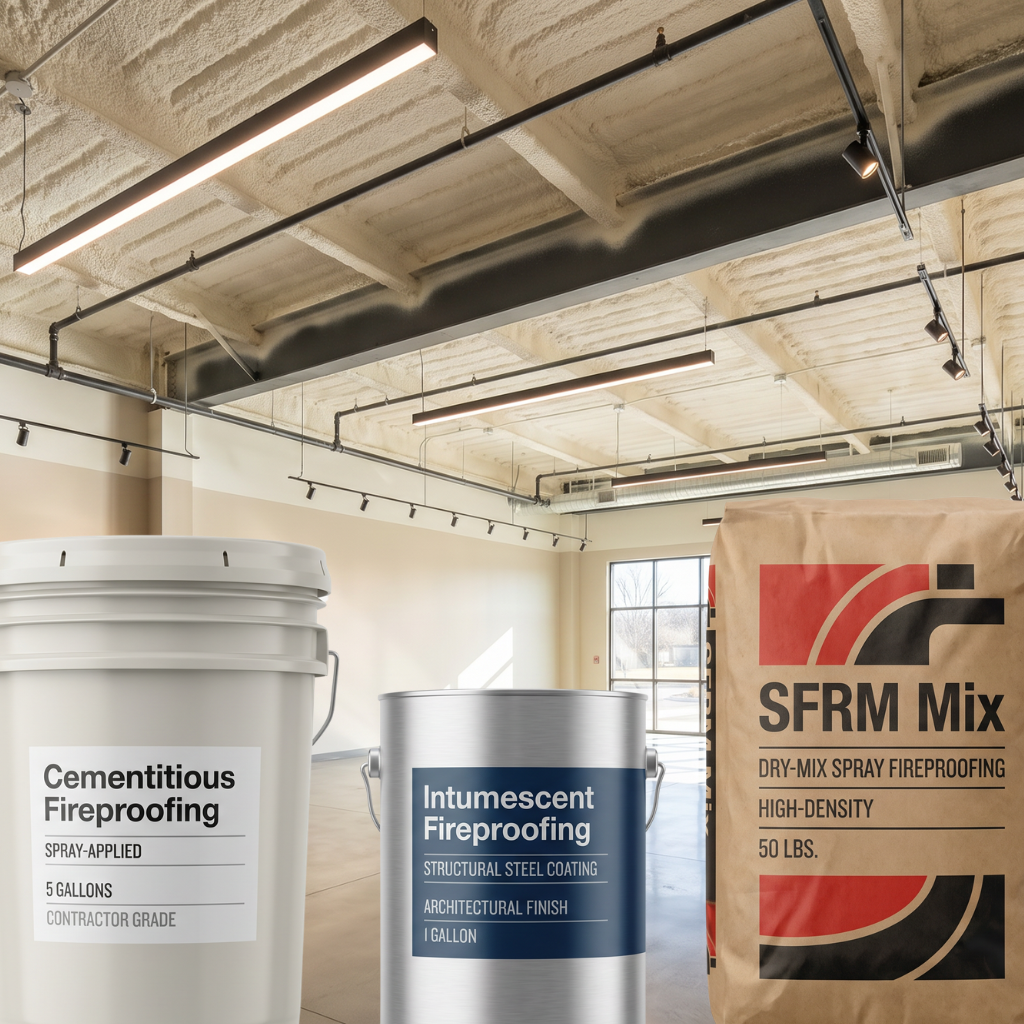
SFRM is grouped into three density categories, and the right one for your project is mostly a question of where the material lives in the finished building. The categories are commercial or low density (roughly 15 to 21 pounds per cubic foot, usually gypsum-based), medium density (roughly 22 to 39 pounds per cubic foot, usually cement-based), and high density (40 pounds per cubic foot and up, cement-based). Manufacturer references like the Isolatek commercial-density product family confirm these ranges and the gypsum-versus-cement binder distinction across the categories.
The decision is more practical than it sounds. Ask one question: where will the fireproofing end up?
| Application environment | Typical density category |
|---|---|
| Concealed behind drywall, above a ceiling grid, or inside a shaft | Commercial / low density |
| Exposed interior with possible contact, such as mechanical rooms or parking garages with indirect weather | Medium density |
| Exterior, direct weather exposure, or heavy physical abuse | High density |
Most commercial work in our region is commercial density, because most fireproofed steel ends up concealed. Medium density steps in where the material is exposed to traffic or equipment contact. High density is for exterior columns, parking structures with weather exposure, and similar punishing environments. There is one important exception to “concealed equals low density” that has nothing to do with exposure and everything to do with building height, and it is the single most common product-selection mistake I see on mid-rise jobs.
What Mid-Rise GCs Get Wrong: The Bond Strength Requirement
This is the technical decision most likely to bite a GC, and almost no buyer’s guide explains it. Bond strength, the measure of how well the SFRM stays adhered to the steel, has a minimum that climbs with building height. For buildings below 75 feet, IBC (2021) Section 1705.15.6 sets the floor at 150 pounds per square foot. For buildings from 75 feet to 420 feet, IBC (2021) Section 403.2.3 and Table 403.2.3 raise it to 430 pounds per square foot, and above 420 feet it jumps to 1,000 pounds per square foot.
Why this matters for product selection: standard commercial-density products often develop field bond strengths in the range of a few hundred pounds per square foot, which is fine below 75 feet but may not clear the 430 threshold for a mid-rise building. The instinct is to jump to medium density to solve it, and that works. But it is not the only path. Some commercial-density products are specifically formulated as high-bond variants that meet the 430 requirement at low density, which can be a more economical option than going to medium density for the whole frame. The right answer is project-specific and belongs to the fireproofing contractor and the engineer of record, but you should know the question exists so a 9-story building does not get specified with a product rated for a 2-story office.
These elevated bond-strength requirements were introduced in the 2009 IBC. They trace to Recommendation 6 of NIST NCSTAR 1, the September 2005 federal investigation of the World Trade Center disaster, which called for improved in-place bond strength on structural steel fireproofing. That history is worth knowing, because it tells your engineer the requirement is not arbitrary.
A jurisdictional reality sits underneath all of this. Texas is a home-rule state, and building code adoption varies by city. The statewide statutory commercial building code is an older edition, but many Texas jurisdictions, including major metros, have moved to the 2021 IBC on their own schedules, and Kansas and Oklahoma jurisdictions vary as well. The bond-strength provisions described here have been in the code since 2009, so they apply under any modern edition, but you should always confirm the adopted edition and any local amendments with the authority having jurisdiction for your specific project.
The Primed Steel Problem
Here is a failure mode that is almost always caused upstream of the fireproofing contractor, and it is expensive. Most structural steel gets primed for corrosion protection by the fabricator or erector. If that primer is not compatible with the specified SFRM, you have a problem, because IBC (2021) Section 704.13.3.1 requires substrates receiving SFRM to be free of primers, paints, and encapsulants other than those fire-tested by a nationally recognized testing agency.
UL does allow SFRM over primed or painted steel, but only under specific conditions: field bond testing per ASTM E736 has to confirm the material holds adequately on the primed surface, and there are limits on member dimensions above which a mechanical bond, typically metal lath, becomes necessary. The exact thresholds vary by manufacturer and product, so they have to be verified against the specific SFRM being used, not assumed.
The practical consequence is simple. When steel is primed before anyone checks primer compatibility with the fireproofing system, you can end up forced into bond testing, lath installation, or primer removal, all of which cost money and time. The fix costs nothing: coordinate primer selection with the fireproofing contractor before the steel is fabricated. This is the same reason substrate condition matters so much at application time, where surface preparation directly determines whether the material bonds.
What to Look for in a Fireproofing Contractor
A qualified fireproofing contractor is not hard to identify if you know what to ask for. The primary industry accreditation is the National Fireproofing Contractors Association Contractor Accreditation Program, which requires a company to have personnel pass the SFRM examination and to document product training and installation experience. Manufacturers also maintain their own approved-applicator qualifications, and these are product-specific, so being trained on one manufacturer’s system does not transfer to another’s.
When you are vetting bids, five questions separate the serious contractors from the rest:
- What is your NFCA accreditation status for SFRM, and can you provide the documentation?
- Which manufacturers have trained and approved you as an applicator? Each system requires its own qualification.
- Can you show three similar projects, same construction type, in this region, completed in the last three years?
- Who is the on-site foreman, and what is their experience?
- How do you handle post-MEP patch-back coordination and the documentation for special inspection closeout?
That last question matters more than it looks. The patch-back after other trades damage fresh fireproofing is where many projects lose time, and a contractor who has a clear answer for it is one who has done this before. What twenty years of commercial work across our service areas in Texas, Oklahoma, Kansas, Nebraska, Minnesota, and Wisconsin looks like in practice is a crew that plans the patch-back into the schedule from the start rather than scrambling for it at the end.
The GC’s Pre-Spray Checklist
Before the fireproofing contractor can do their job, several things have to be in place, and they are your responsibility to coordinate. Run this list before application begins:
- The structural steel is erected and the steel schedule is final and accurate. Changes after the fireproofing submittal is approved can force a re-submittal, because the thickness depends on the steel section.
- The approved fireproofing submittal is in hand, including the UL design number, product data sheet, and special inspection program.
- The substrate meets IBC (2021) Section 704.13.3.1, free of contamination and of any incompatible primer.
- Ambient and substrate temperature is at or above the product minimum, commonly 40 degrees Fahrenheit, maintained per IBC (2021) Section 704.13.4.
- Ventilation is adequate, commonly a minimum of four air exchanges per hour during application and until the material is dry, per the product data sheet.
- The special inspector has been notified that SFRM work is about to begin.
- Other trades are cleared from the areas actively receiving spray.
The thickness question deserves one line of explanation, because GCs ask about it. SFRM thickness for a given fire rating is not a fixed number. It varies with the steel section, expressed as the weight-to-heated-perimeter ratio of each member. Heavier sections relative to their exposed surface heat more slowly and need less material. The fireproofing contractor calculates the required thickness for each member from the approved UL design and the structural steel schedule. Your job is to make sure that steel schedule is final and available early enough for them to produce a complete submittal.
The Special Inspection Process and What It Means for Your Schedule
On projects that require special inspection, the special inspector verifies the SFRM against five things under IBC Section 1705.15: substrate condition, thickness, density, bond strength, and the condition of the finished application. Thickness and density are measured per ASTM E605, and bond strength per ASTM E736. These same five checks apply to repaired areas, not just the original application.
The schedule item that matters most to you is the timing of the post-trade inspection. IBC (2021) Section 1705.15 (Section 1705.14 in the 2018 and earlier editions) requires a visual inspection after the rough installation of electrical, sprinkler, mechanical, and plumbing systems, and before the material is concealed. That is the code-mandated window that catches all the damage other trades cause. If your ceiling grid goes in before that inspection happens, the ceiling comes back out so the inspector can see the steel. Sequencing the patch-back and the inspection before concealment is the single most valuable scheduling move you can make on a fireproofing scope. The full inspection sequence is laid out in our complete guide to the fireproofing inspection process.
Keep this documentation organized and ready for the inspector: the approved submittal with UL design number, the Statement of Special Inspections with the SFRM scope identified, temperature logs for the application periods, the inspector’s periodic reports on thickness and density and bond, and a photo record of substrate condition before application and of the post-MEP patch-back. The Statement of Special Inspections itself is prepared by the engineer or architect of record and must be engaged before or early in construction, and coordinating that inspection and notifying the inspector is a general contractor responsibility.
The 6 Most Common GC Mistakes on Spray Fireproofing Jobs
These are the failures I see repeatedly on commercial steel jobs. None of them are about the spray itself. All of them are about coordination.
- Scheduling SFRM before the structural steel is complete. Out-of-sequence work means changes to the steel after application can require re-inspection or re-application.
- Priming the steel without coordinating with the fireproofing contractor. An incompatible primer forces bond testing, lath, or removal, all of which delay the schedule.
- Not protecting the SFRM from other trades. MEP damage is the most common source of a failed walkthrough, and it is repairable but only if it is caught and patched before concealment.
- Missing the post-MEP inspection window. IBC (2021) Section 1705.15 requires that visual inspection before concealment. Ceilings installed first come back out.
- Specifying low-density SFRM for a mid-rise building without checking bond strength. Above 75 feet, the 430 pounds per square foot requirement applies, and standard low-density product may not meet it without a high-bond variant or a step up to medium density.
- Requesting the SFRM submittal too late. The submittal depends on the UL design, which depends on the steel schedule. Late submittals stall the special inspection program and push the Certificate of Occupancy.
Texas, Kansas, and Oklahoma: What Is Different Here
Two regional realities shape fireproofing work across our service area. First, code adoption is not uniform. Texas is home-rule, so the adopted edition and local amendments vary from city to city, and Kansas and Oklahoma jurisdictions differ as well. Some are on the 2021 IBC, some are on earlier editions, and the only reliable answer for your project comes from the local authority having jurisdiction. Do not assume the edition from a neighboring city carries over.
Second, summer heat changes field practice, particularly for cementitious products and any patch-back work. When ambient temperatures run past 90 degrees, the steel and any existing material dry out fast and pull moisture from fresh material, which is why aggressive pre-wetting and temperature logging matter more here than the baseline manufacturer instructions imply. That field detail connects directly to repair work, where the same drying conditions drive how patch-back gets handled.
Related Reading
- New to how the material actually goes on the steel? Start with our complete guide to spray-applied fireproofing.
- For the substrate side of the job, see why surface preparation determines fireproofing performance.
- For what happens after the trades damage your fireproofing, read fireproofing repair after MEP trades.
Frequently Asked Questions
Q: When is spray-applied fireproofing required on a commercial building? A: It is required when the building’s construction type demands a fire-resistance rating for the structural frame. IBC (2021) Table 601 sets these by construction type. Type I-A requires 3 hours for the frame, Type II-A requires 1 hour, and Type II-B requires none. The design team establishes the construction type from occupancy, area, and height.
Q: What is the difference between low, medium, and high density spray fireproofing? A: Commercial or low density (about 15 to 21 pounds per cubic foot) is for concealed applications behind ceilings and walls. Medium density (about 22 to 39 pounds per cubic foot) handles exposed interior areas like mechanical rooms. High density (40 pounds per cubic foot and up) is for exterior or high-abuse environments. The choice follows where the material ends up in the finished building.
Q: How do I choose a spray fireproofing contractor? A: Look for NFCA accreditation, manufacturer-specific applicator approval for the product you are using, relevant recent projects of the same construction type, an experienced on-site foreman, and a clear plan for post-MEP patch-back and inspection documentation. Ask for the accreditation paperwork rather than taking it on faith.
Q: What does a general contractor need to do before spray fireproofing is applied? A: Confirm the steel is erected and the schedule is final, the approved submittal is in hand, the substrate is clean and free of incompatible primer per IBC (2021) Section 704.13.3.1, temperature and ventilation meet the product minimums, and the special inspector is notified. Clear other trades from the work area before spraying begins.
Q: What is the special inspection process for spray-applied fireproofing? A: A special inspector verifies five items under IBC (2021) Section 1705.15: substrate condition, thickness, density, bond strength, and finished condition. Thickness and density are measured per ASTM E605 and bond strength per ASTM E736. A visual inspection is required after MEP rough-in and before the material is concealed.
Q: Can spray fireproofing be applied over primed steel? A: Sometimes, under specific UL conditions. The primer generally must be one fire-tested by a recognized agency, field bond testing per ASTM E736 must confirm adequate adhesion, and member-size limits apply above which metal lath is required. The exact conditions vary by manufacturer, so verify before priming steel.
Q: Why does the required thickness change from one steel member to another? A: Thickness depends on the steel section, specifically its weight-to-heated-perimeter ratio. Heavier sections relative to their exposed surface heat more slowly and need less material for the same rating. The fireproofing contractor calculates each member’s thickness from the UL design and the steel schedule.
Q: Does my building’s height affect which product I can use? A: Yes. Above 75 feet, IBC (2021) Section 403.2.3 requires a minimum bond strength of 430 pounds per square foot, and above 420 feet it rises to 1,000. Standard low-density products may not meet the 430 threshold, so mid-rise projects need either a high-bond commercial-density product or a step up to medium density. Confirm the selection with your fireproofing contractor.
Key Takeaways
The code, not the material, triggers SFRM. A steel building needs fireproofing only when its construction type requires a rated structural frame under IBC (2021) Table 601. The design team sets the construction type; you read the requirement off the drawings.
Density follows location. Commercial density for concealed steel, medium density for exposed interior, high density for exterior and abuse. Match the category to where the material lives.
Building height changes the product. Above 75 feet, the 430 pounds per square foot bond strength requirement under IBC (2021) Section 403.2.3 means standard low-density product may not qualify. Mid-rise projects need a high-bond variant or medium density.
Primer is a GC trap. Coordinate primer selection with the fireproofing contractor before steel is fabricated. An incompatible primer forces costly bond testing or lath under IBC (2021) Section 704.13.3.1.
Vet the contractor on paper. NFCA accreditation, manufacturer applicator approval, recent same-type projects, and a clear patch-back plan. Ask for documentation.
Sequence the inspection before concealment. IBC (2021) Section 1705.15 requires the post-MEP visual inspection before ceilings go in. Plan the patch-back and inspection into the schedule so the walkthrough closes clean.
Confirm the code with the AHJ. Texas, Kansas, and Oklahoma adopt and amend codes by jurisdiction. Verify the adopted edition and local amendments for your specific project.
If you are planning a commercial steel project and want a fireproofing partner who will coordinate the schedule with you, flag the primer and submittal issues before they cost you, and document the work so your special inspection closes out the first time, let’s talk. Contact Bahl Fireproofing throughout Texas, Oklahoma, Kansas, Nebraska, Minnesota, and Wisconsin at 512-387-2111 or ross@bahlfireproofing.com to schedule a consultation or request a bid.
This article provides general educational information about fireproofing and passive fire protection. It is not a substitute for project-specific guidance from a licensed architect or engineer, the manufacturer’s published installation instructions, or the requirements of your local authority having jurisdiction. Code references reflect the 2021 International Building Code; verify the edition and amendments adopted in your jurisdiction. Product specifications and UL listings change over time and should be confirmed against current manufacturer documentation before use.