Spray-applied fireproofing on structural steel is one of the building elements the code singles out for independent, third-party special inspection. This guide explains what IBC Chapter 17 requires for SFRM special inspection, what the inspector actually measures, and the numbers that decide pass or fail, so the testing gets scheduled and met instead of holding up your certificate of occupancy.
TLDR: SFRM special inspection is not the contractor checking that the fireproofing looks right. Under IBC Chapter 17 it is a code-mandated, owner-funded, third-party program with defined sampling counts and numeric pass/fail thresholds for thickness, density, and bond strength, and the special inspector’s final report is a precondition for occupancy. Treat it as the applicator’s quality control, or skip scheduling it, and the certificate of occupancy waits while crews patch and retest. Know the numbers and build them into the schedule.
Picture the end of a steel job. The fireproofing went on, the ceilings are closing up, and the certificate of occupancy is the only thing between the owner and move-in. Then the building official asks for the special inspection reports, and there is a problem: the third-party thickness, density, and bond testing was never scheduled, or the member sampling does not meet the 25 percent count, or readings came back under the design and nobody corrected them. Now occupancy is on hold while crews go back, patch the thin spots, and retest. SFRM special inspection is not a formality at the end. It is a measurement program that runs alongside the work, and the final report gates the certificate of occupancy. The owner, not the contractor, has to have engaged the inspector for it to happen at all.
What Is SFRM Special Inspection Under IBC Chapter 17?
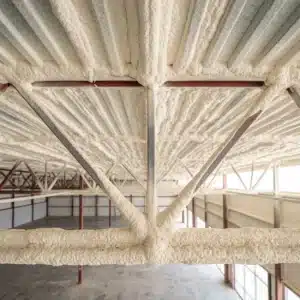
SFRM special inspection is the independent, third-party testing the IBC requires for spray-applied fire-resistive materials on structural steel and assemblies. Under IBC Chapter 17, an approved special inspector engaged by the owner verifies surface conditions, thickness, density, and bond strength against the approved fire-resistance design, then files the report the building official needs before occupancy.
In the 2021 IBC, the requirement sits in Section 1705.15, Sprayed Fire-Resistant Materials, within IBC Chapter 17 special inspections. In the 2018 and earlier editions, the same requirement lived under Section 1705.14, so confirm the adopted edition with the authority having jurisdiction. The inspection draws on two code-referenced test standards: ASTM E605 for thickness and density, and ASTM E736 for cohesion and adhesion (bond strength). AWCI Technical Manual 12-A is a respected industry guide to that field practice, but IBC (2021) Section 1705.15 (Section 1705.14 in the 2018 and earlier editions) does not reference it. Our commercial fireproofing services are run to meet that program, not to work around it.
Code note: unless otherwise stated, code references on this page are to the 2021 International Building Code. Code adoption is state and local. Across the states we serve, adopted IBC editions currently range from the 2012 edition to the 2024 edition, some states have no statewide commercial building code, and several enforce NFPA 1 or NFPA 101 rather than the International Fire Code. Minnesota and Wisconsin publish state-amended code books whose numbering and requirements differ from the model code. This is general technical information, not a code determination for your project. Confirm the adopted edition and any local amendments with your authority having jurisdiction.
Why the Code Requires Independent Inspection
The reason for an independent program is simple: once the building is finished, you cannot see the fireproofing. SFRM hides above ceilings and behind finishes, and you cannot tell by looking whether it is the right thickness or actually bonded to the steel. So the code separates verification from the work. The owner hires the special inspector, who reports to the owner and the building official, not to the contractor applying the material. That independence is the point. A contractor checking their own thickness is quality control; a third party measuring it against the approved design is special inspection, and only the second one satisfies Chapter 17.
That is also why timing matters. The inspector verifies surface conditions before application begins, observes the work, tests the cured material, and performs an additional visual inspection after the rough installation of electrical, sprinkler, mechanical, and plumbing systems, before any of it is concealed. Miss that window and the material gets covered before it is verified.
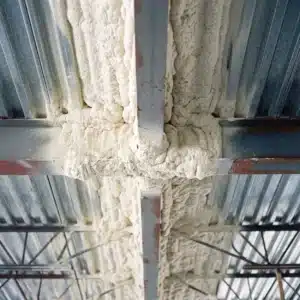
Over the past 20 years on commercial jobs across Texas, Kansas, and Oklahoma, the SFRM that fails special inspection almost never fails because the material was wrong. It fails on thickness at the hard spots, the top flange of a beam, the back side of a column, the deck flute, where the applicator could not get a clean pass, and on bond where the steel was primed with something the fireproofing will not grab. And the jobs that lose time are not the ones with bad fireproofing. They are the ones where nobody scheduled the third-party inspection until the steel was already being covered up. The material is rarely the problem. The schedule and the substrate usually are.
What the Special Inspector Tests
Special inspection of SFRM is four measurements against the approved design, each with its own standard, acceptance criterion, and sampling rate. The table summarizes them, and the sections below explain each.
| What is verified | Standard | Acceptance criterion | Sampling |
|---|---|---|---|
| Surface condition | Visual; bond test if primed | Substrate acceptable to the manufacturer before application | Before application begins |
| Thickness | ASTM E605 | No more than 10% of readings below design; none below the minimum individual thickness | 4+ readings per 1,000 sq ft for assemblies; 25% of members per floor |
| Density | ASTM E605 | Not less than the density in the approved design | 1+ sample per 2,500 sq ft per assembly and per member type, each story |
| Bond strength | ASTM E736 | Not less than 150 psf, increasing with building height | 1+ sample per 2,500 sq ft of sprayed area per assembly, and one per structural member type per 2,500 sq ft of floor area, each story |
Surface Condition and Primer Compatibility
Clean bare steel needs little more than dust removal, but primed or painted steel is where surface inspection earns its place. Some primers keep SFRM from bonding, so painted or primed steel may require a bond test before application proceeds to confirm the fireproofing will adhere. The inspector signs off that surfaces meet the manufacturer’s written instructions before the applicator starts. That sign-off documents acceptable conditions at the beginning rather than leaving a bond failure to surface at the end.
Thickness, Measured to ASTM E605
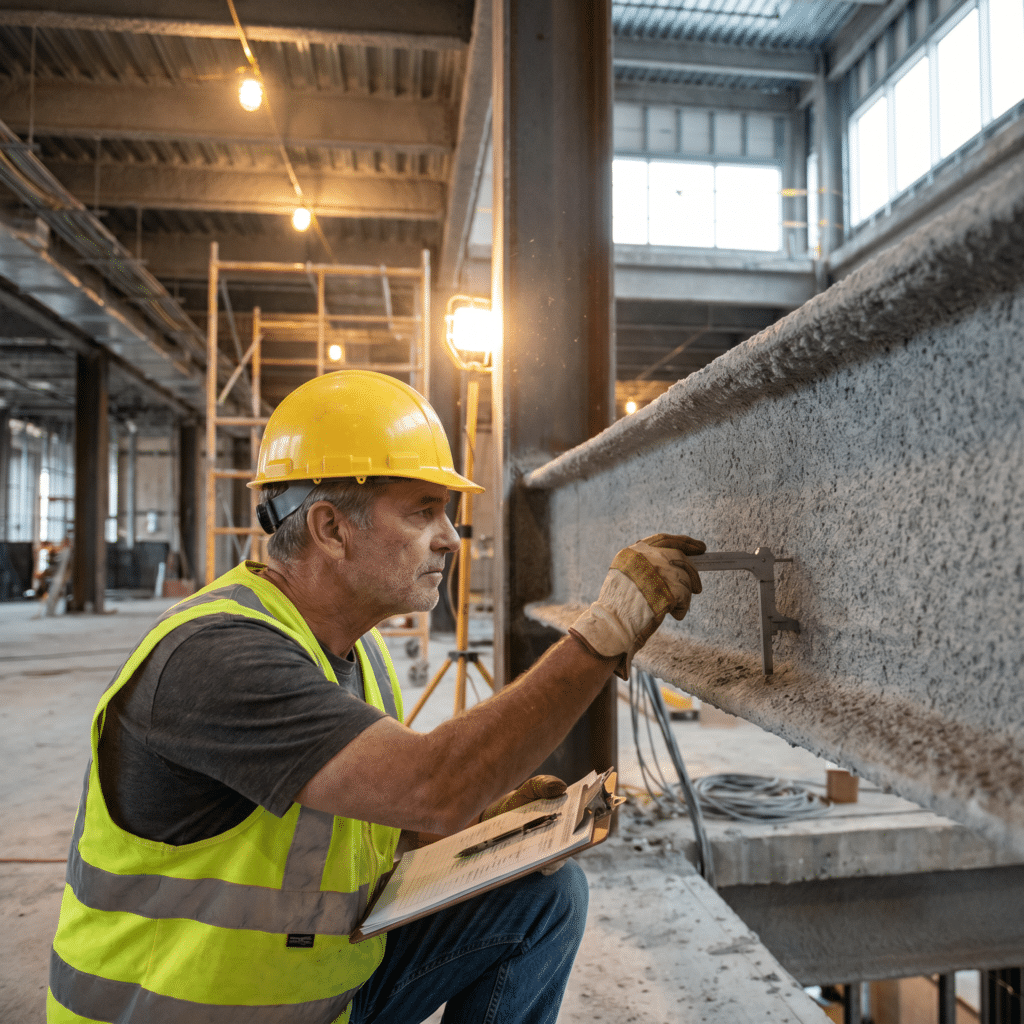
Thickness is the most heavily sampled item, and the pattern is specific. For floor, roof, and wall assemblies, the inspector takes the average of at least four measurements for every 1,000 square feet. For structural members, testing covers at least 25 percent of the members on each floor, with readings taken around the section at each end of a 12-inch length: nine locations on beams and girders, seven on joists and trusses, twelve on wide-flange columns, and at least four on hollow structural section and pipe columns. Acceptance is just as defined: no more than 10 percent of the thickness readings may fall below the design thickness, and none may fall below the minimum allowable individual thickness, which is the design thickness minus one-quarter inch for designs of one inch or more, or the design minus 25 percent for designs under one inch. Those numbers are why a “looks about right” pass does not survive special inspection.
Density, Also to ASTM E605
The cured material has to meet the minimum density in the approved fire-resistance design, tested under ASTM E605, the method the code names. AWCI Technical Manual 12-A describes the same displacement practice as industry guidance. Density samples are taken at no fewer than one for every 2,500 square feet of sprayed area per assembly in each story, and one for each structural member type per 2,500 square feet of floor area per story. Under-density material is rejected and recoated.
Bond Strength, to ASTM E736
Bond strength, the cohesion and adhesion of the cured material, is verified by the ASTM E736 field pull test. The cured SFRM must hold at not less than 150 pounds per square foot for standard commercial buildings, and that minimum climbs with building height, which the next section covers. Per IBC (2021) Section 1705.15.6.1, bond samples are selected from each floor, roof and wall assembly at not less than one sample for every 2,500 square feet of sprayed area per story, and per IBC (2021) Section 1705.15.6.2 at one sample for each type of structural member for each 2,500 square feet of floor area per story. A bond failure usually traces back to the substrate, which is why the surface inspection at the front of the job matters so much.
How Bond Strength Scales With Building Height
The 150 psf minimum is the floor, not the whole story. Since the 2009 code change, the IBC has tied SFRM bond strength to building height, on the logic that taller buildings put more demand on the material staying in place. The height-based thresholds come from IBC (2021) Table 403.2.3. The 150 psf figure in the first row below is not in that table. It is the general minimum in IBC (2021) Section 1705.15.6.
| Building height above lowest fire department vehicle access | Minimum SFRM bond strength |
|---|---|
| Less than 75 feet | 150 psf |
| 75 feet up to 420 feet | 430 psf |
| Greater than 420 feet | 1,000 psf |
This is why product selection on a high-rise is not the same as on a single-story warehouse. A material and thickness that pass at 150 psf may not meet the height-based SFRM bond-strength requirements, so the bond demand has to be checked against the building height before the SFRM is specified, not discovered at the pull test.
When Inspection Happens and What Gates the Certificate of Occupancy
The program runs on a sequence, and the certificate of occupancy sits at the end of it. Surfaces are inspected and accepted before application. Thickness, density, and bond are tested during and after application on the cured material. A visual inspection follows the rough installation of the other trades, before concealment. Then the special inspector compiles a final report documenting every test, any deficiencies, and the corrective action taken to resolve them. That final report is what the building official requires to issue the certificate of occupancy. SFRM special inspection is generally periodic rather than continuous, meaning the inspector works at defined intervals rather than standing over every square foot, but the report at the end is not optional. No accepted report, no occupancy.
Specifying and Scheduling SFRM Inspection in Texas, Kansas, and Oklahoma
In our service area, two things shape how this plays out. First, edition adoption varies, because Texas is a home-rule state and municipalities adopt different IBC editions on different schedules. That changes the section number, 1705.15 in the 2021 edition versus 1705.14 in the 2018 edition, and can change local amendments, so the adopted edition and any amendments should be confirmed with the building department for each project. Second, the authority having jurisdiction sets who is qualified to perform the inspection, and many require an accredited testing agency or a certified special inspector rather than just any third party. On the high-rise work in markets like Houston, Dallas, and Austin, the height-based bond tiers come into play, and a 430 psf or 1,000 psf requirement needs to be designed in from the start. The practical move on commercial steel projects across Texas is to engage the special inspector early, review the fire-resistance design and the bond requirement before steel erection, and schedule the testing into the sequence so nothing gets covered before it is verified.
Common Reasons SFRM Fails Special Inspection
The failures repeat. Thickness coming up short at the hard-to-reach spots, the top flange, the back of a column, inside a deck flute. Bond failures on steel primed with an incompatible coating. Member sampling that does not meet the 25 percent count or the measurement pattern. No third-party inspection scheduled until the material is already being concealed. And final reports missing the documentation, the test locations, the statistical results, and the resolution of every discrepancy, that the building official needs. Each one is preventable, and each one comes down to treating the inspection as part of the construction sequence rather than a box checked at the end.
Frequently Asked Questions
What is SFRM special inspection? It is the independent, third-party testing the IBC requires for spray-applied fire-resistive materials on structural steel. An approved inspector engaged by the owner verifies surface conditions, thickness, density, and bond strength against the approved fire-resistance design under IBC Chapter 17, and files the report the building official needs before occupancy.
Is special inspection required for all spray fireproofing? It applies where SFRM provides a required fire-resistance rating, based on the approved construction documents, which covers essentially all structural fireproofing on commercial steel. The authority having jurisdiction confirms the scope for a given project, so verify the requirement locally rather than assuming an exemption.
Who hires and pays for the special inspector? The owner, not the contractor, engages the special inspector, through the Statement of Special Inspections prepared by the engineer or architect of record. That arrangement keeps the inspection independent of the trade doing the work, which is the whole purpose of the program.
What is the minimum bond strength for SFRM? Not less than 150 psf for standard commercial buildings, increasing with height: 430 psf for buildings from 75 to 420 feet, and 1,000 psf above 420 feet, per IBC (2021) Table 403.2.3. Bond is verified in the field with the ASTM E736 pull test.
How is SFRM thickness checked, and what is the tolerance? Thickness is measured to ASTM E605, with at least four readings per 1,000 square feet for assemblies and 25 percent of members per floor. No more than 10 percent of readings may be below the design thickness, and none below the minimum individual thickness, which is the design minus one-quarter inch for designs of one inch or greater.
Is SFRM special inspection continuous or periodic? It is generally periodic, meaning the inspector works at defined intervals and milestones rather than observing continuously. The key fixed points are surface acceptance before application and the visual inspection after the other trades rough in, before concealment.
Can we get a certificate of occupancy without the special inspection report? No. The special inspector’s final report, documenting all testing and confirming that any deficiencies were corrected, is required for the building official to issue the certificate of occupancy. Skipping or delaying the inspection delays occupancy.
What standards does the inspector use? ASTM E605 for thickness and density and ASTM E736 for cohesion and adhesion (bond strength), the two standards the code names. AWCI Technical Manual 12-A is industry guidance on field inspection practice and is not referenced by the IBC for SFRM. The fire-resistance ratings themselves trace back to ASTM E119 testing of the assembly.
Key Takeaways
- It is a code-mandated, independent program. SFRM special inspection lives in IBC Chapter 17 (Section 1705.15 in the 2021 edition, 1705.14 in 2018) and is performed by a third party engaged by the owner, not the contractor.
- Four things get measured. Surface condition, thickness (ASTM E605), density (ASTM E605), and bond strength (ASTM E736), each against the approved fire-resistance design.
- The thickness rules are specific. At least 25 percent of members per floor, with defined measurement patterns, and no reading below the design minus one-quarter inch. “Looks right” does not pass.
- Bond strength scales with height. At least 150 psf under IBC (2021) Section 1705.15.6, rising to 430 psf from 75 to 420 feet and 1,000 psf above 420 feet under IBC (2021) Table 403.2.3. Design the bond demand in early.
- Timing is built into the sequence. Surfaces are accepted before application, and a visual inspection follows the other trades before concealment. Miss the window and the work gets covered unverified.
- The final report gates occupancy. No accepted special inspection report, no certificate of occupancy. Schedule the inspector before steel gets covered.
- In our region, confirm the edition and the inspector. Home-rule adoption changes the section number and amendments by city, and the authority having jurisdiction sets who is qualified to inspect.
Related Reading
- Want the broader code picture? Our commercial fireproofing code compliance guide maps how fire-resistance requirements drive the whole project.
- Looking at it from the owner’s seat? The fireproofing inspection process for building owners walks the phases from a non-technical angle.
- Need the requirements behind the inspection? See what building owners need to know about fireproofing code compliance.
If your next project puts SFRM on structural steel, the work that keeps the certificate of occupancy on schedule is getting the surface accepted, the thickness and density sampled correctly, the bond verified against the right height-based number, and the special inspection report complete. That is what our crew coordinates on commercial jobs throughout Texas, Oklahoma, Kansas, Nebraska, Minnesota, and Wisconsin. Reach me directly at 512-387-2111 or ross@bahlfireproofing.com, or Contact Bahl Fireproofing to line up fireproofing that meets Chapter 17 the first time through.
This article provides general educational information about commercial fireproofing and the special inspection requirements of the International Building Code. It is not engineering, legal, or code-compliance advice and does not replace project-specific direction from a licensed architect or engineer. Code citations reference specific IBC editions, and the adopted edition, section numbering, amendments, and special-inspection scope vary by the authority having jurisdiction. Test methods, acceptance criteria, and bond-strength requirements depend on the approved fire-resistance design and the listed assembly, and standards are periodically revised, so confirm current requirements with the manufacturer, the building official, and a licensed architect or engineer before relying on any value in this article. The special inspector is an independent third party engaged by the owner; this article does not constitute or replace that inspection.