The fireproofing on your building’s steel was installed once, at construction, and most owners never think about it again. But it is a physical material, and it gets damaged: by the trades, by water, by age and impact. Damaged fireproofing means unprotected steel at that spot. This guide covers the five visible signs that your fireproofing needs repair, what causes each one, and why ignoring them quietly defeats the fire rating your building was designed around.
TLDR: Fireproofing is not install-once-and-forget. It cracks, gets knocked off by MEP and renovation work, takes on water, loses its bond, and wears thin, and every damaged spot is steel left unprotected in a fire. The five signs, visible cracking or missing material, damage after trade work, water stains and rust bleeding through, sagging or separation from the steel, and bare exposed steel, are all things you can see if you look up. Caught early, damaged fireproofing is straightforward to fix. Ignored, it leaves gaps in your building’s fire protection that no one will know about until a fire.
Picture an owner who assumes the fireproofing done at construction is permanent. For years they walk past cracked patches over a beam, a section knocked loose where a duct went in, and a rust stain near an old roof leak, never connecting any of it to fire safety. The steel at every one of those spots is now unprotected, and the two-hour rating the building was permitted for has gaps in it. If a fire starts, it finds those gaps first. The signs were visible the whole time, which is the point of knowing what to look for.
Why Damaged Fireproofing Is a Real Problem
Damaged fireproofing matters because fireproofing works by keeping structural steel below the temperature where it loses strength, and any gap, crack, or missing patch leaves that steel exposed. Steel retains only about 60 percent of its yield strength near 550 degrees Celsius and approaches its critical temperature, often cited around 1,000 to 1,100 degrees Fahrenheit, where it can no longer carry its design load. A protected member reaches that point slowly; an unprotected one gets there fast.
So a damaged spot is not cosmetic. It is a place where the fire-resistance rating the building was permitted for no longer holds, and because the damage is usually small and overhead, it goes unnoticed until it matters. Restoring that protection is the entire purpose of commercial fireproofing repair, and the first step is recognizing the signs.
Sign 1: Visible Cracking, Flaking, or Missing Material
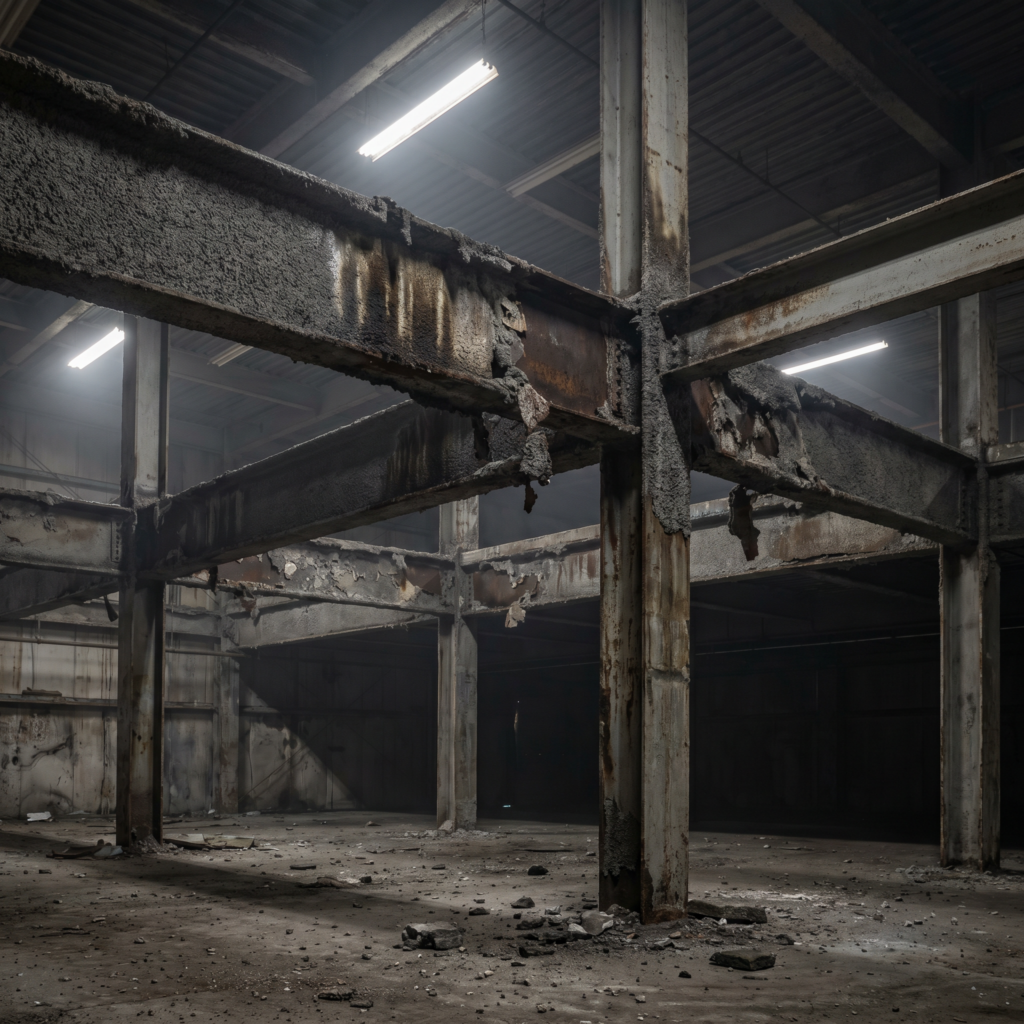
The clearest sign is fireproofing you can see is broken: cracking, flaking off, or with chunks missing over beams, columns, and deck. These are the exact defects a special inspector rejects on new work, where the finished application cannot exhibit cracks, voids, spalls, delamination, or exposed steel. When you see them on an existing building, the same logic applies: the protection at that spot is compromised.
Cracking and loss come from impact, vibration, building movement, and age. A forklift mast, a maintenance lift, equipment swung into a column, or years of settling all take their toll. Wherever the material has cracked through or fallen away, the steel beneath is no longer fully protected, and the area needs to be assessed and patched back to the original system.
Sign 2: Fireproofing Knocked Off After MEP or Renovation Work
The most common single cause of damaged fireproofing is other trades. New ductwork, conduit, sprinkler lines, cable trays, or any renovation that touches fireproofed steel knocks material off as it is installed, and if the fireproofing is not patched afterward, the steel is left bare right where the work happened. This is so routine that the area above any recent mechanical or renovation work is the first place to look.
Over the past 20 years inspecting and repairing fireproofing across Texas, Kansas, and Oklahoma, the damage owners miss is almost never hidden. It is cracked patches over a beam, a section knocked off where a new duct went in, or rust bleeding through near an old roof leak, in plain sight, walked past for years. Fireproofing does not fail quietly because it hides. It fails quietly because no one is looking up. The steel under those spots is unprotected, and the building’s fire rating has gaps the original inspection never saw. Repairing trade damage is a defined process, and it is worth handling as part of closing out any project that disturbs fireproofed steel.
Sign 3: Water Stains, Moisture, or Rust Bleeding Through
Water stains on fireproofing, or rust bleeding through it, signal moisture reaching the steel. Fireproofing is not waterproof and is not a vapor barrier, so a roof leak, a plumbing failure, or persistent condensation degrades the material’s bond and starts corrosion on the steel underneath. Rust bleeding through an otherwise intact-looking surface is the telling one: it means the steel is already rusting under fireproofing that still looks fine from below.
This sign has two problems stacked together, which is why it cannot be ignored. The water source has to be fixed, or the damage will simply return, and the fireproofing has to be repaired to restore protection. Where corrosion has set in, the steel itself may need evaluation before the area is re-covered, because fireproofing over actively rusting steel does not solve the underlying problem.
Sign 4: Fireproofing Sagging or Pulling Away from the Steel
Fireproofing that is sagging, drooping, or visibly separating from the steel has lost its bond, and bond is what makes it work. SFRM has to stay adhered to the member to insulate it, and bond is one of the properties an inspector measures, with adhesion tested per ASTM E736. When material is hanging away from the steel, the protection is failing even if it has not yet fallen.
Bond loss traces back to a few causes: poor surface preparation at the original installation, moisture working into the interface, ongoing vibration, or simple age. Unlike a small crack, separation usually cannot be spot-patched, because the surrounding material has already let go. The affected area typically has to be removed and reapplied to a properly prepared surface so the new material actually bonds.
Sign 5: Bare or Exposed Steel and Coverage Gaps
Any structural steel you can see bare is a gap in the fire protection. Sometimes that is wear in a high-traffic or high-abrasion area, sometimes a connection or a section that was never fully covered, and sometimes material that has thinned below the required thickness over time. From the floor it can be hard to judge thickness, but exposed steel is unmistakable, and so is a stretch of beam where the coverage clearly thins out.
The fix is to restore the required thickness for that member per the original UL design, not just to cover the bare metal. Thickness is specific to the steel shape and the rating, so a proper repair re-establishes the correct depth rather than smearing something over the gap. Where abrasion caused it, a more durable, higher-density product may be the better long-term choice for that location.
What to Do When You See the Signs
None of these signs should be left alone, but the response is straightforward. Document the location and extent, and get a professional assessment of how far the damage goes. Damaged fireproofing is repaired by patching small areas or re-spraying larger ones with a product compatible with the original system and the UL design, and on rated assemblies the repair may need to be re-inspected for thickness, density, and bond, the same checks the original work had to pass. Matching the repair product to the original system matters, because mixing incompatible materials can undermine the bond and the listing.
The practical rule is to treat fireproofing as part of the building you maintain, not a one-time install. Check it after any trade work that touches steel, after any water event, and as part of periodic building assessment, and address what you find before it becomes a larger, more expensive area of removal and reapplication.
How Texas, Kansas, and Oklahoma Conditions Affect Fireproofing
In this region, two of the five signs show up more than the others. Texas heat, humidity, and the roof leaks that come with severe weather accelerate the water-related damage, so rust bleed-through and bond loss are worth watching in older and storm-exposed buildings. And the steady pace of tenant improvements and renovation across commercial space in Texas, Oklahoma, Kansas, Nebraska, Minnesota, and Wisconsin keeps trade damage near the top of the list. Knowing the local conditions and how they age fireproofing is part of how we assess and repair it throughout our service area, so the protection a building was designed with stays intact.
Frequently Asked Questions
Why is damaged fireproofing a problem? Because fireproofing keeps structural steel below the temperature where it loses strength, and any crack, gap, or missing patch leaves that steel exposed. In a fire, an unprotected member heats and weakens far faster, so damaged fireproofing silently undercuts the fire-resistance rating the building was permitted for.
What does fireproofing damage look like? The common signs are visible cracking or chunks missing over steel, material knocked off after MEP or renovation work, water stains or rust bleeding through, fireproofing sagging or pulling away from the steel, and bare exposed steel or thin coverage. All five are visible from the floor if you look up at the structure.
Does fireproofing need maintenance? It is not maintenance-free. Fireproofing is a physical material that gets damaged by impact, trades, water, and age, so it should be checked after any work that touches the steel, after water events, and as part of periodic building assessment, then repaired where damage is found.
Can damaged fireproofing be repaired? Yes. Small areas are patched and larger areas re-sprayed with a product compatible with the original system and UL design. On rated assemblies, the repair may need re-inspection for thickness, density, and bond. The key is restoring the correct thickness for that member, not just covering the gap.
Why does fireproofing fall off? Usually from impact or trade damage, from moisture degrading the bond, or from age and vibration loosening the material. Poor surface preparation at the original installation also shows up later as separation. Wherever it falls off, the steel beneath is left unprotected until the area is repaired.
Does water damage fireproofing? Yes. Fireproofing is not waterproof, so a roof or plumbing leak degrades its bond and starts corrosion on the steel underneath, often showing as stains or rust bleeding through. The water source has to be fixed along with the fireproofing, or the damage returns.
How often should fireproofing be inspected? There is no single interval, but a practical approach is to check it after any trade work that disturbs the steel, after any water event, and as part of regular building assessment. Catching damage early keeps a small patch from becoming a large area of removal and reapplication.
Key Takeaways
- Every damaged spot is unprotected steel. Fireproofing keeps steel below its critical temperature, so a crack, gap, or missing patch undercuts the building’s fire rating at that location.
- Sign 1 is visible loss. Cracking, flaking, and missing material are the same defects an inspector rejects, and they mean the protection there is compromised.
- Sign 2 is trade damage. MEP and renovation work knocks fireproofing off steel, and unpatched, it leaves bare metal right where the work happened.
- Sign 3 is water. Stains or rust bleeding through mean moisture is reaching the steel; fix the leak and repair the fireproofing, and evaluate corroded steel.
- Sign 4 is bond loss. Sagging or separation means the material has let go and usually has to be removed and reapplied, not spot-patched.
- Sign 5 is exposed steel. Bare or thin coverage is a gap that must be repaired back to the required thickness for that member per the UL design.
- Treat fireproofing as maintained, not permanent. Check it after trade work and water events, and repair early before damage spreads.
Related Reading
- Damage from a recent project? See our guide to fireproofing repair after MEP trades for the repair process.
- Want to understand the checks? Read the fireproofing inspection process for what a special inspector verifies.
- Curious why bond fails? Our guide to why surface preparation matters explains where separation starts.
If you have spotted any of these signs on your building’s steel, the right move is a professional assessment of how far the damage goes and a repair that restores the original protection per the UL design. That is work our crew handles throughout Texas, Oklahoma, Kansas, Nebraska, Minnesota, and Wisconsin. Reach me directly at 512-387-2111 or ross@bahlfireproofing.com, or Contact Bahl Fireproofing to have your fireproofing assessed before a small problem becomes a large one.
This article provides general educational information about recognizing damaged commercial fireproofing and when it may need repair. It is not engineering advice and does not replace a project-specific assessment by a qualified fireproofing professional and, where structural concerns exist, a licensed architect or engineer. The presence, extent, and cause of fireproofing damage, the condition of the steel beneath it, and the correct repair method and re-inspection requirements vary by building and must be evaluated on site. Steel performance figures cited are general and depend on the member and conditions. Always confirm repair products, methods, and inspection requirements with the manufacturer, the authority having jurisdiction, and a licensed architect or engineer before proceeding.