When mechanical, electrical, and plumbing trades work around fireproofed steel, they knock material loose. That is not a maybe. This guide walks through why it happens, what the code expects, how to decide between a hand patch and a respray, and exactly what a special inspector needs to see before the work gets signed off.
TLDR: Damaged spray-applied fireproofing has to be repaired, not waved off. Small areas can be hand-patched with a UL-classified compound matched to the original material. Larger areas need a respray. Get the repair documented and inspected before anything gets out of hand, or you risk a failed walkthrough.
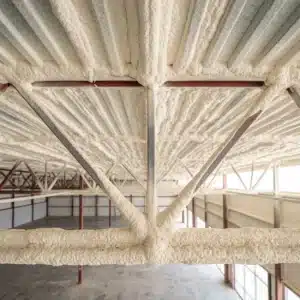
I have spent more than twenty years applying fireproofing on commercial jobs across Texas, Kansas, and Oklahoma. The single most common headache on a steel-framed project is not the original application. It is the patch-back. We apply spray-applied fireproofing to the steel early to hit the building envelope and fire rating milestones, then the MEP trades move in and work directly on and around the members we just coated. By the time the special inspector walks the floor, somebody has to account for every spot of missing material. This article is the process I follow to make sure that account comes out clean.
Why MEP Trades and Fireproofing Are Always on a Collision Course
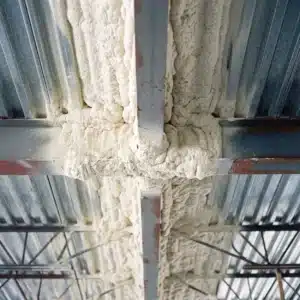
The conflict is built into the construction schedule. Sprayed fire-resistant material (SFRM) goes on the structural steel early, often before the deck is fully closed in. Then the trades that need to reach that same steel show up next. They are not careless. They simply cannot run their systems without touching the members we coated.
Here is where the damage comes from on a typical job:
- Pipe and conduit hangers. Trades fasten or weld supports straight to the steel, which means scraping SFRM off to reach bare metal.
- Cable tray and conduit routing. Crews lean tools and lengths of pipe against coated beams and joists.
- HVAC ductwork. Large duct runs brush and gouge fireproofed joists during placement.
- Sprinkler system installation. The fire protection trade attaches hangers to structural members and knocks material loose in the process.
- Foot traffic and material handling. People walk beams and pass material through framing, abrading the coating as they go.
None of this is avoidable on a live job site. What matters is that every bit of it gets repaired before the work is hidden behind drywall, ceilings, or insulation. A gap you cannot see is a gap that did not get protected.
Does Damaged SFRM Have to Be Repaired? What the Code Says
Yes. Damaged sprayed fire-resistant material has to be repaired, and no code or standard allows you to skip it or accept a percentage of missing coverage. The obligation shows up in two places, depending on whether you are mid-construction or maintaining a finished building.
During construction, the controlling sections are in the 2021 International Building Code. IBC Section 704.13 governs how SFRM is applied, including substrate condition and finished thickness, so any repair has to meet the same application requirements as the original work. IBC (2021) Section 1705.15 (Section 1705.14 in the 2018 and earlier editions) sets the special inspection rules and, critically, requires a visual inspection after the rough installation of electrical, sprinkler, mechanical, and plumbing systems, before the material is concealed. That post-trade inspection is the code’s built-in checkpoint for exactly the damage this article is about.
Code note: unless otherwise stated, code references on this page are to the 2021 International Building Code. Code adoption is state and local. Across the states we serve, adopted IBC editions currently range from the 2012 edition to the 2024 edition, some states have no statewide commercial building code, and several enforce NFPA 1 or NFPA 101 rather than the International Fire Code. Minnesota and Wisconsin publish state-amended code books whose numbering and requirements differ from the model code. This is general technical information, not a code determination for your project. Confirm the adopted edition and any local amendments with your authority having jurisdiction.
For a building already in service, the maintenance duty sits in the 2021 International Fire Code. IFC Section 701.6 makes the owner responsible for keeping required fire-resistance-rated construction intact, and for seeing that it is properly repaired, restored, or replaced when it is damaged, altered, breached, or penetrated. Always verify local adoption with the authority having jurisdiction. Texas, Kansas, and Oklahoma adopt the I-Codes on different cycles, some jurisdictions are already on the 2024 edition, and not every jurisdiction adopts the Fire Code in step with the Building Code.
One more point that catches people off guard. Project specifications, including AIA MasterSpec and the federal master specs, do not allow an “acceptable” amount of missing fireproofing. Every measured location has to meet the design thickness and density. There is no built-in tolerance for a beam that is mostly coated. That is the posture you have to plan around when other trades cause damage.
Hand-Patch or Respray? How to Choose the Right Repair Method
Can spray-applied fireproofing be repaired after damage by other trades? Yes. Damaged SFRM must be restored, and small areas can be hand-patched, typically 144 square inches or less for wet-mix products, using a UL-classified patching compound matched to the original material. Larger areas require respraying with the original product using spray equipment.
That 144 square inch figure, which works out to a 12 inch by 12 inch area, is the number every contractor knows. It is worth understanding where it comes from. The limit originates in the UL Fire Resistance Directory, not in the IBC itself. Over time it migrated into manufacturer data sheets and submittal documents, and it now functions as the practical ceiling for hand patching most wet-mix SFRM products.
But the threshold is not the same for every product. Dry-mix and wet-mix products carry different limits, and getting this wrong is one of the easier ways to void a UL design.
| Repair condition | Required action |
|---|---|
| Damage 144 sq in or less, wet-mix product | Hand-patch with a UL-classified compound listed for that product |
| Damage up to 432 sq in, dry-mix product | Hand-patch with a listed compound; verify the UL design allows it |
| Damage larger than the hand-patch limit | Respray with the original material using spray equipment |
| Original product unknown | Stop; identify the product before repairing |
| Bare steel exposed | Remove damaged material to substrate; full reapplication |
| Primer or contamination on exposed steel | Clean per IBC 704.13.3.1 before reapplying |
To make the wet-mix versus dry-mix split concrete, look at the published CAFCO FIBER-PATCH technical data: Isolatek lists its CAFCO FIBER-PATCH and ISOLATEK Type P compound for use in dry-mix designs such as BLAZE-SHIELD DC/F, Type II, and Type HP for areas up to 432 square inches, while limiting the same compound to 144 square inches when used with wet-mix products like CAFCO 300, 300 ES, 300 SB, and CAFCO 400. The lesson is simple. The patch ceiling depends on the listing for the specific product on your steel, not on a single universal number.
Why You Have to Identify the Original SFRM Product First
You can only patch SFRM with a compound that is UL-classified for the product already on the steel. Mixing systems is not a judgment call you get to make in the field. Using the wrong compound voids the UL design that gives the assembly its fire rating, which means the repair looks finished but no longer carries a listing.
Manufacturers draw these lines tightly. GCP’s MONOKOTE Patching Compound is classified under UL File R4339 for use only in UL designs associated with MONOKOTE MK-5, MK-6, and MK-10, and per UL patching guidelines it is limited to individual areas of 144 square inches or less. It is not a general-purpose patch you can reach for across other manufacturers’ systems. The same product-specific logic applies to every listed patching material.
So before any repair starts, confirm what was originally installed. Check the construction documents and the approved submittal. If those are not clear, contact the general contractor or the SFRM manufacturer directly. Identifying the product is not a formality. It determines which compound is legal to use and what patch size the listing allows.
Step-by-Step SFRM Patch Repair Process
This is the field sequence I follow. The product-specific numbers, such as exact lath border dimensions and cure times, come from the manufacturer’s published application manual for the material on your steel. Always work from that manual, because the details vary by product.
- Stop further damage and document the area. Photograph each damaged location and mark it on the structural drawings before anything gets covered.
- Identify the original SFRM product and manufacturer. Confirm from the submittal or construction documents which material and UL design apply.
- Inspect the surrounding material. Look for delamination or secondary damage beyond the obvious gouge. Loose material at the edges has to come off too.
- Remove damaged material back to sound material or to the substrate. Use the tools and method the manufacturer specifies for that product.
- Clean the substrate. Under IBC 704.13.3.1, the steel must be free of dirt, oil, grease, release agents, loose scale, and any other condition that prevents adhesion. It must also be free of primers, paints, and encapsulants other than those fire-tested by a nationally recognized testing agency. Weld spatter, grinding debris, and thread-cutting oil all have to go.
- Repair or replace damaged lath. Where reinforcement was disturbed, cementitious products like Carboline’s Pyrocrete 241 specify galvanized metal lath tied or fastened back in place before new material goes on.
- Pre-wet the edges of the surrounding SFRM. Cementitious products bond better to a dampened existing edge. Dry edges pull moisture out of the fresh material and weaken the bond.
- Mix the patching compound per the manufacturer’s instructions. Follow the published water ratio and respect the pot life. Do not retemper material past its working time.
- Apply to the required thickness for the rating. Build it up in passes as directed. Do not skim coat below the product’s minimum. Pyrocrete 241, for instance, must never be applied thinner than one quarter inch or feathered to nothing.
- Ventilate the space. SFRM products commonly require a minimum of four complete air exchanges per hour until the material is dry.
- Maintain temperature. Hold the substrate and ambient air at or above the product minimum, commonly 40 degrees Fahrenheit, before, during, and after application as the data sheet requires.
- Verify and document the finished repair. Check thickness and, where required, density, and keep the records ready for the special inspector.
A note on installer qualifications. Some manufacturers restrict who may apply their repair materials. Carboline, for example, requires that application be performed by a qualified applicator acceptable to the Carboline Company. This is not a general labor task, and treating it as one can cost you the listing.
What Does the Special Inspector Need to See After SFRM Repair?
The special inspector verifies the repaired SFRM against the same standard as the original application. Under IBC Section 1705.15, the inspection covers the substrate condition, the thickness of the material, the density of the material, the bond strength, and the condition of the finished application. A patch is not exempt from any of these because it is a patch.
The measurable thresholds matter here:
- Thickness and density are verified using ASTM E605 field methods. The repaired area has to hit the same design thickness and density as the surrounding material.
- Bond strength is tested per ASTM E736. Under IBC (2021) Section 1705.15.6, the minimum cohesion and adhesion for most low-rise commercial work is 150 pounds per square foot. High-rise buildings carry higher requirements under IBC (2021) Section 403.2.3 and Table 403.2.3, which step the minimum up to 430 pounds per square foot, and to 1,000 pounds per square foot for buildings taller than 420 feet. Those enhanced figures trace back to Recommendation 6 of NIST NCSTAR 1, the September 2005 federal investigation of the World Trade Center disaster, which called for improved in-place bond strength on structural steel fireproofing.
For field inspection and testing methodology, the code names ASTM E605 for thickness and density and ASTM E736 for bond strength. AWCI Technical Manual 12-A is a respected industry guide to how thickness, density, and bond are measured on sprayed fireproofing, including repaired areas, but the IBC does not reference 12-A. The AWCI manual the IBC does reference is 12-B, for thin-film intumescent under IBC (2021) Section 1705.16. The frequency of testing, such as how many samples per area, comes from the project specification or from the IBC itself, which calls for bond strength sampling on a per-story, per-area basis. Industry application practice is also governed by the National Fireproofing Contractors Association standards, NFCA 100 for application and NFCA 200 for field quality assurance.
Have your documentation ready before the inspector arrives: the original submittal, the patching compound data sheet, thickness readings, and your photo record of the damage and repair. The inspector’s job is easier and your walkthrough is faster when the paper trail is already assembled.
Separately, if your project is a high-rise, or a Risk Category III or IV building, or contains a Group R occupancy with more than 250 occupants, the through-penetration firestops and fire-resistant joint systems require their own third-party special inspection under IBC (2021) Section 1705.18, tested per ASTM E2174 for penetrations and ASTM E2393 for joints. That is a distinct scope from the SFRM inspection, but the trades that damage your fireproofing often disturb firestopping at the same time, so it is worth tracking together.
A Real Patch-Back Scenario: Warehouse in Central Texas
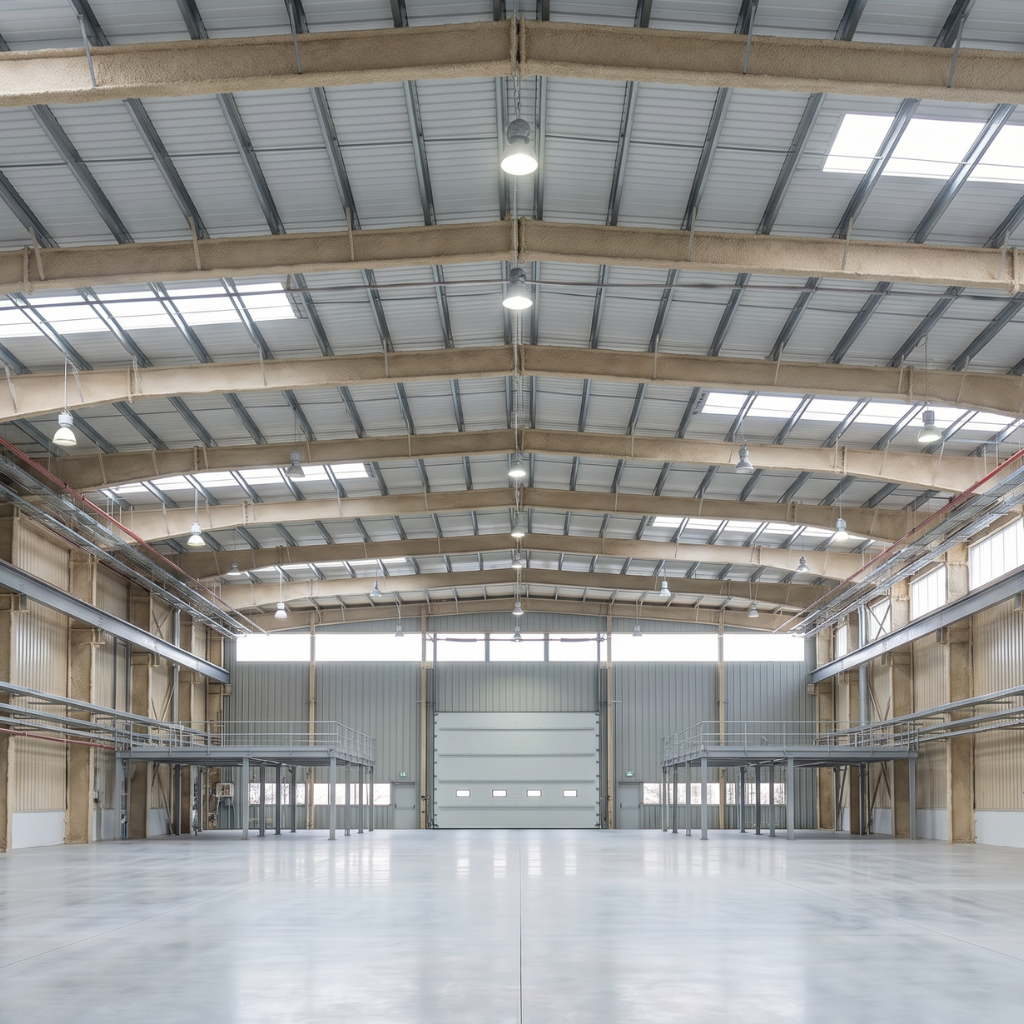
On a steel-framed distribution warehouse outside Austin, we sprayed the joists and beams to the rated thickness early, then the building filled up with trades. When we came back for patch-back, the lower flanges of several beams and the bottom chords of the bar joists had been scraped clean where the conduit and sprinkler crews had run their hangers. Most spots were well under the hand-patch limit, so we matched the original wet-mix product, cleaned each location to bare steel where the coating was gone, pre-wet the edges, and built the patches back to the design thickness.
The detail that saved us time was sequencing. We did not chase the trades spot by spot. We scheduled our return after the rough MEP was substantially complete but before the ceiling grid went in, which is exactly the window IBC 1705.15 contemplates with its post-trade visual inspection. One coordinated pass, fully documented, and the special inspector walked it clean.
A Second Scenario: Identifying an Unknown Product on a Renovation
On a healthcare renovation in Oklahoma, we were brought in to repair fireproofing damaged during a mechanical upgrade in an existing building. The challenge was not the patching. It was figuring out what was already on the steel. The original submittals were long gone.
We pulled samples, worked with the building’s records, and confirmed the product family before specifying a compatible compound. Skipping that step and patching with whatever was on the truck would have produced a repair that looked correct but carried no valid listing. On an occupied healthcare facility, that is not a risk worth taking. The lesson holds anywhere: when the original product is unknown, identification comes before repair, every time.
Texas, Oklahoma, and Kansas Job-Site Considerations
Regional climate changes how you handle a cementitious patch, especially in summer. Across our service areas in Texas, Oklahoma, Kansas, Nebraska, Minnesota, and Wisconsin, ambient temperatures on a summer job site can run well past 90 degrees, and the steel and surrounding SFRM get bone dry. Under those conditions, the existing material pulls moisture out of a fresh patch faster than it would in the controlled 70-degree conditions a data sheet assumes.
That means pre-wetting matters more here than the baseline manufacturer instruction implies. Manufacturers acknowledge the principle directly. Carboline’s Pyrocrete 241 data sheet, for example, advises that in low humidity, high temperature, direct sun, or wind, the surface should be kept damp to slow rapid water loss. In practice on a Texas summer floor, I wet the substrate and the surrounding edges more aggressively and keep an eye on how fast the patch is setting up. A patch that dries too fast can crack or fail to bond.
The other regional reality is documentation. Hold and record your application temperatures. When the special inspector asks whether conditions met the product minimums during the repair, a temperature log answers the question before it becomes an argument. This applies the same way whether the building minimum is the common 40 degrees for SFRM or the higher figure a thin-film intumescent product typically requires, which is often around 50 degrees but always verified against that product’s data sheet.
Related Reading
- Getting the substrate right is the prerequisite to any durable repair: see why surface preparation determines fireproofing performance.
- For how the sign-off works end to end, read our complete guide to the fireproofing inspection process.
- For the full application picture behind these repairs, see our complete guide to spray-applied fireproofing.
Frequently Asked Questions
Q: Who is responsible for repairing fireproofing damaged by other trades? A: On most commercial jobs, the project specification assigns the fireproofing contractor the duty to inspect and repair damaged SFRM. That same contractor should document damage caused by other trades, with photos and drawing markups, so back-charges can move through the proper change-order process. Responsibility for the cost and the responsibility for the physical repair are two different questions, and the specs usually separate them.
Q: Can you patch spray-applied fireproofing by hand? A: Yes, for small areas. Hand patching is allowed up to the limit in the product’s UL listing, commonly 144 square inches for wet-mix products and up to 432 square inches for some dry-mix products with a listed compound. The compound has to be UL-classified for the specific material on your steel.
Q: How large an area can be hand-patched? A: It depends on the product. The widely known ceiling is 144 square inches, which comes from the UL Fire Resistance Directory and applies to most wet-mix products. Some dry-mix systems allow up to 432 square inches with a listed patching compound. Always check the listing for your specific product.
Q: What happens if fireproofing is damaged during construction and not repaired? A: The assembly loses the fire-resistance rating it was designed to provide, and the work will not pass special inspection. IBC (2021) Section 1705.15 requires a visual inspection after MEP rough-in and before concealment, so unrepaired damage gets caught, often after ceilings or walls are already up, which means tearing them back open.
Q: Does damaged fireproofing need to be repaired before inspection? A: Yes. The post-trade visual inspection under IBC 1705.15 exists specifically to confirm that damage from MEP and ceiling work has been repaired before the material is hidden. Schedule your patch-back to finish before that inspection, not after.
Q: Can you use any patching compound on any SFRM? A: No. Each patching compound is UL-classified for specific products. MONOKOTE Patching Compound, for instance, is listed only for MONOKOTE MK-5, MK-6, and MK-10. Using a compound outside its listing voids the UL design and the fire rating. Match the compound to the original material every time.
Q: Are there patch products that cover larger areas than 144 square inches? A: Yes. Some third-party hand-applied patch products are UL-classified for areas up to 432 square inches on medium and low density SFRMs. Before specifying one, verify compatibility against the current UL listing and the in-place SFRM manufacturer’s repair guidance. These products are generally not for use with intumescent coatings or exterior applications, so confirm the exclusions.
Q: How is a repaired patch tested? A: The same way the original work is. Thickness and density are checked per ASTM E605, and bond strength per ASTM E736, against the design values for that assembly. AWCI Technical Manual 12-A is a widely used industry guide to those field test methods, though the code itself names the ASTM standards.
Key Takeaways
Damage is unavoidable, repair is not optional. MEP trades will knock SFRM loose on every steel-framed job, and IBC (2021) Section 704.13 plus IBC (2021) Section 1705.15 require that the damage be repaired and inspected before concealment. IFC Section 701.6 carries the maintenance duty for finished buildings.
Match the method to the damage size. Small areas can be hand-patched, commonly up to 144 square inches for wet-mix products and up to 432 square inches for some dry-mix products. Anything larger needs a respray with the original material.
Identify the product before you patch. Patching compounds are UL-classified for specific SFRM products. Using the wrong one voids the listing and the rating, so confirm the original material from the submittal or the manufacturer first.
Clean the substrate to code. Under IBC 704.13.3.1, exposed steel must be free of contamination and of any primer or coating not fire-tested by a recognized agency before new SFRM goes on.
Inspect to the full standard. Under IBC 1705.15, the special inspector verifies substrate, thickness, density, bond strength, and finished condition, with bond strength meeting the 150 pounds per square foot minimum for most low-rise work under IBC (2021) Section 1705.15.6. Have your documentation assembled in advance.
Account for regional climate. On hot, dry Texas, Oklahoma, and Kansas summer sites, pre-wet substrates and surrounding edges more aggressively, and log your application temperatures for the inspector.
If your next commercial project needs fireproofing repair done right, by a crew that understands the code requirements and the manufacturer listings inside out, let’s talk. We coordinate patch-back around your MEP schedule and document the work so your special inspection walkthrough goes clean the first time. Contact Bahl Fireproofing throughout Texas, Oklahoma, Kansas, Nebraska, Minnesota, and Wisconsin at 512-387-2111 or ross@bahlfireproofing.com to schedule a consultation or request a bid.
This article provides general educational information about fireproofing and passive fire protection. It is not a substitute for project-specific guidance from a licensed architect or engineer, the manufacturer’s published installation instructions, or the requirements of your local authority having jurisdiction. Code references reflect the 2021 International Building Code and International Fire Code; verify the edition and amendments adopted in your jurisdiction. Product specifications and UL listings change over time and should be confirmed against current manufacturer documentation before use.