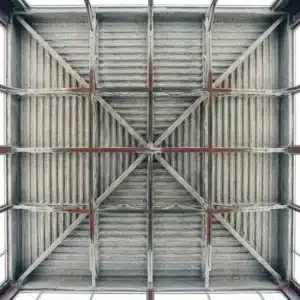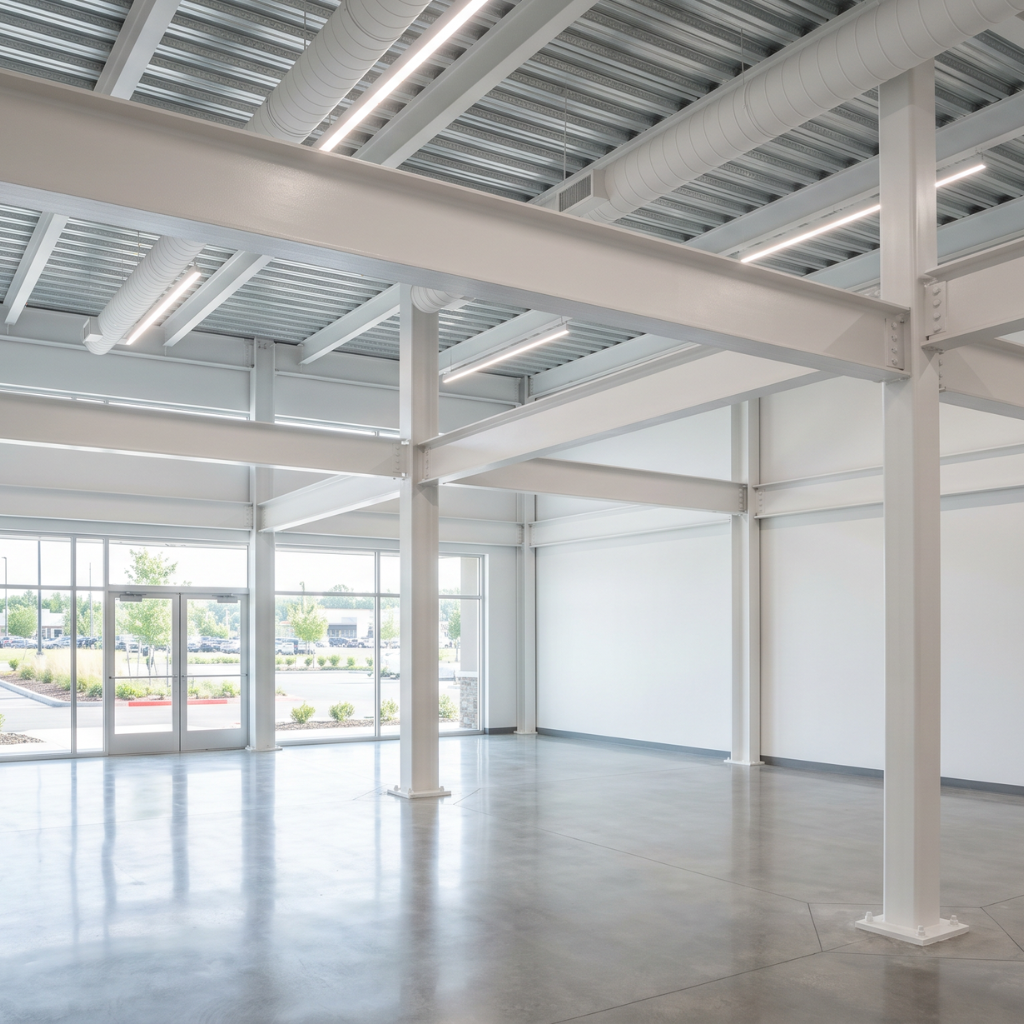
Retail design has shifted hard toward open-ceiling, exposed-structure aesthetics over the last decade. Big-box anchors, grocery, home improvement, lifestyle centers, and flagship brand stores all leave the structural steel visible because it reads modern, costs less than dropped-ceiling alternatives, and gives the architect more vertical volume to work with. The trade-off is that visible steel still has to meet IBC fire-resistance requirements. Cementitious spray-applied fire-resistive material does that fine in concealed locations, but its rough textured finish does not belong over a sales floor. Intumescent fireproofing is the answer that protects the steel and lets the architect keep the design.
TLDR: Intumescent fireproofing for retail buildings is thin-film passive fire protection applied like paint to exposed structural steel, dried smooth and topcoated to match brand colors. Retail buildings classify as IBC Group M (Mercantile) under IBC (2021) Section 309.1, which is excluded from the IBC (2021) Table 601 footnote b 20-foot roof exemption that applies to most other commercial occupancies. That means even tall single-story retail with high ceilings still requires fire protection on roof structural members per the construction type. Water-based intumescent is the standard for occupied retail because of low VOC and overnight scheduling. Installation must follow a UL-listed assembly specified by a licensed architect or engineer, with special inspection per AWCI Technical Manual 12-B.
Code note: unless otherwise stated, code references on this page are to the 2021 International Building Code. Code adoption is state and local. Across the states we serve, adopted IBC editions currently range from the 2012 edition to the 2024 edition, some states have no statewide commercial building code, and several enforce NFPA 1 or NFPA 101 rather than the International Fire Code. Minnesota and Wisconsin publish state-amended code books whose numbering and requirements differ from the model code. This is general technical information, not a code determination for your project. Confirm the adopted edition and any local amendments with your authority having jurisdiction.
Why exposed structural steel is common in retail buildings
Three things drive the visible-steel trend in retail. Volume and natural light: open-ceiling design adds 4 to 8 feet of effective ceiling height that drop ceilings would consume. Cost: leaving the structure exposed eliminates an entire ceiling system, which adds up across hundreds of thousands of square feet for a chain rollout. Brand: modern retail design language treats exposed steel as an architectural feature, not a value-engineered compromise.
What this means for fireproofing specification is straightforward. The construction type and occupancy classification still drive the fire-resistance rating required by IBC (2021) Table 601. The steel that delivers that rating is now visible from the sales floor, which rules out cementitious SFRM in nearly every visible application. Intumescent coating, applied as a thin paint-like film and topcoated to match brand standards, becomes the default. For the broader code framework, see our commercial fireproofing code compliance guide.
How intumescent fireproofing works
Intumescent coatings look like paint until they encounter fire. At approximately 200 to 250°C (around 390 to 480°F), a chemical reaction kicks off and the coating expands dramatically, forming a thick carbonaceous char layer approximately 15 to 50 times the original dry film thickness. That char insulates the structural steel from heat transfer, slowing the rate at which the steel reaches its critical failure temperature. Structural steel begins losing about half its load-bearing capacity around 500°C (roughly 930°F), and unprotected steel can reach that temperature within about 15 minutes in a standard cellulosic fire. Intumescent extends the time to critical temperature, typically delivering 30 to 120 minutes of fire resistance depending on dry film thickness and steel section, with some systems engineered to higher ratings.
The retail-specific advantage versus cementitious SFRM is the finish. Intumescent dries smooth, accepts topcoats, and reads as a finished architectural surface rather than a code-required afterthought.
What the IBC requires for retail buildings
Retail buildings are classified as Group M (Mercantile) under IBC (2021) Section 309.1. The classification covers department stores, drug stores, markets, retail and wholesale stores, sales rooms, and motor fuel-dispensing facilities. Group M carries elevated life-safety risk in the IBC’s framework because of variable occupant loads during sales events, public unfamiliar with egress paths, and high combustible fuel loads from merchandise.
IBC (2021) Table 601 sets hourly ratings for the structural frame, bearing walls, floors, and roofs by construction type. The most common construction types in regional retail work are:
| Construction Type | Primary Structural Frame | Floor Construction | Roof Construction | Typical Retail Use |
|---|---|---|---|---|
| Type I-A | 3 hr | 2 hr | 1.5 hr | Multi-story department stores, mixed-use towers |
| Type I-B | 2 hr | 2 hr | 1 hr | Mid-rise retail podium |
| Type II-A | 1 hr | 1 hr | 1 hr | Most anchor stores and newer strip mall construction |
| Type II-B | 0 hr | 0 hr | 0 hr | Common when fully sprinklered |
Simplified excerpt showing construction types most common in retail work. The full IBC (2021) Table 601 also includes Type I-B, exterior and interior bearing walls, and other elements. Consult the applicable edition adopted in your jurisdiction.
The Group M footnote that everyone gets wrong. The International Code Council’s technical guidance on fire protection of structural columns walks through one of the most consequential nuances in IBC (2021) Table 601 for retail. Footnote b normally allows fire protection of structural members in roof construction to be omitted when every part of the roof is 20 feet or more above the floor below. That sounds like an obvious cost-saver for big-box and anchor retail with tall ceilings. The exemption explicitly does not apply to Group M occupancies, along with Group F-1 (Factory Industrial Moderate-Hazard), H (Hazardous), and S-1 (Moderate-Hazard Storage). The 2021 IBC clarified the language to confirm that primary structural frame members supporting the roof are also covered, removing any ambiguity about whether main columns are exempt.
Practical implication: a 30,000-square-foot grocery store with a roof deck 28 feet above the sales floor in Type II-A construction still requires the 1-hour structural frame rating on every steel truss, beam, and column supporting that roof. Intumescent applied to a UL-listed 1-hour assembly is the standard solution. The 20-foot shortcut that lets an office building leave roof steel unprotected does not work for Group M retail.
Sprinkler thresholds. IBC (2021) Section 903.2.7 requires automatic sprinklers in Group M when the fire area exceeds 12,000 square feet, when combined Group M area on all floors exceeds 24,000 square feet, when the occupancy is more than 3 stories above grade, or in upholstered furniture or mattress display areas over 5,000 square feet. Most regional retail above a small neighborhood storefront ends up fully sprinklered. Sprinkler protection does not eliminate the structural fire protection requirement created by the footnote b exclusion. Both compliance paths apply.
A licensed architect or engineer must specify the rated assembly. Intumescent coating on its own does not carry an ASTM E119 or UL 263 fire-resistance rating. Those ratings apply to complete tested assemblies, with the rating earned through furnace testing under a standard time-temperature curve. The architect specifies the UL-listed assembly. We install per their design.
Is intumescent fireproofing required in retail buildings?
Whether intumescent fireproofing is required in a retail building depends on the construction type assigned under IBC (2021) Table 601 and the Group M occupancy classification. The critical nuance is that Group M is excluded from the IBC (2021) Table 601 footnote b exemption that would otherwise allow roof structural members to go unprotected when 20 feet or more above the floor. A licensed architect or engineer must specify the required fire-resistance rating and the UL-listed assembly that achieves it.
The aesthetic case: from code requirement to brand asset
The retail design conversation about intumescent has shifted in the last few years. It used to be framed as a necessary cost premium over cementitious SFRM for the rare project where steel had to remain visible. Now, with topcoat systems that match Pantone and RAL standards across hundreds of shades, intumescent has become a brand-finish opportunity rather than a compliance burden.
The system is three coats: a primer over prepared steel, the intumescent layer at the specified dry film thickness, and a compatible topcoat. Major manufacturers offer water-based topcoats available in several hundred RAL shades, including the option for custom RAL color matching for chains with proprietary brand standards. Critically, the topcoat must be approved within the specific UL-listed system. An incompatible topcoat can affect the intumescent foaming reaction and void the listing.
AESS categories matter. AISC defines four Architecturally Exposed Structural Steel categories under AISC 303-22 Section 10, plus AESS C for custom showcase work. Mapping them to retail applications:
| AESS Category | Description | Typical Retail Use |
|---|---|---|
| AESS 1 | Basic exposed, viewed at 20+ feet | Warehouse retail, distribution-style discount stores |
| AESS 2 | Standard exposed, 6 to 20 foot viewing distance | Grocery anchors, home improvement stores, strip mall anchor tenants |
| AESS 3 | Feature elements, 0 to 6 foot viewing or touchable | Lifestyle retail, mixed-use, boutique chains, food halls |
| AESS 4 / C | Showcase quality | Flagship stores, luxury retail |
A practical reality the architect needs to know early: intumescent coatings have a natural orange-peel surface texture that increases with thickness. AISC’s own guidance acknowledges this. For AESS 1 and AESS 2, the texture is acceptable and reads as intentional finish. For AESS 3 and AESS 4 in flagship or luxury retail, the finish quality has to be coordinated up front, with mock-ups, surface preparation upgrades, and topcoat selection driving the result. Watch for our forthcoming detailed guide on intumescent coating for architecturally exposed structural steel.
DFT, section factors, and why one thickness does not fit all
Required dry film thickness (DFT) is not a single number. It varies by required fire rating in hours, the steel section’s section factor (W/D ratio), member orientation (beam vs. column vs. HSS), and the specific product’s UL listing. Heavier sections heat up more slowly and need less coating; lighter sections heat up faster and need more.
Structure Magazine’s analysis of passive fire protection coating thickness illustrates the range. A W10x39 beam used as a beam (one face in concrete contact) requires approximately 161 mils DFT for a 2-hour rating. The same W10x39 used as a column requires 198 mils for the same rating, about 23 percent more, because all four faces are exposed to fire. An HSS 10x10x¼ column requires 309 mils for the same 2-hour rating. The numbers move significantly with the geometry, and UL prohibits using extrapolated thicknesses outside the published UL design.
For retail, this matters because the architect’s structural framing varies tenant by tenant. The big-box anchor’s roof trusses, the cafe’s lighter-gauge tube columns, and the loading dock canopy beams each carry different DFT requirements even at the same fire rating. A licensed architect or engineer specifies the UL-listed assembly. We apply per the design and per the manufacturer’s tolerances. Watch for our forthcoming detailed walk-through of dry film thickness requirements for your required fire rating.
Special inspection under IBC Chapter 17
The IBC requires special inspection of intumescent fire-resistive materials applied to structural elements, performed in accordance with AWCI Technical Manual 12-B. The applicable IBC section is Section 1705.16 in the 2018, 2021, and 2024 IBC editions. (Note: Section 1705.15 covers spray-applied fire-resistive materials, a separate cementitious material category, not intumescent coatings.)
The special inspector verifies five things: substrate condition and surface preparation before application; dry film thickness measured per ASTM D7091 with magnetic and eddy-current gauges; density and visual quality of the cured film; adhesion per ASTM D4541 or ASTM D3359; and final finish condition. The inspector is engaged by the building owner or general contractor, not the fireproofing contractor. Readings outside the manufacturer’s tolerance for the specified UL design trigger remediation. The way to avoid that on a retail project is correct application the first time.
Scheduling intumescent work around retail operations
Retail does not stop. Most stores close for a few hours overnight, reopen the next morning, and that is the working window we have. The two viable approaches are overnight phased work and full-store closure during planned remodels.
Water-based intumescent for occupied retail. Water-based products are the practical default for occupied stores. VOC content is typically well under 100 g/L per current product technical data sheets, and odor is minimal compared to solvent-based formulations. That allows phased overnight work without forcing the store closed during business hours. Recoat intervals between coats are typically 24 hours, with a maximum of two coats per 24-hour period by airless spray, so multi-coat systems for higher fire ratings stretch over several nights. The work has to be sequenced around store operations, fixture protection, and ventilation.
Shop-applied intumescent for new retail construction. For new build anchor tenants, big-box stores, and grocery, shop-applied intumescent has become increasingly common. The structural steel is coated at the fabrication facility before shipping to the site, which delivers tighter quality control on dry film thickness, more consistent finish quality for AESS work, and faster on-site erection because the coating is already in place. Epoxy-based intumescent formulations are particularly suited to shop application because they tolerate the rigors of transport and erection better than water-based products. For renovation work on existing retail, field-applied water-based intumescent is typically the only practical option. To compare options across the broader product family, see our Types of Intumescent Fireproofing cluster article.
Common retail applications across Texas, Oklahoma, Kansas, Nebraska, Minnesota, and Wisconsin
Five scenarios cover most of the intumescent retail work I see in our region.
Grocery anchor and home improvement stores. Large-span steel roof trusses left visible above the sales floor. Type II-A construction with a 1-hour rating. Footnote b exclusion applies, so the roof steel is fireproofed regardless of ceiling height. AESS 2 finish quality is the typical specification.
Strip mall anchor tenants and big-box. Exposed steel columns on the sales floor, sometimes painted to match brand colors. AESS 1 to AESS 2 depending on the chain’s design standards.
Lifestyle retail and mixed-use. Feature structural elements integrated into the architectural design. AESS 2 to AESS 3, with topcoat color matching to brand standards. Often coordinated with the food and beverage tenants on shared structural systems.
Flagship and luxury retail. Showcase-quality steel that the brand wants as a focal element. AESS 3 or AESS 4. Mock-ups, finish samples, and tight coordination with the architect from design development forward.
Renovation and chain rollouts. Existing retail buildings adding intumescent to steel that was previously unprotected, or recoating where existing intumescent has aged out. For chain rollouts across multiple locations, consistency across stores is the operational priority, which makes upfront product and finish standardization critical.
Frequently asked questions
What IBC occupancy group is a retail building? Retail buildings, including department stores, drug stores, markets, and wholesale or retail stores, are classified as Mercantile Group M under IBC (2021) Section 309.1. Group M triggers specific fire protection requirements, including automatic sprinklers when fire areas exceed 12,000 square feet under IBC (2021) Section 903.2.7. Fire-resistance ratings for the structural frame depend on the construction type assigned under IBC (2021) Table 601.
Is intumescent fireproofing required for exposed steel in retail stores? It depends on the construction type and the Group M occupancy classification. The critical nuance is that Group M is excluded from the IBC (2021) Table 601 footnote b exemption that lets other occupancies skip fire protection on roof steel located 20 feet or more above the floor. In Type II-A retail (1-hour rating required), intumescent applied to a UL-listed assembly is a code-compliant method. A licensed architect or engineer must specify the assembly.
Can intumescent coating be color-matched to a brand’s interior palette? Yes. Intumescent systems are three-coat assemblies (primer, intumescent, topcoat), and several major manufacturers offer water-based topcoats in hundreds of RAL shades, with custom RAL matching available. The topcoat must be approved within the specific UL-listed system. An incompatible topcoat can affect the intumescent foaming reaction and void the listing, so brand color matching has to happen within the boundaries of the UL design.
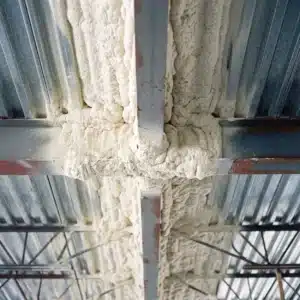
What is the difference between intumescent and cementitious (spray-on) fireproofing for retail? Cementitious SFRM is a thick, sprayed mineral-based coating with a rough textured finish, typically used on concealed steel because of cost. Intumescent is a thin paint-like coating that dries smooth and accepts topcoats, used on visible steel for aesthetic reasons. SFRM is dramatically cheaper per square foot. Intumescent is the right call when the steel will be seen.
Does intumescent coating provide fire-resistance ratings on its own? No. ASTM E119 and UL 263 fire-resistance ratings apply to complete tested assemblies, not to intumescent coating alone. The rating comes from the UL-listed assembly that includes the steel section, the intumescent product, the specified dry film thickness, and any required primer or topcoat. A licensed architect or engineer specifies the assembly.
How long does intumescent coating last in a retail building? Properly applied intumescent coatings in controlled interior environments have substantial service lives when maintained per the manufacturer’s recommendations and protected with a compatible topcoat. Periodic visual inspection, AHJ-required reinspection cycles, and prompt repair of mechanical damage from forklifts, fixtures, or facility maintenance extend usable life. Research has shown that older intumescent coatings on existing steel can degrade over decades, which means renovation projects need to evaluate the existing coating before applying new systems.
Can intumescent fireproofing be applied in an occupied retail store? Yes, with overnight phased work and water-based product selection. Water-based intumescent has low VOC and minimal odor, allowing the store to reopen the next morning after proper ventilation. Multi-coat systems for higher fire ratings stretch across multiple overnight shifts because of recoat intervals. Coordination with store operations, loss prevention, and merchandise protection is essential.
Who performs the special inspection for intumescent coatings on a retail project? A qualified third-party special inspector engaged by the building owner or GC performs the inspection, working from IBC Section 1705.16 (the IFRM special inspection section in the 2018, 2021, and 2024 IBC editions) and AWCI Technical Manual 12-B. The inspector verifies substrate, DFT, density, adhesion, and finish condition. The contractor cannot self-inspect.
Key takeaways
Code framework
- Retail buildings are IBC Group M per IBC (2021) Section 309.1.
- IBC (2021) Table 601 footnote b excludes Group M from the 20-foot roof exemption: roof structural members still require fire protection in retail regardless of ceiling height.
- Sprinklers required when fire areas exceed 12,000 square feet (IBC (2021) Section 903.2.7), but sprinkler protection does not replace structural fire protection.
Product selection
- Water-based intumescent is the standard for occupied retail because of low VOC and overnight scheduling compatibility.
- Solvent-based and epoxy intumescent formulations apply to semi-exposed and exterior conditions and to shop-applied new construction.
- Topcoat must be approved within the UL-listed system. Brand color matching is achievable within those constraints.
Aesthetics and AESS
- AESS 1 and AESS 2 cover most retail anchor and grocery applications. AESS 3 and AESS 4 apply to lifestyle retail and flagship work.
- Intumescent has a natural orange-peel texture that increases with DFT. Specify finish expectations early for AESS 3 and AESS 4.
Inspection and liability
- IBC Section 1705.16 requires special inspection of IFRM per AWCI Technical Manual 12-B in the 2018, 2021, and 2024 IBC editions.
- Intumescent does not carry an ASTM E119 or UL 263 rating on its own. Fire-resistance ratings are assembly properties.
- A licensed architect or engineer must specify the UL-listed assembly.
Related reading
- Intumescent vs. Cementitious Fireproofing
- Types of Intumescent Fireproofing: Which Coating Fits Your Project
- Intumescent Fireproofing for Existing Buildings: Retrofit Guide
Let’s scope your retail project
If your design team, GC, or facilities group is evaluating intumescent fireproofing on a Texas, Kansas, or Oklahoma retail project, single store, anchor tenant, lifestyle center, or chain rollout, I would be glad to walk the buildings and review the spec. Bahl Fireproofing handles intumescent fireproofing services for commercial and institutional buildings regularly, with overnight scheduling that fits around store operations and direct experience on AESS work. Reach me at 512-387-2111 or ross@bahlfireproofing.com, or use the Contact Bahl Fireproofing form to start the conversation.
Disclaimer: This article is for general educational purposes and does not constitute engineering, architectural, or legal advice. Building code requirements vary by jurisdiction and adopted edition. Project specifications must be developed and stamped by a licensed architect or engineer familiar with the specific building, occupancy, and local amendments. Performance figures and product VOC ranges cited reflect product categories generally and do not apply to any specific product or project without verification against the current technical data sheet. Bahl Fireproofing makes no representation that the figures or code summaries here apply to any specific project.
Disclaimer: This article provides general educational information about fireproofing and insulation systems and does not constitute professional engineering advice or product specification. System selection must be based on project-specific fire ratings, thermal requirements, acoustic performance needs, environmental conditions, substrate requirements, and budget constraints. Code requirements vary by jurisdiction and project type. Always consult with a licensed architect or engineer and verify UL or FM assembly listings before finalizing specifications.