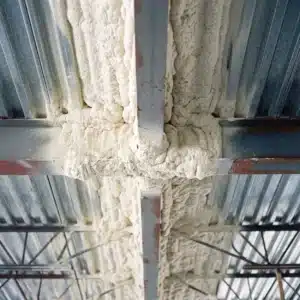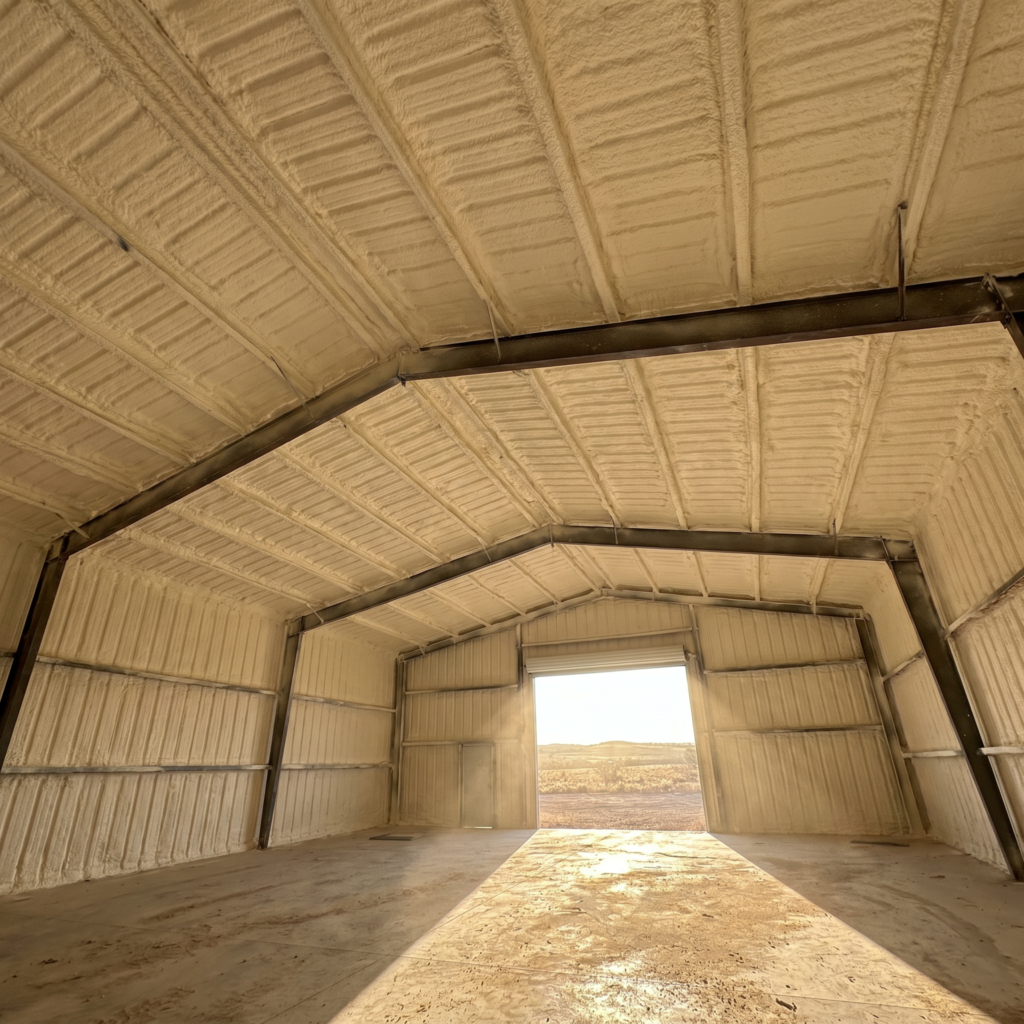
Metal buildings are everywhere in Texas, and they share a problem that standard fiberglass insulation does not fully solve: condensation on cold steel and heat pouring straight through the framing. This guide explains why spray foam, especially closed-cell, is the insulation that addresses the metal-building envelope directly, and what to weigh before specifying it.
TLDR: In a Texas metal building, the real enemy is not just heat, it is condensation on cold steel panels and purlins, plus heat bridging through the steel framing. Spray foam for metal buildings, specifically closed-cell, tackles both at once: sprayed directly to the metal, it keeps the surface above the dew point, seals air, acts as a vapor retarder, and breaks the thermal bridge, which the traditional fiberglass-blanket-over-purlins system does not. The trade-offs are higher material cost and the code-required thermal barrier in occupied spaces.
Picture a metal building that rains on a humid morning, water dripping off the underside of the roof panels and rusting the purlins it lands on. The building is insulated, but the fiberglass blanket’s facing broke at every purlin, so warm interior air reached cold steel and condensed. Or picture a metal shop that is insulated and still cooks in July, because the heat pours through the steel framing that the batts between the members never covered. Both are envelope problems, and both are problems that fiberglass laid between purlins does not fully solve. That is the gap spray foam fills.
Does Spray Foam Stop Condensation in Metal Buildings?
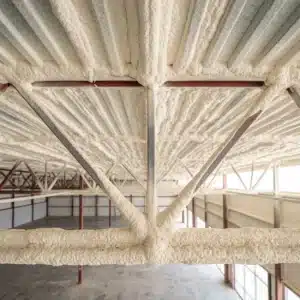
Yes. Closed-cell spray foam sprayed directly onto the metal keeps the steel surface above the dew point and acts as an air barrier and vapor retarder, so warm, humid interior air never reaches a cold surface to condense on. That is the core reason it is specified for metal buildings: it eliminates the condensation plane rather than just adding R-value on top of the problem.
The distinction matters because condensation, not heat, is what quietly destroys a metal building. Rust on purlins, panels, and roof sheets shortens the life of the structure, and it starts with moisture that insulation alone does not stop. Solving it is part of how we approach commercial spray foam insulation services on steel structures.
Why Metal Buildings Have a Condensation Problem
Metal panels and steel purlins and girts are excellent heat conductors and, on a cool night or a humid morning, cold surfaces. When warm, moisture-laden interior air contacts them, it reaches the dew point and condenses, then drips and rusts the steel. In uninsulated or poorly sealed metal buildings, morning condensation is routine, and over years it does real structural damage.
The traditional fix is faced fiberglass blanket draped over the purlins and girts as the panels are installed, with the facing acting as a vapor retarder. The weakness is at the steel. If the facing is not sealed continuously, it breaks at each purlin, and warm air works through that gap to the cold panel above. Add the sagging, compression, and punctures that fiberglass blanket picks up over time, and the vapor retarder that was supposed to be continuous is not, so the condensation returns. A continuous air seal is what actually stops it, which is exactly what spray foam delivers as an air and moisture control layer.
Over the past 20 years insulating metal buildings across Texas, Kansas, and Oklahoma, the call that comes back most is not about a cold building, it is about a wet one: drips, rust streaks, and water stains on the underside of a roof that was supposedly insulated. Almost every time, the foam or the facing did not maintain a continuous seal against the steel, and warm humid air found the cold panel. Insulating a metal building is not only about R-value. It is about never letting interior air touch a cold surface, and that is a sealing problem first.
How Closed-Cell Spray Foam Solves It
Closed-cell spray foam applied to the metal does three jobs at once. It warms the interior surface so the steel stays above the dew point in normal operation, it air-seals the assembly, and at sufficient thickness it performs as a Class II vapor retarder. That combination is why it is the foam recommended for direct application to metal panels.
Foam type matters here more than on most assemblies. Open-cell foam air-seals well but stays vapor-permeable, so on a metal building it can let moisture migrate to the cold steel unless a separate vapor retarder is added. Closed-cell is the denser, vapor-resistant option, and it also carries the higher R-value: closed-cell runs about R-6 to R-7 per inch versus about R-3.5 to R-3.8 per inch for open-cell, so it reaches a target R-value in fewer inches. For a metal building where condensation control is the point, closed-cell is usually the right call.
Breaking the Thermal Bridge at Steel Framing
Steel framing conducts heat far more readily than wood, by common estimates on the order of 300 to 400 times, so every purlin and girt in a metal building is a thermal bridge. Insulation installed only between the framing members does nothing for those bridges, which is why a metal building can be insulated and still lose or gain heat rapidly through the steel. Closed-cell foam applied continuously over the framing surface covers and breaks that bridge in a way batts between members cannot.
Fiberglass blanket makes this worse at exactly the wrong spot. Where the blanket is compressed between the purlin and the panel, it loses much of its R-value, so the thermal break is thinnest right at the steel member that needs it most. A continuous layer of foam over the framing keeps the insulation value uniform across the framing and the bays alike.
Structural and Air-Sealing Benefits
Beyond moisture and heat, closed-cell foam adds rigidity to the assembly. Studies have shown that closed-cell spray foam applied to wall sheathing can increase racking strength substantially, with figures cited up to roughly 300 percent, which is one reason it is popular in metal building and pole barn construction. On a metal building that flexes in wind, that added stiffness is a genuine secondary benefit.
The air seal is the other quiet advantage. Metal buildings leak air at panel laps, fastener penetrations, and the base, and closed-cell foam seals those paths as it is applied. Less air leakage means less of the humid outside air that drives the condensation problem in the first place, on top of the energy it saves.
The Code-Required Thermal Barrier Still Applies
One point that gets overlooked on metal buildings: in occupied spaces, the foam still needs a thermal barrier. Spray foam is a foam plastic, and IBC Section 2603.4 requires it to be separated from the building interior by an approved thermal barrier, typically half-inch gypsum board or a tested coating, in most occupied spaces. There are narrow exceptions for limited-access areas and certain assemblies, but an occupied metal shop, office, or warehouse generally needs the barrier. That covering is a separate scope, so it has to be planned and budgeted, not discovered at inspection.
Spray Foam for Metal Buildings Across Texas
Texas metal buildings span the humid Gulf Coast and the hot, dry west, and the climate sets the priority. On the Gulf Coast, where humidity is high for much of the year, condensation control is the headline reason to use closed-cell foam, because cold steel and humid air are a constant pairing. In the hot, dry parts of the state, heat and thermal bridging through the steel move to the front, though the air seal still matters. Statewide, metal buildings carry agricultural, industrial, commercial, and worship uses, and the right foam, thickness, and barrier depend on how the building is used and where it sits, which is how we scope spray foam throughout our Texas, Kansas, and Oklahoma service area.
Metal Building Walls and When NFPA 285 Comes Into It
A pre-engineered metal building is normally Type II construction, a noncombustible steel frame with steel panel walls, and that is one of the types this provision names. IBC (2021) Section 2603.5 applies to exterior walls containing foam plastic insulation in buildings of Type I, II, III or IV construction, of any height, and also to multi-story cold storage buildings required to be of noncombustible construction. Spray foam on the inside face of a metal panel wall is foam plastic insulation in an exterior wall, so IBC (2021) Section 2603.5.5 applies, requiring that the exterior wall assembly be tested in accordance with and comply with the acceptance criteria of NFPA 285.
Code note: unless otherwise stated, code references on this page are to the 2021 International Building Code. Code adoption is state and local. Across the states we serve, adopted IBC editions currently range from the 2012 edition to the 2024 edition, some states have no statewide commercial building code, and several enforce NFPA 1 or NFPA 101 rather than the International Fire Code. Minnesota and Wisconsin publish state-amended code books whose numbering and requirements differ from the model code. This is general technical information, not a code determination for your project. Confirm the adopted edition and any local amendments with your authority having jurisdiction.
The height language deserves a pause, because metal buildings are usually short. No height threshold exists in 2603.5. A 20-foot eave shop and a four-story building of the same construction type are treated identically.
The Panel and the Foam Are Tested Together
NFPA 285 is the Standard Fire Test Method for Evaluation of Fire Propagation Characteristics of Exterior Wall Assemblies Containing Combustible Components, current edition 2025. It qualifies the complete wall, meaning the metal panel, its fasteners and girts, the foam, any barrier layer and the opening details, as one system. This is an assembly test, not a product test, so no spray foam carries NFPA 285 compliance alone, and changing the panel profile, the attachment or the foam thickness can move the wall out of the tested assembly.
On metal building work that substitution tends to happen quietly, because the panel supplier and the foam contractor are procured separately and neither one is holding the assembly listing. Somebody has to own it. In practice that is the architect or engineer who selected the assembly, and the listing belongs in the specification before either package is awarded.
What Else Chapter 26 Asks
IBC (2021) Section 2603.3 requires foam plastic to have a flame spread index of 75 or less and a smoke-developed index of 450 or less. A metal building wall of Type I through IV construction is held instead to IBC (2021) Section 2603.5.4, which is 25 or less flame spread and 450 or less smoke developed, tested at the thickness intended for use up to 4 inches per ASTM E84 or UL 723. The interior thermal barrier in IBC (2021) Section 2603.4 is its own separate requirement: 1/2-inch gypsum wallboard, heavy timber complying with IBC (2021) Section 602.4, or a material meeting the acceptance criteria of both the Temperature Transmission Fire Test and the Integrity Fire Test of NFPA 275.
The Ways Out
- Type V construction. Those exterior walls comply with IBC (2021) Sections 2603.2, 2603.3 and 2603.4 only, and 2603.5 does not reach them. A steel building is rarely Type V, though a wood framed structure on the same property can be.
- Exception 1. One-story buildings complying with IBC (2021) Section 2603.4.1.4. A lot of Texas metal buildings are one story, which makes this the exception most worth reading word for word instead of assuming.
- Exception 2. Foam plastic covered on each face by not less than 1 inch of masonry or concrete, with either no airspace, or a flame spread index of 25 or less and an airspace not more than 1 inch.
Construction type is assigned by the architect or engineer and confirmed by the building official, and code adoption varies from one Texas jurisdiction to the next. Ask before the foam is scheduled.
Frequently Asked Questions
Does spray foam stop condensation in metal buildings? Yes. Closed-cell spray foam sprayed directly to the metal keeps the steel above the dew point and acts as an air barrier and vapor retarder, so warm, humid interior air never reaches a cold surface to condense on. It eliminates the condensation plane rather than just adding insulation over it.
Closed-cell or open-cell spray foam for a metal building? Closed-cell, in most cases. It is the vapor-resistant foam recommended for direct application to metal panels, and it carries a higher R-value per inch. Open-cell air-seals but stays vapor-permeable, so on metal it can allow moisture to reach the cold steel unless a separate vapor retarder is added.
Why do metal buildings get condensation? Because steel panels and framing are strong conductors and become cold surfaces, and when warm, humid interior air contacts them it reaches the dew point and condenses. The condensation then drips and rusts the steel. It is the most commonly overlooked metal-building problem.
Is spray foam better than fiberglass for metal buildings? Spray foam addresses two things the fiberglass-blanket system does not fully solve: a continuous air and vapor seal against the steel, and breaking the thermal bridge through the framing. Fiberglass blanket is cheaper but compresses at the purlins and loses its seal if the facing breaks. The trade-off is foam’s higher material cost.
Does spray foam add strength to a metal building? Closed-cell foam adds rigidity to the assembly. Studies have shown it can increase wall racking strength substantially, with figures cited up to around 300 percent, which is part of why it is favored on metal buildings that flex in wind. It is a secondary benefit, not the main reason to use it.
Does a metal building with spray foam still need a thermal barrier? In occupied spaces, generally yes. Spray foam is a foam plastic that the IBC requires to be covered by a thermal barrier, usually half-inch gypsum or a tested coating, in most occupied areas. Narrow exceptions exist for limited-access spaces and certain assemblies, so confirm against the adopted code.
Can you spray foam an existing metal building? Yes. Closed-cell foam can be applied to the interior metal surfaces of an existing building. Existing insulation usually has to be removed first for proper adhesion and moisture control, so a retrofit includes that step in the scope.
Key Takeaways
- Condensation is the real enemy. Cold steel plus warm, humid interior air produces condensation that rusts purlins and panels, and it is the most overlooked metal-building problem.
- Closed-cell foam solves it at the source. Sprayed to the metal, it keeps the surface above the dew point, air-seals, and acts as a Class II vapor retarder at sufficient thickness.
- Use closed-cell, not open-cell, on metal. Closed-cell is vapor-resistant and higher R-value (about R-6 to R-7 per inch); open-cell stays vapor-permeable and can let moisture reach the steel.
- It breaks the thermal bridge. Steel framing conducts heat far more than wood, and continuous foam over purlins and girts covers the bridges that batts between members leave open.
- There is a structural bonus. Closed-cell foam can increase wall racking strength substantially, a useful secondary benefit on buildings that flex in wind.
- The thermal barrier still applies. In occupied spaces, the foam needs an IBC-required thermal barrier, typically half-inch gypsum or a tested coating, as a separate scope.
- Climate sets the priority in Texas. Gulf Coast humidity makes condensation control the headline; the hot, dry west pushes heat and thermal bridging to the front.
Related Reading
- New to commercial foam? Start with our commercial spray foam insulation guide for the full overview.
- Choosing a foam type? See closed-cell vs open-cell spray foam for how the choice plays out.
- Insulating a plant or facility? Read our guide to spray foam insulation in industrial buildings for the broader facility picture.
If you have a Texas metal building fighting condensation or heat, the work is choosing closed-cell foam at the right thickness, sealing it continuously against the steel, and planning the thermal barrier where the space is occupied. That is how our crew insulates metal buildings throughout Texas, Oklahoma, Kansas, Nebraska, Minnesota, and Wisconsin. Reach me directly at 512-387-2111 or ross@bahlfireproofing.com, or Contact Bahl Fireproofing to scope the right system for your building.
This article provides general educational information about insulating commercial metal buildings with spray foam. It is not engineering or code-compliance advice and does not replace project-specific direction from a licensed architect or engineer. Vapor control, foam type, thickness, and R-value targets depend on the assembly, the building’s use, the climate zone, and the authority having jurisdiction, all of which vary. R-values cited are general per-inch ranges that vary by product and formulation, and structural figures are drawn from published studies and depend on the assembly tested. Always confirm code requirements, vapor strategy, and product suitability with the manufacturer, the building official, and a licensed architect or engineer before specifying or installing any system.