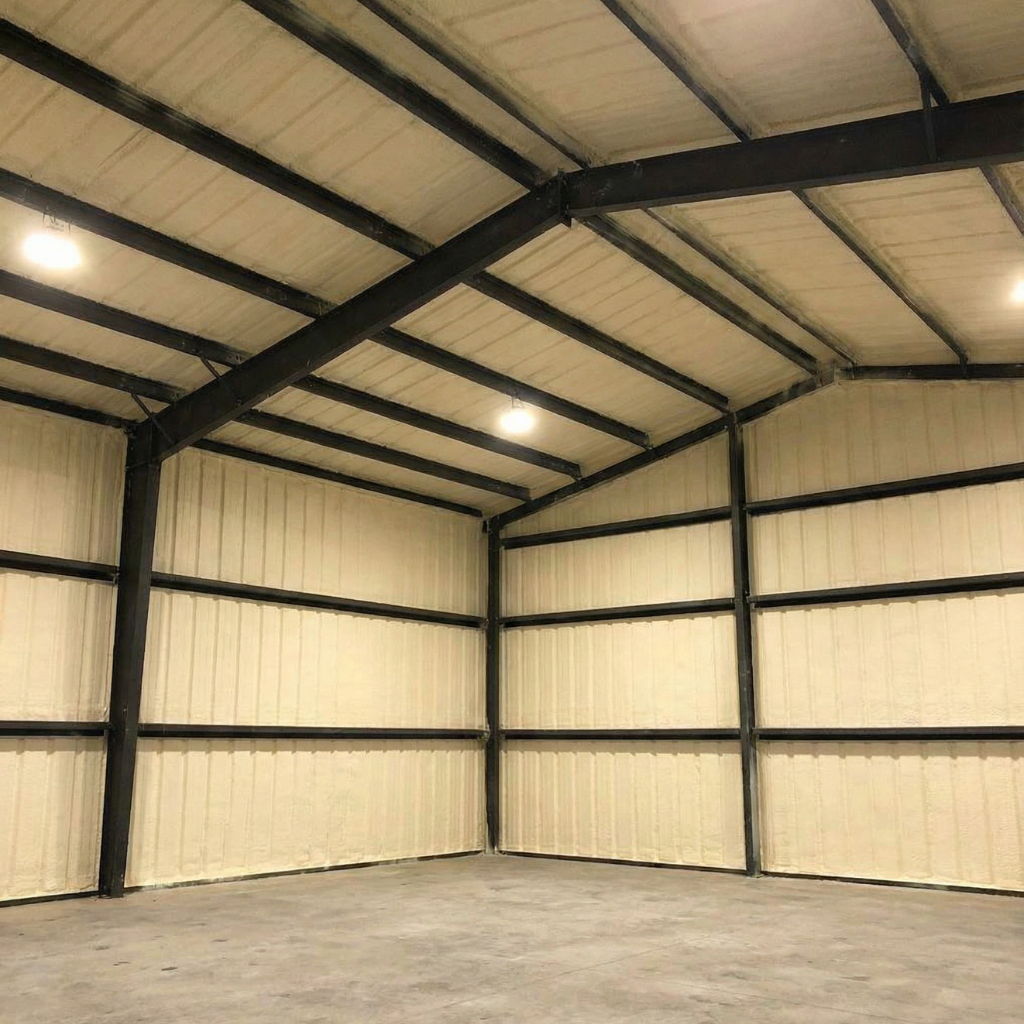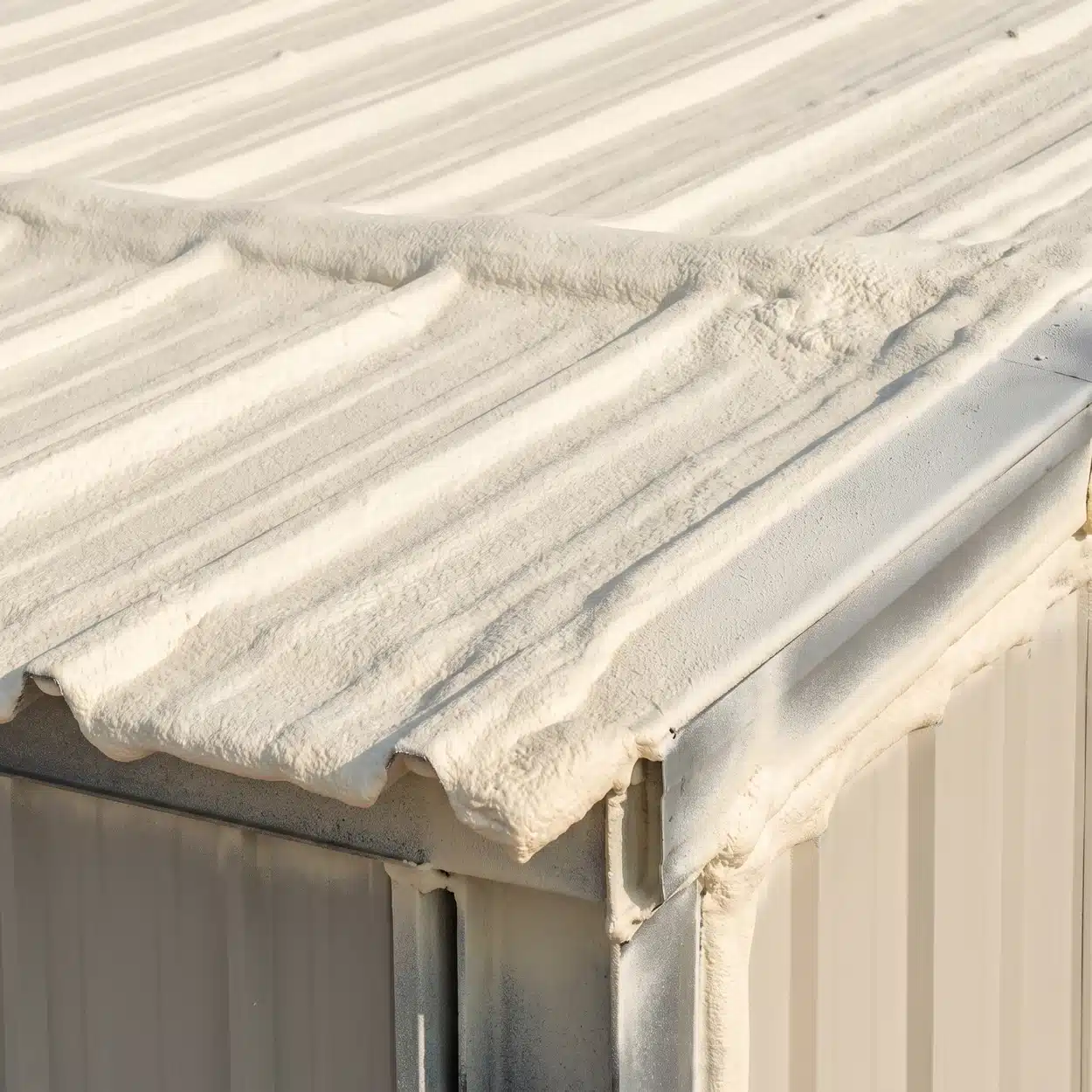
Almost every spec section that calls for a vapor barrier in a metal building is asking for something spray foam does not provide. What the material provides is a vapor retarder, and the class it reaches depends on the specific product and the installed thickness. This article covers what the code defines, what the tested permeance numbers say, and why vapor drive in a Texas metal building runs opposite to the assumption most rules of thumb were built on.
TLDR: Closed-cell spray foam is not a vapor barrier, and it does not become one at any thickness you would actually install. It is a Class II vapor retarder from roughly 1.5 inches up, and three of the four closed-cell products measured below are still Class III at 1 inch. In a cooling-dominated climate, the direction of vapor drive matters more than the class number does.
A contractor sends over a metal building spec that reads “provide 1 inch closed-cell spray polyurethane foam at underside of roof deck as vapor barrier.” Two things there are wrong, and both come back as rust. One inch of most closed-cell products measures above 1.0 perm, which is Class III. And the word barrier invites somebody downstream to add a polyethylene sheet, or to leave the faced fiberglass blanket in place, which is how an assembly ends up with two low-permeance layers and nowhere to dry.
That building passes inspection. It fails four or five years later, when somebody pulls a liner panel to chase a stain and finds corrosion running the purlin flanges. Nobody put that in the spec on purpose. It came out of one imprecise word.
Is Closed-Cell Spray Foam a Vapor Barrier?
No. Closed-cell spray polyurethane foam is a vapor retarder, and on most products it reaches Class II at roughly 1.5 inches. Class I, the 0.1 perm threshold the word barrier implies, sits outside any thickness anyone installs. Huntsman’s own published permeance curve does not reach 0.09 perm until 13 inches.
That 13-inch figure is the number to remember, and it is the manufacturer’s own. Nobody sprays 13 inches on a roof deck. A heavy Texas commercial application is 3 or 4 inches. Huntsman measures 0.42 perm at 3 inches and Gaco 183M measures 0.28 perm at 4 inches, both solidly Class II.
So the honest spec language is “Class II vapor retarder and air barrier,” with product and thickness named. That survives a plan review. Vapor barrier does not, because the code word for 0.1 perm and under is Class I.
Vapor Retarder Classes Come From the Code. “Vapor Barrier” Does Not.
The 2021 International Building Code defines vapor retarder classes in Section 1404.3 and Table 1404.3(1). Class I is 0.1 perm or less, Class II is greater than 0.1 up to 1.0 perm, Class III is greater than 1.0 up to 10 perms. Classification comes from ASTM E96 tested by the water method, Procedure B.
Notice what is not on that list. There is no code class called a vapor barrier. The term is shorthand that usually means Class I, and it gets stuck onto Class II and Class III materials constantly.
One distinction costs more job-site time than any other. A thermal barrier and a vapor barrier are unrelated obligations that share a word. Section 2603.4 of the 2021 IBC requires foam plastic to be separated from the interior by an approved thermal barrier, a fire provision. Section 1404.3 sets vapor retarder classes, a moisture provision. Half-inch gypsum board satisfies the first and does little for the second. I have watched a submittal come back rejected because an applicator answered a vapor retarder RFI with a thermal barrier listing.
The “15-minute thermal barrier” language still quoted on job sites came out of the 2006 through 2012 IBC. The current route is half-inch gypsum wallboard, heavy timber per Section 602.4, or a material meeting NFPA 275. Confirm the adopted edition with the authority having jurisdiction.
What Actually Fails on Metal Buildings, and It Is Almost Never the Foam
I have been applying spray foam across Texas, Kansas, and Oklahoma for more than twenty years, and the metal building assemblies that condense are usually the ones where the foam was specified correctly. What people blame is the product or the thickness. What actually goes wrong is that the assembly ended up with two vapor control layers, or one that stopped short.
The two-layer version shows up on retrofits. The building came with vinyl-faced fiberglass blanket insulation, and that facing is itself a vapor retarder. A crew foams over it, or foams the deck and leaves the blanket hanging inboard. Now a fibrous layer that holds water has a low-permeance face on each side, and moisture that gets in by air leakage cannot leave in either direction.
The stopped-short version is more common. Foam runs across the roof deck and dies six inches from the eave, or covers the wall panels and skips the girt-to-purlin intersections. Warm humid interior air finds that gap, reaches bare steel behind a finished surface, and condenses where nobody looks for years.
Richard Gates at the University of Illinois Extension states the mechanism in one line in his May 2011 publication on metal-walled building condensation: if the metal interior temperature is below the dew-point temperature of the interior air, condensation occurs on the wall. Both failures above are that sentence playing out where the owner cannot see it. The prevention is not more resistance. It is one intentional vapor control layer, held continuous. Assembly-level work through building envelope research at the Department of Energy keeps landing on the same point: continuity decides envelope performance more than nameplate R-value does.
Measured Permeance Is Product Specific, Not Foam-Type Specific
Closed-cell spray foam does not have a permeance. Individual products do, and they differ by more than 50 percent at the same thickness. The values below are published results measured to ASTM E96, and blank cells mean the manufacturer publishes no value at that thickness.
| Product | 1 inch | 1.5 inches | 2 inches | 3 inches | 4 inches |
|---|---|---|---|---|---|
| Gaco 183M | 1.12 perms | not published | 0.56 perms | 0.37 perms | 0.28 perms |
| Huntsman closed-cell | 1.25 perms | 0.83 perms | 0.63 perms | 0.42 perms | 0.09 perms at 13 inches |
| Johns Manville Corbond III | 1.1 perms | 0.61 perms | not published | not published | not published |
| Carlisle SealTite PRO | 0.8 perms | not published | not published | 0.23 perms at 3.5 inches | not published |
| Johns Manville No Mix, open-cell | about 26.7 perms | not published | not published | 7.54 perms at 3.5 inches | not published |
Read the 1-inch column first. Gaco, Huntsman, and Johns Manville all land above 1.0 perm, which is Class III. Carlisle SealTite PRO at 0.8 perm is Class II there. So the shop-floor claim that one inch of closed-cell gives you a vapor barrier is wrong twice: wrong about the class on three of these four, and wrong about the word on all four.
Before a product is selected, use the generic threshold from the Spray Polyurethane Foam Alliance: at 1.5 inches closed-cell foam has a moisture permeance typically less than 1.0 perms. After selection, use its number.
The Data Sheet Trap: Dry Cup Versus Wet Cup
ASTM E96 has two procedures, and many published permeance values do not say which one produced them. Procedure A is the desiccant method, known on job sites as dry cup. Procedure B is the water method, known as wet cup. They hold different humidity conditions, and their results are not interchangeable.
That matters because the vapor retarder classes in the 2021 IBC are tied to the water method. Classify a material against Table 1404.3(1) using a dry-cup number and the classification rests on a test the code did not ask for. On a mild assembly that may never surface. On a cold-storage box or a high-humidity process room, it can move a design decision.
The fix takes one email. Ask the manufacturer, in writing, which ASTM E96 procedure produced the published permeance and at what specimen thickness. We have had a submittal package come back with a revised sheet because nobody had asked before. A vague answer tells you something too.
Closed-Cell Versus Open-Cell: The Numbers Side by Side
These are not two grades of one product. They differ in every row that matters for moisture, and the permeance rows decide a metal building.
| Factor | Closed-cell spray foam | Open-cell spray foam |
|---|---|---|
| Permeance at 1 inch | 0.8 to 1.25 perms, product specific | roughly 26 to 27 perms |
| Class at 1 inch | Class II or Class III depending on product | no class; above the 10 perm limit |
| Permeance at 1.5 inches | 0.61 to 0.83 perms where published | still well above 10 perms |
| Class at 1.5 inches | Class II | no class |
| Permeance at 2 inches | 0.56 to 0.63 perms | above 10 perms |
| Permeance at 3 to 4 inches | 0.23 to 0.42 perms | 7.54 perms at 3.5 inches |
| Class at 3 inches and above | Class II | Class III, reached at about 2.7 inches |
| Class I, 0.1 perm or less | not reached at any installed thickness | never reached |
| Aged R-value per inch | about 6.2 to 7.0 | about 3.6 to 4.5 |
| Density | 1.5 to 2.4 pounds per cubic foot | roughly 0.5 to 0.7 pounds per cubic foot, typical for the class |
| Behavior in bulk water | does not absorb; rejects liquid water | absorbs and holds water |
| Air control behavior | adhered and monolithic; continuity at eaves and penetrations decides the result | adhered and monolithic; seals air but does not slow diffusion |
Two rows need a note. Aged R-value is the correct term here, and R per inch is not constant with thickness: Gaco publishes about 6.4 per inch at 1 inch and about 6.67 per inch above 3.5 inches. Multiplying one R-per-inch figure by thickness is not a design method.
The other is open-cell permeance. Johns Manville’s No Mix measures 26.72 perm-inches, roughly 26.7 perms at 1 inch and 7.54 perms at 3.5 inches, and it does not enter Class III until about 2.7 inches. That is why the Spray Polyurethane Foam Alliance notes open-cell may require the installation of a vapor retarder in colder climates.
A Class I Vapor Barrier on the Wrong Side Is a Real Failure Mode in Texas
Most vapor retarder rules of thumb were written for heating-dominated climates. There the interior is warm and moist for months, the exterior is cold and dry, and vapor drive runs outward, so a low-permeance layer toward the inside lets the assembly dry outward. That logic is sound where it came from.
Texas is not that place for most of the year. Through the cooling season the outdoor air is hotter and carries more water vapor than the conditioned interior, so vapor drive runs inward toward the cool side. That reverses the assumption the interior-side rule was built on.
Now add what a metal building already has. A steel panel is essentially impermeable to water vapor, so the assembly starts with a vapor barrier on its exterior face whether anyone specified one or not. Add a Class I layer inboard and the cavity between them has no drying direction in either season. Moisture from air leakage, a roof leak, or construction wetting stays. That is the mechanism behind the corroded purlins we cut out of buildings insulated by the book.
Two qualifications. Texas is a hybrid climate: inward drive through most of the season, outward drive on a January night. And none of this substitutes for analysis. Where the vapor control layer belongs, and which class it should be, is a determination for a licensed architect or engineer working from a hygrothermal analysis of that assembly and its humidity load. What a contractor can say is narrower. Count the layers, and if two face each other with something absorptive between them, raise it before anyone sprays.
What the Energy Code and the Fire Code Ask of a Metal Building Envelope
The prescriptive envelope requirement lives in the opaque envelope table of the edition your building official enforces, read for the project’s climate zone and assembly. In the 2021 IECC that table is C402.1.3, the insulation component R-value method, where Zones 2 and 3 ask R-19 plus R-11 in a liner system at the roof and R-13 plus R-6.5 continuous on above-grade walls, and Zone 4 walls rise to R-13 plus R-13 continuous. Those are 2021 values, and Texas enforces the 2015 IECC statewide, so they govern a Texas job only where a city amended up, as Dallas has. Every one of those rows is a cavity value plus a continuous value: quote half of one and you have described a wall that does not comply. The suffixes are not decoration. LS means liner system, FC means filled cavity, ci means continuous insulation, and none is interchangeable with a cavity R-value. A foam-only assembly usually shows compliance by the assembly U-factor method instead, Table C402.1.4 in that edition.
The 2021 IECC also requires a continuous air barrier across the building thermal envelope. Standard 90.1 carries a parallel provision where a jurisdiction adopted it or the design elected that path. That is where adhered foam earns its place, because air leakage moves far more water vapor than diffusion does.
On the fire side, Section 2603.3 of the 2021 IBC limits foam plastic to a flame spread index of not more than 75 and a smoke-developed index of not more than 450 when tested to the ASTM E84 surface burning test, in the maximum thickness intended for use. Those are code minimums. Spray foam evaluation reports commonly show tested results well inside them, and on a submittal the tested score and the threshold belong in separate sentences.
Texas, Oklahoma, and Kansas Do Not Share an Energy Code
Texas enforces the 2015 IECC statewide, effective November 1, 2016, under 34 Texas Administrative Code 19.53(a). Home-rule cities may amend upward. Dallas is on the 2021 IECC, Fort Worth is still on the 2015: same eave detail, two editions, twenty miles apart. Oklahoma’s adopted commercial standard is the 2006 IECC with ASHRAE 90.1-2003, effective September 14, 2022, a 2022 effective date on a 2006 edition. Kansas names the 2006 IECC under K.S.A. 66-1227 and is a home-rule state, so the answer there is jurisdiction by jurisdiction, starting with the building official. The DOE Building Energy Codes Program tracks which edition each state has adopted.
The 2021 map matters only where the 2021 edition is in force. It was the first zone update since 2003 and moved roughly ten percent of US counties warmer, but a jurisdiction on the 2015 IECC is judged against the 2015 map. Confirm the county in Table C301.1 of the adopted edition, not a map graphic. Dallas-Fort Worth, Oklahoma City, and Tulsa are Zone 3A, Wichita 4A, Houston 2A.
Then there is the diurnal swing, which is why Texas metal buildings condense on nights that follow warm days. Central and West Texas routinely run a 30 degree difference between the afternoon high and the pre-dawn low. On a clear night a metal roof panel radiates heat to the sky and drops below the outdoor air temperature, so its interior face can sit under the dew point of the air inside after a daytime high in the eighties. Owners find that backwards, which is why these calls come in October.
How to Specify Vapor Control in a Metal Building
This is the sequence we walk before quoting a metal building, and most of it costs nothing but attention.
- Count the vapor control layers already in the assembly. Steel panel, faced blanket, liner facing, any membrane. Two facing each other with an absorptive layer between is the problem to catch.
- Ask which ASTM E96 procedure produced the perm number. The code classification is tied to the water method, Procedure B. Get the tested thickness with it.
- Set the class from the assembly, not from habit. Humidity load, panel type, and climate zone drive it, and the call belongs to a licensed architect or engineer.
- Fix bulk water first. Foaming over an active roof leak seals water into the assembly. Fasteners, ridge closures, and flashing come first.
- Hold the plane continuous. Eaves, ridge, sidewall base, girt and purlin intersections, every penetration. A partial application relocates condensation somewhere nobody inspects.
- Draw the thermal barrier in the same set as the foam. Retrofits fail inspection when the barrier is treated as a later phase.
- Confirm the adopted edition and climate zone with the building official before the spec goes out.
There is no credible published installed price per square foot for this work in Texas, Kansas, or Oklahoma. Pricing turns on substrate condition, access, thickness, and reach, so any per-square-foot number circulating as an industry figure came from a lead-generation site. Get a project bid.
Related Reading
- Spray Foam Insulation for Metal Buildings in Texas covers the metal building envelope, including thickness and sequencing.
- Closed-Cell vs. Open-Cell Spray Foam for Commercial Buildings works through foam selection beyond permeance.
- When Does Spray Foam Need a Thermal Barrier? covers the fire provision that gets confused with this one.
Frequently Asked Questions
Is closed-cell spray foam a vapor barrier? No. It is a vapor retarder, and the class depends on the product and thickness. Common products measure 0.8 to 1.25 perms at 1 inch and reach Class II, meaning 1.0 perm or less, at roughly 1.5 inches. Huntsman’s published curve does not reach the 0.1 perm Class I line until 13 inches.
Do I need a separate vapor retarder with open-cell spray foam? Often, depending on climate and assembly. Open-cell measures roughly 26 to 27 perms at 1 inch, which is not a vapor retarder of any class, and it does not reach Class III until about 2.7 inches. The Spray Polyurethane Foam Alliance notes it may require one in colder climates.
Does spray foam prevent condensation in metal buildings? It removes the cold condensing surface and closes the air paths that carry most of the moisture. It does not help if it is discontinuous, or if a second vapor control layer traps moisture behind it. Continuity matters more here than thickness.
What causes condensation on metal building roofs? The interior face of the panel drops below the dew point of the air inside. Richard Gates at the University of Illinois Extension puts it directly: if the metal interior temperature is below the dew-point temperature of the interior air, condensation occurs. Clear-night radiant cooling of the panel drives it here.
Should the vapor retarder go on the inside or the outside in Texas? That is a determination for a licensed architect or engineer based on hygrothermal analysis of the assembly. Broadly, Texas is cooling dominated, vapor drive runs inward much of the year, and a metal panel is already impermeable outboard. Stacking a Class I vapor barrier inside can leave the assembly no drying direction.
Can I foam over the existing faced fiberglass blanket in a retrofit? Raise it with the engineer of record first. That vinyl facing is a vapor retarder, so foaming over it puts two low-permeance layers around an absorptive one. On most of our retrofits it comes out.
Key Takeaways
The wrong word causes real failures.
- The 2021 IBC defines Class I, II, and III vapor retarders, not vapor barriers.
- Closed-cell spray foam is a Class II vapor retarder at roughly 1.5 inches and up, and specifying it that way survives plan review.
Class I is out of reach at installed thicknesses.
- Huntsman’s published curve needs 13 inches to reach 0.09 perm.
- A heavy Texas application is 3 to 4 inches, measuring 0.23 to 0.42 perm.
Permeance belongs to the product, not the foam type.
- Three of four common closed-cell products are still Class III at 1 inch.
- Open-cell at 1 inch is roughly 26 to 27 perms and carries no class at all.
Ask which ASTM E96 procedure produced the number.
- Procedure A is dry cup, Procedure B is the water method, and they are not interchangeable.
- The 2021 IBC classification is tied to the water method at a stated thickness.
Direction of vapor drive changes the answer in Texas.
- Cooling-dominated climates drive vapor inward for much of the year, and a steel panel is already impermeable, so the assembly starts with one sealed face.
- Placement is a licensed architect or engineer decision backed by hygrothermal analysis.
The three states are not on the same code, and neither are two DFW cities.
- Texas is on the 2015 IECC statewide; Dallas amended up to the 2021, Fort Worth did not.
- Oklahoma is on the 2006 IECC with ASHRAE 90.1-2003; Kansas names the 2006 IECC under home rule.
- Confirm the edition first, then the zone, then the assembly row.
If you are specifying or building a metal building envelope and you want a crew that counts the vapor control layers before spraying, asks the manufacturer which ASTM E96 procedure produced the perm number, and holds the foam plane continuous through the eaves and the penetrations, that is the work we do throughout Texas, Kansas, and Oklahoma. Call me at 512-387-2111 or email ross@bahlfireproofing.com to walk your building, or Contact Bahl Fireproofing to get a scope and a bid. Our spray foam insulation page covers the commercial side of this work, and our service areas page shows where we work.
This article provides general educational information about insulation, moisture control, and building envelope performance. It is not engineering, legal, or code-compliance advice and does not replace project-specific direction from a licensed architect or engineer. Water vapor permeance, aged R-value, and density are product specific, are revised by manufacturers, and depend on the ASTM E96 procedure and specimen thickness used; confirm current values and the test procedure against the manufacturer’s latest published data sheet before specifying. Code citations reference a specific edition and the adopted edition varies by jurisdiction, so confirm current requirements with your local building department. Vapor control layer placement for a specific assembly requires hygrothermal analysis by a licensed architect or engineer, and installation must follow the manufacturer’s written instructions and be performed by a qualified applicator.