Agricultural buildings fail differently than commercial ones. A warehouse with a thin envelope runs an expensive HVAC bill. A grain building or a poultry house with the wrong envelope grows mold on stored product and rusts its own frame from the inside. This guide covers what agricultural insulation has to control in Texas, why closed-cell spray foam is usually the right answer, and where it is not.
TLDR: With agricultural insulation you are not buying R-value. You are buying a surface the dew point cannot land on. Condensation on the underside of a metal roof is what ruins stored grain and corrodes purlins, and it happens on buildings that already meet code. Closed-cell spray foam works here because it is continuous and low-permeance, not because it is thick.
The Number That Actually Costs Farmers Money
A grain owner calls in November because the top center of the pile has crusted. He assumes the bin leaked. It did not. The roof sheet was cold, the air under it was warm and carrying moisture off 60,000 bushels of stored corn, and that moisture condensed on the steel and dripped back down onto the grain. Purdue Extension’s grain storage guidance is blunt about this: check for condensation or frost on the underside of roof surfaces, hatches, and vents on cold mornings, because it almost always indicates moisture migration and often indicates poor grain condition.
That is a five-figure loss on a single bin, and it repeats every winter until the envelope changes. The same physics rusts the underside of a machine shed and blisters the ceiling of a processing room. It is not a code violation. A building can carry every R-value the energy code asks for and still do this, because R-value and dew point are two different problems.
What Agricultural Insulation Has to Do That Commercial Insulation Does Not
A conditioned office has a stable interior moisture load, a mechanical system sized to remove it, and no product sitting inside that spoils. An ag building has none of that.
Stored grain respires. Livestock and manure release moisture continuously. A washdown bay puts hot water into the air twice a day. In each case the interior air carries far more water vapor than a commercial interior does, and the building is often unconditioned, so nothing is actively pulling that moisture back out.
Then the envelope is usually a single skin of corrugated metal on steel purlins. Metal has almost no thermal mass and no meaningful thermal resistance. On a clear Texas night the roof sheet radiates heat to the sky and drops below the outside air temperature. Richard Gates at the University of Illinois Extension states the mechanism in one sentence: if the metal interior temperature is below the dew-point temperature of the interior air, condensation occurs on the wall. He names ventilation as the primary control, and closed-cell insulation applied to the interior side with proper vapor control as the remedy that follows it.
So agricultural insulation has three jobs at once. Keep the interior surface above the dew point. Stop air movement through the assembly, because air carries far more moisture than diffusion does. Do both with a material that survives washdown, dust, and rodents.
The Failure We See Most, and It Is Not Thickness
I have been applying spray foam and spray insulation across Texas, Kansas, and Oklahoma for more than twenty years, and on ag work the jobs that go wrong almost never go wrong because somebody bought too little R-value. They go wrong because somebody left a path for air.
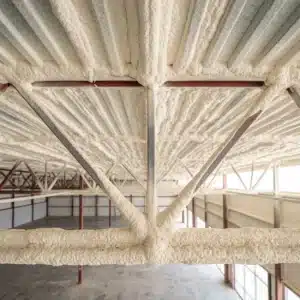
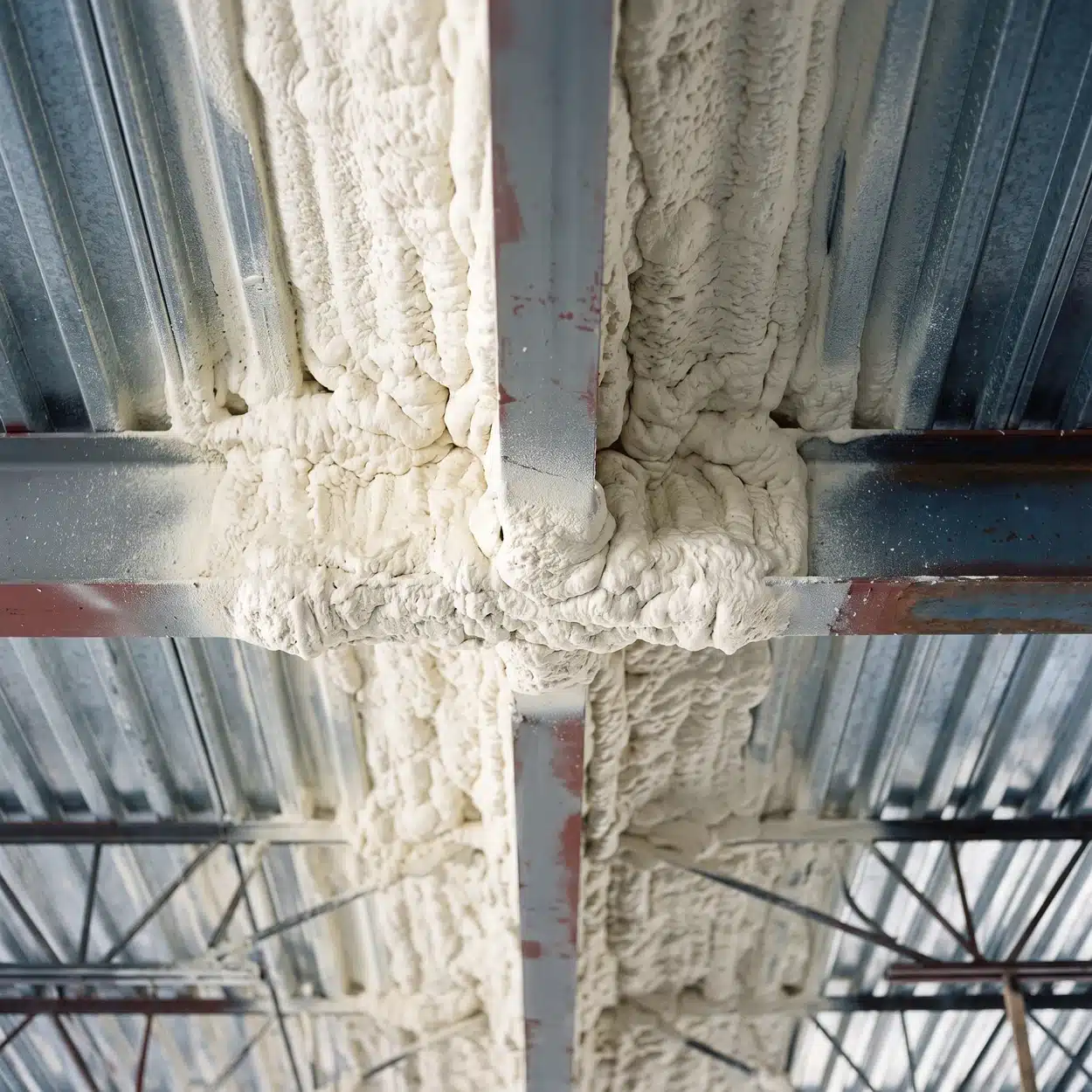
The pattern repeats. A crew foams the roof deck beautifully and stops at the eave. Or they foam the walls and leave the purlin-to-girt intersections open. Or there is an equipment penetration nobody accounted for. Warm moist interior air finds that path, reaches cold steel behind the foam, and condenses where nobody can see it. The owner then reports that the spray foam did not work, when what actually happened is that a continuous material got installed discontinuously.
That is why we walk the entire perimeter before quoting an ag building. Eaves, ridge, sidewall base, every penetration, every place two planes meet. A partial application is worse than none, because it moves the condensation to a spot you cannot inspect.
How Much Agricultural Insulation Does a Texas Building Need?
For most Texas commercial ag buildings, expect roughly 2 to 3 inches of closed-cell spray foam on the roof deck and 2 inches on walls, which lands near R-13 to R-19 at a defensible aged R-value of about 6.5 per inch. The exact number comes from the energy code your jurisdiction adopted, not from a rule of thumb, and many agricultural structures are wholly or partly exempt from it.
Texas is on the 2015 IECC for commercial construction, effective November 1, 2016 under 34 Texas Administrative Code 19.53(a). The State Energy Conservation Office stayed there on purpose, saying continued use of the 2015 edition best serves statewide energy conservation while supporting compliance training for local jurisdictions. So the governing figure comes out of the opaque envelope table in the edition your building official enforces, for your climate zone and your assembly. Metal building roofs and walls are written as a cavity value plus a liner-system or continuous value, so quoting half the row describes an assembly that does not comply. A foam-only application generally complies through the U-factor path, not by matching the prescriptive row.
Two things matter more than the table. First, whether the structure is regulated at all: many farm buildings fall outside the commercial energy code, and the moisture case for agricultural insulation stands on its own regardless. Second, the thickness that controls condensation is usually less than the thickness that satisfies the energy code. Solve the dew point first.
Confirm the adopted edition with the authority having jurisdiction before you specify. The DOE Building Energy Codes Program tracks state adoption, and Texas, Kansas, and Oklahoma are not on the same edition.
Closed-Cell or Open-Cell for Agricultural Insulation?
Closed-cell, in nearly every ag application we see. The comparison below uses aged R-values and measured permeance from current product data, not nameplate marketing figures.
| Factor | Closed-cell spray foam | Open-cell spray foam |
|---|---|---|
| Aged R-value per inch | About 6.2 to 7.0 | About 3.6 to 4.5 |
| Density | 1.5 to 2.4 lb per cubic foot | 0.5 to 0.7 lb per cubic foot |
| Water vapor permeance at 1 inch | About 0.8 to 1.25 perms, product specific | Roughly 26 perms |
| Vapor retarder class | Class II at about 1.5 inches and above | Class III only at about 2.7 inches and above |
| Behavior in bulk water | Does not absorb; rejects liquid water | Absorbs and holds water |
| Structural contribution | Adds racking stiffness to metal panels | None meaningful |
| Washdown tolerance | Rigid, closed surface | Open surface, retains moisture |
| Rodent resistance | Hard and dense, difficult to tunnel | Soft, easily tunneled |
| Typical ag use | Roof decks, walls, cold-chain rooms | Interior partitions only |
The permeance row decides ag projects, and it is the row most often stated wrong. Closed-cell spray foam is not a vapor barrier. Measured against ASTM E96, common products run 1.1 to 1.25 perms at 1 inch, which is still Class III. They reach Class II, meaning 1.0 perm or less, at roughly 1.5 inches. Class I, at 0.1 perm, would take something on the order of 11 to 13 inches, which nobody installs. If a contractor tells you 1 inch of closed-cell gives you a vapor barrier, that contractor has not read a data sheet.
For agricultural insulation, Class II at 1.5 inches and up is the right target. It slows diffusion enough, and because the foam is adhered and continuous it eliminates the air leakage that carries most of the moisture anyway.
Grain Storage: Temperature Control Is the Whole Job
Purdue Extension puts it plainly: more dried grain goes out of condition because grain temperatures are not controlled than for any other reason. Warm grain against cold winter air drives convection currents inside the pile that carry moisture upward, where it meets the cold roof and condenses. The published rule of thumb is to keep grain temperature within 15 to 20 degrees Fahrenheit of the average monthly air temperature.
Insulation does not replace aeration, and any contractor who says it does is selling the wrong thing. What foam on the roof deck does is raise the interior surface temperature of the steel, so that when moisture migrates upward it does not find a condensing surface waiting for it. Aeration manages the pile. The envelope manages the ceiling. You need both.
On a Texas grain facility we look hardest at the underside of the roof, the hatches, and the vents, because those are the three places the extension literature names and the three places we consistently find rust.
Livestock Barns, Poultry Houses, and the Ammonia Question
Be careful here, because a lot of published claims about spray foam in animal housing are not supported by test data.
What is defensible: closed-cell spray foam is a rigid, low-permeance material with a continuous adhered surface. It does not absorb moisture and hold it against the structure the way fibrous batt insulation does when it gets wet in a barn, and a wet batt sagging off a purlin is a very common thing to find in an older livestock building.
What is not defensible: any claim that closed-cell spray foam resists ammonia off-gassing. We could not find published testing on long-term gaseous ammonia exposure of spray foam in animal housing. The polyurethane chemical-resistance charts that circulate in this conversation cover injection grouts in aqueous immersion, which is a different material in a different exposure, and an engineer will catch that substitution.
So in ammonia-heavy buildings our practice is to specify a coating or interior liner rated for that exposure over the foam, and to follow the foam manufacturer’s own written agricultural guidance rather than a general chemical chart. If a manufacturer will not put agricultural service in writing, that tells you something.
Ag-Processing Plants and the Code Obligation That Follows the Foam
Processing rooms are the hardest ag envelope to get right, because they combine high interior moisture, daily hot washdown, and a sanitation regime that punishes any surface holding water. Closed-cell foam’s advantage there is that it is monolithic: no facing to delaminate, no seam to fail, no cavity behind it for water to occupy. Its limit is that raw foam is not a cleanable finish surface. In those rooms the foam is the thermal and air-control layer, and a rated coating or an insulated metal panel liner is the sanitary surface.
Foam is also a foam plastic under the building code, which brings a separate obligation that catches owners off guard. Section 2603.4 of the 2021 IBC requires foam plastic to be separated from the interior of a building by an approved thermal barrier: prescriptively half-inch gypsum wallboard, heavy timber per Section 602.4, or a material tested to and meeting the acceptance criteria of NFPA 275. The older fifteen-minute thermal barrier phrasing you still hear on job sites came out of the 2006 through 2012 editions. Since 2015 the IBC points to NFPA 275 instead, and quoting the old language to a plans examiner is a quick way to lose credibility.
Section 2603.3 separately limits foam plastic to a flame spread index of not more than 75 and a smoke-developed index of not more than 450 when tested to ASTM E84 in the maximum thickness intended for use. That last clause gets dropped in marketing copy, and it is the one an inspector asks about.
Applying Agricultural Insulation to an Existing Metal Building
Most ag work we do is retrofit. The sequence that works:
- Walk the building cold. Come out on a morning after a clear night and look at where moisture has already been. Rust stains, stained purlins, and drip lines on the floor tell you where the assembly is failing before you spend a dollar.
- Fix bulk water first. Foam over an active roof leak and you have sealed water into the assembly. Panel fasteners, ridge closures, and flashing come first.
- Clean and dry the substrate. Foam bonds to clean steel, and adhesion failures on ag retrofits almost always trace back to substrate prep. Dust in an ag building is not incidental.
- Pick the plane and hold it continuous. Roof deck only, or roof and walls, but whichever plane you choose has to close at the eaves, the ridge, the sidewall base, and every penetration.
- Draw the thermal barrier and liner in the same set. Retrofits fail inspection when the foam goes in and the barrier is treated as a later phase.
- Schedule around substrate temperature. In a Texas summer a west-facing metal wall in the afternoon sits outside most manufacturers’ application window, so ag work gets sequenced by orientation and time of day.
On budget: material input costs are trackable, but installed pricing is not published anywhere credible. Any per-square-foot figure quoted as an industry number came from a lead-generation site, not a data source. Get a project bid.
Three Texas Conditions That Change This Work
Texas ag work has local wrinkles a national article will not give you.
The first is the climate zone map. The 2021 IECC carried the first zone update since 2003, and roughly ten percent of US counties changed, nearly all of them to warmer zones. Confirm your own county against Table C301.1 in the adopted edition, and remember that a jurisdiction still on the 2015 IECC is judged against the 2015 map. Dallas-Fort Worth, Oklahoma City, and Tulsa are Climate Zone 3A, Houston 2A, Wichita 4A.
The second is that the three states we serve are nowhere near the same edition, and neither are two cities in one metro. Texas is on the 2015 IECC. Oklahoma adopted the 2006 IECC and ASHRAE 90.1-2003 with state amendments, effective September 14, 2022, a 2022 effective date on a 2006 edition. Kansas names the 2006 IECC as its standard for new commercial and industrial structures under K.S.A. 66-1227, but Kansas is a home-rule state, so adoption and enforcement sit locally. Home-rule cities amend upward, and that is the sharp edge: Dallas enforces the 2021 IECC while Fort Worth is still on the 2015. Same envelope detail, two editions, twenty miles apart. So on any ag job we confirm the edition the local official enforces. The state answer will not tell you.
The third is the diurnal swing. Central and West Texas routinely run a 30 degree difference between afternoon and pre-dawn. That swing is exactly what drives the radiant cooling of a metal roof at night, and it is why Texas ag buildings condense on the same nights the daytime high was in the eighties. Owners find that counterintuitive, which is why they call in the fall and not the spring.
Related Reading
- Spray Foam Insulation for Metal Buildings in Texas covers the metal-building envelope in full, and most ag structures are metal buildings first and agricultural second.
- Closed-Cell vs. Open-Cell Spray Foam for Commercial Buildings works through foam selection in more depth than the table above.
- Spray Foam Insulation in Industrial Buildings applies the same moisture-control logic to processing and manufacturing plants.
Frequently Asked Questions
What R-value does agricultural insulation need in Texas? It depends on whether the building is regulated at all, and many farm buildings are exempt. Where it is regulated, Texas is on the 2015 IECC, so the value for agricultural insulation comes from the opaque envelope table in that edition, for your climate zone and assembly, not the 2021 numbers that circulate online. Metal building rows read as a cavity value plus a liner-system or continuous value, so use the whole row. The condensation-control thickness is usually less, and it is the number worth solving first.
Does spray foam prevent condensation in grain storage buildings? It removes the cold condensing surface, which is the mechanism that puts water back onto stored grain. It does not replace aeration. Purdue Extension’s guidance is that most out-of-condition grain traces to uncontrolled grain temperature, so foam on the roof deck and a working aeration plan solve different halves of the same problem.
Is closed-cell spray foam safe for livestock barns? It is widely used in animal housing and does not absorb and hold water the way batt insulation does. Exposed foam is a foam plastic under IBC Section 2603.4 and generally requires an approved thermal barrier, and in barns it also needs protection from physical contact. Confirm the product’s agricultural service guidance with the manufacturer in writing.
How does spray foam perform against ammonia exposure in poultry facilities? We are not aware of published testing on long-term gaseous ammonia exposure of spray foam in animal housing, so we do not make a resistance claim. In ammonia-heavy buildings we specify a coating or liner rated for that exposure over the foam and follow the manufacturer’s written guidance.
What does agricultural insulation cost per square foot in Texas? There is no credible published figure. Installed cost turns on substrate condition, thickness, access, and how much of the building is reachable without disassembly, so it has to be bid. Any per-square-foot number circulating as an industry figure traces to a lead-generation site.
Can spray foam be applied to existing metal ag buildings? Yes, and most of our ag work is retrofit. The building has to be watertight first, the steel has to be cleaned, and the substrate has to sit inside the manufacturer’s temperature window. Foaming over an active leak seals water into the assembly.
Is closed-cell spray foam a vapor barrier? No. At 1 inch most products measure between 0.8 and 1.25 perms, which is Class II or Class III depending on the product. Class II, at 1.0 perm or less, is typically reached around 1.5 inches, and Class I would take roughly 11 to 13 inches. Specify it as a Class II vapor retarder and an air barrier, which is what it is.
Key Takeaways
The controlling problem is dew point, not R-value.
- Condensation on cold metal is what ruins stored product and corrodes framing.
- A building can meet every insulation requirement and still condense.
Closed-cell is the default for agricultural insulation.
- About 6.2 to 7.0 aged R-value per inch, 1.5 to 2.4 pounds per cubic foot.
- Class II vapor retarder at roughly 1.5 inches, not at 1 inch.
- It is not a vapor barrier, and no honest data sheet says it is.
Continuity beats thickness.
- Partial applications move condensation somewhere you cannot inspect.
- Eaves, ridge, sidewall base, and penetrations decide whether the job works.
Code obligations follow the foam.
- 2021 IBC Section 2603.4 requires an approved thermal barrier: half-inch gypsum, heavy timber, or a material meeting NFPA 275.
- Section 2603.3 caps flame spread at 75 and smoke developed at 450 per ASTM E84, tested at the maximum thickness intended for use.
The three states do not share a code edition.
- Texas is on the 2015 IECC, Oklahoma on the 2006 IECC with ASHRAE 90.1-2003, Kansas on the 2006 IECC under home rule.
- Dallas enforces the 2021 IECC while Fort Worth holds the 2015, so confirm the edition with the jurisdiction.
Ammonia resistance claims are unsupported.
- No published testing covers long-term gaseous ammonia exposure of spray foam in animal housing.
- Specify a rated coating or liner and get the manufacturer’s agricultural guidance in writing.
If you own or are building an ag or ag-processing facility and you want a crew that walks the building cold before quoting, holds the foam plane continuous through the eave and the penetrations, and tells you which code edition actually applies to your site, that is the work we do throughout Texas, Kansas, and Oklahoma. Call me at 512-387-2111 or email ross@bahlfireproofing.com to walk your building, or Contact Bahl Fireproofing to get on the schedule. Our Texas service area page shows where we work, and our spray foam insulation page covers the commercial side of this work.
This article provides general educational information about insulation and building envelope performance and is not engineering, legal, or code-compliance advice. It does not replace project-specific direction from a licensed architect or engineer. Product specifications including R-value, density, and water vapor permeance are product specific and are revised by manufacturers; confirm current values against the manufacturer’s latest published data sheet before specifying. Code citations reference a specific edition and the adopted edition varies by jurisdiction, so confirm current requirements with your local building department. Installation must follow the manufacturer’s written instructions and be performed by a qualified applicator, and product suitability for agricultural service, including chemical exposure, depends on project-specific conditions and should be confirmed with the manufacturer and a licensed architect or engineer.