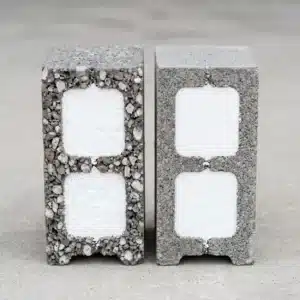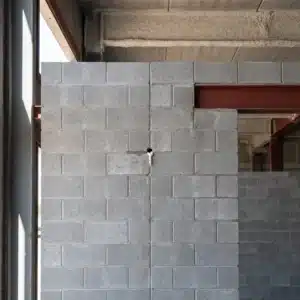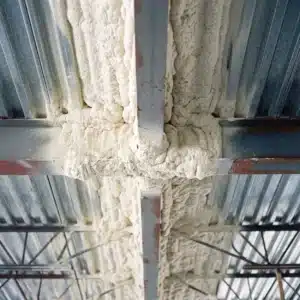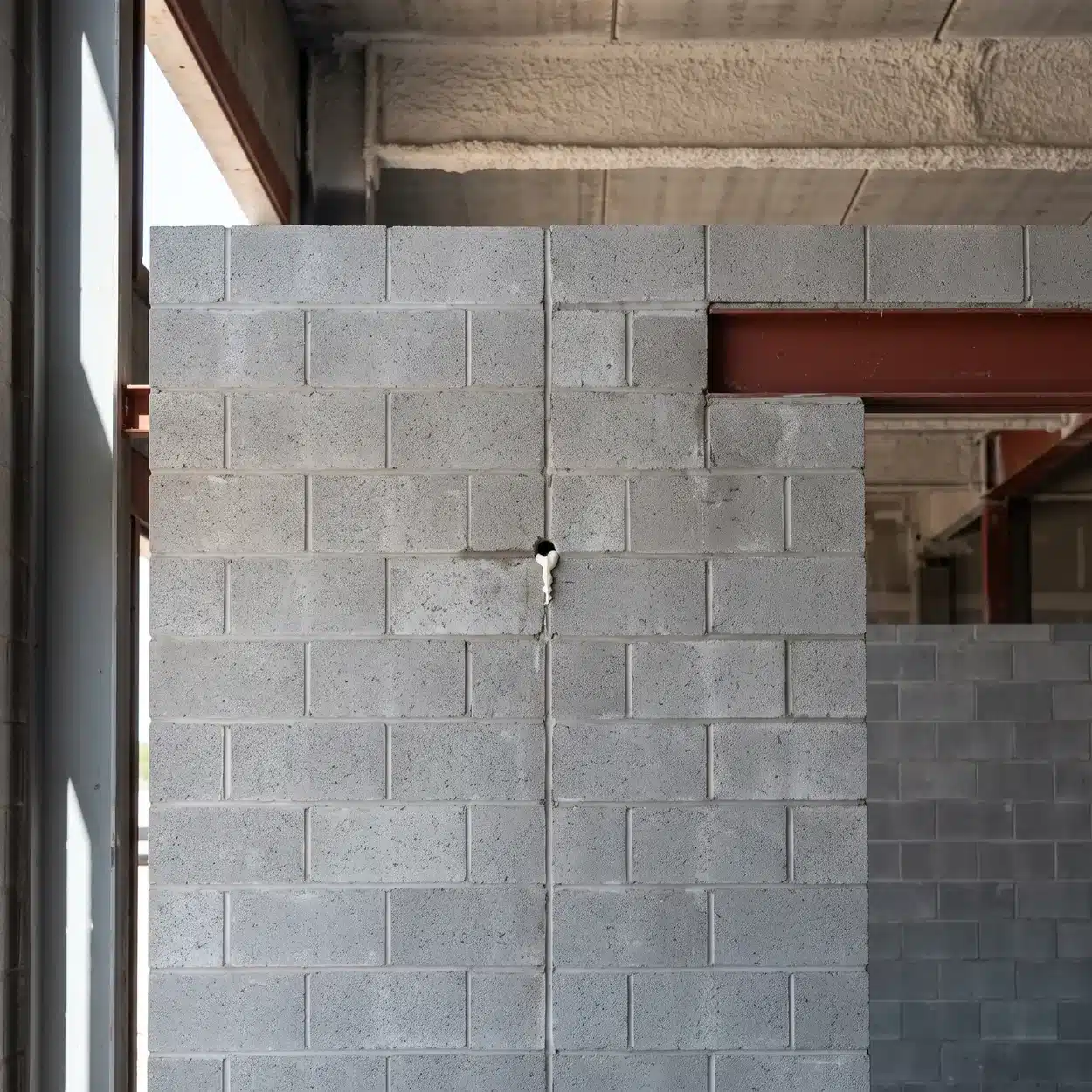
Bahl Fireproofing is adding masonry cavity-fill foam to its insulation work across Texas, Kansas, and Oklahoma. Core-Fill 500 is a two-component aminoplast foam injected into concrete block cores and masonry cavities. This article covers what the product is, what the code-recognized wall numbers actually are, where the foam does not belong, and how to specify it on a real project.
TLDR: Core-Fill 500 is masonry insulation, not a general-purpose foam, and the number that decides your wall is not printed on the product literature. The block density your architect specified moves the wall R-value more than the foam does. Same 8-inch unit, same foam, and the code-recognized value swings by a factor of 2.1 from lightweight block to normal-weight block. Read the block submittal before you read the brochure.
The R-Value Mistake That Shows Up at Plan Review
An owner buys a 60,000 square foot CMU school addition on a design that shows foam-filled block cores carrying the wall’s thermal performance. The energy model closes. The block goes up. Then a plans examiner asks how the wall R-value was calculated, and the answer turns out to be a manufacturer construction table. The wall gets recalculated by the code-recognized method, loses a large share of the number the model was built on, and somebody has to add continuous insulation to a wall that is already standing.
That is not a hypothetical failure mode. It is the predictable result of using the wrong table. Manufacturer construction tables for foamed cores do not account for thermal bridging through the block webs, and the webs are solid concrete running face to face, a straight thermal path around the foam.
The values that hold up are calculated by the series-parallel method, also called isothermal planes. CMHA TEK 06-02C on R-values and U-factors of single wythe concrete masonry walls publishes those values and states plainly that the method accounts for the energy loss through the webs of concrete masonry units. If a number in front of you was not produced that way, it is a marketing number, and it will not survive a plan review that asks the question.
What Core-Fill 500 Masonry Insulation Actually Is
Core-Fill 500 is a two-component aminoplast foam system manufactured by Tailored Chemical Products, Inc. of Hickory, North Carolina. One component is an aminoplast resin, the other a catalyst and foaming surfactant. The two are mixed at the nozzle with compressed air and injected into the hollow cores of a masonry wall, where the mix expands to fill the cavity and sets in roughly 20 seconds under typical conditions per the current technical data sheet.
The cured foam is light. The current data sheet puts dry density at approximately 0.8 pounds per cubic foot, and wet density at 2.7 to 3.3 pounds per cubic foot as it goes in. Shrinkage is reported as less than one percent under the D.O.E. (E)(11) and H.U.D. 6.2.5 test references, and corrosion testing showed no perforations on aluminum, copper, or steel and no pitting on galvanized steel.
Thermal performance is measured under ASTM C518-21. The manufacturer’s reference values are R-4.5 per inch at 74F mean temperature and R-4.9 per inch at 32F mean temperature. Use the 74F number. United States design R-values are stated at a 75F mean, so 4.5 belongs in a submittal for a building in our region. The 4.9 figure is the cold-side test point, and it is the one repeated unqualified on almost every page written about this product.
Acoustically, the manufacturer reports STC 53 and OITC 44 in 8-inch concrete block tested to ASTM E90-90. Name the 8-inch block whenever you quote those numbers, because sound transmission class is a property of an assembly, not a material.
What Actually Goes Wrong on Masonry Insulation Jobs
I have been applying sprayed and injected insulation across Texas, Kansas, and Oklahoma for more than twenty years, and on masonry work the jobs that go wrong almost never go wrong because of the foam. They go wrong because the wall the foam went into is not the wall the energy model assumed.
The pattern repeats. A design team runs the wall on a lightweight unit. At bid time the block package gets value-engineered to a heavier, cheaper unit from a different plant. Nobody re-runs the wall, because the substitution reads like a masonry decision rather than a thermal one. The foam performs as specified, and the assembly still lands short, because the concrete around the foam changed.
The second thing we see is a core that was never fillable. Bond beams, grouted cells carrying reinforcement, and mortar droppings on a web all block the path the foam has to travel, and injected foam takes the route of least resistance. If an obstruction splits a cell, the foam stops, and you have a void you cannot see from either face.
Both failures are preventable on paper, before anybody drills a hole. Get the block density off the approved submittal rather than off the specification’s generic call for concrete masonry units, then read the reinforcing and grouting drawings and decide, cell by cell, what is actually open.
Why Block Density Moves the Wall R-Value More Than the Foam Does
Here is the whole argument in two numbers. Take one 8-inch concrete masonry unit with its cores filled with foamed-in-place insulation. In 85 pound per cubic foot lightweight block, the code-recognized wall value is R-8.58. In 135 pound per cubic foot normal-weight block, the same unit with the same fill is R-4.08. Nothing about the insulation changed, and the wall lost more than half its resistance to the concrete alone.
That is a swing of 2.1 times, driven by a material decision most people treat as structural. Below are the series-parallel values from TEK 06-02C for cores filled with foamed-in-place insulation.
| Unit size | 85 pcf | 95 pcf | 105 pcf | 115 pcf | 125 pcf | 135 pcf |
|---|---|---|---|---|---|---|
| 6 inch | R-6.38 | R-5.54 | R-4.80 | R-4.17 | R-3.63 | R-3.16 |
| 8 inch | R-8.58 | R-7.40 | R-6.38 | R-5.49 | R-4.73 | R-4.08 |
| 10 inch | R-10.47 | R-8.98 | R-7.69 | R-6.57 | R-5.62 | R-4.82 |
| 12 inch | R-12.99 | R-11.10 | R-9.47 | R-8.07 | R-6.87 | R-5.86 |
Two qualifiers belong with that table. First, the published row is calculated for foamed-in-place polyurethane, which carries a higher R per inch than aminoplast. At R-4.5 per inch the aminoplast foam sits between the perlite and polyurethane rows of the same table, nearer the polyurethane row. Treat those numbers as the top of the band for a Core-Fill installation, not a guaranteed result.
Second, the values assume a unit with three full-height webs at the minimum thickness required by historical versions of ASTM C90, the standard specification for dry-cast loadbearing concrete masonry units. The 2011 revision to C90 cut the minimum web material substantially, and units with less web area bridge less heat and calculate higher. So ask a block supplier not only what the unit weighs, but how much web it has.
For compliance, do not hand an examiner a manufacturer table. Use the calculation path in the energy code your jurisdiction adopted, or the Standard 90.1 tables where that path is open to you.
Core-Fill 500 and Fire: Reading the ASTM E84 Result Correctly
Tested to ASTM E84, the standard test method for surface burning characteristics of building materials, this foam produced a flame spread of 0, a smoke developed of 5, and fuel contributed of 0. That is the product’s tested result.
Class A is a threshold, not a test result. Under Section 803.1.2 of the 2021 and 2024 IBC, a Class A interior finish means a flame spread index of 0 to 25 and a smoke developed index of 0 to 450. The tested numbers fall well inside that band. Keep the two ideas separate, because a threshold and a score are different things.
A second code provision quotes ASTM E84 numbers, and it is the one people conflate with Class A. Section 2603.3 of the 2021 IBC limits foam plastic insulation to a flame spread index of not more than 75 and a smoke developed index of not more than 450, tested in the maximum thickness intended for use. That is a foam plastic rule in Chapter 26, not an interior finish classification in Chapter 8. Section 2603.4 separately requires a thermal barrier over foam plastic, with exceptions at 2603.4.1. Whether an exception reaches foam concealed inside masonry cores is a call for the licensed architect or engineer and the authority having jurisdiction, and the adopted edition varies across the three states we work in.
One thing this foam does not do is make a block wall more fire resistant. The manufacturer’s position is that the product is not intended and should never be used to increase the fire rating of a concrete masonry unit. A wall’s rating comes from the tested or calculated assembly and has to be confirmed against the applicable listing. We could not locate a current third-party evaluation report for this product, and we will not cite one we cannot produce.
Core-Fill 500 Compared With the Other Masonry Cavity Options
Four materials compete for the same job and do not occupy the same place in the wall. Loose-fill mineral and injected foam go inside the block cores. Rigid board and mineral wool batts go in the drainage cavity of a multi-wythe wall or behind furring. That distinction decides half the comparison before performance enters it.
| Factor | Core-Fill 500 | Loose-fill vermiculite or perlite | Rigid foam board | Mineral wool cavity batts |
|---|---|---|---|---|
| Material R per inch | R-4.5 per inch at 74F mean temperature; R-4.9 per inch at 32F mean temperature | Product specific, per the manufacturer | About R-5 to R-6, product and facer specific | About R-4, product specific |
| Filled 8 inch wall R-value, 85 to 135 pcf block | 8.58 down to 4.08, foamed-core row | 6.92 down to 3.75, perlite row | Not addressed; sits outside the block | Not addressed; sits outside the block |
| Settling and shrinkage | Under one percent per D.O.E. (E)(11) and H.U.D. 6.2.5 | Can settle and bridge over obstructed cells | None; it is rigid board | None if supported; can slump in a tall cavity |
| ASTM E84 tested result | Flame spread 0, smoke developed 5, fuel contributed 0 | Mineral; confirm the product listing | Product specific; regulated under IBC Chapter 26 | Mineral; confirm the product listing |
| Effect on wall fire rating | None claimed by the manufacturer | Confirm against the assembly listing | None; outside the block | Confirm against the assembly listing |
| Moisture behavior | Water absorption 3 percent, floating test; no below-grade vapor barrier use | Mineral fills can hold and move water | Closed-cell boards reject liquid water | Drains and dries; non-absorptive |
| Retrofit into a finished building | Yes, through drilled holes | Usually only from open core tops | No; the assembly has to be opened | No; the assembly has to be opened |
| Installation method | Resin and catalyst mixed at the nozzle, sets in roughly 20 seconds | Poured or blown, gravity dependent | Cut and set by hand, fastened or adhered | Cut and set by hand |
The perlite and foamed-core rows come from the same TEK 06-02C table, run through the same calculation on the same units, which is the only fair way to compare them. Use current manufacturer data sheets for board and batt values, since those change by product line.
Where Core-Fill 500 Does Not Belong
The limitations are the most useful part of any product conversation, and this manufacturer publishes them clearly. We repeat them on every masonry job we quote.
It is not recommended for ceiling or attic applications. It will not support compressive loads, and it is not for flotation. It is not for overhead applications, and it is not to be used underground as a vapor barrier. It should not be used in any environment likely to see sustained temperatures above 190 degrees Fahrenheit, which is 88 degrees Celsius. And as covered above, it is not a way to buy fire-resistance rating.
The applications the manufacturer does list are narrow: block insulation by side, pressure, or top fill, masonry cavity fill in double walls, fascia walls and utility brick wall systems, commercial and industrial retrofit, and precast hollow-core panels. If somebody proposes an application outside that list, the burden is on them to produce the manufacturer’s written support, and we ask for it.
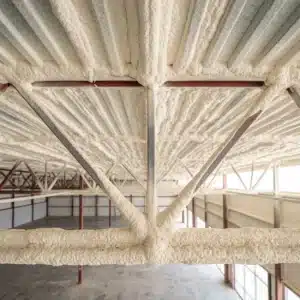
The product is also not a replacement for anything we already do. Steel-frame buildings, metal building envelopes, and exposed deck work are spray foam and sprayed fiber jobs. Masonry cavity assemblies are where this foam earns its place, and the choice starts with the wall type, not the R-value chart.
What the Energy Code Does With a Foam-Filled Block Wall in Texas, Kansas, and Oklahoma
Here is the compliance trap, and it is specific to core fill. The prescriptive mass wall rows in the energy code are written in continuous insulation, abbreviated ci, and continuous means uninterrupted by framing or webs. Foam inside block cores is interrupted by every web, so it is cavity insulation and generally does not satisfy a prescriptive ci row on its own. That does not mean the wall fails. It means you comply through the U-factor path, an added continuous layer, or the Standard 90.1 tables where the adopted code opens that door.
Which number you owe depends on the edition your jurisdiction enforces. In the 2021 IECC, Table C402.1.3 is the insulation component R-value method and Table C402.1.4 is the assembly U-factor method, and that edition puts above-grade mass walls at R-5.7ci in Climate Zone 2, R-7.6ci in Zone 3, and R-9.5ci in Zone 4 for most occupancies, higher for Group R. Those figures govern only where a jurisdiction amended up to the 2021 edition, as Dallas has. Everywhere else the value comes off the opaque envelope table in the adopted edition, for the project’s climate zone and assembly.
Then the three states diverge, and this is where a national article stops being useful. Texas is on the 2015 IECC, effective November 1, 2016 under 34 Texas Administrative Code 19.53(a). Oklahoma is on the 2006 IECC with ASHRAE 90.1-2003 and state amendments, effective September 14, 2022, which is a 2022 effective date on a 2006 edition. Kansas names the 2006 IECC as the state standard for new commercial and industrial structures under K.S.A. 66-1227, but Kansas is a home-rule state, so adoption and enforcement belong to the local jurisdiction. Wichita, for example, is on the 2024 IBC, and that tells you nothing about which energy code the same department enforces.
The sharpest version of this sits inside one Texas metro. Dallas enforces the 2021 IECC. Fort Worth is still on the 2015. The same foam-filled block wall gets reviewed against two different editions twenty miles apart, and no state-level answer warns you which one you are in.
The 2021 IECC also carried the first climate zone map update since 2003, and roughly ten percent of US counties changed, nearly all to warmer zones, but a jurisdiction still on the 2015 IECC is judged against the 2015 map. So do not read a county’s climate zone off a map graphic. The governing list is Table C301.1 in the adopted edition.
How to Specify Core-Fill 500 and How to Get a Bid
Masonry insulation is a paper problem before it is a field problem. This is the order we work in and recommend to design teams.
- Pull the block density off the approved submittal, not off the specification’s generic call for concrete masonry units. The density decides the wall, and it is the most likely thing to change between design and bid.
- Ask the supplier about web configuration. The published tables assume three full-height webs at historical minimum thickness, and a reduced-web unit calculates differently.
- Look up the wall value in the code-recognized table for that unit size and density, and write the source and the density into the energy model notes so the next person can audit it.
- Pick the compliance path before the block ships. Prescriptive ci row, U-factor path, or the 90.1 path where the adopted code allows it. Core fill usually points you away from the prescriptive row.
- Map the cells that are actually open. Bond beams, grouted reinforced cells, and control joints change what can be filled and what counts as unfilled.
- Check the exposure against the limitations. No sustained heat above 190 degrees Fahrenheit, nothing overhead, nothing below grade as a vapor barrier, no compressive load.
- Get a project bid. There is no citable published installed price for masonry cavity fill in this market, and any per-square-foot figure circulating as an industry number came from a lead-generation site.
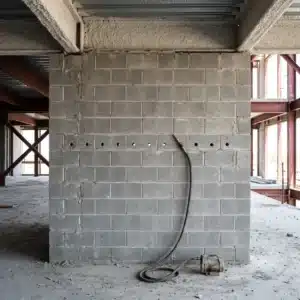
On the wall itself, the licensed-installer documentation calls for injection holes roughly every 8 inches on center, about 5 feet off the floor, and every 10 feet vertically. Verify that geometry against the project specification and the manufacturer’s long-form guidance before it goes into a submittal, since hole layout depends on unit size, bond pattern, and grouting.
We are rolling this service out across the territory we already cover, on commercial, institutional, educational, and industrial masonry projects, and existing clients can add a masonry scope to an active job by calling or emailing us. Three follow-up guides are in production and will publish here over the next several weeks: our upcoming guide to Core-Fill 500 installation, our full R-value and fire safety breakdown, and our Core-Fill 500 versus K-13 comparison. Until those are live, this article is the hub.
Related Reading
- K-13: The Complete Contractor Guide is the hub for our sprayed fiber work, where steel-frame and exposed deck buildings usually land instead of masonry core fill.
- K-13 versus fiberglass batt insulation for commercial buildings runs the same selection logic as the table above on a different pair of materials.
- Commercial spray foam insulation guide covers the envelope side of our work, including the code obligations that follow any foam plastic.
Frequently Asked Questions
What is Core-Fill 500 made of? It is an aminoplast foam system with two components: an aminoplast resin and a catalyst that also acts as the foaming surfactant. The two are combined with compressed air at the nozzle and injected as a wet foam that expands to fill the cavity. The manufacturer of record is Tailored Chemical Products, Inc. of Hickory, North Carolina.
What R-value does the foam provide? The material figure is R-4.5 per inch at 74F mean temperature under ASTM C518-21. The wall figure is different, because the block webs bridge heat around the foam. For an 8-inch unit with filled cores, code-recognized values run from about R-8.58 in 85 pcf block down to about R-4.08 in 135 pcf block.
Is Core-Fill 500 fireproof? No, and the manufacturer does not claim it is. Its ASTM E84 result was a flame spread of 0, a smoke developed of 5, and fuel contributed of 0. That result meets the Class A threshold for interior finish. The foam adds no fire-resistance rating, so a rated wall still has to be confirmed as a listed or calculated assembly.
Can Core-Fill 500 be used in existing buildings? Yes. Retrofit of commercial and industrial masonry is a listed application, and the foam is injected through small drilled holes rather than by opening the wall. The limits match new work: the cores have to be open, and grouted or obstructed cells cannot be filled.
How is this different from spray foam insulation? Spray foam is applied to a surface, adheres to it, and forms a continuous plane across a roof deck or a wall. Masonry core fill is injected into a closed cavity and is interrupted by the webs of every block. They serve different assemblies, and core fill does not replace spray foam on steel-frame or metal buildings.
Does Core-Fill 500 settle over time like loose-fill insulation? The cured foam is reported at less than one percent shrinkage under the D.O.E. (E)(11) and H.U.D. 6.2.5 test references, unlike gravity-dependent loose fill that can settle and bridge. What does create voids is an obstructed cell that stopped the foam during injection, which is an installation issue rather than a material one.
What does masonry cavity fill cost per square foot? There is no credible published installed price for this work in Texas, Kansas, or Oklahoma, and we will not invent one. Cost turns on unit size, how many cells are fillable, access, and whether the wall is new or a retrofit. Get a project-specific bid.
Key Takeaways
The block decides the wall, not the foam.
- Same 8-inch unit and same fill, the code-recognized value runs R-8.58 in 85 pcf block and R-4.08 in 135 pcf block.
- That is a 2.1 times swing from a decision most teams treat as structural.
- Re-run the wall any time the block package changes.
Use the code-recognized table, not the construction table.
- Series-parallel, also called isothermal planes, accounts for thermal bridging through the webs.
- Published values assume three full-height webs at historical ASTM C90 minimums; reduced-web units calculate higher.
Quote the 74F R-value.
- R-4.5 per inch at 74F mean temperature is the design figure under ASTM C518-21.
- The 4.9 figure is the 32F mean test point and should never appear without that qualifier.
Keep the fire numbers straight.
- Tested result: flame spread 0, smoke developed 5, fuel contributed 0 on ASTM E84.
- Class A is a threshold of 0 to 25 flame spread and 0 to 450 smoke developed, and the tested result sits inside it.
- The foam contributes no fire-resistance rating to a masonry wall.
The limitations are the specification.
- Not for ceilings, attics, or overhead work, and not underground as a vapor barrier.
- Will not support compressive loads and is not for flotation.
- Not for sustained temperatures above 190 degrees Fahrenheit.
Three states, three different code answers.
- Texas is on the 2015 IECC, Oklahoma on the 2006 IECC with ASHRAE 90.1-2003, Kansas on the 2006 IECC under home rule.
- Dallas enforces the 2021 IECC while Fort Worth holds the 2015, twenty miles apart.
- Read the edition and the climate zone off the jurisdiction, never off the state.
If you are specifying or building a masonry wall and you want a crew that reads the block density off the submittal, calculates the wall by the series-parallel method instead of a construction table, confirms which energy code edition your building department enforces, and tells you up front where this foam does not belong, that is the work we do throughout Texas, Kansas, and Oklahoma. Call me at 512-387-2111 or email ross@bahlfireproofing.com to walk a wall section, or Contact Bahl Fireproofing to get a masonry scope priced. Our sprayed insulation systems page covers the steel-frame side of this work until the masonry service page publishes, and our service areas across Texas, Kansas, and Oklahoma page shows where we work.
This article provides general educational information about masonry insulation, thermal performance, and passive fire protection, and it is not engineering, legal, or code-compliance advice. It does not replace project-specific direction from a licensed architect or engineer. Product specifications including R-value, density, shrinkage, and acoustic ratings are revised by manufacturers, so confirm current values against the manufacturer’s latest published data sheet, and note that product suitability depends on project-specific conditions. Fire-resistance ratings depend on the tested or calculated assembly and correct installation and must be confirmed against the applicable listing. Code citations reference a specific edition and the adopted edition varies by the authority having jurisdiction, and installation must follow the manufacturer’s written instructions and be performed by a qualified applicator, so confirm current requirements with your local building department before specifying or installing.