Intumescent coatings can be one of the most dependable forms of passive fire protection for exposed structural steel. Applied correctly, they hold up for years with little attention. The problem is that “low maintenance” gets misread as “no maintenance,” and that gap is where the risk lives. This guide walks through what a code-compliant inspection and maintenance program actually looks like, what to watch for, and when to act.
TLDR: Intumescent coatings need periodic visual inspection, dry film thickness verification, and prompt repair of any damage that compromises the rated thickness. The 2021 IBC requires special inspection of these coatings under Section 1705.16, carried out per AWCI Technical Manual 12-B. A practical baseline is a formal inspection every two years, with more frequent walkdowns in high-impact or high-humidity settings. Skip it and you risk voiding the listing that the rating depends on.
Why Maintenance Decides Whether the System Actually Works
Intumescent coatings are thin, paint-like materials applied to structural steel and other substrates. Unlike cementitious spray-applied fireproofing, they are reactive. When the surface reaches roughly 300°F to 400°F (149°C to 205°C), the coating swells and chars, forming a thick insulating layer between the fire and the steel. UL Solutions notes these materials expand many times their original thickness when tested to ASTM E119 or UL 263. Peer-reviewed work on coating chemistry places the dominant reaction onset a little higher, near 200°C (about 392°F), so treat the manufacturer figure as the practical trigger and the lab figure as the underlying chemistry.
That char layer is the whole point, and it only forms if the coating is intact and at the right thickness when a fire starts. Here is the part most owners underestimate: the protection is doing nothing on a normal Tuesday. It sits there as a dormant film until heat activates it. So a chip, a gouge, or a thinned area is not a cosmetic issue. It is a hole in the protection that nobody notices until the day it matters.
Structural steel itself does not need to melt to fail. It loses strength steadily as it heats. Per AISC guidance, structural steel retains roughly 60% of its room-temperature yield strength at 1,000°F (538°C) and about 50% at 1,100°F (593°C), and most building fires push past those temperatures. The standard fire-resistance tests, ASTM E119 and its harmonized counterpart UL 263, set acceptance limits at a 1,000°F (538°C) average for columns and an 1,100°F (593°C) average for unrestrained beams. Depending on the steel section factor and the applied load, an unprotected loaded member can reach those temperatures in roughly 12 to 30 minutes. A properly applied and maintained intumescent system extends that window to a 1, 2, 3, or 4-hour rating. A neglected one quietly gives that time back.
What the Code Actually Requires: 2021 IBC Section 1705.16 and AWCI 12-B
IBC Section 1705.16
The 2021 International Building Code requires special inspection of mastic and intumescent fire-resistant coatings applied to structural elements and decks. That requirement lives in Chapter 17, Section 1705.16, and points to AWCI Technical Manual 12-B for the inspection procedures. This is worth getting right, because the numbering changed: in the 2012, 2015, and 2018 editions this material sat under Section 1705.15. In the 2021 IBC, Section 1705.15 now covers sprayed fire-resistant materials (SFRM), and intumescent and mastic coatings moved to 1705.16. If a spec or an older report still cites 1705.15 for intumescent work, it is referencing a prior edition.
Special inspection here is not optional. The code places the requirement under the building official rather than leaving it to the contractor’s discretion, a point the ICC’s own guidance on passive fire protection in the IBC makes clear. The practical exception is when the local building official determines the work is minor in nature or grants a jurisdiction-specific waiver.
Adopted editions vary, so this matters on the ground. Jurisdictions across Texas, Kansas, and Oklahoma may sit on different code cycles, and a jurisdiction still on the 2018 IBC or an earlier edition will reference intumescent and mastic coatings under Section 1705.15, not 1705.16. Local amendments can also change inspection triggers or frequencies. Always confirm the adopted edition and any amendments with the Authority Having Jurisdiction (AHJ) before you finalize an inspection scope or cite a section number in project documents.
AWCI Technical Manual 12-B
AWCI Technical Manual 12-B, the standard practice for testing and inspection of field-applied thin-film intumescent fire-resistive materials, is the governing field standard. It defines the dry film thickness measurement methods and frequency, the acceptable tolerances, the equipment requirements, and the documentation expectations.
The measurement protocol is more demanding than most owners expect, and it is a documented source of field disputes. Sampling frequency is tied to the structure: AWCI 12-B calls for thickness determinations on a random basis in at least one bay per floor, or one test per roughly 10,000 square feet of floor area, with one column, one primary beam, one secondary beam, and one truss tested within each randomly selected bay. The exact number and placement of thickness readings per member is set by the current edition of 12-B, so pull the actual manual rather than working from memory or a secondhand summary.
ASTM E2924
ASTM E2924, Standard Practice for Intumescent Coatings, gives architects, specifiers, and building owners consensus guidance for the full life of an intumescent system, from manufacturing and storage through application and inspection. Citing ASTM E2924 in project documents alongside AWCI 12-B is a sound way to lock in both initial application quality and long-term verification expectations.
How Long Do Intumescent Coatings Last?
Service life depends on three things: the coating chemistry (water-based, solvent-based, or epoxy), the exposure environment, and the quality of the original application. There is no single number that fits every project.
For interior, conditioned spaces such as offices, schools, and hospitals, a well-applied and maintained intumescent system can run for many years before it needs significant attention. Be careful with the durability claims floating around the industry, though. The default working life documented in European Technical Assessments for these coatings, under the assessment framework EAD 350402-00-1106, is 10 years. Longer figures, including the 25-year numbers you sometimes see quoted, apply only to specific products that hold an individual assessment certifying that extended life under defined exposure conditions. They are not a blanket property of “interior intumescent coatings.” Recent research from BAM and Leibniz University Hannover (Häßler and colleagues, published in the Fire Safety Journal in 2024) actually proposed a test concept for verifying working life beyond 10 years rather than confirming any product reaches 25. The same work reported markedly better weathering performance for epoxy systems than for water-based ones.
Exterior and semi-exposed steel is a different conversation. Moisture is the enemy. Water intrusion leaches the reactive ingredients, ammonium polyphosphate and melamine among them, that drive the char reaction. Water-based products are especially vulnerable to humidity without a properly specified topcoat. The practical takeaway: match the chemistry to the exposure, and do not assume an interior-grade product will survive outdoors.
| Coating Type | Typical Interior Service | Exterior / Semi-Exposed Suitability | Humidity Sensitivity |
|---|---|---|---|
| Water-Based | Long, in conditioned space | Limited; requires approved topcoat | High |
| Solvent-Based | Moderate to long | Mild outdoor with topcoat | Moderate |
| Epoxy-Based | Long | Best option for harsh or wet exposure | Low |
General industry data; verify the specific product’s technical data sheet and any European Technical Assessment for documented working life.
The manufacturer rating is a baseline measured under favorable conditions. Real-world performance depends on application quality, exposure, and whether anyone has kept the system intact. Treat a published lifespan as a ceiling, not a guarantee.
How Often Should Intumescent Coatings Be Inspected?
A formal inspection every two years is a reasonable baseline for most commercial buildings, carried out as part of the routine maintenance program. Isolatek, a major manufacturer of intumescent fire-resistive materials, advises owners and managers to put a comprehensive periodic inspection and maintenance program in place rather than treating these coatings as install-and-forget.
The right interval for a given building flexes with conditions:
- Product and manufacturer guidance. Check the specific product’s technical data sheet for any stated inspection interval.
- Steel location. Concealed steel above a hard ceiling with no access is lower risk than exposed steel at a loading dock.
- Occupancy and use. A warehouse with forklift and pallet-jack traffic carries far more impact risk than an office lobby.
- Environmental exposure. High-humidity settings such as natatoriums, food processing plants, and coastal industrial sites accelerate degradation and justify a tighter schedule.
- Post-construction activity. Any renovation, MEP trade work near protected steel, or equipment installation should trigger an immediate look at nearby coatings.
In our work across Texas, warehouse and manufacturing facilities consistently demand more attention than office environments. Forklifts and heavy equipment produce exactly the kind of impact damage that, left alone in a humid space, opens the door to moisture and progressive failure.
Texas, Kansas, and Oklahoma Considerations
Central Texas heat and humidity cycles are hard on water-based systems. On projects through the Austin and Round Rock corridor, San Antonio, and the Houston-area industrial belt, specifying an epoxy-based intumescent for any semi-exposed or high-humidity location is usually the right call. The higher upfront cost typically pays for itself in reduced long-term maintenance.
Kansas brings the opposite stress: hard winter-to-summer temperature swings that load exterior coatings with freeze-thaw cycling. That kind of weathering exposure is exactly what durability testing for exterior-classified coatings is meant to address, so confirm the product carries the correct exterior classification for its actual exposure before it goes on the steel.
Oklahoma facilities often combine humidity, wind-driven grit, and occasional chemical exposure in petrochemical and agricultural settings. In those environments, a quarterly visual walkdown of exposed steel is a sensible supplement to the standard two-year comprehensive inspection.
What to Look for During an Inspection
A practical field sequence, drawn from manufacturer guidance and AWCI 12-B:
- Start with the high-impact zones. Steel at grade, near loading docks, in mechanical rooms, and anywhere heavy equipment moves is where mechanical damage shows up first.
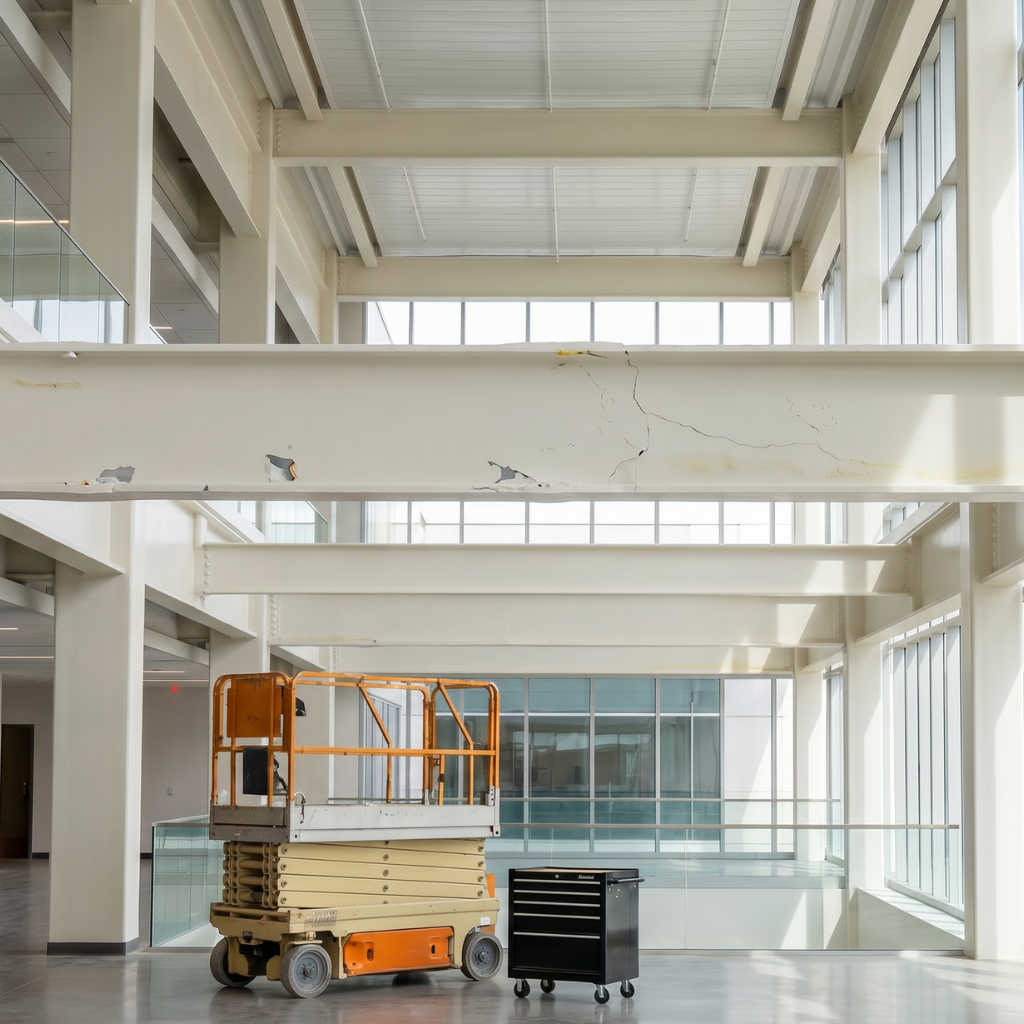
- Document every deficiency. Note cracking, chips, scrapes, voids, delamination, blistering, discoloration, or any exposed bare steel. Photograph each with a reference marker so you can track it over time.
- Inspect around the damage. Once you find a defect, check the coating for at least 12 inches in every direction to confirm the rated thickness is intact in the surrounding zone.
- Assess topcoats on their own. Where a topcoat is part of the system, evaluate it separately. In a wet environment, topcoat failure is what lets moisture reach the intumescent layer and start the degradation cycle.
- Watch for heat-proximity damage. Because these coatings react in the 300°F to 400°F range, welding or torch work nearby can partially activate them. Flag any color change, puffing, or surface disturbance near recent hot work.
- Check the connections. Beam-to-column joints, bolted connections, and attachments are common spots for thin or missing coating. Look hard at these.
Reading the Defects
| Defect | Likely Cause | Action |
|---|---|---|
| Minor chips and scrapes | Incidental impact or contact | Monitor; repair promptly in wet or exposed locations |
| Larger gouges exposing substrate | Significant impact or abrasion | Repair to restore rated thickness |
| Surface cracking | Thermal cycling, aging | Verify thickness; repair if cracking reaches the substrate |
| Delamination or lifting | Adhesion failure, moisture | Remove affected material, investigate cause, recoat |
| Blistering | Moisture trapped beneath coating | Check for substrate corrosion; repair system |
| Discoloration or swelling | Heat exposure or partial activation | Structural review; replace affected coating |
| Rust staining or bleed-through | Corrosion of underlying steel | Treat substrate before recoating |
| Excessive topcoat build-up | Repeated touch-ups over time | Evaluate total thickness; too much topcoat can impair expansion |
There is no industry-wide “minimum size that requires repair” number, and you should be skeptical of any source that quotes one as if it came from a manufacturer. The real standard is functional: any area where the design dry film thickness has been compromised, or where impact has exposed the substrate, gets repaired in accordance with the manufacturer’s published instructions. Size is a prompt for judgment, not a hard threshold.
Dry Film Thickness Verification
Visual inspection alone does not establish compliance. AWCI 12-B calls for dry film thickness (DFT) measurement when there is evidence of a deficiency, and as part of a formal periodic inspection. Two non-destructive methods are standard: the magnetic pull-off method for steel substrates, and the ultrasonic method, which works on metallic and non-metallic substrates alike. Digital gauges such as the DeFelsko PosiTector 6000 are common in the field, and AWCI 12-B requires calibration before and after measurement.
The required thickness for any given member is not a single universal number. It comes from the steel section factor (the Hp/A or W/D ratio), the specified fire-resistance rating, and the specific certified design for that product. Each member type and size carries its own thickness requirement. Do not apply one figure across the whole structure.
One caution that gets overlooked: more is not safer. Certified designs publish a maximum thickness as well as a minimum. Over-application can leave the char layer unable to support its own weight during a fire, which leads to delamination and cracking and reduces protection. Exceeding the certified maximum can compromise the listing just as surely as falling short of the minimum.
Repairing Damaged Intumescent Coatings
When inspection turns up damage that needs repair, the work has to follow the original manufacturer’s published instructions. Substituting a different product or applying the wrong thickness voids the certification for that member.
- Identify the original product. Pull the construction documents, contact the original applicator, or call the manufacturer’s technical service line. You cannot repair what you cannot identify.
- Get the manufacturer’s repair instructions. Primer requirements, compatibility, and repair steps differ by product. Do not assume one product’s process applies to another.
- Remove unsound material. Scrape or sand away all loose, flaking, or delaminated coating. Cut back to a sound edge, working an inch or two beyond the visibly damaged area.
- Prepare the substrate. Where bare steel is exposed, clean it to the manufacturer-specified standard, commonly ISO 8501-1 St 2 (thorough hand and power tool cleaning) or St 3 where conditions call for it. The surface must be dry and free of oil, grease, salts, dust, and debris before anything goes on.
- Re-prime as required. Most systems need a specific primer over bare steel, applied to the data sheet thickness. Use only primers the coating manufacturer approves.
- Reapply the intumescent to the required thickness. Use the same product as the original and restore the specified dry film thickness, taking care not to build total thickness above the certified maximum.
- Reinstate the topcoat if the system requires one. Match the original topcoat and overlap onto sound surrounding finish. Use only the topcoat in the original certified design.
- Document everything. Record the location, the extent of damage, the repair date, the product and batch numbers, and the post-repair thickness readings. This is what makes your compliance record defensible.
Who Should Do the Work
This is not a general maintenance crew task. Intumescent repairs belong with a certified passive fire protection specialist who understands the original system. An unauthorized topcoat or an incorrect thickness restoration can quietly impair fire performance and undermine compliance. For most commercial and industrial facilities in Texas, Kansas, and Oklahoma, the right move is to bring back the original applicator or a qualified fireproofing contractor. When there is any doubt about product or procedure, call the manufacturer’s technical service line with the original data in hand.
Building a Long-Term Maintenance Program
A defensible, code-aligned program has a handful of moving parts:
- Baseline documentation at closeout. Capture and retain the QA reports, DFT records, certified design references, product data sheets, and batch numbers. This package is the foundation for every future inspection.
- Annual visual walkdowns. Informal yearly looks at high-impact and high-humidity areas catch damage early. This is not a full AWCI 12-B inspection, but it does real work.
- Formal inspection every two years. A comprehensive inspection per manufacturer guidance and AWCI 12-B, including DFT verification in any suspect areas.
- Periodic topcoat assessment. The topcoat is the first defense against moisture reaching the intumescent layer. Assess it on its own schedule and renew when it shows degradation.
- Post-event inspections. Inspect after any renovation, fire event however minor, significant water intrusion, or major impact such as an equipment collision or vehicle strike.
- Records kept with building management. For buildings under IBC Chapter 17 special inspection requirements, a final report is required for the Certificate of Occupancy, and ongoing periodic records support continued compliance.
What Can Void the Certification
Understanding what nullifies a certified design helps owners prioritize. Any of the following can compromise it:
- Applied thickness above the certified maximum
- Applied thickness below the minimum for the member size and rating
- A non-approved primer used during original installation or repair
- The wrong topcoat, or a non-required topcoat applied in excessive thickness
- A different intumescent product used in repair than the design specifies
- Application under temperature or humidity conditions outside the manufacturer’s allowable range
- Galvanized steel coated without manufacturer confirmation the product is approved for that substrate
Each of these can meaningfully reduce the fire protection the steel was supposed to have. None of them is visible once the work is buttoned up, which is exactly why documentation and qualified labor matter.
Frequently Asked Questions
Q: Does intumescent coating need to be replaced after a fire?
Yes, wherever the coating was hot enough to react. Once the char layer forms, it cannot be relied on again, and activated coating does not regenerate. Any area that visibly expanded, charred, or changed color during a fire event needs replacement, and a qualified professional should assess the structure and the coating before restoration.
Q: Can I paint over intumescent coating for aesthetic reasons?
Only carefully and within the certified design. Topcoats outside the listed system need AHJ approval and manufacturer sign-off. Successive layers of non-required topcoat can build to a thickness that interferes with the coating’s ability to expand. Document any topcoat decision and keep it with the building’s fire protection file.
Q: Who performs the special inspection under IBC 1705.16?
An approved agency engaged by the building owner or the owner’s authorized agent, not the contractor, provides the special inspection. The special inspector documents findings, brings discrepancies to the contractor’s attention, and submits a final report to the building official before the Certificate of Occupancy is issued.
Q: How do I know what thickness my coating requires?
The required dry film thickness comes from the steel section factor (Hp/A or W/D ratio), the specified fire-resistance rating, and the certified design number for the specific product. The product’s design tables, which vary by member type, give the thickness for each configuration. Keep that documentation in the project records.
Q: What happens if the coating is under-applied?
Under-application means the member will not hold its load-bearing capacity for the full rated duration. Protection can fail before evacuation finishes or before suppression controls the fire. Under-applied thickness found during special inspection has to be corrected before occupancy.
Q: Is intumescent coating suitable for exterior use in a humid climate like Texas?
Water-based products generally are not suitable outdoors without a specific manufacturer-approved topcoat system. For exterior steel in humid Texas conditions, specify an epoxy-based intumescent rated and classified for exterior exposure, and confirm the topcoat is part of the certified design. Epoxy systems consistently outperform water-based ones under weathering.
Key Takeaways
Code and Standards
- The 2021 IBC requires special inspection of mastic and intumescent coatings under Section 1705.16, performed per AWCI Technical Manual 12-B.
- Section numbering changed in 2021; earlier editions placed this under 1705.15, which now covers SFRM.
- ASTM E2924 provides consensus best practice for specification, application, and inspection.
Inspection Frequency
- A formal inspection every two years is a workable baseline.
- High-impact, high-humidity, and industrial environments justify more frequent walkdowns.
- Renovation, fire events, and major impacts trigger an immediate look.
What to Inspect
- Visual: cracking, delamination, chips, blistering, discoloration, exposed steel, and topcoat condition.
- DFT verification with calibrated magnetic or ultrasonic gauges per AWCI 12-B.
- Connections, where coating is most often thin or missing.
Repairs
- Use the original product and follow the manufacturer’s published procedure.
- Restore the certified thickness and never exceed the certified maximum.
- Leave structural-system repairs to certified passive fire protection specialists.
Lifespan
- Match coating chemistry to exposure; epoxy is the durable choice for harsh or wet conditions.
- Published working-life figures are baselines tied to specific products and exposure conditions, not blanket guarantees.
- The default European working life is 10 years; longer claims require product-specific certification.
Related Reading
- New to these systems and weighing them against cementitious fireproofing? Start with our complete guide to intumescent fireproofing.
- Budgeting for reinspection and wondering how long your system should hold up? Read how long intumescent fireproofing lasts on structural steel.
- Comparing protection methods for a specific project? See our breakdown of intumescent versus cementitious fireproofing.
Let’s Talk About Your Building
If your structure has intumescent coatings that have never been formally inspected, or you cannot say when the last thickness verification happened, that uncertainty is the risk. Bahl Fireproofing works with facility managers, general contractors, and property owners throughout Texas, Kansas, and Oklahoma to inspect, document, and restore intumescent systems to a code-compliant, defensible condition. We bring you our intumescent fireproofing services and field experience across the region we serve. To schedule a consultation or request a project assessment, contact Bahl Fireproofing or call 512-387-2111.
Disclaimer: This article provides general educational information about intumescent coating maintenance and inspection. It is not a substitute for professional engineering evaluation, manufacturer-specific technical guidance, or consultation with your Authority Having Jurisdiction. All fire protection decisions should be made with a licensed architect or engineer and a qualified fire protection professional familiar with the applicable local codes and the specific products installed in your structure.