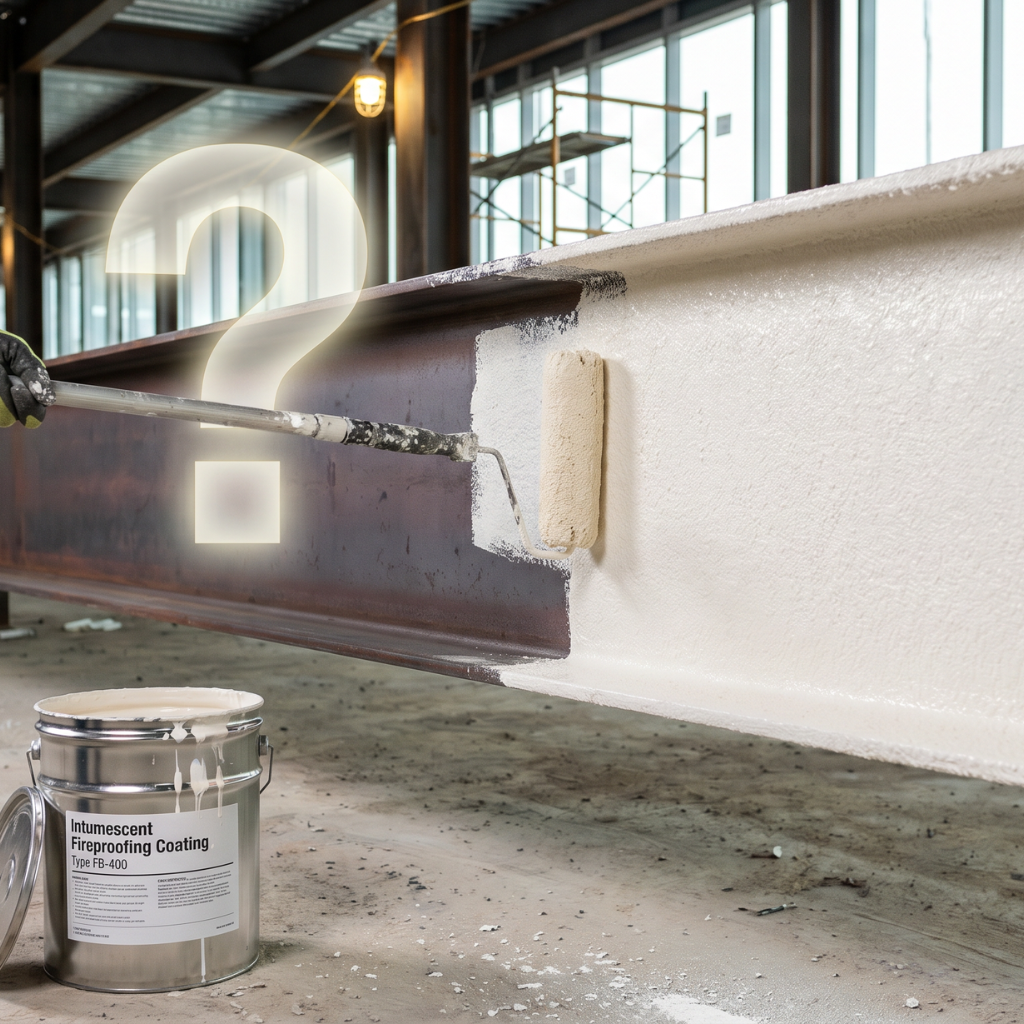
If you are looking at fire-rated intumescent coating applied to steel and wondering whether you can put a finish coat over it, the short answer is yes, but only with the right product applied the right way. This guide explains what a topcoat actually does, when it is required versus optional, why the wrong paint can quietly void a fire rating, and how to specify and time it correctly on commercial projects across Texas, Oklahoma, Kansas, Nebraska, Minnesota, and Wisconsin.
TLDR: You can paint over intumescent coating, but only with a manufacturer-approved topcoat applied at the correct thickness and after the basecoat has fully cured. Generic or household paint can mechanically restrain the char during a fire and reduce the rating. The topcoat does two jobs: it seals the coating against moisture and UV, and it provides color and finish.
A question I get on almost every architecturally exposed steel project is some version of “can we just paint it the color we want?” The instinct is reasonable. Intumescent coating looks like paint, sprays like paint, and dries like paint. But it is a tested fire-protection system, not a finish, and the topcoat is part of that system. Get it right and you keep the rating and the look. Get it wrong and you can compromise the fire protection without anyone noticing until it is tested by an actual fire. This article walks through the whole decision so you specify it correctly the first time. For the broader chemistry picture, our complete guide to intumescent fireproofing covers product selection across all three families.
Can You Paint Over Intumescent Coating?
Yes, you can paint over intumescent coating, but only with a topcoat that the coating manufacturer has tested and approved as part of the fire-protection system. The approved topcoat is engineered to protect the coating in normal conditions and then yield in a fire so the intumescent layer can expand freely. A generic paint that was never fire-tested with the system can restrain that expansion and shorten the fire duration.
This is not a preference or a warranty technicality. It is a life-safety and code-compliance issue. Intumescent fire protection is certified as a complete assembly, primer plus intumescent basecoat plus topcoat, and the certification only holds when every layer matches what was tested. Swapping in an off-the-shelf finish breaks that chain. The rest of this guide explains why, and how to do it correctly.
The one claim to ignore: any advice that “normal metal paint works fine” over intumescent. It does not, and manufacturer and testing-body sources are unanimous on that point. A finish that looks identical on the wall can behave very differently at 300 degrees Celsius.
What a Topcoat Actually Does
A topcoat on an intumescent system performs two distinct jobs: it seals the reactive coating against moisture and weather, and it provides the color and sheen the project calls for. In a conditioned interior, the second job may be the only reason a topcoat is specified. In a semi-exposed or exterior setting, the first job is what protects the fire rating over the building’s service life.
The sealing function matters because intumescent coatings are reactive and moisture-sensitive by nature. The char-forming chemistry relies on ingredients such as ammonium polyphosphate and melamine, and water ingress can leach or degrade those reactive components over time. A peer-reviewed durability study found that without a proper topcoat, moisture exposure chemically weakens the intumescent reaction even when the coating still looks intact. The failure is invisible until the coating is called on to perform.
The aesthetic function is why topcoats show up on exposed steel at all. Intumescent replaced spray-applied cementitious fireproofing on exposed architectural steel precisely because it accepts a clean, paint-like finish. The topcoat carries the color and gloss, which is often what the architect actually cares about. Both functions have to coexist with one hard constraint: in a fire, the topcoat must let the char expand.
Why the Wrong Topcoat Can Void the Rating
The wrong topcoat voids a fire rating by physically or chemically interfering with char expansion. When intumescent coating reaches its activation temperature, it swells many times its applied thickness to form an insulating char. A topcoat that is too thick, too rigid, or chemically incompatible can hold that expansion back, and a restrained char does not insulate the steel the way the tested assembly did.
Thin-film intumescent is where this risk is sharpest. Research on thin-film systems shows that because the coating expands many times over and the expanding char is soft, a topcoat that does not yield can mechanically restrain it. The same research notes this is less of an issue for thick-film epoxy intumescent, which expands far less, but the thin-film products common on commercial steel are sensitive to it. This is why topcoat thickness is controlled, not open-ended.
There are three distinct ways a topcoat goes wrong. It can be applied too thick, where excess dry film restrains the char and shortens the fire duration. It can be chemically incompatible, where the binder interacts with the intumescent ingredients and degrades the reactive package. Or it can simply be unapproved, a generic or household paint that was never fire-tested with the system and has no data behind it at all. Any one of these can reduce performance.
When intumescent fire protection fails, the consequence is structural. Unprotected structural steel reaches its critical temperature of 1000 degrees Fahrenheit (538 degrees Celsius) quickly under fire exposure. At about 1022 degrees Fahrenheit (550 degrees Celsius), steel retains only around 60 percent of its room-temperature yield strength, the threshold most often cited as the critical point in ASTM E119 fire-resistance testing. The whole point of the coating system is to delay the steel reaching that point for the rated duration. A compromised topcoat undercuts that delay.
When Is a Topcoat Required Versus Optional?
A topcoat is optional for fire performance in a dry, conditioned interior, but it is the standard call and is effectively required for durability in semi-exposed and exterior conditions. The deciding factor is the exposure environment, which maps to the ISO 12944 corrosivity categories that drive coating specification.
In a true conditioned interior, ISO 12944 category C1, the intumescent often does not need a topcoat to meet its rating, and testing bodies confirm topcoating is not required for general interior fire performance there. In that setting, a topcoat is usually specified only for color or sheen. Once you move into unconditioned interior or semi-exposed space, category C2, a sealing topcoat becomes the practical requirement, because humidity and condensation will otherwise attack the coating. Fully exterior steel, category C3 and above, typically requires a topcoat, and often a more robust two-component product.
| Exposure environment | Rough ISO 12944 category | Topcoat status |
|---|---|---|
| Conditioned interior, dry and climate-controlled | C1 | Optional, for color and finish only |
| Unconditioned interior or semi-exposed | C2 | Recommended; effectively required for durability |
| Semi-exposed with higher humidity or industrial exposure | C3 | Required; weather-resistant topcoat |
| Fully exterior or aggressive industrial | C3 to C4 and above | Required; two-component topcoat often specified |
One detail specifiers miss often: the construction phase counts too. A system destined for a dry interior may still sit exposed to weather during transport and before the building is enclosed. In that case a temporary sealing topcoat may be needed to protect the coating during construction, even though the finished space would not require one. Specify for the conditions the coating will actually see, not just the conditions it will eventually live in.
What Makes a Topcoat “Approved”
An approved topcoat is one that the intumescent manufacturer has fire-tested as part of the specific coating system and published on its compatibility list. Topcoats are evaluated individually, not by generic family, because binder chemistry and film behavior vary enough that one product’s approval does not transfer to another. If it is not on the list for your specific intumescent product, it is not approved, regardless of how similar it looks.
The testing is rigorous for a reason. Under durability standards such as UL 2431 in the United States and the equivalent European assessment, the full system is subjected to simulated weathering, aging, humidity, and UV exposure, and then fire-tested to confirm the char still forms correctly. UL Solutions notes that mastic and intumescent coatings must demonstrate fire-resistance performance after these simulated environmental conditions before approval. The topcoat has to survive normal service and then get out of the way in a fire. Only topcoats that are required as part of the certified fire-protective system have to carry that certification, and those products are labeled to show it.
This is also why mixing brands or substituting products is not allowed unless the certification explicitly covers it. The fire-resistance rating belongs to the tested assembly, not to any single layer, and under IBC Section 703.2 that rating is established by fire-resistance testing in accordance with ASTM E119 or UL 263. Specifying and applying that full system correctly is the core of professional intumescent fireproofing work, and the detail on how film build and cure timing interact with the rating, the dry film thickness and cure time requirements for the specific product, governs the result and comes from the manufacturer’s data sheet rather than a rule of thumb.
How Thick Can the Topcoat Be?
Topcoat dry film thickness is tightly limited because excess thickness can restrain char expansion, and the controlling number always comes from the manufacturer’s approval for the specific intumescent product. Reference figures in the literature typically fall in the range of about 25 to 75 microns per coat, with some exterior systems calling for two coats, but those are orientation values, not a universal specification.
The reason for the ceiling is mechanical. Patent and manufacturer technical literature both note that a topcoat applied too thick can inhibit the intumescent reaction, so manufacturers cap it. Some exterior specifications call for two passes of an approved topcoat to reach the required weather protection in higher corrosivity categories, but each pass is still held to its approved film thickness. The takeaway for a specifier is simple: more topcoat is not more protection, and over-application is one of the more common ways a well-intentioned finish coat compromises the system.
Because these values are product-specific, treat any published range as a starting point only. The number that goes in the specification is the topcoat thickness listed in the manufacturer’s approval for the exact intumescent system on your project.
Timing: Cure First, Then Topcoat
The intumescent basecoat must be fully cured before a topcoat goes on, and the topcoat must be applied within the manufacturer’s defined overcoat window. Apply too early and you trap solvent or moisture, which causes blistering and delamination. Apply too late, past the maximum overcoat time, and the surface may need light abrasion to restore adhesion before the topcoat will bond.
The minimum overcoat time protects against trapping anything in a coating that has not finished curing. Intumescent films can hold solvent or moisture longer than they appear to, and sealing that in under a topcoat is a recipe for bubbling and disbondment. That is why the basecoat reaching its specified dry film thickness and full cure comes first, always.
The maximum overcoat window is the part people forget. Many systems specify a window beyond which the cured intumescent surface needs preparation before topcoating, typically a light scuff to restore a bondable profile. Whether and how much surface prep is needed is product-specific and comes from the data sheet. One caution: any abrasion has to be light enough that it does not reduce the intumescent below its tested minimum thickness, because cutting into the fire-protective layer to improve topcoat adhesion can void the rating you are trying to finish.
The Aesthetics Angle: AESS Finish Levels
On architecturally exposed structural steel, the topcoat is often driven less by durability and more by appearance, and the required finish quality scales with the AISC AESS category. The American Institute of Steel Construction defines five categories that set expectations for fabrication and finish based on how closely and prominently the steel will be viewed, and the higher the category, the more refined and labor-intensive the coating and topcoat process.
The categories track viewing distance and prominence. AESS 1 covers basic elements with minimal treatment beyond standard fabrication. AESS 2 covers feature elements viewed at a distance greater than 20 feet, where the surface should read as uniform from that range. AESS 3 covers feature elements in close view, within 20 feet, where texture and finish are noticeable to someone standing near the steel. AESS 4 covers showcase elements where the form itself is the architectural feature, demanding the smoothest, most defect-free finish, with mock-ups typically required.
| AISC AESS category | Viewing context | Finish expectation |
|---|---|---|
| AESS 1, basic elements | Aesthetics not critical | Minimal treatment beyond standard fabrication |
| AESS 2, feature, not close view | Generally 20 feet or more | Uniform appearance read from distance |
| AESS 3, feature, close view | Within 20 feet | Uniform finish; texture noticeable up close |
| AESS 4, showcase elements | Showcase; form is the architectural feature | Smooth, defect-free; mock-up usually required |
For the project team, this means the topcoat decision sits at the intersection of fire protection and architecture. A coating that satisfies the fire rating may still need additional surface work and a higher-grade topcoat application to meet an AESS 3 or AESS 4 finish. Coordinating the fire-protection spec with the architectural finish spec early prevents the expensive surprise of a compliant coating that does not look the way the design intended.
Service Life, Inspection, and Maintenance
An intumescent topcoat is not a one-time finish; it is the layer that carries the system’s durability across its service life, which makes inspection and maintenance part of the specification. In semi-exposed and exterior settings especially, the topcoat protects the reactive coating from the moisture and UV that would otherwise degrade it, and that protection has to be maintained to keep the rating valid.
Periodic inspection should look for topcoat damage, cracking, disbondment, or coating loss that exposes the intumescent layer underneath. Where the topcoat has failed, re-topcoating with the approved product restores the seal, but it has to be done within the manufacturer’s guidance so the repair does not itself compromise the system. Overcoating with a random paint during maintenance is the same mistake as specifying the wrong topcoat at the start. Routine inspection and maintenance keeps the protection performing for the long haul, and intumescent systems in service are also subject to the special-inspection requirements that apply to fire-resistive coatings.
Related Reading
- New to the chemistry families? Start with Types of Intumescent Fireproofing: Which Coating Fits Your Project?
- Deciding between coating and spray-applied systems? See Cementitious vs. Intumescent Fireproofing
- Working on covered or semi-exposed steel? Read Intumescent Fireproofing in Parking Garages
Frequently Asked Questions
Q: Can I use regular paint over intumescent coating? A: No. Regular metal paint and household paint are not fire-tested as part of the intumescent system, and they can restrain the char expansion that protects the steel in a fire. Only a topcoat the manufacturer has approved for the specific intumescent product should be used. The approved topcoat is engineered to yield under fire so the coating can expand freely.
Q: Do I have to topcoat intumescent coating? A: It depends on the environment. In a dry, conditioned interior, a topcoat is usually optional and specified only for color. In unconditioned, semi-exposed, or exterior conditions, a topcoat is effectively required to protect the reactive coating from moisture and UV. A temporary topcoat may also be needed during construction if the steel will be exposed before the building is enclosed.
Q: How thick can the topcoat be? A: Topcoat thickness is limited because excess film can restrain char expansion. Reference figures typically fall around 25 to 75 microns per coat, but the controlling value is always the thickness listed in the manufacturer’s approval for the specific intumescent system. More topcoat is not more protection, and over-application is a common way to compromise the rating.
Q: How long do I wait before topcoating? A: The intumescent basecoat must be fully cured first, and the topcoat must go on within the manufacturer’s overcoat window. Applying too early traps solvent or moisture and causes blistering. Applying past the maximum window may require a light surface scuff to restore adhesion. The exact timing comes from the product data sheet.
Q: What does the topcoat actually do? A: It does two things. It seals the intumescent coating against moisture, humidity, and UV, which protects the reactive char-forming ingredients over time. And it provides the color and sheen the project requires. In a fire, it has to step aside and let the coating expand, which is why it must be tested as part of the system.
Q: Will a topcoat change the fire rating? A: An approved topcoat applied correctly maintains the tested rating because it was part of the certified assembly. An unapproved or over-thick topcoat can reduce the rating by interfering with char expansion. The fire-resistance rating belongs to the complete tested system, primer plus intumescent plus topcoat, not to any single layer.
Q: Can I topcoat intumescent on exposed architectural steel? A: Yes, and on architecturally exposed structural steel the topcoat usually carries the finish the design calls for. The required finish quality scales with the AISC AESS category, from basic AESS 1 up to showcase AESS 4. Coordinate the fire-protection specification with the architectural finish requirement early, since a higher AESS finish adds surface work and labor.
Key Takeaways
The short answer with conditions
- You can paint over intumescent coating, but only with a manufacturer-approved topcoat.
- The topcoat must be applied at the correct thickness and after full cure of the basecoat.
- Generic and household paints are never a substitute for an approved product.
What the topcoat does
- It seals the reactive coating against moisture, humidity, and UV.
- It provides the color and finish the project requires.
- In a fire, it must yield so the intumescent char can expand freely.
Why the wrong product fails
- A topcoat that is too thick can mechanically restrain char expansion.
- An incompatible binder can chemically degrade the reactive ingredients.
- Unapproved paints have no fire-test data behind them at all.
When it is required
- Optional for fire performance in a dry, conditioned interior (ISO 12944 C1).
- Effectively required for durability in semi-exposed and exterior conditions (C2 and above).
- A temporary topcoat may be needed during the construction phase.
Thickness and timing are controlled
- Topcoat thickness is capped, typically referenced around 25 to 75 microns per coat.
- The manufacturer’s approval for the specific product is the controlling value.
- Cure the basecoat fully, then topcoat within the defined overcoat window.
Aesthetics and service life
- On exposed steel, finish quality scales with the AISC AESS category, 1 through 4.
- The topcoat carries the system’s long-term durability and must be maintained.
- Re-topcoat only with the approved product, and never abrade into the intumescent layer.
If you are specifying fire protection for exposed or semi-exposed steel and need the topcoat decision handled correctly, from product approval to finish quality to inspection, that is exactly the kind of detail that separates a clean specification from a callback. We have applied and topcoated intumescent systems across Texas, Kansas, and Oklahoma for more than two decades. Contact Bahl Fireproofing to review your project, or reach Ross directly at 512-387-2111 or ross@bahlfireproofing.com.
This article provides general educational information about fireproofing and intumescent coatings. It is not a substitute for project-specific engineering, code analysis, or manufacturer specifications. Topcoat selection, dry film thickness, overcoat timing, and fire-resistance ratings must be determined using the specific manufacturer’s approved system documentation and confirmed by a licensed architect or engineer using current code editions and ASTM E119 or UL 263 test data. Product availability and approved-product lists change over time; verify current options with the manufacturer. Verify all code and inspection requirements with the authority having jurisdiction.