A hotel envelope gets judged in guest reviews before it ever shows up on a utility bill. Every room is its own thermostat, its own occupancy schedule, and its own complaint. This article covers what hotel insulation controls in a guest room, what the building code requires for sleeping units, and where spray foam belongs in a hospitality envelope and where it does not.
TLDR: The two complaints that decide a hotel’s reviews, temperature swings and noise from the next room, are fixed by two completely different assemblies. Spray foam solves the first and does nothing for the second, so hotel insulation money spent on the wrong one buys the same reviews back. Sound is an assembly property under the building code. Air leakage is what keeps a guest room on setpoint.
The Renovation That Bought the Wrong Wall
A property finishes a brand-mandated renovation. A real share of the envelope budget went into the walls between guest rooms, because two years of reviews had said the rooms were loud. The hotel reopens, and the next quarter of reviews says the same two things it always said. The rooms are loud, and 412 never cooled below seventy-six.
None of that is mysterious. The demising wall was one of two problems, and not the one driving the temperature comments. The exterior wall leaked at the floor line, the slab edge ran straight to the outside, and the PTAC in each room fought outdoor air it could not shut off. The hotel insulation money went to a real problem, just not the one the reviews described. That is a scope error, not a product error.
It is also why hotel insulation is a guest-experience system before an energy system. An office building has one occupancy schedule and a few dozen zones. A 120-key hotel has 120 zones, and a guest checks into one at eleven at night, sets it to sixty-six, and expects the room to get there. Two complaint categories dominate the reviews, temperature and noise, and only one is an insulation problem.
What Twenty Years of Hospitality Envelope Calls Sound Like
I have been applying spray insulation across Texas, Kansas, and Oklahoma for more than twenty years, and hotel calls arrive in a shape I can nearly predict. The owner or the regional director of engineering opens with a mechanical problem. The third-floor units are undersized. The PTACs are being replaced four years into a seven-year expectation.
Then you walk it, and the equipment is fine. What people think fails is the equipment. What actually fails is the envelope it is fighting, and it fails in the same two places nearly every time. The exterior wall loses continuity at the floor line, where framing, deck, and cladding all change at once. The slab edge or balcony carries concrete straight from conditioned space to the weather.
The second pattern costs the most, and it is the renovation above. A property upgrades the walls between rooms and still fields temperature complaints, because that wall has nothing to do with whether either room holds setpoint. Both rooms sit on the same side of it. Both failures are preventable at design, which is why this work starts at the floor line, the slab edge, the balconies, and the roof-to-wall transition.
Does Spray Foam Stop Noise Between Hotel Guest Rooms?
No. Spray polyurethane foam is an air-control and thermal layer, not an acoustic assembly. It cuts noise arriving through the exterior envelope, because it seals air paths and air paths carry sound. It does not make a wall between two guest rooms comply, because the code’s sound requirement is written against a tested assembly, not against whatever fills the cavity.
Sound transmission class and impact insulation class are properties of a complete tested assembly: the studs, the layers, the fasteners, the resilient elements, the perimeter sealant, measured as a system. Adding foam to a cavity does not transfer a rating to that wall, and no published ASTM C423 absorption data exists for spray polyurethane foam. The real failures in a corridor wall are flanking paths: back-to-back electrical boxes, an unsealed head of wall, a partition stopped at the ceiling grid.
What the Code Requires in a Hotel Guest Room, and What It Does Not
The requirement genuinely specific to guest rooms is the sound requirement, not the insulation requirement.
Sound transmission is keyed to sleeping units, not to Group R-1
In the 2021 IBC, sound transmission sits at Section 1206, keyed to “dwelling units and sleeping units.” It is not keyed to Group R-1. Guest rooms are sleeping units, so they are captured, but so are Group R-2 apartments and Group I-1 residential care rooms. Writing that the code requires a rating “for Group R-1” is imprecise. Say it applies to sleeping units, which includes hotel guest rooms. Name the edition too: this sat at Section 1207 in the 2015 IBC and moved to 1206 from the 2018 edition on.
Section 1206.2 covers airborne sound. Walls, partitions, and floor-ceiling assemblies separating sleeping units from each other and from public and service areas are required to reach a sound transmission class of not less than 50, tested per ASTM E90, the laboratory method for airborne sound transmission loss. The field alternative is a normalized noise isolation class of not less than 45 under ASTM E336. Entrance doors to guest rooms carry their own line: not less than STC 28.
Section 1206.3 covers structure-borne sound. Floor-ceiling assemblies between sleeping units, and between a sleeping unit and a public or service area below, are required to reach an impact insulation class of not less than 50 tested per ASTM E492, with a field alternative of not less than 45 under ASTM E1007. The name of that field metric changed between editions: the 2021 IBC calls it NISR, the 2024 IBC calls it AIIC. Cite the number and the standard, and name the metric only against the edition you cite.
Here is the number to carry out of this article. The corridor wall has to reach STC 50, and the entrance door in that same wall only STC 28. So the weakest acoustic element in the wall is the one item nobody in the ownership group ever looks at, and no insulation anywhere in the building improves it.
Foam plastic is regulated by occupancy-neutral rules
There is no Group R-1-specific insulation or thermal barrier provision in the IBC. Spray foam in a hotel falls under the same foam plastic chapter that governs it in a warehouse.
Section 2603.4 of the 2021 IBC requires foam plastic to be separated from the building interior by an approved thermal barrier: prescriptively half-inch gypsum wallboard, heavy timber construction complying with Section 602.4, or a material tested to and meeting the acceptance criteria of NFPA 275. The fifteen-minute thermal barrier you still hear named on job sites is 2006 through 2012 wording, not the current criterion.
Section 2603.3 is a separate obligation, conflated with the barrier constantly. It limits foam plastic to a flame spread index of not more than 75 and a smoke-developed index of not more than 450 when tested to ASTM E84 surface burning characteristics of building materials, in the maximum thickness intended for use. Meeting 2603.3 does not satisfy 2603.4, and adopted editions vary.
Which Guest Complaint Does Hotel Insulation Actually Fix?
This is the table worth having at the budget meeting. It sorts the common complaints by what the owner blames, what is usually happening, and whether spray foam is part of the fix.
| Guest complaint | Usually blamed on | Usually actually happening | What fixes it | Spray foam? |
|---|---|---|---|---|
| Room will not cool | Undersized PTAC | Exterior wall and floor-line air leakage | Continuous air barrier | Yes, the core case |
| Hearing the neighbors | Thin walls | Demising assembly off the tested detail | Tested wall assembly, 1206.2 | No |
| Footsteps overhead | Floor covering | Impact transmission and flanking | Tested floor-ceiling assembly, 1206.3 | No |
| Corridor noise, door slams | Other guests | The entrance door and its gasketing | Door assembly at STC 28 or better | No |
| Musty room | Housekeeping | Humid outdoor air drawn through the envelope | Air sealing plus a vapor strategy | Yes |
| Cold stripe on the wall | The window | Slab edge or balcony thermal bridging | Thermal break at the slab edge | Partly |
| Corridor odors in the room | Smoking or cooking | Stack effect through a leaky envelope | Envelope and shaft sealing | Yes |
| Top-floor doors stick | Door hardware | Stack pressure across corridor doors | Envelope and shaft air sealing | Yes |
| Top-floor rooms overheat | Roof color | Roof deck insulation and plenum leakage | Roof as an air and thermal plane | Yes |
Three of those nine complaints are acoustic, and no insulation purchase touches them.
Where Hotel Insulation Earns Its Place in the Envelope
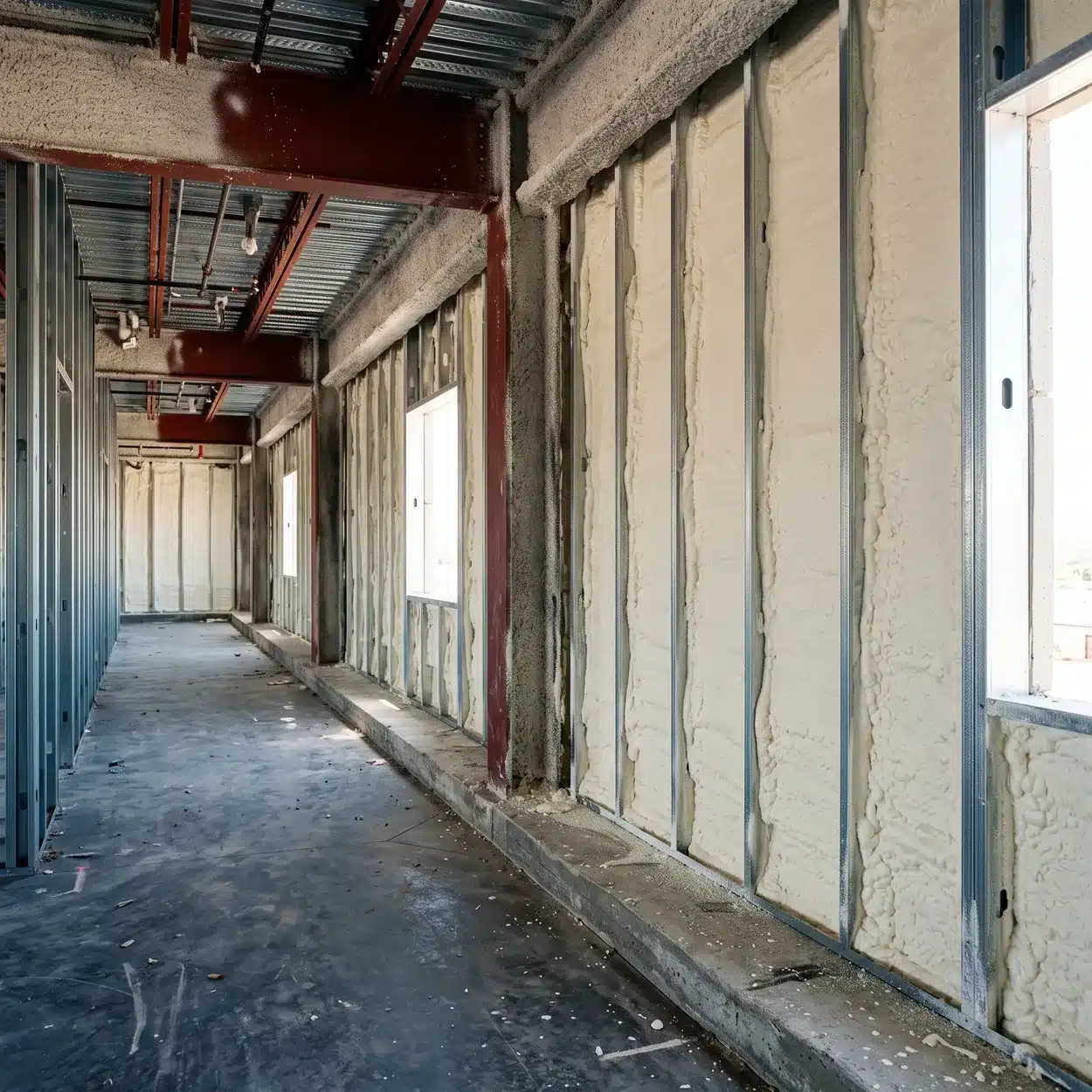
Spray foam belongs on the exterior wall and the roof deck, where its job is air control first and thermal resistance second. Three hospitality conditions make that worth paying for.
Guest rooms are individually conditioned and intermittently occupied, so a packaged terminal unit or fan coil serves one room with no help from anything else. When the exterior wall leaks, that unit is not fighting a design load. It is fighting an unmetered outdoor air load that runs whether the room is sold or not, which is what makes air sealing the first purchase.
Stack effect is the second. A leaky multi-story hotel moves air vertically through stairs, shafts, and chases, out at the top and in down low. Corridor odors then get drawn into upper-floor rooms, and doors get hard to close on the top floors. Owners read both as housekeeping or hardware. They are pressure problems.
The third is the slab edge. Hospitality construction is full of exposed slab edges and cantilevered balconies, and concrete conducts well, so an uninterrupted edge carries heat straight between the room and the outdoors. Inside the room that reads as a cold or hot stripe along the floor line, and in a humid month it is where condensation shows first. Foam inboard reduces leakage at that joint, but the bridge belongs to the licensed architect or engineer.
Musty Rooms, Inward Vapor Drive, and Choosing the Foam
Most of Texas and Oklahoma is cooling dominated, and for much of the year the vapor drive runs inward, from hot humid outdoor air toward the cooled guest room. That is the opposite of the cold-climate assumption most hotel insulation rules of thumb were built on. A leaky envelope here gets damp carpet, musty rooms, and reviews that mention the smell, a revenue problem before an energy problem. Treat this as design guidance: the assembly and the vapor control strategy, including any hygrothermal analysis, belong to a licensed architect or engineer.
| Factor | Closed-cell spray foam | Open-cell spray foam |
|---|---|---|
| Aged R-value per inch | About 6.2 to 7.0 | About 3.6 to 4.5 |
| Density | 1.5 to 2.4 pounds per cubic foot | A soft, low-density foam |
| Permeance at 1 inch | About 0.8 to 1.25 perms | Roughly 26 perms |
| Class under 2021 IBC Table 1404.3(1) | Class II at about 1.5 inches | No class at 1 inch |
The permeance row is what this trade states wrong most often. Closed-cell spray foam is not a vapor barrier. Vapor retarder classes are defined in the 2021 IBC at Section 1404.3 and Table 1404.3(1), measured under ASTM E96 by the water method, Procedure B. Class II, meaning 1.0 perm or less, generally arrives around 1.5 inches, and Class I would take 11 to 13 inches, which nobody installs. Two submittal habits follow: ask for aged R-value and refuse LTTR, a boardstock designation under a different standard, and remember that R per inch is not constant with thickness.
One Prototype, Four Envelope Requirements Across Texas, Kansas, and Oklahoma
This is where a flag brand’s development team gets caught. One prototype rolls across three states, and the same drawing set meets four different envelope requirements, two of them twenty miles apart.
Texas commercial construction is on the 2015 IECC, effective November 1, 2016, under 34 Texas Administrative Code 19.53(a), and a hotel is a commercial building for energy code purposes. Oklahoma adopted the 2006 IECC together with ASHRAE 90.1-2003, with state amendments, effective September 14, 2022. Read that twice: a 2022 effective date on a 2006 edition. Kansas names the 2006 IECC for new commercial and industrial structures under K.S.A. 66-1227, but Kansas is a home-rule state, so adoption sits locally. Home-rule cities amend upward, which is the sharp edge: Dallas enforces the 2021 IECC while Fort Worth is still on the 2015. The DOE Building Energy Codes Program tracks adoption, and the first thing we confirm on a hotel is the edition enforced at that address.
Climate zone is the second variable. Dallas-Fort Worth, Oklahoma City, and Tulsa sit in Climate Zone 3A, Houston in 2A, Wichita in 4A, and a jurisdiction on an older edition is judged against that edition’s map, so confirm the county against Table C301.1 in the adopted edition. One hospitality wrinkle is worth knowing. In the 2021 IECC, Table C402.1.3, an above-grade mass wall in a Group R occupancy in Climate Zone 3 is listed at R-9.5 continuous insulation, against R-7.6 for the same wall in other occupancies. A hotel is Group R-1, so the higher row applies where a jurisdiction amended up to the 2021 edition, as Dallas has. Hotel insulation values otherwise come from the opaque envelope table in the edition your building official enforces, for your climate zone and assembly, and steel-framed walls are written as a cavity value plus a continuous value, so quoting half the row describes a wall that does not comply.
One clarification worth carrying into a development meeting: the sound provisions in IBC Section 1206 come from the building code, not the energy code. They do not move when a jurisdiction changes energy code editions.
Sequencing Hotel Insulation Around a PIP or a Re-Skin
Hotels refresh on brand-mandated cycles, so a property improvement plan or a re-skin is the natural window for this work. Most of the trouble comes from doing these steps out of order.
- Name the complaint you are buying down before anyone quotes. Temperature and noise are two bid packages.
- Specify acoustic performance by tested assembly, never by fill. Reference the assembly and its test report, then inspect against that detail.
- Put the guest room entrance door in the acoustic scope. Door, frame, gasketing, and undercut.
- Walk the floor line, the slab edge, the balconies, and the roof-to-wall transition. A partial air seal moves the problem where nobody can inspect it.
- Draw the thermal barrier in the same set as the foam. Not a later phase and not an allowance.
- Confirm both adopted editions with the jurisdiction. The energy code edition and the building code edition are separate answers.
- Sequence for a property that stays partly open. Floor by floor or stack by stack, with containment, ventilation, odor control, and re-occupancy timing agreed with the operator first.
On budget, no credible installed price is published for hotel insulation in this market, and we are not going to invent one. Access, occupied-floor sequencing, substrate condition, foam type and thickness, and the thermal barrier scope are what move the number.
Related Reading
- Fireproofing for Hotels and Hospitality Buildings covers the passive fire protection side of hospitality construction, a different service line from this work.
- Commercial Spray Foam Insulation Guide works through material selection, code obligations, and detailing.
- When Does Spray Foam Need a Thermal Barrier? is the next read if a guest room ceiling or a mechanical space will leave foam exposed.
Frequently Asked Questions
Does spray foam reduce noise between hotel guest rooms? Not the way owners expect. It reduces noise arriving through the exterior envelope because it seals air paths, but it does not make a wall between two rooms meet the code’s sound requirement. That requirement is written against a tested assembly, so the rating belongs to the wall as a system, not the fill.
What does the building code require for sound between hotel rooms? In the 2021 IBC, Section 1206.2 requires assemblies separating sleeping units to reach a sound transmission class of not less than 50 per ASTM E90, with a field alternative of NNIC not less than 45 under ASTM E336. Section 1206.3 requires an impact insulation class of not less than 50 per ASTM E492, with a field alternative of 45 under ASTM E1007. Entrance doors are set at not less than STC 28.
Is there a special insulation requirement for hotels under the building code? No. There is no Group R-1-specific insulation or thermal barrier provision. Foam plastic in a hotel is governed by 2021 IBC Section 2603.4 for the thermal barrier and Section 2603.3 for surface burning, as in any other occupancy.
Is closed-cell spray foam a vapor barrier in a humid climate? No. Vapor retarder classes are defined in the 2021 IBC at Section 1404.3 and Table 1404.3(1), and measured closed-cell products run about 0.8 to 1.25 perms at 1 inch. Class II, 1.0 perm or less, generally arrives near 1.5 inches, and Class I would take roughly 11 to 13 inches.
What does hotel insulation cost per square foot in Texas? There is no credible published figure for this market, so it has to be bid. Access, whether the property stays open during the work, substrate condition, foam type and thickness, and the thermal barrier scope are what move the price.
Does the same energy code apply to a hotel in Texas, Kansas, and Oklahoma? No. Texas commercial work is on the 2015 IECC, Oklahoma on the 2006 IECC with ASHRAE 90.1-2003, and Kansas names the 2006 IECC under K.S.A. 66-1227 with adoption handled locally. Texas home-rule cities amend upward, so Dallas is on the 2021 IECC while Fort Worth holds the 2015.
Key Takeaways
Temperature and noise are two scopes, not one.
- The envelope decides whether each guest room holds setpoint, and the demising and floor-ceiling assemblies decide what guests hear.
Sound ratings belong to tested assemblies.
- Sound transmission class and impact insulation class describe a complete system, not a cavity fill.
- No published ASTM C423 absorption data exists for spray polyurethane foam.
The sound provisions are keyed to sleeping units.
- 2021 IBC Section 1206.2 sets airborne sound at STC not less than 50 per ASTM E90, or NNIC 45 in the field per ASTM E336, and Section 1206.3 sets impact at IIC not less than 50 per ASTM E492, or 45 per ASTM E1007.
- Entrance doors are set at not less than STC 28, the weakest link in the corridor wall.
Foam plastic rules are occupancy-neutral.
- 2021 IBC Section 2603.4 requires half-inch gypsum wallboard, heavy timber per Section 602.4, or a material meeting NFPA 275.
- Section 2603.3 caps flame spread at 75 and smoke developed at 450 per ASTM E84, at the maximum thickness used.
Hotel insulation earns its money on air, moisture, and code editions.
- Closed-cell foam runs about 6.2 to 7.0 aged R-value per inch and is not a vapor barrier.
- Texas is on the 2015 IECC, Oklahoma the 2006 IECC with ASHRAE 90.1-2003, Kansas the 2006 IECC under home rule, and Dallas is on the 2021 IECC while Fort Worth holds the 2015.
If you own or are developing a hospitality property and you want a crew that separates the acoustic scope from the envelope scope before anyone quotes, holds the air seal continuous through the floor line and the slab edge, and confirms which building code and energy code editions your address is under, that is the hotel insulation work we do throughout Texas, Kansas, and Oklahoma. Call me at 512-387-2111 or email ross@bahlfireproofing.com and we will walk the property with you, or Contact Bahl Fireproofing to get on the schedule. Our spray foam insulation page covers the commercial side, and our Texas service area page shows where we work.
This article provides general educational information about insulation, acoustics, and building envelope performance, and it is not engineering, legal, or code-compliance advice. It does not replace project-specific direction from a licensed architect or engineer. Sound transmission class and impact insulation class are properties of a specific tested assembly and depend on correct installation, so confirm ratings against the applicable test report and the adopted code. Aged R-value and water vapor permeance are product specific and are revised by manufacturers, so verify current values against the latest data sheet and have vapor control reviewed for the specific assembly. Code citations reference a specific edition and adopted editions vary by jurisdiction. Installation must follow the manufacturer’s written instructions, and the cost discussion here is not a quote.