Spray foam and K-13 get compared as if they are competing for the same job, but they are not. One seals the building envelope; the other absorbs sound and finishes an exposed ceiling. Comparing them on R-value alone, where foam wins, misses what each is actually for. This guide breaks down what spray foam vs K-13 each does and how to pick by the problem you are solving rather than by the spec that is easiest to compare.
TLDR: The spray foam vs K-13 question is usually the wrong question, because the two products do not do the same job. Closed-cell spray foam is an envelope material: high R-value per inch, an air and vapor barrier, and condensation control. K-13 is an acoustic and finish material: high sound absorption, a finished exposed ceiling, and a Class A surface. The decision is not which is better, it is which problem you have. To seal the envelope, choose foam; to quiet and finish an exposed ceiling, choose K-13.
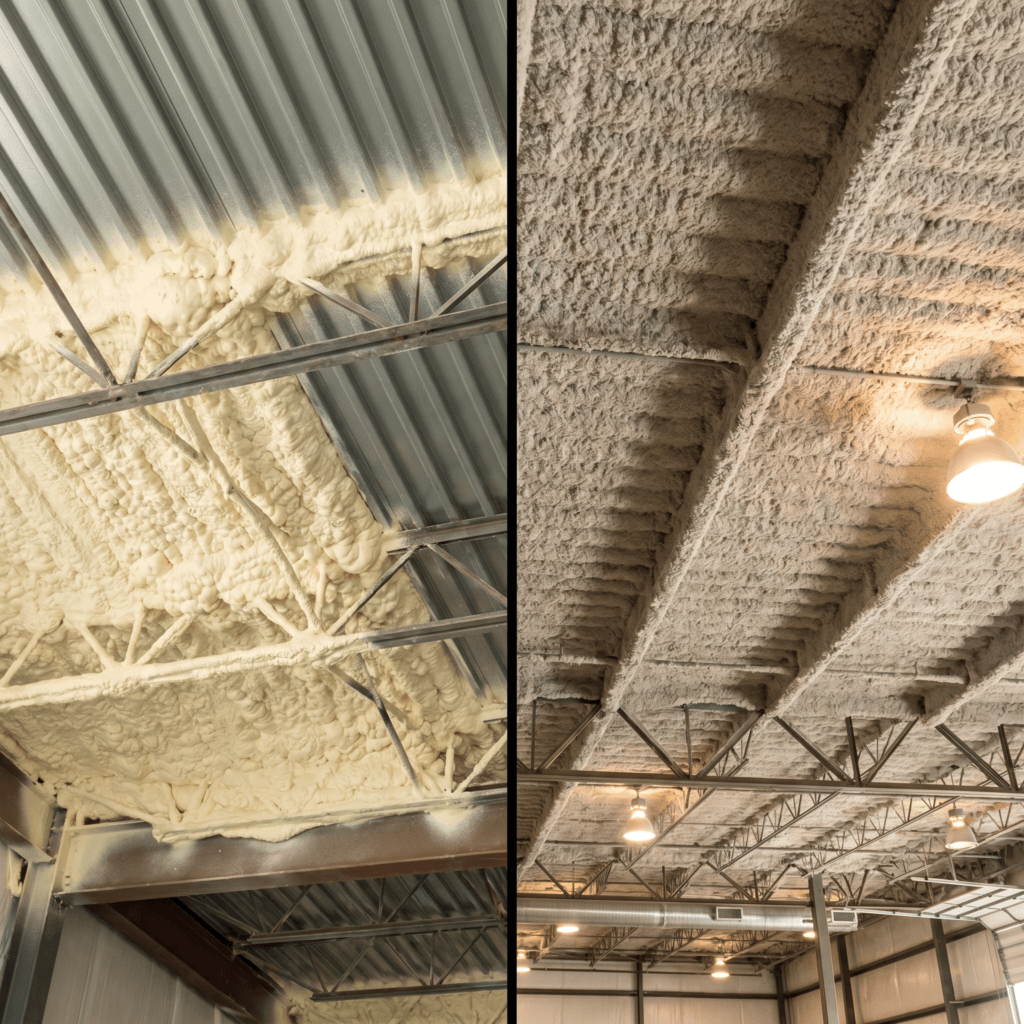
Here is the mistake this comparison exists to prevent. A contractor specifies closed-cell spray foam for a gym or restaurant ceiling because it has the higher R-value, and ends up with a space that is sealed tight but still deafening, and a ceiling that looks like raw foam. The actual problem was acoustics and appearance, neither of which foam solves. Run it the other way and the same thing happens: K-13 specified for a metal building envelope delivers a great-looking, quiet ceiling that does not stop the condensation. Picking the wrong product for the problem is the failure mode, and avoiding it starts with understanding that these two are not interchangeable.
Spray Foam vs K-13: They Solve Different Problems
Spray foam and K-13 are not really competitors, because they solve different problems. Closed-cell spray foam is a thermal and air-sealing material with a high R-value, about R-6 to R-7 per inch, that acts as an air and vapor barrier and controls condensation. K-13 is an acoustic and finish material, about R-3.7 per inch, that absorbs sound and serves as a finished exposed ceiling. The right choice depends on which of those jobs the building needs done, not on a single number.
That framing matters because the two are easy to line up on a spec sheet and compare on the wrong axis. Choosing between spray foam and K-13 is really about diagnosing the problem first, sealing and insulating an envelope versus quieting and finishing a ceiling, and then picking the product built for it. The rest of this guide lays out the differences and the decision.
Side-by-Side Comparison
The table below compares the two products on the factors that actually drive the decision. Notice that they trade off, with foam leading on the envelope metrics and K-13 leading on acoustics and finish, because each was designed for a different role. Thermal values are consistent with general insulation material data.
| Factor | Closed-Cell Spray Foam | K-13 Spray-Applied Insulation |
|---|---|---|
| R-value per inch | About R-6 to R-7 | About R-3.7 |
| Primary role | Thermal, air, and moisture envelope | Acoustic control and finished ceiling |
| Air barrier | Yes, seals the surface | Reduces infiltration, not a sealed barrier |
| Vapor barrier | Yes, Class II at roughly 1.5 inches and up | No |
| Acoustic absorption (NRC) | About 0.70, relatively low | 0.80 to 1.05 by thickness and substrate, high |
| Finished appearance | No, not a finish in itself | Yes, exposed finish in five standard colors |
| Surface fire rating | Foam plastic, requires a thermal barrier | Class A, serves as an exposed finish |
| Condensation control | Yes, warms the surface above dew point | Limited |
| Material | Polyurethane, petrochemical-based | Cellulose, about 80 percent recycled |
| Best for | Metal buildings, cold storage, tight envelopes | Gyms, restaurants, offices, exposed acoustic ceilings |
The takeaway is not that one column is better. It is that the columns describe two different tools, and the right one is whichever matches the row that matters most for the project.
When Spray Foam Is the Right Choice
Choose closed-cell spray foam when the job is the envelope. Its high R-value per inch delivers thermal performance in limited depth, it air-seals the surface, it functions as a vapor barrier at typical thicknesses, and it controls condensation by keeping surfaces above the dew point. Those are exactly the demands of a metal building, a cold storage facility, or any structure where the priority is sealing and insulating the building shell against heat, air, and moisture.
There is one important code consequence: spray foam is a foam plastic, which is combustible, so it generally requires a thermal barrier between it and the occupied space under IBC Section 2603.4. It cannot simply be left exposed the way K-13 can. That requirement does not make foam the wrong choice, it just means an exposed-ceiling application has to account for the barrier, which is part of why foam and K-13 fit different situations.
When K-13 Is the Right Choice
Choose K-13 when the job is acoustics and a finished exposed ceiling, with thermal performance as a secondary benefit. Its sound absorption reaches a noise reduction coefficient as high as 1.05 depending on thickness and substrate, measured per ASTM C423, which is what controls reverberation in a loud, hard-surfaced space. And it is a monolithic Class A finish in five standard colors, so it serves as the visible ceiling itself. Gyms, restaurants, offices, worship centers, and warehouses with noise problems are where that combination fits.
Over the past 20 years applying both products across Texas, Kansas, and Oklahoma, the spray-foam-versus-K-13 question almost always means someone is comparing them on R-value, where foam obviously wins. But that is not the question. I have watched people put closed-cell foam on a gym ceiling for the R-value and still have a space too loud to officiate a game in, because the problem was never thermal, it was acoustic. The two products solve different problems, and the mistake is picking by the spec that is easy to compare instead of the problem you actually have.
The R-Value Trap: Why the Obvious Comparison Misleads
The R-value comparison is a trap because it answers a question most ceiling decisions are not actually asking. Foam’s R-6 to R-7 per inch beats K-13’s R-3.7, and if thermal resistance in minimal depth is the whole problem, that settles it. But K-13 was never primarily a thermal product, it is an acoustic and finish product that also insulates, so judging it against foam on R-value is like judging a ceiling tile against a wall by its strength. It misses the point of what the product is for.
A useful tell is when a project seems to need both high R-value and acoustics. That is usually a sign it has two problems, not one, and that the answer is not a single product chosen by R-value. Recognizing that early is what keeps a team from buying foam for a noise problem or K-13 for a moisture problem, which is the most common way this decision goes wrong.
Can You Use Both?
Yes, and on some buildings that is the right answer. Because foam and K-13 do different jobs, they are not mutually exclusive: closed-cell foam can seal and insulate the envelope while K-13 provides acoustic control and a finished surface where it is needed, each doing what it is built for. They are different layers serving different purposes rather than two options competing for one slot.
This is worth knowing precisely because the products get framed as either-or. A building with both an envelope problem and an acoustic problem does not have to pick one and live with the other unsolved. The practical question becomes where each product belongs and how they coordinate, not which single material has to do everything, which is a better question than the versus framing implies.
Fire and Code Differences
The fire behavior of the two products is a real difference, not a footnote. Closed-cell spray foam is a foam plastic and is combustible, so it requires a thermal barrier, commonly half-inch gypsum board or a tested equivalent, between it and the occupied space, and additional protection applies in some concealed and exposed conditions. Leaving foam exposed without an approved barrier or tested assembly is not permitted.
There is a second foam plastic requirement that the thermal barrier does not cover. Where foam goes into an exterior wall of a Type I, II, III, or IV building at any height, IBC (2021) Section 2603.5.5 requires the exterior wall assembly to be tested to and meet the acceptance criteria of NFPA 285, and IBC (2021) Section 2603.5.4 tightens the foam’s own flame spread index to 25 or less rather than the general 75. NFPA 285 tests the complete assembly, not the foam alone, so a listing belongs to a specific combination of cladding, insulation, barriers, framing, and window detail. K-13 raises none of this, because it is an interior finish rather than a foam plastic in an exterior wall. K-13 is the opposite case. It carries a Class A rating with a flame spread and smoke-developed index of 5, and it is designed to serve as an exposed interior finish, so it does not need a separate barrier to be left visible as the ceiling. That distinction is often the deciding factor for an exposed-structure design: K-13 can be the finished, fire-rated ceiling directly, while foam in the same exposed location brings a barrier requirement with it.
Code note: unless otherwise stated, code references on this page are to the 2021 International Building Code. Code adoption is state and local. Across the states we serve, adopted IBC editions currently range from the 2012 edition to the 2024 edition, some states have no statewide commercial building code, and several enforce NFPA 1 or NFPA 101 rather than the International Fire Code. Minnesota and Wisconsin publish state-amended code books whose numbering and requirements differ from the model code. This is general technical information, not a code determination for your project. Confirm the adopted edition and any local amendments with your authority having jurisdiction.
Choosing Between Spray Foam and K-13 in Texas, Kansas, and Oklahoma
Across our Texas, Oklahoma, Kansas, Nebraska, Minnesota, and Wisconsin service area, both products see heavy use, just on different building types. Closed-cell foam goes on the region’s metal buildings, cold storage, and envelope-driven projects, where sealing against heat and humidity is the priority. K-13 goes on gyms, schools, restaurants, worship centers, and warehouses where noise and a finished exposed ceiling are the priority. The decision on any given project comes down to diagnosing which problem dominates, and sometimes recognizing that both apply. Helping owners and contractors make that call, and applying whichever product or combination the building needs, is the work our team does throughout our service area.
Frequently Asked Questions
What is the difference between spray foam and K-13? Closed-cell spray foam is an envelope material: high R-value per inch, an air and vapor barrier, and condensation control. K-13 is an acoustic and finish material: high sound absorption, a finished exposed ceiling, and a Class A surface. They are built for different jobs rather than as competing versions of the same thing.
Which has a higher R-value, spray foam or K-13? Closed-cell spray foam, at about R-6 to R-7 per inch, well above K-13’s roughly R-3.7. But K-13 is not primarily a thermal product, so comparing the two on R-value alone misses that K-13’s main jobs are acoustic absorption and serving as a finished ceiling.
Which is better for acoustics? K-13, by a wide margin. Its noise reduction coefficient reaches as high as 1.05 depending on thickness and substrate, while closed-cell spray foam is around 0.70. For controlling reverberation and noise in a hard-surfaced space, K-13 is the product designed for the job.
Can spray foam be left exposed like K-13? No, not without additional protection. Spray foam is a foam plastic and generally requires a thermal barrier between it and the occupied space under IBC (2021) Section 2603.4. K-13 is a Class A material designed to serve as an exposed finish, so it can be left visible as the ceiling.
Which controls condensation in a metal building? Closed-cell spray foam. It air-seals the surface, acts as a vapor barrier at typical thicknesses, and keeps the surface above the dew point, which is what prevents condensation on cold metal. K-13’s condensation control is limited by comparison, since it is not a sealed barrier.
Can you use both spray foam and K-13? Yes. Because they do different jobs, closed-cell foam can seal and insulate the envelope while K-13 provides acoustic control and a finished surface, each in the role it is built for. They are not mutually exclusive, and some buildings benefit from both.
How do I choose between them? Diagnose the dominant problem. If it is sealing and insulating the envelope, including air, vapor, and condensation control, choose closed-cell spray foam. If it is controlling noise and providing a finished exposed ceiling, choose K-13. If the project clearly has both problems, the answer may be both products in their respective roles.
Key Takeaways
- They solve different problems. Spray foam is an envelope material; K-13 is an acoustic and finish material. The comparison is about fit, not which is better.
- Foam leads on the envelope. Higher R-value per inch, air and vapor barrier, condensation control, the right call for metal buildings and cold storage.
- K-13 leads on acoustics and finish. Noise reduction up to 1.05 and a Class A exposed ceiling, the right call for gyms, restaurants, and offices.
- R-value alone misleads. Foam wins on R-value, but K-13 was never primarily thermal, so that axis answers the wrong question.
- Fire behavior differs. Foam needs a thermal barrier under IBC (2021) Section 2603.4; K-13 is Class A and serves as an exposed finish.
- They can coexist. Foam for the envelope and K-13 for acoustics and finish are different layers, not competing options.
- Choose by the problem. Diagnose whether the job is envelope or acoustics and finish, and pick the product, or combination, built for it.
Related Reading
- Want the full K-13 picture? Read our K-13 complete contractor guide.
- Comparing foam types? See closed-cell vs open-cell spray foam for commercial buildings.
- Focused on noise? Read K-13 insulation soundproofing.
If you are weighing spray foam against K-13 for a commercial ceiling and want to choose by the problem rather than the spec sheet, the work is diagnosing whether the job is sealing the envelope or quieting and finishing the ceiling, and applying the right product or combination. That is work our crew handles throughout Texas, Oklahoma, Kansas, Nebraska, Minnesota, and Wisconsin. Reach me directly at 512-387-2111 or ross@bahlfireproofing.com, or Contact Bahl Fireproofing to figure out which fits your project.
This article provides general educational information comparing closed-cell spray foam and K-13 spray-applied insulation for commercial ceilings. It is not engineering advice and does not replace project-specific direction from a licensed architect or engineer. Product selection depends on thermal, acoustic, moisture, fire, and budget requirements specific to each project. R-values, acoustic performance, and vapor characteristics depend on product, thickness, and assembly, and spray foam thermal barrier requirements vary by jurisdiction. Always confirm product specifications and code requirements with the manufacturer, the authority having jurisdiction, and a licensed architect or engineer before specifying or installing any system.