Fireproofing protects your structural steel for the life of the building, but it does not take care of itself. Trades knock it off, renovations disturb it, and water and abrasion wear it down, and nobody notices until an inspector or a fire does. This is a practical fireproofing inspection checklist for building owners and facility managers to keep existing fireproofing intact, separate from the one-time special inspection performed during construction.
TLDR: The fireproofing inspection that matters most is the one that happens after the building opens. The code-mandated special inspection only confirms the fireproofing was correct on day one; keeping it correct over the building’s life is the owner’s job, and most in-service fireproofing damage stays invisible until someone looks above the ceiling. This fireproofing inspection checklist covers what to check, where to look, how often, what to document, and when to call a professional.
Picture a steel beam above a drop ceiling where an HVAC contractor knocked the fireproofing loose during a tenant fit-out two years ago and never patched it. The bare steel has been sitting there, unprotected, ever since, which means the fire-resistance rating that assembly was built to has been compromised the entire time. The construction special inspection signed off years ago, the certificate of occupancy is framed on the wall, and no one has looked above that ceiling since. That gap is exactly what an owner’s inspection routine exists to catch.
Why Building Owners Need an Ongoing Fireproofing Inspection
Building owners need an ongoing fireproofing inspection because the special inspection performed at construction only verifies the fireproofing was correct when the building opened. Over the building’s life, MEP work, renovations, water, and abrasion damage it, and because most fireproofing sits above ceilings and out of sight, that damage goes unnoticed until it is found by a re-inspection, an insurer, or a fire. Keeping the protection intact after occupancy is the owner’s responsibility, not the original inspector’s.
That responsibility is easy to overlook precisely because fireproofing is passive and hidden. It does its job silently for decades, which makes it simple to forget until something forces the issue. A periodic owner inspection turns that hidden system into something you actually verify, instead of something you assume is fine. It is the difference between knowing your fireproofing is intact and hoping it is.
Construction Inspection Versus Ongoing Inspection: Know the Difference
These are two different things, and confusing them is how buildings end up unprotected. The construction special inspection, required by IBC Section 1705.15, is a one-time, code-mandated verification of thickness, density, and bond strength, performed by a qualified special inspector before the certificate of occupancy is issued. It proves the installation met the approved documents on the day it was done.
The ongoing inspection is something else entirely: the owner’s periodic check that the fireproofing is still there and still intact years later. The first inspection gets you occupancy; the second keeps you protected. This checklist is about the second, the one that has no certificate riding on it and that, for that reason, is the one most likely to be skipped. For the details of the construction-phase process, the inspection-process guide linked at the end covers it in full.
What Damages Fireproofing After the Building Opens
I have been in this trade for over forty years, and the damage I find above ceilings often traces to work that happened after the building opened, not to bad original application. MEP trades are a common culprit: an electrician, plumber, or HVAC tech runs a new line through a fireproofed beam or deck, knocks material loose, and moves on without patching it. Renovations and tenant fit-outs disturb it the same way, often years apart, so the damage accumulates.
Water is the second pattern. A roof or plumbing leak saturates fireproofing, and certain materials lose bond or degrade when they stay wet, leaving sagging or crumbling protection over corroding steel. Abrasion and impact in mechanical rooms, storage areas, and high-traffic zones wear material away, and vibration near equipment can loosen it over time. None of these announce themselves, which is why a deliberate look is the only way to find them.
The Fireproofing Inspection Checklist: What to Check and Where
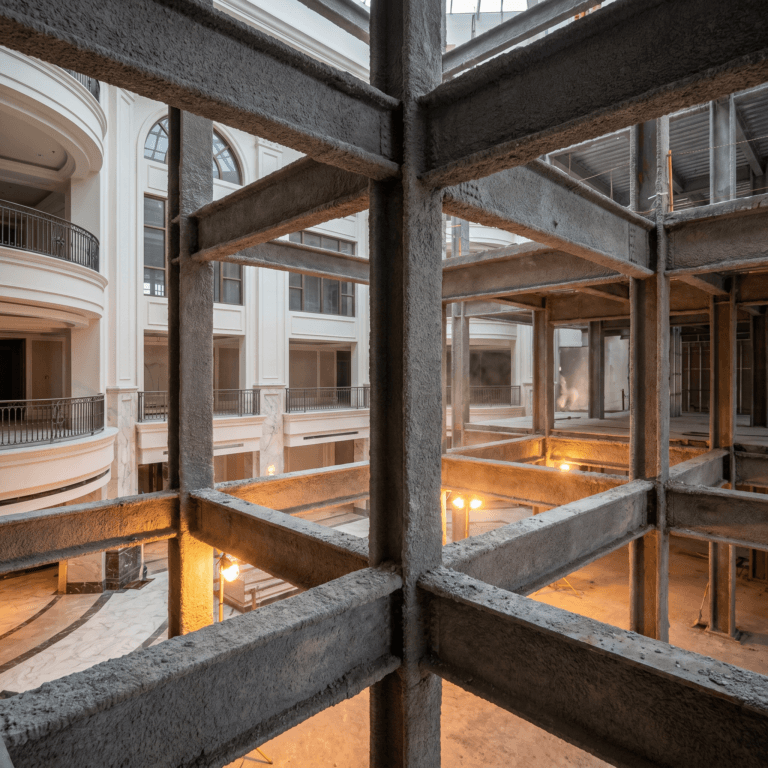
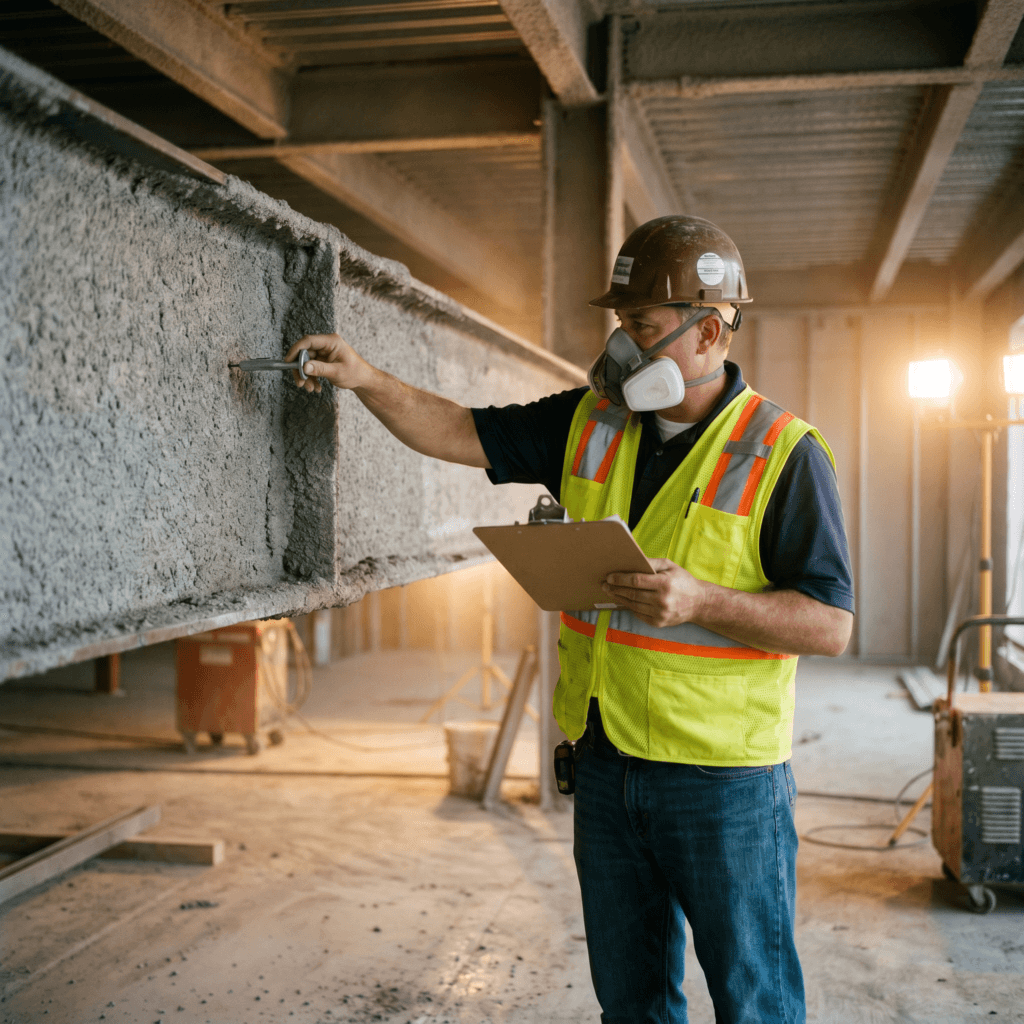
A useful fireproofing inspection checklist works through the building’s fire-rated steel systematically rather than glancing around. Start with where the fireproofing actually is: above ceiling tiles at beams, columns, and connections, on the underside of floor and roof deck, around every MEP penetration, and in mechanical rooms and high-traffic areas where physical damage is likely. Pull ceiling tiles in a representative sample of spaces rather than assuming what you cannot see is fine.
Work through this checklist at each location:
- Bare steel. Any spot where material is missing or knocked off, exposing uncoated steel, is a compromised assembly.
- Unpatched penetrations. Gaps and open areas around newly run pipes, conduit, or duct where trades cut through and did not restore the fireproofing.
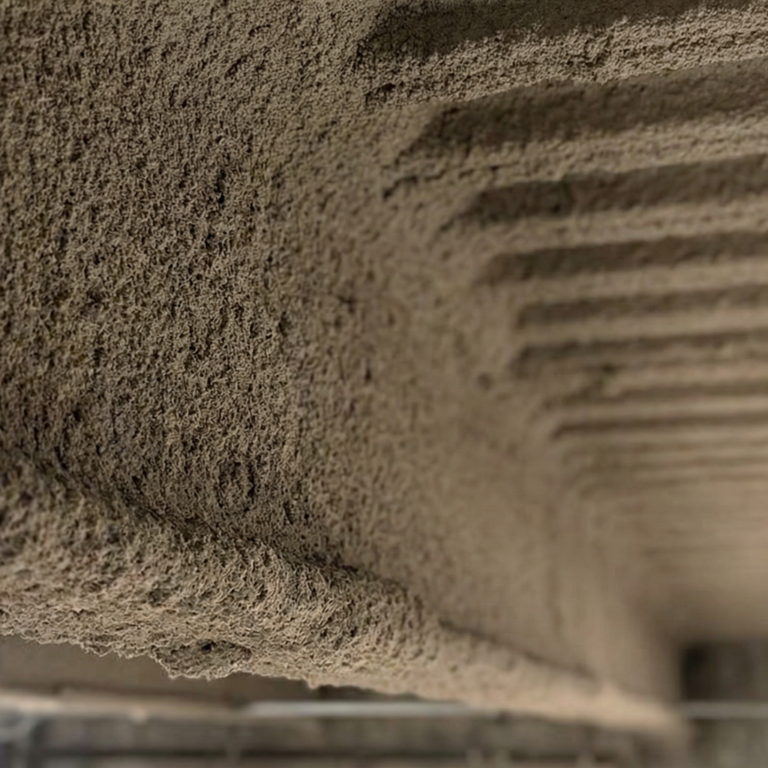
- Cracks, delamination, or sagging. Material separating from the steel, cracking, or hanging loose has lost the bond it needs to perform.
- Water damage. Staining, dampness, or visible corrosion under or around the fireproofing points to a leak and possible material degradation.
- Removed or thinned material. Areas where trades scraped, crushed, or compressed the fireproofing, including overspray that was cleaned off and never reapplied.
- Traffic and impact damage. Crushed or gouged material in storage, mechanical, and high-use areas.
Photograph anything questionable with its location noted, so the condition can be tracked and shown to a professional. The checklist identifies problems; it does not fix them.
What the fire code asks of owners. In the International Fire Code (2021 and 2024 model editions), Section 701.6 requires the owner to keep an inventory of required fire-resistance-rated construction, visually inspect it every year, repair anything damaged and keep records. Section 708.1, added in the 2021 edition, says sprayed and intumescent fireproofing that was required when the building was permitted must be visually inspected to confirm no steel is exposed. The 2027 IFC, published in 2026 but not yet adopted in any state we serve, extends that 708.1 check to other fire-resistance protection materials such as boards and wraps, and adds Section 708.2: the material has to stay securely bonded, without deterioration, delamination, cracks or voids that expose the steel, and repairs follow the original listing and the manufacturer’s repair instructions where those are known, or use the same material type and thickness as originally used where they are not. Local amendments can change any of this, so check the version your fire marshal enforces.
Not every building runs on the IFC. Nebraska and Wisconsin use NFPA 1, the Fire Code, statewide, and the Texas State Fire Marshal applies NFPA 1 and NFPA 101 to state-owned buildings, while Texas and Missouri cities adopt their own fire codes. The 2021 edition of NFPA 1 (Section 12.3.3) requires fire-resistive construction, including spray-on materials, to be maintained, and in high-rise buildings to be visually inspected at least every three years. Hospitals, nursing homes and other facilities that take Medicare or Medicaid answer to the 2012 edition of NFPA 101, the Life Safety Code, through federal CMS rules, and there fire-resistive construction is inspected and maintained as that code and the authority having jurisdiction direct. Oklahoma and Iowa (2024 IFC), Minnesota (a state fire code built on the 2018 IFC), Arizona (2018 IFC for state buildings and areas without a local code) and Kansas (2006 IFC with NFPA 101) sit on the IFC side.
How Often Should You Inspect, and What Triggers a Check
A reasonable baseline is a periodic walk-through of representative areas, but the more important inspections are event-driven. Inspect after any work that happened above the ceiling or near the structure, because that is when most damage occurs. Inspect after any water event, since a leak can loosen the bond and start corrosion on the steel. And inspect before a tenant turnover or fit-out, both to document the existing condition and because the incoming work is likely to disturb the steel again.
The principle is simple: any time someone has been working in the ceiling or the structure has been wet, assume the fireproofing may have been affected and verify it. Treating those events as inspection triggers catches the damage close to when it happened, while the responsible party may still be on record, rather than discovering it years later with no idea who did it.
What an Intact Assembly Actually Protects
The reason any of this matters is that fireproofing is rated as part of a tested assembly, not as a coating in isolation. A fire-resistance rating is established by testing the complete assembly to ASTM E119, and that rating assumes the fireproofing is present and intact at the specified thickness. Strip a section of it off, and that part of the assembly is no longer the rated assembly: a two-hour beam with a bare patch is not a two-hour beam anymore.
That is why a small area of missing material is not a cosmetic issue. In a fire, steel loses strength as it heats, and the fireproofing is what slows that heating long enough for people to evacuate and the structure to hold. A gap in the protection is a gap in exactly the place the rating was counting on, which is what makes finding and restoring damage worth the effort of looking.
Documentation: The Records Every Owner Should Keep
An inspection is only as useful as the records behind it. Keep the original special-inspection reports from construction, the as-built fireproofing specifications (the product, the required thickness, and the assemblies used), photographs of current conditions, and a running log of any damage found and repairs made. Those documents are what a future special inspector, an insurer, or a prospective buyer will ask for, and reconstructing them after the fact is far harder than maintaining them.
Good documentation also makes each inspection faster and more accurate, because you can compare current conditions to a known baseline and to your required thicknesses rather than guessing. For an owner, that record is the proof that the building’s fire protection has been maintained, not just installed, which is increasingly what diligence on a commercial property looks like.
When to Call a Professional: From Checklist to Repair
The owner’s checklist identifies; a qualified professional verifies and repairs. Bring in a qualified fireproofing contractor whenever you find bare steel, unpatched penetrations, water-damaged material, or anything you are unsure about. Repairs have to restore the assembly with the correct listed material at the right thickness, not just fill the gap with whatever is handy, and where your jurisdiction requires it, an independent special inspector or testing agency confirms the repair with thickness and density checks per ASTM E605 and bond strength per ASTM E736, never the contractor who did the work.
Access and safety are part of this step, since proper inspection and repair of overhead fireproofing often require lifts, ladders, and ceiling access that a casual look does not. The handoff is clean: you walk the building and document what you find, and a professional brings the listed materials and the equipment to put the protection back to its rated condition. The repair guide and inspection-process guide linked below cover what that work involves.
Fireproofing Inspection for Building Owners in Texas, Kansas, and Oklahoma
Across our Texas, Oklahoma, Kansas, Nebraska, Minnesota, Wisconsin, Arizona, Missouri, and Iowa service area, the buildings to check first are the ones that have been through tenant turnovers, expansions, or roof repairs. The practical move for owners and facility managers is to build this fireproofing inspection checklist into the building’s routine, especially as an automatic step after any ceiling work or water event. Catching and restoring damage early is far cheaper than discovering it during a sale, a re-inspection, or an emergency, which is the work our team handles for owners throughout our service area.
Frequently Asked Questions
Why do building owners need an ongoing fireproofing inspection? Because the special inspection at construction only confirms the fireproofing was correct on opening day. MEP work, renovations, water, and abrasion damage it over time, and since it sits above ceilings out of sight, that damage goes unnoticed until a re-inspection or a fire finds it. Maintaining the protection is the owner’s responsibility.
Is an in-service fireproofing inspection required by code? The special inspection during construction is code-mandated under IBC (2021) Section 1705.15 (Section 1705.14 in the 2018 and earlier editions). Ongoing in-service inspection is part of the owner’s broader responsibility to maintain the building’s fire protection, and while the framework varies by jurisdiction, leaving damaged fireproofing unaddressed means the rated assembly is no longer performing as required.
Where is fireproofing damage usually found? Above ceiling tiles at beams, columns, and connections, on the underside of floor and roof deck, and around MEP penetrations where trades have run new lines. Mechanical rooms and high-traffic areas are also common, because that is where physical impact and abrasion occur.
How often should fireproofing be inspected? A periodic baseline walk-through plus event-driven checks. Inspect after any work above the ceiling, after any water event, and before a tenant turnover or fit-out, because those are the moments when fireproofing is most likely to have been disturbed or damaged.
What does damaged fireproofing actually affect? It compromises the fire-resistance rating of the assembly, which is established by testing the complete assembly to ASTM E119 with the fireproofing intact. A section of missing material means that part of the structure no longer carries its rated protection, so a two-hour assembly with bare steel is no longer a two-hour assembly.
Can I inspect fireproofing myself? Owners and facility managers can and should visually check and document conditions using a checklist like this one. Repairing damage is work for a qualified fireproofing contractor, and any required testing for thickness, density, and bond is done by an independent special inspector or testing agency, so the owner’s role is to find and record problems and then bring in a professional.
What should I do if I find damaged fireproofing? Document it with photos and location notes, and bring in a qualified fireproofing contractor to restore the assembly with the correct listed material at the proper thickness. Do not ignore it or patch it with an unlisted product, because either leaves the assembly’s fire rating compromised.
Key Takeaways
- The inspection that matters is after opening. The construction special inspection confirms day-one condition; keeping fireproofing intact over the building’s life is the owner’s job.
- Most damage is post-construction and hidden. MEP work, renovations, water, and abrasion cause it, and it sits above ceilings where no one looks.
- Know where to look. Beams, columns, connections, deck undersides, MEP penetrations, and mechanical and high-traffic areas.
- Use event triggers. Inspect after any ceiling work, any water event, and before tenant turnovers, not just on a calendar.
- Damage breaks the rating. Fireproofing is rated as part of an ASTM E119 assembly, so bare steel means that section is no longer its rated assembly.
- Keep the records. Original inspection reports, as-built specs, photos, and a repair log are what inspectors, insurers, and buyers will want.
- Hand off to a professional. Owners find and document; a qualified contractor restores the assembly with listed material and confirms it with field testing.
Related Reading
- Want the construction-phase process? Read the fireproofing inspection process for what happens before occupancy.
- Found damage from trades? See our fireproofing repair after MEP trades guide for how restoration works.
- Need the code basics? Review commercial fireproofing requirements for building owners.
- How to Choose a Fireproofing Contractor: A Buyer’s Checklist
If you own or manage a commercial building and have never looked above the ceiling at your fireproofing, the work is straightforward: walk the rated steel with this checklist, document what you find, and bring in a professional to restore anything that is damaged. That is work our crew handles throughout Texas, Oklahoma, Kansas, Nebraska, Minnesota, Wisconsin, Arizona, Missouri, and Iowa. Reach me directly at 512-387-2111 or ross@bahlfireproofing.com, or Contact Bahl Fireproofing to schedule an assessment of your building’s fire protection.
This article provides general educational information about inspecting in-service commercial fireproofing. It is not engineering advice and does not replace the code-required special inspections performed by qualified special inspectors meeting IBC criteria, nor repair and field testing performed by qualified professionals. An owner’s visual self-inspection supplements but does not satisfy code-mandated inspection requirements. Inspection intervals, responsibilities, and repair requirements vary by jurisdiction and by the specific rated assemblies in your building. Always confirm fire-protection inspection and maintenance obligations with the authority having jurisdiction and a licensed architect or engineer before relying on any inspection or repair approach.