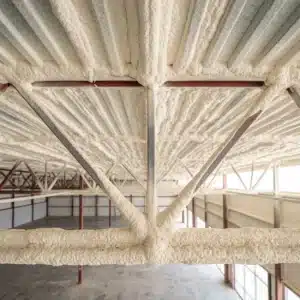
There is no single per-square-foot price for commercial spray foam, because the spray foam insulation cost on any given project is driven by a specific set of variables. This guide walks through what actually moves the number, so you can read a bid intelligently and recognize one that is too low to be complete. It does not quote prices, because an honest number comes from a site-specific quote, not a published rate.
TLDR: Commercial spray foam insulation cost is driven by the foam type, the target R-value and the thickness it requires, the square footage, building access, the code-required thermal barrier, and surface preparation, not by a flat per-square-foot rate. A bid that quotes one number without accounting for these is either incomplete or too low to be real. This guide explains the drivers so you can read a quote intelligently, not so you can skip getting one.
Here is how this goes wrong. An owner collects bids, takes the lowest per-square-foot number, and then watches it climb with change orders. Or the cheap “insulation” line turns out to have excluded the thermal barrier the code requires over the foam. Or the bid quietly assumed open-cell foam at a thickness that will not hit the R-value the building needs. In each case the low number was not actually cheap. It was incomplete. The mistake is shopping spray foam on a single rate instead of on what the job actually requires, and the fix is understanding the handful of things that move the price.
What Determines Spray Foam Insulation Cost?
Commercial spray foam insulation cost is determined by the foam type, the R-value the project must hit and the thickness needed to reach it, the total square footage, building access and complexity, the code-required thermal barrier, and surface preparation. Because every one of these varies by project, a meaningful number comes from a site-specific quote rather than a published rate or a number pulled from a competitor’s website.
The rest of this guide takes those drivers one at a time. None of them is exotic, but together they explain why two bids on what looks like the same building can land far apart, and why the spread is usually about scope, not about one contractor being greedy and another being generous. Getting the scope right is the part we focus on before a number ever goes on paper for our commercial spray foam insulation work.
Foam Type Is the First Cost Driver
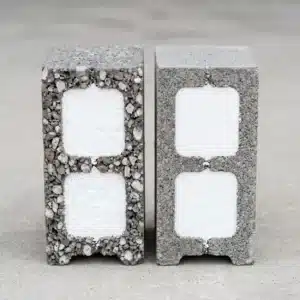
The single biggest material variable is whether the job uses closed-cell or open-cell foam, because the two are different products with different yields. According to the DOE Building America spray foam guide, closed-cell foam runs about R-6 to R-7 per inch at a density near 2 pounds per cubic foot, while open-cell foam is about R-3.5 to R-3.8 per inch at roughly half a pound per cubic foot. Closed-cell is denser, doubles as a vapor retarder, adds racking strength to the assembly, and uses more material per board foot, which makes it cost more per unit. Open-cell is lighter, gives a more economical yield, and air-seals well, but it is vapor-permeable and needs more thickness for the same R-value.
The point is not that one foam is the “expensive” choice and the other is the “cheap” choice. The point is that the application decides which one the job needs, and that decision drives the material side of the cost. A moisture-prone or thin-cavity application may require closed-cell regardless of budget, while an interior application where vapor permeability is fine may run open-cell.
Over the past 20 years quoting and installing commercial spray foam across Texas, Kansas, and Oklahoma, the bids that blow up almost never blow up because the foam itself got more expensive. They blow up because the original number left something out: the thermal barrier the code requires, the prep on a dirty or wet deck, the access on a high or congested ceiling, or a foam type and thickness that could not hit the required R-value. The foam is the easy part to price. What surrounds it is where the real cost lives.
R-Value and Thickness: How Much Foam the Job Needs
The required R-value sets the thickness, and thickness sets how much material gets sprayed. Energy codes drive the requirement: the minimum R-values by climate zone come from IECC Section C402, enforced in Texas as the 2015 edition, and most of Texas sits in Climate Zones 2 and 3, which call for less insulation than the colder zones north of it. Once the target R-value is set, the foam type determines the inches. Closed-cell reaches a given R-value in fewer inches but at a higher cost per inch, while open-cell reaches the same R-value with more inches of a cheaper-per-unit material.
That interaction is why “how much does spray foam cost” has no clean answer without the specs. The same target R-value can be met two ways, with different material volumes and different per-unit costs, and the right answer depends on the assembly, the cavity depth, and whether moisture control is in play. A quote that does not state the foam type and the thickness is not really a quote, because those two facts are most of the material cost.
Square Footage and Project Scale
Total area is the obvious multiplier, but scale cuts both ways. A large, open project spreads the fixed costs of mobilization, setup, and equipment over more square footage, which tends to improve the per-unit economics. A small job carries those same fixed costs over a smaller area, so the effective rate is higher, and many contractors apply a project minimum for that reason. This is why a per-square-foot number from a big warehouse job does not transfer to a small mechanical room, even with identical foam.
Building Access and Complexity
How hard the foam is to reach moves the labor side of the number more than people expect. An open, empty, new-construction shell sprays fast. A high ceiling, a deck congested with mechanical, electrical, and plumbing runs, an occupied building that requires masking and off-hours work, or a cut-up space with limited access all add labor and time. Two buildings with the same square footage and the same foam can carry very different labor costs purely because of access, and that difference is legitimate, not padding.
The Thermal Barrier Is a Separate Cost
This is the line item most often missing from a low bid. Because spray foam is a foam plastic, IBC Section 2603.4 generally requires it to be separated from the building interior by a thermal barrier, typically half-inch gypsum board or a tested coating. That barrier is a separate scope and a separate cost from the foam itself. A bid that prices the insulation but leaves out the gypsum or the tested coating is not cheaper, it is incomplete, and the gap shows up either as a change order or as a failed inspection. When comparing quotes, confirming that each one includes the barrier is one of the fastest ways to tell whether you are comparing equal scope.
Surface Preparation and Existing Conditions
Foam needs a clean, dry, sound substrate to bond, so the condition of what it is going onto affects the cost. A bare new deck sprays as-is. An existing building may need cleaning, drying, moisture remediation, or removal of old insulation before foam can go down, and each of those is added scope. Retrofit work generally costs more than new construction for this reason, and a quote on an existing building should be clear about what prep and removal it includes.
How to Read a Spray Foam Bid
A few checks separate a complete bid from a number that will grow later.
- Confirm the foam type and thickness, and that they match the R-value the building actually needs.
- Confirm the thermal barrier is in the scope, not assumed to be someone else’s line item.
- Confirm that surface prep and any removal of existing insulation are accounted for.
- Compare bids on equal scope, not on the headline per-square-foot rate.
- Treat a number far below the others as a flag to ask what it left out, not as a win.
Run those checks and a confusing spread of bids usually resolves into a clear picture of who priced the whole job and who priced part of it.
Spray Foam Cost in Texas, Kansas, and Oklahoma
Regional factors shape the number on top of the building-specific ones. Climate zone sets the required R-value, which most of this region keeps moderate. Local labor and material markets vary by metro. And because code adoption happens locally, the thermal barrier requirements and any amendments depend on the adopted edition in that jurisdiction. None of that produces a single regional rate, which is why the honest answer to a price question is a site visit. That is how we approach spray foam quoting throughout Texas and the surrounding states: look at the actual building, define the full scope, and put a real number to it.
What NFPA 285 Does to an Exterior Wall Budget
This is a cost driver that never appears as a line item, because it is not a material. IBC (2021) Section 2603.5 governs exterior walls containing foam plastic insulation in buildings of Type I, II, III or IV construction, of any height, plus multi-story cold storage buildings required to be of noncombustible construction. For those walls IBC (2021) Section 2603.5.5 requires that the exterior wall assembly be tested in accordance with and comply with the acceptance criteria of NFPA 285.
Code note: unless otherwise stated, code references on this page are to the 2021 International Building Code. Code adoption is state and local. Across the states we serve, adopted IBC editions currently range from the 2012 edition to the 2024 edition, some states have no statewide commercial building code, and several enforce NFPA 1 or NFPA 101 rather than the International Fire Code. Minnesota and Wisconsin publish state-amended code books whose numbering and requirements differ from the model code. This is general technical information, not a code determination for your project. Confirm the adopted edition and any local amendments with your authority having jurisdiction.
Why It Shows Up in the Price
NFPA 285 is the Standard Fire Test Method for Evaluation of Fire Propagation Characteristics of Exterior Wall Assemblies Containing Combustible Components, current edition 2025. It evaluates an entire wall as built, cladding through framing, which puts it in the category of an assembly test, never a product test. A drum of foam cannot be NFPA 285 compliant on its own, whatever a price sheet implies.
The budget consequence follows directly. Once a listed assembly is chosen its components are fixed: that cladding, that barrier, that foam at that thickness, those opening details. Swapping in a cheaper component can take the wall outside the listing, so the saving being quoted may not be available on a wall in scope at all. When someone offers a lower number by changing a layer, the first question is whether the assembly listing survives the change.
The costly version is finding out late. A wall already closed up that matches no listing leaves two options, a fire protection engineer’s engineering judgment or a fresh NFPA 285 test, and both cost more in schedule than the substitution ever saved in material.
The Other Chapter 26 Line Items
Two further requirements attach to the same foam. The general foam plastic limits in IBC (2021) Section 2603.3 remain a flame spread index of 75 or less and a smoke-developed index of 450 or less. IBC (2021) Section 2603.5.4 is stricter for exterior walls of Type I through IV construction, at 25 or less flame spread and 450 or less smoke developed, tested at the thickness intended for use up to 4 inches per ASTM E84 or UL 723. IBC (2021) Section 2603.4 requires an interior thermal barrier, which is a genuine line item: 1/2-inch gypsum wallboard, heavy timber complying with IBC (2021) Section 602.4, or a material meeting the acceptance criteria of both the Temperature Transmission Fire Test and the Integrity Fire Test of NFPA 275.
When It Is Not in the Budget at All
- Type V buildings. Their exterior walls comply with IBC (2021) Sections 2603.2, 2603.3 and 2603.4, and 2603.5 does not apply to them.
- Exception 1. One-story buildings complying with IBC (2021) Section 2603.4.1.4.
- Exception 2. Foam plastic covered on each face by not less than 1 inch of masonry or concrete, with either no airspace, or a flame spread index of 25 or less and an airspace not more than 1 inch.
Ask which of these applies during design, while the answer is still free. The determination is your architect or engineer’s to make and the authority having jurisdiction’s to accept.
Frequently Asked Questions
What determines spray foam insulation cost? The foam type, the required R-value and the thickness needed to reach it, the square footage, building access and complexity, the code-required thermal barrier, and surface preparation. Because these vary by project, a meaningful number comes from a site-specific quote rather than a published per-square-foot rate.
Is closed-cell or open-cell spray foam more expensive? Closed-cell generally costs more per unit because it is denser, uses more material per board foot, and delivers a higher R-value per inch. But the application usually decides which one the job needs, so the right question is which foam the assembly requires, not which one is cheaper.
Why do spray foam quotes vary so much? Almost always because of scope, not greed. Different bids assume different foam types, thicknesses, barrier inclusion, and prep. Comparing them on equal scope, rather than on the headline rate, is the way to see what is actually being priced.
Does the thermal barrier add to the cost? Yes. The code-required thermal barrier, typically half-inch gypsum or a tested coating, is a separate scope from the foam. A bid that omits it is incomplete, and the cost reappears later as a change order or a failed inspection.
How thick does spray foam need to be? Enough to reach the R-value required for the climate zone, which depends on the foam type. Closed-cell hits a target R-value in fewer inches than open-cell. The thickness is a specification driven by the required R-value, not a number you choose to save money.
Can I get a price per square foot for spray foam? A reliable number requires a site visit, because a flat per-square-foot rate ignores the foam type, thickness, barrier, access, and prep that actually drive the cost. A published rate is a starting point at best, not a quote.
Why is my spray foam bid so low compared to others? Often because it left something out, most commonly the thermal barrier, the surface prep, or a thinner or cheaper foam than the required R-value calls for. A low bid is a reason to ask what scope it includes before treating it as the best deal.
Does spray foam cost more than fiberglass? Generally more per unit, yes. But spray foam air-seals the assembly and holds its R-value over time, so the comparison is more useful on installed performance than on material rate alone. Whether the added cost is worth it depends on the building’s goals.
Key Takeaways
- There is no flat per-square-foot price. Commercial spray foam insulation cost is driven by foam type, required R-value and thickness, square footage, access, the thermal barrier, and prep.
- Foam type is the first lever. Closed-cell costs more per unit at about R-6 to R-7 per inch, open-cell is cheaper per unit at about R-3.5 to R-3.8 per inch, and the application decides which the job needs.
- R-value sets the thickness, and thickness sets the material. The required R-value for the climate zone, met by the chosen foam type, is most of the material cost.
- The thermal barrier is a separate cost. The code-required gypsum or tested coating is its own scope, and a bid that omits it is incomplete, not cheap.
- Access and prep are real costs. High or congested ceilings, occupied buildings, and dirty or existing substrates add legitimate labor and scope.
- Compare bids on equal scope. A confusing spread usually resolves once you check that each quote includes the same foam type, thickness, barrier, and prep.
- A real number needs a site visit. Climate zone, local market, and code edition all factor in, so an honest price comes from looking at the actual building.
Related Reading
- Deciding between foam types? See closed-cell vs open-cell spray foam for how the choice affects both performance and cost.
- Want the full picture? Our commercial spray foam insulation guide covers the system end to end.
- Weighing the payback? Read spray foam insulation energy savings for how the operating cost side works.
If your next project needs spray foam and you want a number that holds, the work is defining the real scope: the foam type and thickness for your required R-value, the thermal barrier, the access, and the prep, then pricing all of it instead of a rate. That is how our crew quotes spray foam throughout Texas, Oklahoma, Kansas, Nebraska, Minnesota, and Wisconsin. Reach me directly at 512-387-2111 or ross@bahlfireproofing.com, or Contact Bahl Fireproofing for a site-specific quote on your building.
This article provides general educational information about the factors that affect commercial spray foam insulation cost. It does not quote prices, rates, or cost ranges, and it is not a bid or an estimate. Actual cost depends on the specific building, foam type, required R-value and thickness, access, surface conditions, the code-required thermal barrier, and local market and labor factors, and can only be determined by a site-specific quote from a qualified contractor. R-value figures cited here are general and vary by product and formulation. Energy code R-value requirements and the foam plastic provisions of the building code vary by the adopted edition and the authority having jurisdiction. Confirm insulation requirements and assembly design with a licensed architect or engineer and obtain a project-specific quote before making any purchasing decision.