Retail buildings burn through energy harder than almost any other commercial building type, and the envelope is usually the reason. Long operating hours, constant door cycling at storefronts, big flat roofs over uninsulated metal deck, and tenant-fit-out construction that leaves gaps everywhere add up to an HVAC system fighting a leaky building all day, every day. Spray foam insulation, specified correctly and installed by an experienced contractor, is the single most direct fix for that envelope problem in Texas, Kansas, and Oklahoma retail.
TLDR: Retail buildings classified as IBC Group M (Mercantile) face a unique envelope challenge: extended operating hours, frequent door cycling, and large roof-to-floor area ratios. EIA CBECS data shows mercantile buildings use 14 percent of all U.S. commercial building energy while occupying only 11 percent of the floorspace. Closed-cell spray foam at 1.5 to 2 inches simultaneously meets ASHRAE 90.1 continuous insulation, air barrier, and Class II vapor retarder requirements in a single application. IBC (2021) Section 2603 requires foam plastic to be separated from interior spaces by an approved thermal barrier, and a licensed architect or engineer must specify any rated assembly. NFPA 13 treats spray foam as combustible, which has implications for concealed-space sprinkler design.
Code note: unless otherwise stated, code references on this page are to the 2021 International Building Code. Code adoption is state and local. Across the states we serve, adopted IBC editions currently range from the 2012 edition to the 2024 edition, some states have no statewide commercial building code, and several enforce NFPA 1 or NFPA 101 rather than the International Fire Code. Minnesota and Wisconsin publish state-amended code books whose numbering and requirements differ from the model code. This is general technical information, not a code determination for your project. Confirm the adopted edition and any local amendments with your authority having jurisdiction.
Why retail buildings lose more energy than most commercial buildings
Three things make retail envelopes harder to manage than offices or warehouses.
Operating hours. Most retail runs 12 to 16 hours per day, seven days per week. The HVAC system never gets the long unoccupied stretches that let an office building coast overnight. Every hour of operation is an hour of conditioned air pushing against an envelope that may have been built to minimum code standards in the early 2000s.
Door cycling. Storefront entries open and close hundreds of times per hour during peak shopping. Every cycle dumps conditioned air out and pulls unconditioned air in. ASHRAE 90.1-2019 requires vestibules at commercial building entries in all climate zones, with air curtains meeting ANSI/AMCA Standard 220 (minimum 400 ft/min airstream velocity near the floor) approved as alternatives in Climate Zones 0, 3, and 4, and in buildings up to 15 stories in Climate Zones 5 through 8. Climate Zones 1 and 2, which include Houston and the Texas Gulf Coast, are not covered by the air curtain exception in 90.1-2019.
Geometry. Strip mall and big-box retail buildings have very large roof areas relative to their floor area, and the roof is typically the only meaningful thermal boundary. A 5,000-square-foot strip mall tenant with 12-foot ceilings has roughly the same envelope-to-volume ratio as a much larger building because the roof and floor dominate the surface area.
The numbers from the U.S. Energy Information Administration’s 2018 Commercial Buildings Energy Consumption Survey make this concrete. Mercantile buildings used 953 trillion BTU of energy in 2018, accounting for 14 percent of total U.S. commercial building energy consumption while occupying only 11 percent of commercial floorspace. Strip shopping centers and enclosed malls drove 61 percent of that electricity use and 74 percent of the natural gas. ENERGY STAR Portfolio Manager national medians put a typical retail store at roughly 114 to 120 kBtu per square foot per year of source EUI; strip malls run around 229 kBtu per square foot per year, nearly double the standalone retail figure, largely because of multi-tenant entry cycling.
How spray foam addresses the retail envelope problem
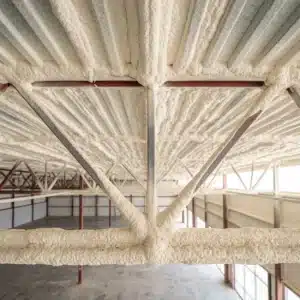
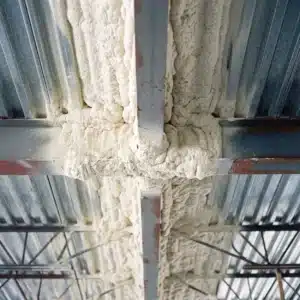
Spray polyurethane foam expands on contact with the substrate, sealing penetrations, joist webs, deck flutes, and irregular surfaces in a single pass. That matters for retail because the typical strip mall or big-box assembly is metal stud framing with metal exterior panels, hat channels, and dozens of MEP penetrations through walls and roof deck. Batt insulation in that geometry leaves gaps everywhere it bridges around the structure. Spray foam fills those gaps.
Per U.S. Department of Energy guidance, open-cell SPF at roughly 0.5 lb/ft³ density delivers about R-3.6 per inch, while closed-cell SPF at about 2.0 lb/ft³ delivers up to R-6.7 per inch. Closed-cell at 1.5 to 2 inches reaches Class II vapor retarder performance (0.5 to 0.8 perms) and acts as a continuous air barrier when properly applied. For a Climate Zone 2 or 3 retail building, closed-cell at 1.5 inches achieves roughly R-9.75 to R-10 in a single application, which clears the ASHRAE 90.1-2022 R-7.5 continuous insulation requirement for steel-framed walls in those zones while simultaneously providing the air barrier and vapor control. That is three code requirements satisfied by one trade. For a deeper specification breakdown, see our complete commercial spray foam guide. Want to dig into when each foam type fits which application? See our Closed-Cell vs. Open-Cell Spray Foam for Commercial Buildings cluster article.
What the energy data actually shows for retail
I will not put contractor-blog savings percentages in this article. The numbers below come from federal primary sources.
The U.S. Department of Energy and NIST infiltration research estimate that air infiltration through commercial building envelopes accounts for approximately 6 percent of total energy consumed by U.S. commercial buildings, and approximately 21 percent of heating and cooling energy. A 2022 Oak Ridge National Laboratory analysis went further and found that infiltration is the single largest envelope-driven energy loss component in commercial buildings, exceeding losses through fenestration. Lawrence Berkeley National Laboratory and NIST modeled stand-alone retail prototype buildings across 15 cities at four air leakage rates and showed meaningful HVAC energy reductions in every climate zone when the envelope tightened.
For HVAC context, HVAC systems account for roughly 40 percent of commercial building energy use overall (15 to 18 percent heating, 12 to 15 percent cooling, 8 to 10 percent ventilation). The 2018 CBECS reported an average commercial energy cost of $1.47 per square foot per year in nominal terms.
The honest framing: spray foam is one of several tools that move an envelope from leaky to tight. Real dollar savings on a specific retail project depend on baseline tightness, climate zone, HVAC efficiency, and operating hours. Treat any “30 to 50 percent savings” claim with skepticism unless backed by a project-specific energy model using ASHRAE 90.1 Appendix G as the baseline framework. We do not promise a number we cannot model.
The storefront entry: where retail loses the most conditioned air
Spray foam in the wall and roof assembly handles continuous infiltration. It does not solve door-cycling losses at the storefront. Those are addressed through vestibules or air curtains.
ASHRAE 90.1-2019 requires a vestibule at commercial building entries in all climate zones for buildings over 1,000 square feet, with air curtains meeting ANSI/AMCA Standard 220 (at least 400 ft/min airstream velocity near the floor) approved as code-compliant alternatives in Climate Zones 0, 3, and 4, and in buildings up to 15 stories in Climate Zones 5 through 8. Climate Zones 1 and 2 are not covered by the air curtain exception, so Houston and Gulf Coast retail need a vestibule or another approved means rather than an air curtain alone. Field studies of properly designed air curtain installations in retail show whole-building energy savings of roughly 0.3 to 2.2 percent compared to vestibules.
For an existing retail building targeting envelope improvements, the right scope is usually both: spray foam in the surrounding wall, rim joist, and roof deck assemblies to address continuous infiltration, plus a vestibule or AMCA-certified air curtain at the storefront entry to address door cycling. They are complementary measures, not substitutes.
What the IBC requires for spray foam in retail buildings
Retail buildings are classified as Group M (Mercantile) under IBC (2021) Section 309.1, which covers buildings used for the display and sale of merchandise to the public. Examples include department stores, drug stores, markets, retail and wholesale stores, and motor fuel-dispensing facilities. Group M is treated by the IBC as a higher life-safety risk than Group B office space because of variable occupant loads, unfamiliar exits, and high fuel loads from merchandise.
Sprinkler thresholds. The IBC’s fire protection and life safety provisions include IBC (2021) Section 903.2.7, which requires automatic sprinklers in Group M when a single fire area exceeds 12,000 square feet, when the combined Group M area on all floors exceeds 24,000 square feet, when the occupancy is more than 3 stories above grade, or in upholstered furniture or mattress display areas over 5,000 square feet. Most regional anchor tenants, big-box stores, and full-line department stores hit at least one of these thresholds and run fully sprinklered.
Fire-resistance ratings. IBC (2021) Table 601 sets hourly ratings for the structural frame, bearing walls, floors, and roofs by construction type. The most common construction types I see in regional retail are Type II-A (1-hour rating throughout) or sprinklered Type II-B (0-hour rating). Multi-story retail and Type III mixed-use buildings may require higher ratings. One IBC nuance worth flagging for retail: IBC (2021) Table 601 footnote b lists Group M among the occupancies where fire protection of structural members, including roof framing and decking, is required regardless of the 20-foot height-above-floor exception that applies to other occupancies. Translation: the shortcut that lets an office building skip fireproofing on roof structure 20 feet up does not apply to retail.
Foam plastic requirements. IBC (2021) Section 2603.3 requires foam plastic insulation to have a flame spread index of 75 or less and a smoke-developed index of 450 or less when tested per ASTM E84 or UL 723. IBC (2021) Section 2603.4 requires foam plastic to be separated from the interior of the building by an approved thermal barrier, with the prescriptive option for commercial construction being half-inch (12.7 mm) gypsum wallboard or any material meeting NFPA 275 acceptance criteria. IBC (2021) Section 2603.4.1.5 provides a roof-assembly exception: when the foam plastic is part of a Class A, B, or C roof-covering assembly tested per FM 4450 or UL 1256, a separate thermal barrier above the deck is not required, provided the complete roofing assembly passes the test. This is the path most spray-foam roofing systems on flat retail roofs take. For more on when spray foam requires a thermal barrier under the IBC, watch for our forthcoming detailed code article.
Spray foam does not replace rated assemblies. This is the part the spec writer needs to underline. Spray foam by itself does not carry an ASTM E119 or UL 263 fire-resistance rating. Where IBC (2021) Table 601 requires a 1-hour or 2-hour rated structural assembly, that rating comes from a UL-listed assembly using SFRM, intumescent coating, gypsum encasement, or another tested system. A licensed architect or engineer must specify the rated assembly. We install the spray foam per their design.
NFPA 13 concealed space alert. This one catches design teams off guard regularly. Spray polyurethane foam, open-cell or closed-cell, is a combustible material. It does not qualify as noncombustible insulation under NFPA 13 Section 9.2.1.8, which is the provision that allows omitting sprinklers from concealed spaces filled with noncombustible insulation like fiberglass or mineral wool. If a retail building has concealed spaces insulated with spray foam, the fire protection engineer needs to evaluate whether those spaces require sprinklers under NFPA 13, independent of any IBC thermal barrier requirement. The IBC rule and the NFPA 13 rule are separate compliance paths that can interact on the same project.
Closed-cell vs. open-cell for retail applications
| Application | Recommended Type | Reason |
|---|---|---|
| Flat roof deck (underside) | Closed-cell | Vapor and moisture control in cooling-dominated climates; air barrier; structural rigidity |
| Metal wall cavity or panel back | Closed-cell | Continuous insulation + air barrier + Class II vapor retarder in one pass |
| Interior partition between tenant spaces | Open-cell | Acoustic separation; moisture and vapor not at risk |
| Below-slab perimeter foundation walls | Closed-cell | Bulk water and ground contact resistance |
| Rim joist and band joist | Closed-cell or open-cell | Climate zone and access drive the call |
| Interior soffits, drop ceilings | Open-cell | Cost, acoustic, low moisture exposure |
Most retail projects in our region end up using both: closed-cell on the high-stakes envelope locations (roof deck, exterior wall, perimeter) and open-cell where moisture is not a risk and budget matters more. The architect’s specification should call out the product type by application.
Regional climate considerations across Texas, Oklahoma, and Kansas
Texas (DOE Climate Zones 2A and 3A). Cooling-dominated, high humidity. Vapor drive runs inward most of the year. Houston-area retail (CZ 2A) sees the most aggressive moisture conditions; DFW, Austin, and San Antonio (CZ 3A) are slightly milder but still cooling-dominated. Closed-cell SPF on the underside of flat roof decks and inside exterior wall assemblies controls both conductive load and vapor drive. I have walked Houston-area strip malls where oversized rooftop units cycled so quickly they never dehumidified, leading to interior microbial growth on finishes. Tightening the envelope first, before resizing equipment, is almost always the right sequence.
Oklahoma (CZ 3A). Similar to north Texas with hotter summers and colder winters. Wind-driven infiltration through older masonry and metal-panel envelopes is significant in Oklahoma City and Tulsa shopping centers. Closed-cell foam in wall cavities controls vapor drive in both directions across shoulder seasons.
Kansas (CZ 4A and 5A). Heating-dominated. The 21 percent of heating and cooling energy attributable to infiltration in commercial buildings becomes proportionally larger in heating-dominated climates, which means Kansas retail sees the strongest dollar return per square foot from envelope tightening. Wichita, Manhattan, and Kansas City strip malls and metal-building retail with uninsulated panels are common spray foam retrofit candidates.
ROI for chain retail: the multi-location math
The single-store math on retail envelope improvements does not always justify the investment by itself. The chain math is what changes the conversation.
A 5,000-square-foot strip mall tenant operating at the 2018 CBECS commercial average of $1.47 per square foot per year carries roughly $7,350 per year in energy spend. If the envelope upgrade reduces HVAC infiltration losses (the 21 percent of heating and cooling energy attributable to infiltration per DOE/NIST data) by even half, the dollar impact at one store is real but modest. Across a 10-store regional chain, that same retrofit applied uniformly multiplies the impact tenfold. Across 50 locations, the portfolio-level savings start to look like a capital plan line item rather than a facilities expense.
I am explicitly not promising a specific savings percentage in this article. The dollar calculation belongs in a project-specific energy model using ASHRAE 90.1 Appendix G as the baseline framework. A scoping walk and an energy model give you a real number for your specific buildings, climate zones, HVAC equipment, and operating schedule. The point of the multi-location math is that envelope upgrades that look marginal at one location can scale into meaningful capital decisions at portfolio level.
Practical application in occupied retail
Three things drive scheduling on occupied retail projects.
Off-hours work. Most retail spray foam application happens during overnight hours (midnight to 6 a.m.) or during scheduled remodel shutdowns. Coordination with store management, loss prevention, and the landlord-tenant lease terms determines what is possible at each location.
Re-occupancy timing. Most current-generation SPF products allow re-occupancy within 24 hours after the final pass with proper ventilation per the manufacturer data sheet. Confirm the specific product’s published guidance and any local AHJ requirements before committing to a schedule.
Indoor air quality on sensitive retail. Pharmacy, food and beverage, and grocery retail have stricter IAQ expectations than general merchandise. For these applications, specify SPF products tested per CDPH Standard Method V1.2 for low-emitting compliance and build adequate ventilation time into the schedule.
Strip Centers, Big Boxes, and Where NFPA 285 Applies in Retail
Retail splits cleanly on this requirement, and the split is construction type. IBC (2021) Section 2603.5 picks up exterior walls containing foam plastic insulation in buildings of Type I, II, III or IV construction, of any height, plus multi-story cold storage buildings required to be of noncombustible construction. Where it reaches, IBC (2021) Section 2603.5.5 requires that the exterior wall assembly be tested in accordance with and comply with the acceptance criteria of NFPA 285.
A great deal of small-format retail is Type V-B, wood framed and sprinklered, and exterior walls of Type V buildings are exempt. They comply with IBC (2021) Sections 2603.2, 2603.3 and 2603.4 only, so the NFPA 285 requirement never attaches to a typical strip center. Anchor stores and big-box shells are the other case, generally Type II-B with steel framing or Type III with masonry, and foam in those exterior walls puts the assembly in scope regardless of the building being one story.
There is a one-story exception, and it is not the general pass people assume. It covers one-story buildings complying with IBC (2021) Section 2603.4.1.4, a section carrying conditions of its own. Having a single story is the entry requirement, not the exception. A big box that does not satisfy 2603.4.1.4 remains inside 2603.5.5.
The Listing Covers the Whole Wall
NFPA 285 is the Standard Fire Test Method for Evaluation of Fire Propagation Characteristics of Exterior Wall Assemblies Containing Combustible Components, current edition 2025. It tests cladding, insulation, air and water-resistive barrier, framing and window head as one wall. Being an assembly test rather than a product test, it yields listings that belong to a specific build-up and never to a foam, which means no product is NFPA 285 compliant on its own. Change the EIFS, the metal panel or the storefront head detail and the wall may no longer be the wall that passed.
That is a live risk in multi-tenant retail, where the landlord shell was permitted with one facade and a tenant build-out changes it. Altering an exterior wall containing foam plastic is a code question before it is a branding one, and the answer comes from a fire protection engineer qualified to issue an engineering judgment, or from a test of the wall as designed.
The Baseline Numbers
Under IBC (2021) Section 2603.3, foam plastic must show a flame spread index of 75 or less and a smoke-developed index of 450 or less. On Type I through IV exterior walls, IBC (2021) Section 2603.5.4 lowers flame spread to 25 or less at that same 450 smoke limit, tested at the thickness intended for use up to 4 inches per ASTM E84 or UL 723. The interior thermal barrier from IBC (2021) Section 2603.4 remains due either way: 1/2-inch gypsum wallboard, heavy timber complying with IBC (2021) Section 602.4, or a material meeting the acceptance criteria of both the Temperature Transmission Fire Test and the Integrity Fire Test of NFPA 275.
The remaining exception, for completeness, applies to foam plastic covered on each face by not less than 1 inch of masonry or concrete, with either no airspace, or a flame spread index of 25 or less and an airspace not more than 1 inch. Your architect and the local building official confirm the construction type and decide whether any of these actually fit the store.
Frequently asked questions
What occupancy group is a retail building under the IBC? Retail buildings, including department stores, drug stores, markets, and wholesale or retail stores, are classified as Mercantile Group M under IBC (2021) Section 309.1. Group M triggers specific fire protection requirements including automatic sprinklers when fire areas exceed 12,000 square feet under IBC (2021) Section 903.2.7. Spray foam in Group M buildings must comply with IBC (2021) Section 2603 thermal barrier requirements.
Does spray foam meet IBC fire code requirements for retail buildings? Spray foam plastic insulation must meet IBC (2021) Section 2603.3 for surface burning characteristics (FSI ≤ 75 and SDI ≤ 450 per ASTM E84 or UL 723) and IBC (2021) Section 2603.4 thermal barrier requirements (half-inch gypsum board or NFPA 275-tested alternative). The foam itself does not provide ASTM E119 or UL 263 fire-resistance ratings. Fire-resistance ratings apply to complete tested assemblies specified by a licensed architect or engineer.
How much energy can spray foam save in a retail building? Federal data establishes the framework but not a specific percentage. DOE and NIST estimate that infiltration accounts for about 6 percent of total commercial building energy use and 21 percent of heating and cooling energy. Spray foam tightens the envelope, recovering a fraction of that loss. Real dollar savings depend on baseline conditions, climate zone, HVAC efficiency, and operating hours. A project-specific energy model gives you a real number.
Does spray foam work on flat retail roofs? Yes. Spray foam is widely used on flat retail roofs, either as a roofing system itself (with appropriate top coatings tested per FM 4450 or UL 1256) or applied to the underside of the metal deck. The IBC (2021) Section 2603.4.1.5 roof-assembly exception lets a Class A, B, or C roof-covering assembly omit a separate thermal barrier above the deck when the complete tested roofing assembly meets the criteria.
Is spray foam required to have a thermal barrier in a retail building? Yes, except where the IBC roof-assembly exception applies. IBC (2021) Section 2603.4 requires foam plastic insulation to be separated from the interior of the building by an approved thermal barrier (typically half-inch gypsum or an NFPA 275-tested equivalent) in occupied retail interiors. The exception under 2603.4.1.5 covers tested roof-covering assemblies.
What is the difference between open-cell and closed-cell for retail applications? Closed-cell SPF (about 2.0 lb/ft³) delivers up to R-6.7 per inch and acts as an air barrier, Class II vapor retarder, and bulk water resistor. Open-cell SPF (about 0.5 lb/ft³) delivers about R-3.6 per inch, costs less, and provides better acoustic absorption but no significant moisture resistance. Retail roof decks and exterior walls in TX, OK, and KS typically specify closed-cell. Interior partitions and acoustic applications use open-cell.
Does spray foam provide fire-resistance ratings for retail wall assemblies? No. Fire-resistance ratings under ASTM E119 or UL 263 apply to complete tested assemblies, not to spray foam alone. Where IBC (2021) Table 601 requires a rated structural assembly for the building’s construction type, the rating is achieved through a UL-listed assembly using SFRM, intumescent coating, gypsum encasement, or another tested method. A licensed architect or engineer must specify it. Spray foam can be installed within or alongside that rated assembly per the design.
Can spray foam be installed in an occupied retail store? Yes, with off-hours scheduling and proper ventilation. Most current-generation SPF products allow re-occupancy within 24 hours after the final pass per the manufacturer data sheet. Sensitive retail (pharmacy, food and beverage, grocery) should specify products tested per CDPH Standard Method V1.2 for low-emitting compliance and allow extra ventilation time.
Key takeaways
Code framework
- Retail buildings are IBC Group M (Mercantile) per IBC (2021) Section 309.1.
- Sprinklers required when fire areas exceed 12,000 square feet (IBC (2021) Section 903.2.7).
- IBC (2021) Table 601 footnote b requires structural fire protection for roof framing in Group M without the 20-foot height exemption.
Energy data
- Mercantile uses 14 percent of commercial energy on 11 percent of floorspace (EIA CBECS 2018).
- Strip malls run roughly twice the EUI of standalone retail stores (ENERGY STAR Portfolio Manager).
- DOE/NIST data: infiltration drives 6 percent of total commercial energy and 21 percent of HVAC energy.
Product selection
- Closed-cell SPF is the standard for retail roof decks, exterior walls, and below-grade applications.
- Open-cell SPF works for interior partitions, acoustic separation, and dry conditions.
- Closed-cell at 1.5 to 2 inches meets ASHRAE 90.1 continuous insulation, air barrier, and Class II vapor retarder in one pass.
Liability and scope
- Spray foam carries no ASTM E119 or UL 263 rating. A licensed architect or engineer must specify rated assemblies.
- NFPA 13 treats spray foam as combustible. Concealed-space sprinkler design must be evaluated by the fire protection engineer.
Related reading
- Commercial Spray Foam Insulation Guide
- Closed-Cell vs. Open-Cell Spray Foam for Commercial Buildings
- Spray Foam Insulation for Industrial Buildings: Energy Savings in Manufacturing
Let’s scope your retail project
If your facilities team, GC, or design team is evaluating spray foam for a retail project, single store or multi-location chain, anywhere in Texas, Kansas, or Oklahoma, I would be glad to walk the buildings with you. Bahl Fireproofing handles commercial spray foam insulation work on retail, anchor tenant, and shopping center projects regularly, with off-hours scheduling that fits around store operations. Reach me at 512-387-2111 or ross@bahlfireproofing.com, or use our project inquiry form to start the conversation. We work on commercial projects across our service area in Texas, Oklahoma, Kansas, Nebraska, Minnesota, and Wisconsin.
Disclaimer: This article is for general educational purposes and does not constitute engineering, architectural, or legal advice. Building code requirements vary by jurisdiction and adopted edition. Project specifications must be developed and stamped by a licensed architect or engineer familiar with the specific building, occupancy, and local amendments. Energy performance figures cited reflect federal averages and do not apply to any specific project without an energy model. Bahl Fireproofing makes no representation that the figures or code summaries here apply to any specific project.
Disclaimer: This article provides general educational information about fireproofing and insulation systems and does not constitute professional engineering advice or product specification. System selection must be based on project-specific fire ratings, thermal requirements, acoustic performance needs, environmental conditions, substrate requirements, and budget constraints. Code requirements vary by jurisdiction and project type. Always consult with a licensed architect or engineer and verify UL or FM assembly listings before finalizing specifications.