Modern retail design has moved decisively toward open ceilings: exposed metal deck, visible structural steel, no acoustic tile. It looks great in renderings. On opening day, the same building is a reverberant, energy-leaky shell, and store managers start fielding complaints about noise and HVAC bills within the first quarter. K-13 spray-applied insulation is the single most direct fix for both problems, applied as the exposed ceiling finish itself.
TLDR: K-13 insulation is a spray-applied cellulose fiber insulation that doubles as the exposed ceiling finish in big-box retail, food courts, anchor tenants, and shopping concourses. It delivers NRC 0.80 at 1 inch on solid backing and NRC 1.05 at 1.5 inches on standard 1.5-inch metal deck (ASTM C423), with R-3.7 per inch thermal performance per the manufacturer’s current technical data sheet. The system carries a Class A surface burning rating (FSI 5, SDI 5 per ASTM E84 / UL 723), supports LEED MR and EQ credits, and is installed only by contractors licensed by the manufacturer, International Cellulose Corporation. K-13 is an interior finish, not structural fireproofing, and does not replace any fire-resistance-rated assembly required by IBC (2021) Table 601.
Code note: unless otherwise stated, code references on this page are to the 2021 International Building Code. Code adoption is state and local. Across the states we serve, adopted IBC editions currently range from the 2012 edition to the 2024 edition, some states have no statewide commercial building code, and several enforce NFPA 1 or NFPA 101 rather than the International Fire Code. Minnesota and Wisconsin publish state-amended code books whose numbering and requirements differ from the model code. This is general technical information, not a code determination for your project. Confirm the adopted edition and any local amendments with your authority having jurisdiction.
Why open-ceiling retail buildings need K-13
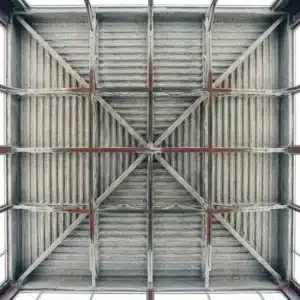
Three things have changed in retail over the last decade. Anchor tenants and big-box stores left the suspended acoustical ceiling tile behind in favor of open metal deck. Food halls and modern concourses pushed ceiling heights up. And HVAC sat unchanged on rooftops, working against the same uninsulated metal deck.
The acoustic result is a space dominated by hard, reflective surfaces: bare metal deck overhead, polished concrete underfoot, glass storefronts, painted gypsum walls. Reflective surfaces have NRC values in the 0.00 to 0.05 range, which is to say they absorb almost no sound. Foot traffic, point-of-sale systems, background music, conversations, and HVAC noise all stack up. Customer experience suffers, staff fatigue rises, and intelligibility drops.
The thermal result is a roof assembly that loses or gains energy through every deck seam, joist connection, and rooftop penetration. Batt insulation laid between bar joists compresses, gaps, and bridges around the structure imperfectly. The HVAC compensates by running longer.
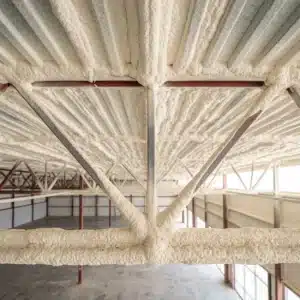
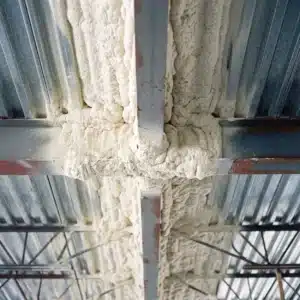
K-13 addresses both at once. Sprayed directly to the underside of the roof deck or ceiling substrate, it forms a monolithic coating that fills voids, seals cracks, and dampens reflection. It is the finish surface, not a layer hidden above one. And because it qualifies as a Class A interior finish under IBC Chapter 8, it works in mercantile occupancies without compromise.
What K-13 is and how it works
K-13 is a spray-applied thermal and acoustical insulation manufactured by International Cellulose Corporation. It combines natural plant-based cellulose fibers with a water-based, zero-VOC adhesive (SK-2000), and is applied like a coating directly to metal deck, concrete, gypsum, wood, and other substrates. The product contains no asbestos, no silica, no mineral or glass fibers, and is made from 80 percent pre-consumer recycled content per the manufacturer’s published Health Product Declaration.
The application method matters as much as the chemistry. K-13 is sprayed on by manufacturer-licensed contractors, building up to the specified thickness in passes. Because it is applied wet and bonds to the substrate, it conforms to bar joist webs, deck flutes, structural penetrations, and irregular surfaces in a way that batt and board insulation cannot. The result is a continuous, void-free thermal and acoustic layer with no seams to fail.
CSI specification sections place the product in 07 21 29 (Sprayed Insulation) and 09 83 16 (Acoustic Finishes), reflecting its dual role.
Acoustic performance: the NRC numbers that matter in retail
Noise Reduction Coefficient (NRC) measures how much sound a surface absorbs versus reflects, on a 0 to 1 scale. NRC is determined under ASTM C423 reverberation room testing. Higher numbers mean more absorption.
Tested NRC values for K-13 in standard retail substrates:
| Application | Thickness | NRC |
|---|---|---|
| Solid backing | 1 inch | 0.80 |
| Solid backing | 1.5 inch | 0.90 |
| Solid backing | 1.75 inch | 1.00 |
| 1.5-inch ribbed metal deck | 1.5 inch | 1.05 |
| 1.5-inch ribbed metal deck | 3 inch | 1.05 |
For context, untreated metal deck or painted gypsum runs NRC 0.00 to 0.05. Standard suspended acoustical ceiling tile runs NRC 0.55 to 0.75. K-13 at 1 inch on solid backing already absorbs more sound than the highest-end ACT tile, and at 1.5 inches on metal deck (the most common big-box and anchor configuration) it achieves essentially full absorption. Values above 1.00 occur because of edge diffraction effects in ASTM C423 testing and are legitimate per the standard.
Field experience translates this into measurable reductions in ambient noise levels and clearly improved speech intelligibility on the sales floor. The exact dB reduction depends on baseline conditions, room volume, and source distribution, which is why we do not promise a specific number without the project’s acoustic model. What we can say with confidence: in retail spaces where customers and staff currently struggle to hear each other across a checkout counter, K-13 makes the conversation possible.
For LEED-targeted retail projects, the LEED v4.1 EQ Acoustic Performance credit asks for reverberation control with NRC thresholds in the 0.70 range for spaces under 20,000 cubic feet. K-13 at any standard thickness clears that threshold by a comfortable margin and provides the documented basis for the credit submission.
Thermal performance: sealing the roof deck in large retail volumes
K-13 delivers R-3.7 per inch per the manufacturer’s February 2025 Technical Data Sheet, measured per ASTM C518. R-value scales linearly with thickness through the standard product range:
| Thickness | R-Value |
|---|---|
| 1 inch | R-3.7 |
| 2 inches | R-7.4 |
| 3 inches | R-11.1 |
| 4 inches | R-14.8 |
| 5 inches | R-18.5 |
| 6 inches | R-22.2 |
For high-volume retail with substantial roof clearance, the K-13 High-R System uses mechanical support to allow application up to 10 inches thick, reaching approximately R-37. That level of continuous insulation on the underside of the roof deck makes a meaningful difference in HVAC sizing on new construction and in operating cost on retrofits.
The reason monolithic application matters in retail is the geometry of the roof. Big-box and anchor tenant roofs have rooftop units, vents, drain leaders, and structural penetrations every few hundred square feet. Each penetration is a place where conventional insulation gets cut, fitted, and inevitably leaves gaps. K-13 sprays into and around all of it, leaving no seams.
We do not promise a specific energy savings percentage in this article. The actual savings on any project depend on baseline envelope condition, climate zone, HVAC efficiency, occupancy hours, and the building’s existing roof assembly. ASHRAE 90.1 Appendix G is the right framework for that calculation, and the design team’s energy modeler is the right person to run it. For broader background on the K-13 product family and how it is specified, see our K-13: The Complete Contractor Guide.
Fire code in retail buildings: what K-13 does and what it doesn’t do
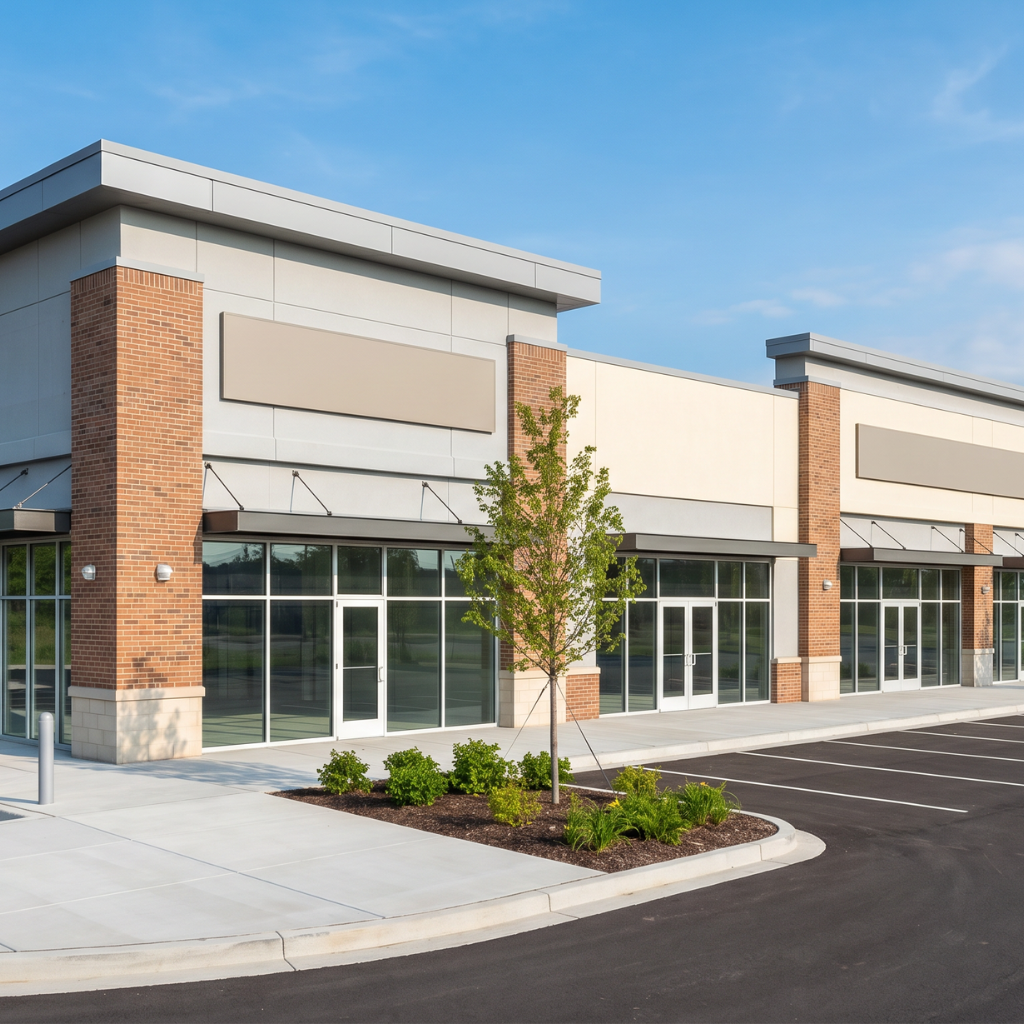
Retail stores are classified as Group M (Mercantile) under IBC Section 309 (Mercantile Group M). That covers department stores, big-box stores, shopping centers, markets, and similar uses. The IBC sets specific sprinkler thresholds for Group M under IBC (2021) Section 903.2.7: any single fire area over 12,000 square feet, combined Group M floor area over 24,000 square feet, dedicated upholstered furniture or mattress display areas over 5,000 square feet, and certain high-piled storage configurations all trigger required sprinklers. Most modern shopping centers and box retailers exceed these thresholds and run fully sprinklered.
For interior finish, IBC (2021) Table 803.13 (Section 803.11 in the 2015 edition) sets minimum classes (A, B, or C) by occupancy and location. K-13’s surface burning characteristics under ASTM E84 and UL 723 are FSI 5 and SDI 5, putting it solidly in Class A, the most stringent finish classification. That clears every interior finish requirement the IBC sets for any Group M space, sprinklered or not.
K-13 is also listed in six UL BXUV guide design assemblies as an allowable sprayed fiber over Spray-Applied Fire-Resistive Material (SFRM). That means in those specific UL designs, K-13 can be the exposed finish layer over cementitious or intumescent fireproofing without voiding the underlying fire-resistance assembly. The architect needs to confirm the specific UL design number applies to the project.
Here is the part the spec writer needs to underline: K-13 is an interior finish material with Class A surface burning characteristics. It is not structural fireproofing. Where IBC (2021) Table 601 requires the structural frame to carry a 1-hour or 2-hour fire-resistance rating, that rating is achieved through a UL-listed assembly using SFRM, intumescent coating, gypsum encasement, or another tested method. K-13 can sit on top of that assembly per applicable UL designs, but the rating is carried by what is underneath. We have walked too many projects where an owner assumed K-13 was the fireproofing. It is not. If the structural design demands a rated assembly and the substrate specification is unclear, that is the moment to call the architect, not improvise on site. For the broader code framework, our commercial fireproofing code compliance guide walks through the IBC chapters that apply.
Color options and design flexibility for retail environments
K-13 is available in a range of standard factory colors and can be supplied in custom colors to match brand specifications. For chain retailers and franchise concepts where brand consistency matters, the ability to specify a corporate color or a near-match to existing finishes is one of the practical reasons K-13 wins out over white-only alternatives. Topcoats can be applied in some cases for additional finish requirements, but topcoat compatibility must be verified per the specific UL listing or manufacturer guidance. Not every topcoat is compatible with every K-13 application, and adding the wrong topcoat can change the surface burning classification or void the listing.
K-13 and LEED / green building credentials
K-13 contributes to multiple LEED v4 and v4.1 credit areas based on the manufacturer’s published documentation:
| LEED Credit Area | K-13 Contribution |
|---|---|
| MR: Recycled Content | 80 percent pre-consumer recycled content (cellulose fiber) |
| EQ: Low-Emitting Materials | M1 classified low-emitting; SK-2000 adhesive < 1.0 g/L VOC |
| MR: Regional Materials | Manufactured in Houston, TX (relevant to TX/OK/KS projects) |
| MR: Rapidly Renewable Materials | Plant-based cellulose qualifies as rapidly renewable |
| EQ: Acoustic Performance (BD+C) | NRC values exceed 0.70 threshold for reverberation control |
Verification of any specific LEED submission requires the current manufacturer documentation, which the licensed architect or LEED consultant assembles for the project record.
Common K-13 retail applications across Texas, Oklahoma, Kansas, Nebraska, Minnesota, and Wisconsin
Five scenarios cover most of the K-13 retail work we see in our region.
Big-box and anchor tenants. Open metal deck ceilings over the sales floor, typically applied at 1.5 to 2 inches for an NRC of 1.05 and continuous thermal coverage. The single most common K-13 retail application.
Shopping mall food courts and concourses. Large-volume spaces with high ambient noise from kitchen equipment, conversation, and foot traffic. K-13 on the deck above the seating area drops reverberation noticeably and improves the dining experience.
Restaurants within retail centers. Casual dining and quick-service concepts with exposed-ceiling design intent benefit from K-13 in custom colors. The finish supports the design aesthetic and solves the acoustic problem inherent in hard-surface restaurant interiors.
Covered retail walkways and outdoor mall corridors. Semi-exposed conditions where the K-13 specification depends on exposure rating. Verify with the manufacturer and the design team.
Retail-warehouse hybrids. Costco-style and Sam’s Club-style buildings combine sales floor and rack storage under one roof. K-13 on the roof deck delivers thermal performance over the entire footprint and acoustic dampening on the customer-facing portion.
Frequently asked questions
Is K-13 a fireproofing product? No. K-13 is a Class A interior finish material with surface burning characteristics of FSI 5 and SDI 5 per ASTM E84 and UL 723. It does not provide structural fire-resistance ratings under ASTM E119 or UL 263. Where the IBC requires a rated structural assembly, that rating must come from a separately specified UL-listed assembly, which K-13 can be applied over in specific UL BXUV designs.
Does K-13 meet IBC interior finish requirements for retail? Yes. K-13’s Class A rating clears the most stringent interior finish requirement under IBC (2021) Table 803.13 for any Group M (Mercantile) space, sprinklered or not. Class A is the highest class the IBC specifies for interior finish.
What NRC should I specify for a retail space? Most commercial retail spaces respond well to acoustic finishes targeting NRC 0.70 to 0.85. K-13 at 1 inch on solid backing reaches NRC 0.80, and at 1.5 inches on standard 1.5-inch metal deck it reaches NRC 1.05. The architect’s acoustic consultant will set the specific target based on room volume, occupancy, and program.
Can K-13 be applied during business hours in an existing retail space? Generally no. K-13 is sprayed wet and requires the work area to be cleared, masked, and ventilated during application and initial cure. For occupied retail buildings, the work happens during off-hours, store closures, or before tenant fit-out. We coordinate scheduling with the GC and the property manager.
Is K-13 LEED-friendly? Yes. K-13 contributes to several LEED v4 and v4.1 credit areas including recycled content, low-emitting materials, regional materials, rapidly renewable materials, and acoustic performance. Final credit assembly is the design team’s responsibility, but the product’s documentation supports each of those credit pathways.
How thick does K-13 need to be? Thickness depends on the project’s acoustic and thermal goals. For acoustic-only retail finish, 1 to 1.5 inches typically delivers all the absorption a sales floor needs. For combined thermal and acoustic on the roof deck, 2 to 4 inches is common. The K-13 High-R System extends application up to 10 inches with mechanical support for projects targeting maximum continuous insulation.
Key takeaways
Retail design fit
- K-13 is the exposed finish for open-ceiling big-box, anchor tenant, food court, and concourse spaces
- Sprayed monolithically over metal deck, concrete, and irregular substrates with no seams or gaps
- Available in standard and custom colors for brand-consistent retail aesthetics
Acoustic and thermal performance
- NRC 0.80 at 1 inch on solid backing; NRC 1.05 at 1.5 inches on 1.5-inch metal deck (ASTM C423)
- R-3.7 per inch thermal performance per the current manufacturer TDS; up to R-37 with the High-R System
Fire code positioning
- Class A interior finish (FSI 5, SDI 5 per ASTM E84 / UL 723) clears IBC (2021) Table 803.13 for Group M
- K-13 is an interior finish, not structural fireproofing; it does not replace UL-listed fire-resistance assemblies
- Retail buildings classified Group M per IBC (2021) Section 309.1; sprinkler thresholds in IBC (2021) Section 903.2.7
Sustainability
- 80 percent pre-consumer recycled content
- Zero-VOC SK-2000 adhesive, M1 low-emitting classification
- Supports LEED MR, EQ, and Acoustic Performance credits
Related reading
- K-13: The Complete Contractor Guide
- K-13 Insulation: Energy Performance Guide
- Intumescent vs. Cementitious Fireproofing
Let’s talk about your retail project
If your retail design or construction team is evaluating K-13 for a Texas, Kansas, or Oklahoma project, new build or tenant improvement, I would be glad to walk the building and review the spec. Bahl Fireproofing is a K-13 applicator licensed by International Cellulose Corporation, handling K-13 spray-applied insulation work on big-box, anchor tenant, and shopping center projects regularly, with scheduling that fits around store hours and tenant turnover. Reach me at 512-387-2111 or ross@bahlfireproofing.com, or use the Contact Bahl Fireproofing form to start the conversation.
Disclaimer: This article is for general educational purposes and does not constitute engineering, architectural, or legal advice. Building code requirements vary by jurisdiction and adopted edition. Project specifications must be developed and stamped by a licensed architect or engineer familiar with the specific building, occupancy, and local amendments. Performance figures cited reflect manufacturer-published data and standardized test conditions; actual project performance depends on application thickness, substrate, building envelope, and operating conditions. LEED credit eligibility requires verification against the current credit language and manufacturer documentation. Bahl Fireproofing makes no representation that the figures or code summaries here apply to any specific project.
Disclaimer: This article provides general educational information about fireproofing and insulation systems and does not constitute professional engineering advice or product specification. System selection must be based on project-specific fire ratings, thermal requirements, acoustic performance needs, environmental conditions, substrate requirements, and budget constraints. Code requirements vary by jurisdiction and project type. Always consult with a licensed architect or engineer and verify UL or FM assembly listings before finalizing specifications.