When a project specifies intumescent fireproofing on parking garage steel, the assumption that any commercial intumescent coating will work in that environment is the single most expensive mistake I see on bid documents. A coating that performs beautifully on the exposed columns of a Class A office lobby can fail in eighteen months on the open-deck level of a parking ramp because the conditions are completely different. Parking structures combine three exposures that interior steel never sees: sustained humidity swings, road-salt aerosols carried in on vehicles, and direct ultraviolet exposure on perimeter members. The fire-resistance rating only holds up over the building’s design life if the coating, the primer, and the topcoat were all tested as one system for the actual environment they will live in.
TLDR: Intumescent fireproofing for parking garage steel is a specification problem, not a product-selection problem. Parking structures combine humidity, road salt, UV exposure, and physical impact, and only intumescent systems tested under UL 2431 for the relevant exposure class (Interior General Purpose or Exterior) will hold their fire-resistance rating over time. Solvent-based and epoxy intumescent are the realistic chemistries for semi-exposed parking steel. Topcoats are part of the fire-tested system, not a finish detail. Substituting a topcoat voids the UL listing.
Nothing in this article is a substitute for project-specific engineering, architectural, or code analysis. Always consult the licensed architect or engineer and the authority having jurisdiction for final decisions on assemblies, products, and details.
I have spent more than twenty years applying spray-applied fireproofing, intumescent coatings, K-13 insulation, and spray foam on commercial projects across Texas, Oklahoma, Kansas, Nebraska, Minnesota, and Wisconsin. Parking structures show up in nearly every mid-rise mixed-use job we work, every healthcare campus expansion, every airport terminal program, and every corporate campus. They are also the building type where the gap between what owners believe they specified and what they actually got is usually the largest. Owners often see a line item that says “intumescent fireproofing” and assume the same coating that protects the steel in their lobby will protect the steel above the cars. That is rarely how it works.
This guide walks through what makes intumescent fireproofing parking garage steel a distinct technical problem, how the International Building Code treats parking structures, what the UL exposure designations actually mean, which intumescent chemistries are realistic candidates for parking conditions, why the topcoat is part of the fire test rather than a paint finish, and how the special inspection process under AWCI Technical Manual 12-B keeps everyone honest. The goal is to give architects, general contractors, engineers, and facility owners enough technical grounding to write a parking garage intumescent specification that will actually pass inspection and last as long as the structure does.
What Makes Intumescent Fireproofing Parking Garage Steel a Different Problem
Intumescent fireproofing for parking garage steel has to perform two jobs simultaneously: it has to deliver the code-required fire-resistance rating during a fire event, and it has to survive years of automotive exhaust, salt-laden moisture, freeze-thaw cycling, and UV exposure without losing the chemistry that produces the protective char. Standard interior intumescent coatings are formulated for stable, conditioned indoor environments. Their resin systems and intumescent reactants are perfectly suitable for an office building or a hospital corridor. Put those same coatings in an open-deck parking structure in Tulsa and the binder begins to break down within the first few seasons.
The difference shows up in three failure modes. The first is moisture intrusion through pinholes and micro-cracks, which compromises the coating’s reactant chemistry over time. The second is UV degradation of the resin, which leads to chalking, surface erosion, and eventual loss of intumescent function. The third is impact and abrasion damage from vehicle traffic, equipment, and incidental contact, which exposes the steel substrate to corrosion at exactly the moments where the fire protection is most critical. None of these failure modes shows up in a standard ASTM E119 fire test, because that test puts the coating into a furnace immediately. UL 2431 was developed specifically to address this gap by conditioning coatings through environmental exposures before running the fire test.
That brings up a useful framing question. If you have ever wondered why two intumescent products with identical UL Designs and identical hourly ratings can have very different installed costs, the answer is almost always the durability listing. A coating qualified for Conditioned Interior Space alone is significantly cheaper than the same chemistry qualified for Exterior Use, because the Exterior listing requires a much more demanding test program. Specifying the right durability tier is how you balance code compliance with realistic life-cycle cost.
How the International Building Code Treats Parking Garage Steel
The 2021 International Building Code distinguishes between open parking garages and enclosed parking garages, and the distinction drives which fire-resistance ratings apply to the structural steel. IBC (2021) Section 406.5 covers open parking garages, which by definition meet the percentage of natural ventilation openings required by the code, while IBC (2021) Section 406.6 governs enclosed parking garages where mechanical ventilation handles air exchange. The construction type assigned under Chapter 6 then sets the fire-resistance rating for the structural frame through IBC (2021) Table 601.
Code note: unless otherwise stated, code references on this page are to the 2021 International Building Code. Code adoption is state and local. Across the states we serve, adopted IBC editions currently range from the 2012 edition to the 2024 edition, some states have no statewide commercial building code, and several enforce NFPA 1 or NFPA 101 rather than the International Fire Code. Minnesota and Wisconsin publish state-amended code books whose numbering and requirements differ from the model code. This is general technical information, not a code determination for your project. Confirm the adopted edition and any local amendments with your authority having jurisdiction.
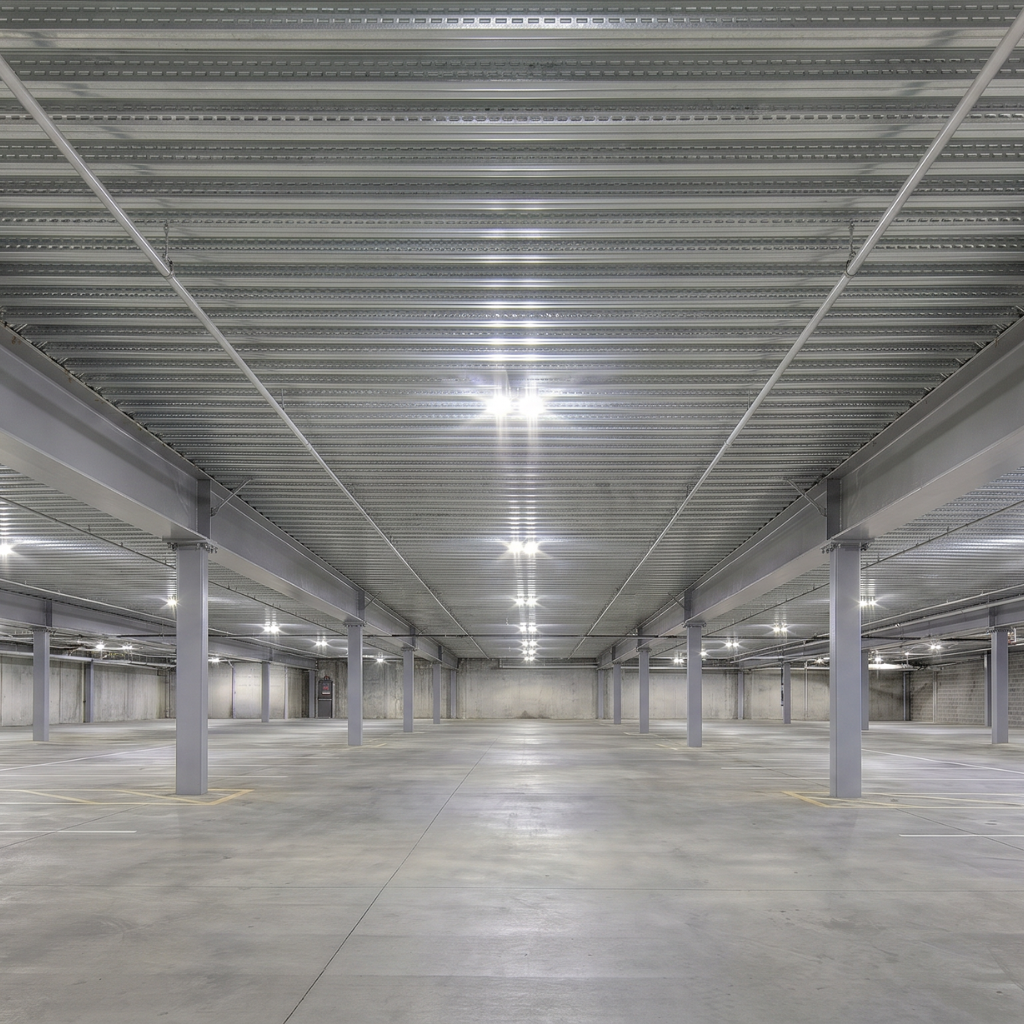
For most open parking structures attached to a podium-style mixed-use development, the parking levels are typically constructed under Type I, II, or IV provisions in the 2021 edition, and the structural frame above the parking levels follows whatever construction type applies to the residential, hospital, or office occupancy above. When a podium configuration is used, IBC (2021) Section 510.2 governs the horizontal building separation, which generally requires a three-hour rating between the parking occupancy below and the residential or commercial occupancy above. The transfer girders and columns that carry the upper structure across the parking levels must achieve that three-hour rating, and that is exactly the steel that often runs along the perimeter of the open parking deck where it sees weather exposure. That perimeter condition is what makes weather-resistant intumescent fireproofing so important on these projects: the steel is structurally critical, code requires a multi-hour rating, and the steel itself is partly exposed to the outdoor environment.
For Type IIA or Type IB construction, fire-resistance ratings between one and two hours apply to the primary structural frame. For Type IA, three or even four hours can apply to columns and transfer elements. The code does not specify how to achieve those ratings. It specifies the rating outcome, and the licensed architect or engineer selects from spray-applied fire-resistive material, intumescent coating, board systems, or concrete encasement to achieve compliance. For exposed steel that will be visible after construction, intumescent coating is typically the most practical choice because of its thin film and finish quality.
I want to be precise about one thing. The IBC does not directly mandate that a parking garage use intumescent rather than cementitious SFRM. The choice between systems is made by the design team based on whether the steel will be visible, whether the environment is conducive to SFRM durability, and what the project’s life-cycle expectations are. Cementitious SFRM remains the right choice for many parking applications, especially in fully enclosed garages with concealed steel, and high-density Portland cement SFRM resists moisture and impact better than gypsum-based products. The article you are reading focuses on intumescent because that is what gets specified on architecturally exposed steel and on perimeter members where finish quality matters.
The Three UL Exposure Designations That Govern Intumescent Selection
This is where most parking garage intumescent specifications go wrong. UL Solutions classifies certified mastic and intumescent coatings (UL Category Code CDWZ) into three exposure environments, and the differences between them are not minor. The categories are Conditioned Interior Space, Interior General Purpose, and Exterior Use, and they are written into the actual UL Design listing for each product.
Conditioned Interior Space, often abbreviated ICS in product literature, is the most restrictive designation. UL describes it as limited to interior climate-controlled spaces with no exposure to condensation, where relative humidity and temperature are controlled to no more than seventy-five percent during application, curing, construction, and occupancy. ICS coatings are typically water-based products formulated for office buildings, hospitals, and similar conditioned environments. Many lobby intumescent products carry only an ICS rating. They are not appropriate for parking structure use.
Interior General Purpose, often abbreviated IGP, applies to coatings that have performed well under UL’s more demanding interior environmental tests. The IGP qualification subjects the coating to a 180-day high-humidity exposure, heat aging, and ultraviolet exposure. IGP coatings can handle the kind of unconditioned interior conditions you find in mechanical rooms, parking levels of fully enclosed garages without dramatic environmental swings, and warehouse facilities. They are not, however, qualified for sustained outdoor exposure.
Exterior Use is the designation that matters for any parking garage steel that sees daylight, wind-driven rain, or salt aerosols. According to UL Solutions guidance on mastic and intumescent coatings, to obtain a UL Certification, intumescent and mastic coatings must demonstrate fire resistance performance after being subjected to several simulated environmental conditions based on the area of installation, including accelerated aging, elevated humidity, carbon dioxide and sulfur dioxide air mixture, salt spray, ultraviolet light, freezing, and simulated rain for coatings intended for outside exposure. That program represents the actual environmental conditions a parking garage perimeter member will see across decades of service, and only coatings that survive that conditioning and still deliver the listed fire rating earn the Exterior Use classification. The salt spray and SO2 components are particularly relevant in cold-climate cities like Wichita and Oklahoma City where road salt and de-icing chemicals contribute to the aerosol environment inside the structure.
The practical takeaway is that any specification for intumescent fireproofing parking garage steel should explicitly call out the required UL exposure designation by name. A line item that says “two-hour intumescent fireproofing per UL Design XXXX” without specifying the ICS, IGP, or Exterior environment is incomplete. The applicator can technically satisfy that specification with a coating qualified only for ICS, and the result will not perform in a parking environment where the steel is not in conditioned interior space.
Solvent-Based, Epoxy, or Water-Based: What Works in a Parking Garage
The three intumescent chemistries respond very differently to parking structure conditions. Water-based intumescent coatings use acrylic resin systems and are excellent for conditioned interior space but generally cannot tolerate sustained moisture exposure or freezing temperatures during application. Some water-based products achieve IGP and Exterior listings only when paired with a specific manufacturer-listed topcoat applied at a defined minimum dry film thickness. The exact topcoat brand, product number, and thickness are tied to the specific UL Design, and substituting any element of the system reverts the coating to its lower exposure rating. This is precisely why the topcoat needs to be treated as part of the engineered fire-resistance assembly rather than as a finish detail selected separately at the end of the project.
Solvent-based intumescent coatings use single-component acrylic resins dissolved in organic solvents. The solvent system tolerates wider application temperature and humidity ranges than water-based products and produces a finish more resistant to moisture intrusion. Sherwin-Williams FIRETEX FX7002 and similar solvent-based products are realistic candidates for the unconditioned interior portions of parking structures and for some semi-exposed canopy and perimeter applications when paired with the appropriate UL-listed topcoat. The trade-off is volatile organic compound content, which can be significant during application and which complicates indoor work in occupied buildings or projects pursuing LEED credits.
Epoxy intumescent coatings use two-component thermosetting resin chemistry, typically formulated as one hundred percent solids with no solvent content. The resulting cured film is hard, impact-resistant, chemical-resistant, and inherently far more durable than acrylic resin systems. Epoxy products such as Carboline Thermo-Lag E100, which carries documented UL 263 cellulosic and UL 2431 Category I-A exterior durability listings, are appropriate for the most demanding parking structure applications, including exposed perimeter columns and transfer girders where the steel sees full weather exposure. Sherwin-Williams FIRETEX FX9502 is another epoxy intumescent in this family, though its specific cellulosic and durability scope should always be verified against the current UL Product iQ listing for the project’s exposure environment. The trade-off with epoxy intumescent across the board is application complexity. The chemistry requires plural-component spray equipment, often heated, and the application crew needs both the equipment and the manufacturer training to install it correctly. The material cost per gallon is higher, though epoxy applies in thicker single-coat builds and often delivers a lower total installed cost on demanding projects compared to multi-coat water-based systems with mandatory topcoats.
| Intumescent Type | Typical Parking Garage Suitability | Application Method | UL Exposure Listings |
|---|---|---|---|
| Water-Based | Conditioned interior or fully enclosed garages with stable RH; exterior only with mandatory topcoat system | Single-component airless spray, brush, roller | ICS standard; IGP and Exterior with topcoat |
| Solvent-Based | Unconditioned interior parking levels; some semi-exposed conditions with topcoat | Single-component airless spray | ICS, IGP, and Exterior with topcoat |
| Epoxy | Open-deck perimeter steel; transfer girders; podium structural members | Plural-component heated spray, two components | ICS, IGP, and Exterior; some products without topcoat |
This is one of the topics where the existing types of intumescent fireproofing guide on our site goes into significantly more detail. If you want a side-by-side comparison of the three chemistries across application conditions, equipment, drying behavior, and cost ranges, that resource is the right starting point.
UL 2431: The Durability Standard That Separates Real Exterior Coatings From Marketing Claims
UL 2431, formally titled the Standard for Safety for Durability of Fire Resistive Coatings and Materials, is the testing protocol that determines whether a coating actually retains its fire-resistive properties after exposure to real-world environmental conditions. The current edition is Edition 2, ANSI-approved with the most recent revision dated January 30, 2025, and it represents the most rigorous durability program in North American fire protection. When a product claims it is qualified for exterior or industrial use, what the manufacturer means is that it has passed the UL 2431 conditioning regimen for those environments. When a product simply claims “weather-resistant” without a UL 2431 listing, that claim has no standardized verification behind it.
The UL 2431 test program subjects samples to a set of conditioning environments before the fire test. Those environments include air erosion, a combination of wet, freeze, and dry cycling, sustained humidity, impact resistance, simulated industrial atmosphere with chemical exposure, salt spray, temperature stability, ultraviolet light, and vibration. The scope clause specifies two fire exposures: a normal temperature rise fire that represents a fully developed interior building fire, which corresponds to the cellulosic ASTM E119 and UL 263 curve, and a rapid temperature rise fire that represents a hydrocarbon pool fire, which corresponds to the UL 1709 curve.
For commercial parking garages, the relevant exposure is the cellulosic curve. UL 1709 hydrocarbon protection is appropriate for petrochemical, offshore, and refining applications where the design fire scenario involves rapid escalation from burning hydrocarbon fuel. Specifying a UL 1709 product on a typical commercial parking structure is over-engineering, and it usually drives the cost out of the realistic range without delivering any code benefit. There are project-specific exceptions, particularly for parking structures attached to or under industrial occupancies with fuel storage, but those are niche cases that need engineering judgment.
Promat’s FENDOLITE MII became one of the early cementitious products to achieve UL 2431 certification, and Sherwin-Williams FIRETEX M90/03 is a leading epoxy intumescent that meets UL 2431 durability without a topcoat for hydrocarbon applications. The standard is becoming a baseline expectation rather than a premium option. For commercial parking garage intumescent fireproofing, looking for products that document UL 2431 conditioning in addition to the underlying UL 263 fire test is a practical way to filter the field.
Topcoats Are Part of the Fire-Tested System
Here is the single most important concept in this article, and it is also the one that most general contractors and even some specifiers misunderstand. When an intumescent coating’s UL Design specifies a topcoat at a particular dry film thickness, that topcoat is not a paint finish. It is a structural component of the fire-resistance rating. The fire test was conducted with that topcoat in place, and the listing is only valid when the topcoat is installed exactly as specified.
Look at how the UL Design listings describe this. FlameOFF Fire Barrier, for example, is investigated for Interior Conditioned Space and Interior General Purpose, but it qualifies for UL 2431 exterior salt spray and industrial atmosphere exposures only when paired with the brand’s Enduratone topcoat or the Tnemec Series 1028 white system applied at the specified thickness. Other intumescent products in the CDWZ category follow the same pattern: a specific topcoat at a documented minimum dry film thickness is the difference between an interior-only listing and an exterior listing. Substituting a different topcoat, even one with similar weather-resistance properties on its own data sheet, changes the system. The fire rating of the substituted system is unknown because no fire test has been run with that combination.
I have walked into parking structure projects where a contractor self-substituted a slightly cheaper topcoat to save a few hundred dollars in materials, and the special inspector flagged it during finish review. The remediation in those cases is removal and replacement, which costs significantly more than the original specified system. The architect’s specification, the structural engineer’s fire-resistance design, and the AHJ’s permit approval all rest on the assumption that the system installed in the field matches the system tested in the UL fire chamber. There is no engineering judgment for swapping a topcoat. The only path is to install the listed system or to find a different UL Design that uses a different topcoat and document the substitution accordingly.
The phrase you will see throughout intumescent product literature is “suitable for interior and exterior applications when used as part of a system.” That language is precise, and it is also the language any specification should mirror. A parking garage intumescent specification should name the primer, the intumescent coating, and the topcoat together by manufacturer and product name, with the matching UL Design number and the applicable exposure designation. Anything less specific gives the field the latitude to install something that does not match the engineered system.
AWCI 12-B Special Inspection on Parking Garage Intumescent
Special inspection of intumescent coatings follows AWCI Technical Manual 12-B, which is the industry standard maintained by the Association of the Wall and Ceiling Industry. The protocol is different from the ASTM E605 process used for cementitious SFRM, and that difference matters for parking structure projects because the inspection sequence affects construction scheduling.
AWCI 12-B requires the special inspector to verify substrate preparation, primer compatibility, primer dry film thickness, intumescent dry film thickness at multiple measurement points across each member, topcoat dry film thickness where required, and overall finish quality. ASTM E2924, the Standard Practice for Intumescent Coatings published by ASTM International, complements AWCI 12-B by establishing best practices for manufacturing, transportation, storage, application, and inspection. Together those two documents form the technical baseline for any well-run intumescent application.
The dry film thickness measurement is the critical control parameter. Intumescent coatings only deliver their listed fire rating when the dry film thickness matches the UL Design value within the specified tolerance. On parking garage steel, where wide-flange columns and transfer girders often have complex geometry and limited access, achieving consistent dry film thickness across all four sides of every member requires careful applicator technique and frequent gauge readings. The special inspector’s job is to verify that thickness, document any short readings, and either approve the work or require additional coating to bring thin areas up to specification before the next layer is applied.
One field practice that produces fewer inspection failures is pre-application coordination between the applicator, the special inspector, and the structural engineer of record. Before the first member is coated, the project team should walk a mockup or first-article assembly together to confirm the primer, intumescent, and topcoat sequence, the dry film thickness targets, and the measurement approach. That single meeting prevents most of the disputes that come up later in the inspection process, and it is especially valuable on parking deck projects where the inspection schedule has to coordinate with the post-tensioning, deck pour, and weatherproofing sequence above.
How Bahl Specifies Intumescent on Semi-Exposed Parking Steel in Texas, Kansas, and Oklahoma
The three states we serve each present a different parking structure environment. Houston and the Texas Gulf Coast region produce sustained high humidity, salt aerosols carried inland from coastal weather, and very little freeze-thaw stress. Dallas-Fort Worth and the I-35 corridor see extreme summer heat, dry winter spells, and occasional freezing weather during cold snaps. Oklahoma City and Wichita see the most aggressive freeze-thaw cycling in our service territory, with temperature swings that can move thirty or forty degrees in a twenty-four-hour window during shoulder seasons. The parking garage intumescent fireproofing specification I recommend on a Houston Medical Center expansion is not the same as the one I recommend on a Tulsa healthcare campus parking deck, even though both buildings might use the same architect and follow the same nominal design intent.
In coastal humidity environments, the salt and moisture loading favors epoxy intumescent on perimeter exposed steel and high-quality solvent-based intumescent on the unconditioned but enclosed interior portions. In freeze-thaw cycling environments, epoxy intumescent’s resistance to wet-freeze-dry cycling becomes the deciding factor on perimeter members. In all three regions, the topcoat selection for any non-epoxy product is the linchpin of the whole system. Skipping the topcoat or substituting a non-listed alternative is the most common and most expensive failure mode I see when intumescent fireproofing parking garage steel is in scope.
For our intumescent fireproofing services, we work with the design team to align the UL Design selection, the dry film thickness targets, the special inspection sequence, and the construction schedule before fabrication begins. On parking projects specifically, the steel often arrives at the site with shop-applied primer, and verifying that the shop primer is compatible with the field-applied intumescent is one of the first steps. Primer incompatibility is one of the leading causes of intumescent disbonding in service, and it is preventable when the primer specification is locked in early.
The other regional consideration is timing. Intumescent application requires the structural steel to be reasonably clean, dry, and at a temperature within the manufacturer’s specified application range. On open-frame parking structures in Wichita or Oklahoma City during winter, the field application window can be narrow, and shop application of the intumescent on critical members is often the better approach. We coordinate with steel fabricators across our Texas, Oklahoma, Kansas, Nebraska, Minnesota, and Wisconsin service area to schedule shop application when the field environment will not support a field install on schedule.
How Much Intumescent Fireproofing Costs in a Parking Garage Setting
I want to be careful with cost numbers because intumescent material pricing has been volatile across 2024 and 2025, with epoxy resins, solvents, and specialty additives all subject to supply-chain fluctuation. The figures that follow are typical installed-cost ranges for intumescent fireproofing parking garage work in our region as of early 2026 and should be treated as planning numbers, not bid pricing. Verify with current quotes for any specific project.
For interior-only conditioned space coatings on parking garage members fully concealed within a structure, water-based intumescent at one-hour ratings typically falls in the lower end of the range, often less than what comparable concealed steel would cost in cementitious SFRM only by a moderate margin. For interior general purpose applications, solvent-based products with topcoats fall in a moderate range that reflects the multi-coat system. For exterior-rated systems on perimeter steel, including transfer girders and exposed columns, epoxy intumescent at two-hour ratings typically runs at the upper end of the commercial intumescent market. Three-hour ratings for podium transfer girders, which combine high required dry film thickness with the demanding exterior exposure, are the most expensive scenario.
The variables that move installed cost most on parking deck projects are the steel section factor (W/D ratio), the required fire rating in hours, the UL exposure designation, the steel access conditions, and whether the application is shop or field. A heavy W14x90 column at a one-hour interior conditioned space rating and a slender W6x15 perimeter beam at a two-hour exterior rating can have wildly different per-square-foot installed costs even when the same product is used, simply because the dry film thickness requirement scales with section factor.
Our commercial fireproofing cost guide walks through the underlying drivers in more detail. For intumescent fireproofing parking garage work specifically, the rule of thumb I use when scoping early-stage budgets is to assume the exposed perimeter members will run materially more per square foot than the concealed interior members, and to budget the difference up front rather than discovering it during shop drawing review.
Frequently Asked Questions About Intumescent Fireproofing for Parking Garage Steel
Q: Can any intumescent coating be used in a parking garage?
No. The first principle of intumescent fireproofing parking garage specification is that intumescent coatings are classified by UL into three exposure environments: Conditioned Interior Space, Interior General Purpose, and Exterior Use. Only coatings carrying the appropriate exposure designation for the specific parking garage environment will retain their fire-resistance rating over time. Specifying without naming the exposure designation is a common mistake.
Q: What is the difference between UL 263 and UL 1709 for parking garage steel?
UL 263 tests fire resistance under the cellulosic time-temperature curve, which represents a fully developed building fire in a typical commercial occupancy. UL 1709 tests fire resistance under the rapid-rise hydrocarbon curve, which represents a hydrocarbon pool fire in a petrochemical environment. Commercial parking structures are governed by UL 263 because the design fire scenario is cellulosic, not hydrocarbon. UL 1709 products are over-specified for typical commercial parking applications.
Q: Why does the topcoat matter so much in intumescent fireproofing?
The topcoat is part of the fire-tested system. UL Designs that include a topcoat were tested with that specific topcoat in place at a specified dry film thickness. Substituting a different topcoat, even one that performs well on its own, voids the listing because no fire test has been run with the substituted system. The topcoat specification, the intumescent specification, and the primer specification are one engineered system.
Q: Is solvent-based or epoxy intumescent better for parking garage steel?
It depends on the exposure. Solvent-based intumescent is appropriate for unconditioned interior portions of parking structures and some semi-exposed canopy applications when paired with the listed topcoat. Epoxy intumescent is the more durable option for perimeter steel, transfer girders, and members with full or partial weather exposure, particularly in freeze-thaw climates. The right answer is project-specific and depends on the UL Design selected, the licensed architect or engineer’s specification, and the special inspector’s verification.
Q: What is UL 2431 and why does it matter for parking garages?
UL 2431 is the Standard for Safety for Durability of Fire Resistive Coatings and Materials. It conditions samples through environments such as salt spray, UV light, wet-freeze-dry cycling, and humidity before running the fire test, which simulates years of real-world service. Parking garage intumescent specifications increasingly call for UL 2431 conformance because it provides verified evidence that the coating will retain its fire performance after environmental exposure.
Q: Does an open parking garage require fireproofing on the steel?
It depends on the construction type assigned under IBC Chapter 6 and the building height and area allowances under Chapter 5. Many open parking garages built under Type IIB construction require no fireproofing on the structural steel because IBC (2021) Table 601 assigns a zero-hour rating to that construction type. Open garages built under Type IA, IB, or IIA construction, or open garages forming the podium below a residential or commercial building under IBC (2021) Section 510.2, will typically require multi-hour ratings on the structural frame. Verify with the licensed architect or engineer and the AHJ.
Q: What does AWCI 12-B verify on a parking garage intumescent project?
AWCI Technical Manual 12-B is the inspection protocol for intumescent coatings. The special inspector verifies substrate preparation, primer compatibility and dry film thickness, intumescent dry film thickness at multiple measurement points across each protected member, topcoat dry film thickness where required, and finished appearance. The dry film thickness verification is the central control parameter because the listed fire rating is only valid at the specified thickness.
Q: Can intumescent fireproofing be applied in the shop or only in the field?
Both approaches are common. Shop application gives a controlled environment with stable temperature and humidity, which is particularly valuable on cold-climate parking garage projects in Kansas or Oklahoma during winter. Field application allows the entire building enclosure to be coordinated. Many parking garage projects use a hybrid approach with shop-applied intumescent on critical members and field touch-up at connections, splices, and field welds. The UL Design and the manufacturer’s application instructions govern what is acceptable in either setting.
Q: How does intumescent fireproofing in a parking garage compare to cementitious SFRM?
Both systems can deliver code-compliant fire ratings on parking garage steel. Cementitious SFRM in a high-density Portland cement formulation is more durable against impact and moisture and is typically less expensive per square foot for concealed members. Intumescent is the right choice when the steel will be exposed in the finished building, when finish quality matters, or when the design intends to read the steel as an architectural element. A more detailed comparison is in our cementitious vs intumescent fireproofing guide.
Q: What is the minimum life expectancy for intumescent fireproofing on parking garage steel?
The intumescent system is designed to perform across the building’s design life, typically fifty years or more, provided the installation matches the UL Design and the topcoat is maintained as the manufacturer recommends. UV exposure, mechanical damage, and chemical exposure can shorten that life. Periodic inspection and recoating of damaged areas keeps the system functional, and the inspection cadence should be part of the building owner’s facility maintenance plan.
Key Takeaways for Specifying Intumescent Fireproofing on Parking Garage Steel
Code framework is non-negotiable
- IBC (2021) Section 406.5 governs open parking garages and IBC (2021) Section 406.6 governs enclosed parking garages, with construction type from IBC (2021) Table 601 setting the fire-resistance rating.
- IBC (2021) Section 510.2 imposes a typical three-hour horizontal building separation between parking levels and the residential or commercial occupancy above, which drives ratings on transfer girders and podium columns.
- The AHJ and the licensed architect or engineer own the final code interpretation for any specific project; this article is general education.
UL exposure designations decide the product
- Conditioned Interior Space (ICS) is for climate-controlled interior environments and is rarely appropriate for parking structures.
- Interior General Purpose (IGP) is for unconditioned interior applications including fully enclosed garage levels with stable conditions.
- Exterior Use is the required designation for any steel that sees daylight, wind-driven rain, salt aerosols, or sustained UV exposure.
Coating chemistry matches the environment
- Water-based intumescent generally requires a UL-listed topcoat to qualify for IGP or Exterior use.
- Solvent-based intumescent is realistic for unconditioned interior parking applications and some semi-exposed conditions with the listed topcoat.
- Epoxy intumescent is the most durable option for perimeter steel, transfer girders, and the most demanding parking garage environments.
Topcoats are part of the fire-tested system
- The topcoat specified in a UL Design is a structural component of the fire rating, not a finish detail.
- Substituting a topcoat voids the UL listing because no fire test has been run with the substituted system.
- Specify the primer, intumescent coating, and topcoat together by manufacturer, product name, and dry film thickness with the matching UL Design number.
UL 2431 verifies real-world durability
- UL 2431 conditions samples through salt spray, UV, wet-freeze-dry cycling, humidity, and other environmental exposures before running the fire test.
- Specifications calling for UL 2431 conformance separate verified durability from marketing claims.
- The 2024 revision of UL 2431 is the current durability standard for fire-resistive coatings and materials.
Special inspection drives field quality
- AWCI Technical Manual 12-B is the inspection protocol for intumescent coatings.
- Dry film thickness at multiple measurement points across each member is the critical control parameter.
- A pre-application coordination meeting between applicator, special inspector, and engineer of record prevents most field disputes.
Related Reading
For more on intumescent fireproofing systems and how parking structures fit into the broader passive fire protection picture, the following resources cover adjacent topics in depth.
The complete intumescent fireproofing selection guide walks through coating chemistry, fire rating standards, dry film thickness requirements, and cost factors across all building types. The companion piece on the three types of intumescent fireproofing breaks down water-based, solvent-based, and epoxy chemistries in more detail. For the cementitious SFRM approach to parking garage steel, our parking garage fireproofing article on protecting semi-exposed steel covers the high-density SFRM specification path. For broader code background on construction types, IBC (2021) Table 601, and IBC parking garage provisions, our commercial fireproofing code compliance guide is the right starting point.
For thermal protection of adjacent occupied spaces above or below a parking structure, the recently produced article Spray Foam Insulation for Parking Structures: Thermal Protection for Adjacent Spaces covers the IBC (2021) Section 2603 and Chapter 26 framework for foam plastic in parking applications and is the spray foam companion to this guide.
Get a Bid for Your Parking Garage Intumescent Fireproofing Project
Bahl Fireproofing has applied intumescent coatings on parking structures, healthcare campuses, corporate offices, schools, and industrial facilities across Texas, Kansas, and Oklahoma for more than two decades. We serve the entire region from Houston, Dallas-Fort Worth, and Austin to Oklahoma City, Tulsa, and Wichita through our Texas and Oklahoma service area teams. If you are designing or building a parking structure that requires intumescent fireproofing parking garage work on architecturally exposed steel, podium transfer members, or perimeter columns, we can help you specify the right UL Design, coordinate the topcoat system, and execute the application with full AWCI 12-B compliance.
Reach out to discuss your project. Call us at 512-387-2111 or send an email to ross@bahlfireproofing.com. You can also reach out through our contact page, and we will get back to you with a project-specific scope and budget.
For more on our intumescent fireproofing services, including our application capabilities, visit the intumescent fireproofing service page.
Disclaimer: This article is educational and represents general industry practice as of April 2026. It is not a substitute for project-specific engineering analysis, code interpretation by the authority having jurisdiction, or product specification by the licensed architect or engineer of record. UL Designs, ICC-ES evaluation reports, IAPMO UES evaluation reports, and manufacturer product listings are reissued and revised regularly; always reference the current document before finalizing any specification. Bahl Fireproofing is a fireproofing and insulation contractor and does not practice architecture or structural engineering. All design decisions, code interpretations, and product approvals are the responsibility of the licensed professional and the AHJ on each project.
Disclaimer: This article provides general educational information about fireproofing and insulation systems and does not constitute professional engineering advice or product specification. System selection must be based on project-specific fire ratings, thermal requirements, acoustic performance needs, environmental conditions, substrate requirements, and budget constraints. Code requirements vary by jurisdiction and project type. Always consult with a licensed architect or engineer and verify UL or FM assembly listings before finalizing specifications.