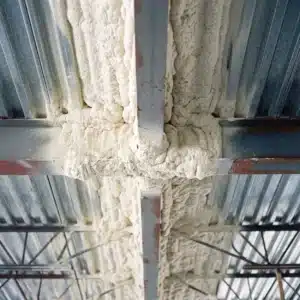
University insulation decisions sit at the intersection of capital budgets, deferred maintenance backlogs, and tightening sustainability targets. Most campuses I work with in Texas, Oklahoma, Kansas, Nebraska, Minnesota, and Wisconsin run a mix of mid-century buildings with leaky envelopes alongside new LEED-targeted research facilities. Spray foam insulation, applied correctly and specified by a licensed architect or engineer, gives capital planners a way to cut envelope-driven HVAC load, hit indoor air quality goals, and stay aligned with the International Building Code.
TLDR: University insulation upgrades using closed-cell or open-cell spray foam can reduce envelope-driven energy loss, support LEED v4.1 Energy & Atmosphere and Indoor Environmental Quality credits, and improve occupant comfort across labs, residence halls, and classroom buildings. Compliance hinges on IBC (2021) Section 2603 (foam plastic), thermal barrier requirements per NFPA 275, ASTM E84 surface burning characteristics, and proper occupancy classification (Group B for higher education, Group A-3 for assembly spaces). Spray foam does not provide structural fire-resistance ratings on its own. A licensed architect or engineer must specify rated assemblies.
Code note: unless otherwise stated, code references on this page are to the 2021 International Building Code. Code adoption is state and local. Across the states we serve, adopted IBC editions currently range from the 2012 edition to the 2024 edition, some states have no statewide commercial building code, and several enforce NFPA 1 or NFPA 101 rather than the International Fire Code. Minnesota and Wisconsin publish state-amended code books whose numbering and requirements differ from the model code. This is general technical information, not a code determination for your project. Confirm the adopted edition and any local amendments with your authority having jurisdiction.
Why university insulation is a different problem than a typical commercial retrofit
University buildings carry a workload most commercial structures never see. A flagship research campus in Austin, Norman, or Manhattan runs labs at full ventilation 24 hours a day, residence halls at peak occupancy nine months a year, and libraries open until 2 a.m. during finals. The envelope never gets a break. That continuous duty cycle is exactly why air sealing and insulation upgrades show up so often in campus master plans and deferred maintenance studies.
Higher education portfolios also span 60 or more years of construction vintages on a single campus. I have walked attics in 1950s classroom buildings where the only thing between conditioned air and a 105 degree Texas summer was rolled fiberglass laid between joists, full of gaps. I have also seen brand new STEM buildings with exterior insulation systems and continuous air barriers performing exactly as the energy model predicted. The variance is enormous, and so is the opportunity.
The third factor is occupied operations. Most campuses cannot shut a residence hall down mid-semester or take a chemistry lab offline for a month. Any university insulation project has to plan around the academic calendar, low-VOC product selection, and tight coordination with the facilities team. That changes how I scope and sequence the work.
How spray foam differs from batt and board insulation in campus envelopes
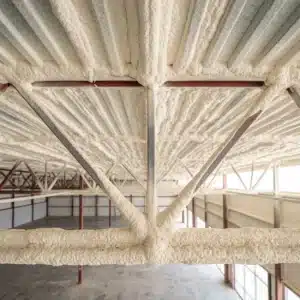
Spray polyurethane foam, often abbreviated SPF, expands on contact and bonds directly to the substrate, sealing penetrations and irregular surfaces in a single pass. Batt insulation relies on perfect cavity fit and a separately installed air barrier. Board insulation requires meticulous taped seams. On the messy reality of an existing campus building, with bracing, conduit, and out-of-plumb framing, spray foam typically achieves a tighter envelope with less labor.
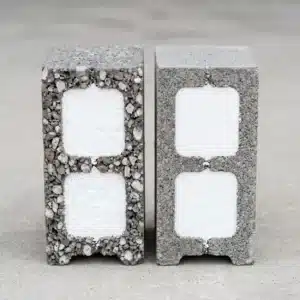
Per U.S. Department of Energy guidance, spray polyurethane foam delivers initial R-values of approximately R-3.6 to R-6.7 per inch, depending on cell structure. Open-cell SPF at roughly 0.5 lb/ft³ runs about R-3.6 per inch. Closed-cell SPF at about 2.0 lb/ft³ falls in the upper portion of that range, and it also acts as a Class II vapor retarder while adding measurable racking strength to the assembly.
For university applications, the choice between closed-cell and open-cell usually comes down to four factors: climate zone, vapor drive, sound attenuation needs, and budget. Texas humidity drives moisture inward during cooling-dominated months. Kansas and Oklahoma see freeze-thaw cycles and shoulder seasons where vapor drive reverses. Closed-cell handles both, but at higher material cost. Open-cell shines in interior partitions and roofs where acoustic performance matters and bulk water is not a risk. For a deeper specification breakdown, see our complete commercial spray foam guide.
Closed-cell vs. open-cell at a glance
| Property | Closed-Cell SPF | Open-Cell SPF |
|---|---|---|
| Density | ~2.0 lb/ft³ | ~0.5 lb/ft³ |
| R-value per inch (DOE) | Up to R-6.7 | Approximately R-3.6 |
| Vapor retarder | Class II at sufficient thickness | Vapor permeable |
| Air barrier | Yes | Yes (at sufficient thickness) |
| Bulk water resistance | High | Low |
| Acoustic performance | Moderate | High |
| Typical campus use | Roof decks, below-grade walls, lab envelopes | Interior partitions, attic ceilings, residence hall sound control |
| Relative cost | Higher | Lower |
What the IBC actually requires for foam plastic in higher education buildings
Foam plastic insulation in any commercial building falls under IBC (2021) Section 2603. The two requirements that come up on every university job are surface burning characteristics under IBC (2021) Section 2603.3 and the thermal barrier requirement under IBC (2021) Section 2603.4.
Per IBC (2021) Section 2603.3, foam plastic insulation must have a flame spread index of 75 or less and a smoke-developed index of 450 or less when tested at the maximum thickness intended for use, in accordance with ASTM E84 or UL 723. Those two standards are the equivalent Steiner tunnel test methods, and the IBC accepts results from either. A more stringent Class A interior finish rating (FSI 25 or less) lives in IBC Chapter 8 IBC (2021) Section 803.1.2 and applies in different contexts, mainly when the foam is exposed as an interior finish, which is rarely permitted.
IBC (2021) Section 2603.4 requires foam plastic to be separated from the interior of a building by an approved thermal barrier. The prescriptive option for commercial buildings is half-inch (12.7 mm) gypsum wallboard, or any material that meets the acceptance criteria of both the Temperature Transmission Fire Test and the Integrity Fire Test of NFPA 275, Standard Method of Fire Tests for the Evaluation of Thermal Barriers. The “15-minute thermal barrier” language you see in product literature is informal industry shorthand for the NFPA 275 criteria, not literal code text. For more on this code interface, watch for our forthcoming article on when spray foam requires a thermal barrier under the IBC.
I want to be direct here: spray foam by itself does not carry an ASTM E119 or UL 263 fire-resistance rating. As the International Code Council explains in its breakdown of IBC fire-resistance test standards, those standards apply to complete tested wall, floor, and ceiling assemblies, with the rating earned through furnace testing under a standard time-temperature curve. A licensed architect or engineer must specify the rated assembly required by the building’s construction type and occupancy. Spray foam does not replace fire-resistance-rated construction.
Occupancy classification matters: universities are Group B, not Group E
This is where I see the most confusion on campus projects. IBC (2021) Section 305.1 defines Group E as educational use through the 12th grade, period. Higher education does not fall under Group E. Per the IBC Code Commentary on IBC (2021) Section 304, college and university classroom buildings are classified as Group B (Business) because educational use above the 12th grade is treated as a business occupancy.
Assembly spaces inside a university change the analysis. Lecture halls, libraries, museums, gymnasiums without spectator seating, and similar uses with an occupant load of 50 or more are typically classified as Group A-3 under IBC (2021) Section 303.4. Cafeterias and dining commons often hit Group A-2 thresholds. Spaces with fewer than 50 occupants, or accessory assembly spaces under 750 square feet, may remain Group B per IBC Sections 303.1.1 and 303.1.2. Mixed-occupancy provisions then drive the construction type, fire-resistance ratings, and the assemblies that any spray foam installation has to integrate with.
Why does this matter for university insulation specifications? Construction type and occupancy directly affect required fire-resistance ratings of walls, floor-ceilings, and roof-ceilings. The thermal barrier separating foam plastic from the interior is a separate IBC requirement, but it has to coexist with whatever rated assembly the architect has specified. Getting the layering wrong creates code violations and field rework. For comparison, spray foam insulation strategies for K-12 schools track Group E rules and have a different occupancy and life-safety calculus.
Energy efficiency and HVAC load: what the verified data actually says
I will not quote contractor blog statistics here. The numbers below come from primary federal and standards bodies.
According to U.S. Department of Energy estimates referenced in NIST commercial building infiltration research, air infiltration through building envelopes accounts for roughly 6 percent of total energy use in U.S. commercial buildings, representing about $11 billion in annual energy cost. Separately, NIST’s 2021 commercial-building modeling work, using updated weather-correlated infiltration inputs, found that adding envelope air barriers produces average HVAC energy savings of about 6 percent of HVAC-EUI compared to the same buildings without air barriers. As newer buildings reduce conductive losses through better insulation, infiltration becomes a proportionally larger share of envelope-driven energy loss.
DOE Building Envelope Campaign data reports that the building envelope accounts for approximately 30 percent of primary energy consumed in U.S. commercial buildings. The Campaign recognizes envelope retrofits that achieve 30 percent or 50 percent performance improvement over the existing baseline (Retro 30 and Retro 50 tiers) and new buildings hitting 20 percent or 40 percent improvement over code. DOE’s Advanced Energy Retrofit Guide for Office Buildings (PNNL-20761) further documents that whole-building deep retrofits combining envelope, lighting, and HVAC upgrades can exceed 45 percent total energy savings.
For residential context, EPA ENERGY STAR estimates that homeowners save an average of 15 percent on heating and cooling costs (about 11 percent on total energy) through air sealing and added insulation. That figure is residential and should not be transferred directly to university buildings. Campus energy savings should be quantified through a project-specific energy model using ASHRAE 90.1 Appendix G as the baseline framework.
The practical takeaway: spray foam is one of several tools that can move an envelope from leaky to tight, and the dollars it saves depend entirely on baseline tightness, climate zone, HVAC system efficiency, and occupancy patterns. Treat any “20 to 50 percent” load reduction claim you read on a contractor site with skepticism unless it is backed by a project energy model.
LEED v4.1 contributions for spray foam in higher education
Universities competing for sustainability rankings or pursuing LEED certification on new construction typically pursue points in two categories where spray foam contributes directly.
| LEED v4.1 Credit Area | Specific Credit | How Spray Foam Contributes |
|---|---|---|
| Energy & Atmosphere | Minimum Energy Performance (Prerequisite) | Improves envelope U-factor and air leakage inputs to the ASHRAE 90.1-2016 Appendix G energy model |
| Energy & Atmosphere | Optimize Energy Performance (up to 18 points, BD+C: New Construction) | Drives modeled energy cost savings via reduced infiltration and conductive losses |
| Indoor Environmental Quality | Low-Emitting Materials (insulation category) | Requires VOC emissions testing per CDPH Standard Method v1.2 (January 2017) |
| Materials & Resources | Building Product Disclosure and Optimization | Manufacturer EPDs and HPDs for SPF products can contribute |
For Indoor Environmental Quality compliance, insulation must be tested per California Department of Public Health Standard Method V1.2, the protocol historically known as “California Section 01350,” published as Standard Method for the Testing and Evaluation of Volatile Organic Chemical Emissions from Indoor Sources Using Environmental Chambers. At least 75 percent of the project’s insulation by cost must comply, with manufacturer documentation less than three years old per USGBC addenda. Several major SPF manufacturers now publish CDPH v1.2 compliance documentation, but it must be verified per project.
For existing campus buildings pursuing LEED O+M, envelope tightening directly improves measured EUI and ENERGY STAR Portfolio Manager scores, which feed into the rating system.
Regional climate considerations across Texas, Kansas, and Oklahoma campuses
Mixed-humid climate (most of Texas and Oklahoma) and mixed-dry climate (western Kansas) each push different specification choices.
Texas campuses from UT Austin to Texas Tech sit in DOE Climate Zones 2A and 3A, cooling-dominated with high humidity for much of the year. Vapor drive runs inward during summer. Closed-cell SPF on roof decks and exterior wall cavities controls both moisture and conductive load. I have seen oversized HVAC systems in Houston-area university buildings cycle so quickly that they never dehumidify properly, which then causes microbial growth on interior finishes. Tightening the envelope first, before resizing equipment, is the right sequence.
Oklahoma campuses in Stillwater and Norman sit in Climate Zone 3A with hotter summers and colder winters than coastal Texas. Wind-driven infiltration through older masonry envelopes is significant. Closed-cell foam on the warm side of the wall assembly controls vapor drive in both directions across shoulder seasons.
Kansas campuses like Manhattan and Lawrence span Climate Zones 4A and 5A, heating-dominated with significant winter loads. NIST data on heating-load infiltration becomes especially relevant here, since up to a quarter of the heating load can be infiltration-driven in tighter buildings. Roof and attic spray foam upgrades typically deliver the largest dollar return per square foot on Kansas campuses.
For project-specific climate strategy, our Texas service area page outlines how we approach moisture management across DFW, Austin, San Antonio, and the Houston metro. Similar logic applies in Oklahoma City, Tulsa, Wichita, and Kansas City.
Two job-site scenarios from recent campus work
Research lab roof retrofit, central Texas. A research building at a public university came to me with a chronic envelope problem. The 1980s built-up roof had been re-coated twice, but the interior of the lab still showed condensation streaks on hard ceilings during summer high-humidity events. The mechanical engineer’s report flagged infiltration as a likely contributor. We scoped a closed-cell SPF application on the underside of the roof deck after the building team removed the existing batt insulation, which had compressed and gone rotten in places. The work happened over a 14-day window between summer and fall semesters, with negative pressure and HEPA filtration so the labs below could continue operating. Closed-cell at 2.5 inches gave us roughly R-15 of continuous insulation plus the air barrier and vapor control the assembly needed. The licensed architect specified a half-inch gypsum thermal barrier per IBC (2021) Section 2603.4 below the foam. Six months later, the facility manager reported no recurrence of the ceiling condensation and a measurable drop in the building’s summer EUI on Portfolio Manager.
Residence hall envelope upgrade, Oklahoma. A 1960s residence hall on a Big 12 campus had cold spots, drafty windows, and complaints stacking up every fall. Capital planning had budget for a partial envelope upgrade but not a full window replacement. We worked with the architect to scope open-cell spray foam in the rim joist and band joist locations on every floor, plus closed-cell in the attic at the perimeter where ice dams had formed in past winters. Total disruption per floor was three days, scheduled around residence life’s room changeover during winter break. The thermal barrier was provided by existing gypsum board on the room side, with a new layer added in the attic to meet IBC (2021) Section 2603.4. Heating complaints dropped sharply that spring, and the housing office reported the mechanical contractor was able to balance the steam radiators that had been chronically overshooting on the south side of the building. The lesson: targeted spray foam in the right locations beats a full re-insulation budget that capital planning cannot approve.
Practical retrofit considerations on occupied campuses
Three issues come up on every occupied university job.
Low-VOC product selection. Confirm the SPF product is third-party tested per CDPH Standard Method V1.2 with documentation under three years old. For occupied residence halls and academic buildings, this is non-negotiable.
Re-occupancy timing. Manufacturer guidelines for re-entry vary, but most current-generation SPF products allow re-occupancy within 24 hours after spraying with proper ventilation. Always follow the specific product data sheet and local jurisdictional requirements.
Coordination with the academic calendar. The realistic windows for invasive envelope work on most campuses are winter break, spring break, and the summer semester gap. Any project longer than three days needs to fit one of those windows or a specific building shutdown approved by the registrar and facilities.
The dollar conversation belongs in a dedicated cost guide rather than this article. Costs vary by climate zone, access, scope, thermal barrier requirements, and labor market. A scoping walk and an energy model give you a real number.
Featured answer: is spray foam insulation safe for schools and universities?
Yes, when properly specified and installed. Modern spray polyurethane foam products tested per CDPH Standard Method v1.2 meet stringent VOC emission limits for low-emitting materials in occupied institutional buildings. Installation must comply with IBC (2021) Section 2603 thermal barrier requirements, manufacturer re-occupancy timelines, and a project ventilation plan. A licensed architect or engineer should specify the assembly, and the installing contractor should be experienced with occupied institutional work.
Campus Recladding and the NFPA 285 Assembly Listing
Most of the building stock on a campus is Type I or Type II, which is exactly the construction this exterior wall provision targets. IBC (2021) Section 2603.5 takes exterior walls containing foam plastic insulation in buildings of Type I, II, III or IV construction, of any height, along with multi-story cold storage buildings required to be of noncombustible construction. IBC (2021) Section 2603.5.5 then requires that the exterior wall assembly be tested in accordance with and comply with the acceptance criteria of NFPA 285. A residence hall, a science building and a single-story field house can all be in scope at once.
Recladding Is Where the Listing Slips
NFPA 285 is the Standard Fire Test Method for Evaluation of Fire Propagation Characteristics of Exterior Wall Assemblies Containing Combustible Components, current edition 2025. It qualifies a complete wall, cladding through framing, as a single system. Because it is an assembly test and not a product test, no foam carries NFPA 285 compliance by itself, and any listing describes one particular combination of materials.
Campus envelope work is rarely new construction. It is a recladding, a window replacement or an added layer of continuous insulation over a wall that already exists, and every one of those is a substitution into a build-up. A different rainscreen panel, a different water-resistive barrier, a change in foam thickness or a new head flashing detail can each take the wall outside the assembly that was listed. When the built wall no longer matches one, what is left is a qualified fire protection engineer’s engineering judgment, or a full test of the assembly as drawn.
At a public institution the specification and the substitution review are the control point. If the listed assembly and its components are not called out as no-substitution items, they will be substituted during buyout, and the basis of compliance leaves with them.
The Related Limits
IBC (2021) Section 2603.3 requires foam plastic to reach a flame spread index of 75 or less and a smoke-developed index of 450 or less. Campus exterior walls of Type I through IV construction answer to IBC (2021) Section 2603.5.4 instead, at flame spread of 25 or less with smoke developed of 450 or less, tested at the thickness intended for use up to 4 inches per ASTM E84 or UL 723. Separately again, IBC (2021) Section 2603.4 requires the interior thermal barrier: 1/2-inch gypsum wallboard, heavy timber complying with IBC (2021) Section 602.4, or a material meeting the acceptance criteria of both the Temperature Transmission Fire Test and the Integrity Fire Test of NFPA 275.
Where It Does Not Apply
- Type V exterior walls, held only to IBC (2021) Sections 2603.2, 2603.3 and 2603.4. Some older ancillary and residential campus buildings fall here; the main academic stock generally does not.
- Exception 1. One-story buildings complying with IBC (2021) Section 2603.4.1.4.
- Exception 2. Foam plastic covered on each face by not less than 1 inch of masonry or concrete, with either no airspace, or a flame spread index of 25 or less and an airspace not more than 1 inch.
Facilities staff should expect the architect or engineer of record to identify the assembly listing by number, and the authority having jurisdiction to accept or reject it.
Frequently asked questions
Is spray foam insulation safe for occupied university buildings? Yes, with proper specification and installation. Products tested per CDPH Standard Method v1.2 meet low-VOC emission limits suitable for institutional indoor environments. Re-occupancy timing follows manufacturer data sheets, typically within 24 hours under proper ventilation. The work should be scheduled around classes, with negative pressure containment and HEPA filtration for adjacent occupied spaces. A licensed architect or engineer should specify the assembly.
What occupancy classification do universities fall under in the IBC? Higher education buildings are typically classified as Group B (Business) per IBC Chapter 3, because Group E is limited to educational use through the 12th grade. Assembly spaces such as lecture halls, libraries, museums, and gymnasiums above the 50-occupant threshold are classified as Group A-3, with cafeterias often hitting A-2. The construction type and required fire-resistance ratings flow from these classifications.
Does spray foam meet IBC fire code requirements? Spray foam plastic insulation must meet IBC (2021) Section 2603.3 for surface burning characteristics (FSI ≤ 75 and SDI ≤ 450 per ASTM E84 or UL 723) and IBC (2021) Section 2603.4 thermal barrier requirements (half-inch gypsum board, or an NFPA 275-tested alternative). The foam itself does not provide fire-resistance ratings under ASTM E119 or UL 263. Fire-resistance ratings apply to complete assemblies.
Can spray foam contribute to LEED certification on a university project? Yes, in two main ways. Improved envelope thermal performance and airtightness contribute to the Energy & Atmosphere Optimize Energy Performance credit, worth up to 18 points on most BD+C projects. Insulation products tested per CDPH Standard Method V1.2 contribute to the Indoor Environmental Quality Low-Emitting Materials credit, provided at least 75 percent of project insulation by cost complies.
Closed-cell or open-cell for university projects? Closed-cell is the better choice for roof decks, below-grade walls, and any assembly with bulk water or vapor drive concerns, especially in mixed-humid Texas and Oklahoma climates. Open-cell works well for interior partitions, attic ceilings, and residence hall sound control where moisture risk is low. Many campus projects use both, specified by application.
How long does the work take on an occupied building? Most envelope retrofits I run on occupied campuses fit into 3 to 14 day windows aligned with academic breaks. Re-occupancy of treated spaces typically follows 24 hours after the final pass with proper ventilation, though manufacturer data sheets and local requirements govern the specific timing.
Does spray foam replace fire-resistance-rated wall and floor assemblies? No. Fire-resistance ratings are properties of complete tested assemblies under ASTM E119 or UL 263. Spray foam by itself has no rating. Where the IBC requires a 1-hour or 2-hour rated assembly, the foam must be installed within an assembly that has been tested and listed at that rating, with a licensed architect or engineer specifying the layup.
What R-value should I expect from spray foam on a campus project? Per DOE guidance, spray polyurethane foam delivers R-3.6 to R-6.7 per inch initially. Open-cell at about 0.5 lb/ft³ runs around R-3.6 per inch. Closed-cell at about 2.0 lb/ft³ falls in the upper range. Total assembly R-value depends on application thickness and continuity of the air barrier.
Will spray foam reduce my campus utility bills? It typically reduces envelope-driven heating and cooling load, but the dollar impact depends on baseline envelope tightness, HVAC efficiency, climate zone, and occupancy schedule. NIST data shows commercial building infiltration accounts for about 6 percent of total energy use on average, with heating-dominated buildings seeing greater proportional savings. A project-specific energy model gives you a real estimate.
What product approvals should I require in the specification? At minimum: ASTM E84 or UL 723 surface burning data showing compliance with IBC (2021) Section 2603.3, an ICC-ES Evaluation Report covering thermal barrier compliance, CDPH Standard Method v1.2 testing for low-VOC compliance, and current SDS documentation. Where LEED is targeted, request the EPD and HPD as well.
Key takeaways
Code compliance
- IBC (2021) Section 2603 governs all foam plastic. The thermal barrier under IBC (2021) Section 2603.4 (half-inch gypsum, or NFPA 275-tested alternative) is required in occupied campus interiors.
- Universities are Group B, with assembly spaces typically Group A-3. Group E does not apply to higher education.
Energy performance
- DOE Building Envelope Campaign reports envelope accounts for about 30 percent of commercial building primary energy.
- NIST data shows infiltration accounts for roughly 6 percent of total commercial building energy use, with envelope airtightening delivering measurable HVAC savings.
LEED v4.1 contributions
- Energy & Atmosphere Optimize Energy Performance (up to 18 points BD+C).
- Indoor Environmental Quality Low-Emitting Materials when products test per CDPH Standard Method V1.2.
Liability and scope
- Spray foam carries no ASTM E119 or UL 263 rating. Fire-resistance ratings are assembly properties.
- A licensed architect or engineer must specify rated assemblies. Local code adoption varies, especially across Texas, Kansas, and Oklahoma jurisdictions.
Related reading
- Closed-Cell vs. Open-Cell Spray Foam for Commercial Buildings
- Commercial Spray Foam Insulation: Closed-Cell and Open-Cell Guide
- Spray Foam Insulation for Industrial Buildings: Energy Savings in Manufacturing
Let’s scope your campus project
If your facilities team is evaluating envelope upgrades for residence halls, research labs, classroom buildings, or athletic facilities anywhere in Texas, Kansas, or Oklahoma, I would be glad to walk the buildings with you. Bahl Fireproofing handles commercial spray foam insulation work on occupied institutional projects routinely, with code-grounded specifications and academic-calendar scheduling. Reach me directly at 512-387-2111 or ross@bahlfireproofing.com, or use our project inquiry form to start the conversation.
Disclaimer: This article is for general educational purposes and does not constitute engineering, architectural, or legal advice. Building code requirements vary by jurisdiction and adopted edition. Project specifications must be developed and stamped by a licensed architect or engineer familiar with the specific building, occupancy, and local amendments. Energy performance figures cited are from primary federal sources and should not be applied to a specific project without an energy model. Bahl Fireproofing makes no representation that the figures or code summaries here apply to any specific project.
Disclaimer: This article provides general educational information about fireproofing and insulation systems and does not constitute professional engineering advice or product specification. System selection must be based on project-specific fire ratings, thermal requirements, acoustic performance needs, environmental conditions, substrate requirements, and budget constraints. Code requirements vary by jurisdiction and project type. Always consult with a licensed architect or engineer and verify UL or FM assembly listings before finalizing specifications.