K-12 schools across Texas, Oklahoma, Kansas, Nebraska, Minnesota, and Wisconsin are increasingly built with exposed structural steel in gymnasiums, cafeterias, and covered walkways. When code requires fire-resistance ratings on that steel and the architect wants the steel to stay visible, intumescent fireproofing is the answer that keeps the design intent intact and the building safe.
TLDR: Intumescent fireproofing for schools is thin-film passive fire protection that expands under heat to insulate structural steel, applied like paint and topcoat-able to match school colors. K-12 schools fall under IBC Group E with construction-type-driven fire-resistance ratings per IBC (2021) Table 601. Water-based intumescent products are the standard for occupied school work because of low VOC, low odor, and clean finish quality. Installation must follow a UL-listed assembly specified by a licensed architect or engineer, with special inspection per IBC Chapter 17 (Section 1705.15 in the 2018 IBC, Section 1705.16 in the 2021 and 2024 IBC) and AWCI Technical Manual 12-B.
Code note: unless otherwise stated, code references on this page are to the 2021 International Building Code. Code adoption is state and local. Across the states we serve, adopted IBC editions currently range from the 2012 edition to the 2024 edition, some states have no statewide commercial building code, and several enforce NFPA 1 or NFPA 101 rather than the International Fire Code. Minnesota and Wisconsin publish state-amended code books whose numbering and requirements differ from the model code. This is general technical information, not a code determination for your project. Confirm the adopted edition and any local amendments with your authority having jurisdiction.
Why schools choose intumescent over cementitious fireproofing
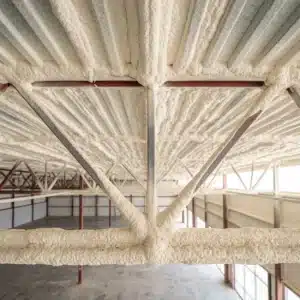
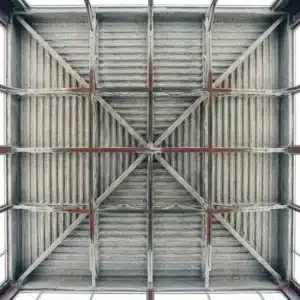
Most K-12 fireproofing work in our region falls into two buckets. The first is back-of-house steel that gets covered by ceilings or drywall, where cementitious spray-applied fire-resistive material (SFRM) is fast and economical. The second is steel the architect wants left visible: gymnasium roof trusses, cafeteria framing, library mezzanines, and covered breezeway columns. For visible steel, intumescent coating is the default. It applies like paint, dries to a smooth finish, and accepts topcoats in school colors. SFRM cannot deliver that result.
Beyond aesthetics, intumescent works well in occupied school buildings because water-based formulations have very low VOC and minimal odor. That matters when administrators want phased work that does not interfere with classes, sports, or food service. For broader background on the full intumescent product family and where each fits, see our complete intumescent fireproofing guide.
How intumescent fireproofing works
Intumescent coatings are passive fire protection materials that look like ordinary paint until exposed to fire. At approximately 250°C (about 480°F), a chemical reaction kicks off: the coating swells dramatically, expanding many times its original thickness (commonly cited as 15 to 50 times under standard test conditions, and product specific), and forms a thick carbonaceous char layer. That char insulates the structural steel below, slowing the rate at which the steel reaches its critical temperature. Structural steel loses roughly half its load-bearing capacity around 1,100°F (593°C), so anything that delays heat transfer buys time for occupants to evacuate and fire crews to respond. Properly applied to a UL-listed assembly, thin-film intumescent typically delivers 1 to 2 hours of fire resistance, with some systems engineered for higher ratings.
What the IBC requires for K-12 schools
K-12 schools are classified as Group E under IBC (2021) Section 305.1, which defines the educational occupancy as the use of a building by six or more persons for educational purposes through the 12th grade. Higher education sits in Group B, but K-12 is squarely Group E.
Once the occupancy is set, the construction type drives the fire-resistance rating requirements. IBC (2021) Table 601 establishes hourly ratings for the primary structural frame, bearing walls, floors, and roofs by construction type. The most common construction types for K-12 work in our region are:
| Construction Type | Primary Structural Frame | Floor Construction | Roof Construction |
|---|---|---|---|
| Type I-A | 3 hours | 2 hours | 1.5 hours |
| Type II-A | 1 hour | 1 hour | 1 hour |
| Type II-B | 0 hours | 0 hours | 0 hours |
| Type III-A | 1 hour | 1 hour | 1 hour |
Simplified excerpt showing construction types most common in K-12 school work. The full IBC (2021) Table 601 also includes Type I-B, exterior and interior bearing walls, and other elements. Consult the applicable edition adopted in your jurisdiction.
Most Texas and Oklahoma K-12 buildings I work on are Type II-A noncombustible with a 1-hour structural frame rating, or Type II-B with a 0-hour rating where the building is fully sprinklered. Group E fire areas larger than 12,000 square feet must be sprinklered per IBC (2021) Section 903.2.3, which captures most modern K-12 buildings. Even where Type II-B reduces or eliminates the structural frame rating, many districts still spec intumescent on visible steel for redundancy and consistency across the campus. For a wider treatment of the code framework around all of this, see our commercial fireproofing code compliance guide.
A licensed architect or engineer specifies the construction type, the rating, and the UL-listed assembly. We install per the design.
Is intumescent fireproofing required in K-12 schools?
Whether intumescent fireproofing is required in a K-12 school depends on the construction type assigned under IBC (2021) Table 601 and whether the building is sprinklered. Type II-A construction requires a 1-hour structural frame rating, and intumescent applied to a UL-listed 1-hour assembly is one code-compliant method to achieve it. In sprinklered Type II-B buildings, the frame rating may drop to zero. A licensed architect or engineer must specify the assembly.
Why water-based intumescent is the standard for school projects
For occupied school interiors, water-based intumescent has been the practical default for years. Several reasons drive that.
VOC content of water-based intumescent products is typically a small fraction of the limits set under SCAQMD and CARB rules for interior coatings. Many current water-based products test at well under 10 g/L, with some ultra-low-VOC formulations testing below 1 g/L per their published technical data sheets. Solvent-based products, by contrast, run substantially higher and produce noticeable odor during application and curing. In a school environment with kids, staff, and food service, the difference between a low-odor water-based product and a solvent-based product is the difference between phased occupied work and a full building shutdown.
Aesthetics also tilt toward water-based. The finish dries smooth and accepts compatible topcoats in any school color, supporting architecturally exposed structural steel applications in gymnasium trusses and cafeteria framing. Topcoat compatibility must be verified per the specific UL assembly, since not every topcoat is listed with every intumescent system. Watch for our forthcoming dedicated guide on intumescent coating for architecturally exposed structural steel for a deeper treatment of finish quality, AESS categories, and topcoat selection.
Solvent-based and epoxy intumescent products still have a place. Semi-exposed walkway structures, exterior canopies, and some industrial-shop areas in vocational programs may need the moisture and weather tolerance those formulations provide. The right call depends on the exposure category and the UL listing in the specification. Verify VOC content and odor characteristics against the current product data sheet for any specific product before specifying.
DFT, UL listings, and why one number does not fit all
Required dry film thickness (DFT) for intumescent coating is not a single value. It varies with three things: the required fire rating in hours, the steel section’s section factor (W/D ratio), and the specific product’s UL listing. A heavier section heats up more slowly and needs less coating; a lighter section heats up faster and needs more.
Structure Magazine’s analysis of passive fire protection coating thickness illustrates the range with a single product. A W10x39 beam used as a beam (one face in contact with concrete) requires 161 mils DFT for a 2-hour rating. The same W10x39 used as a column requires 198 mils, about 23 percent more, because all four faces are exposed to fire. An HSS 10x10x¼ column requires 309 mils for the same 2-hour rating. The numbers move significantly with the geometry, and as UL’s best practice guide for passive fire protection of structural steel makes clear, using extrapolated thicknesses outside the published UL design voids the listing.
For a school project, this is why the architect’s stamped specification matters. We apply per the UL design and per the manufacturer’s tolerances. Field-improvised thicknesses, even when they “look about right,” are a path to failed inspection. Watch for our forthcoming detailed walk-through of dry film thickness requirements for your required fire rating in our cluster series.
Special inspection under IBC Chapter 17
The IBC requires special inspections of intumescent fire-resistive materials applied to structural elements, performed in accordance with AWCI Technical Manual 12-B, Standard Practice for the Testing and Inspection of Field Applied Thin Film Intumescent Fire-Resistive Materials. The specific IBC section number depends on the edition adopted in your jurisdiction: Section 1705.15 in the 2018 IBC, Section 1705.16 in the 2021 and 2024 IBC. The North Central Texas Council of Governments summary of 2024 IBC special inspection requirements walks through how this requirement is enforced regionally. This is an owner-driven, third-party inspection, not the contractor’s responsibility, but the contractor lives or dies by it.
The special inspector verifies five things on every job: substrate condition and surface preparation before application; dry film thickness measured per ASTM D7091 with magnetic and eddy-current gauges; density and visual quality of the cured film; adhesion per ASTM D4541 or ASTM D3359; and final finish condition.
Every reading must fall within the manufacturer’s tolerance for the specified UL design. Readings outside that band trigger remediation, which on a school project usually means working a second time around the academic calendar. The way to avoid that pain is correct application the first time.
Scheduling intumescent work around the academic calendar
The realistic windows for invasive intumescent fireproofing on an occupied K-12 campus are summer break, winter break, and spring break. Summer is the workhorse window. June and July give us long enough stretches to handle multi-coat systems, recoat intervals, and ventilation periods.
Water-based products have low VOC and low odor, but they still need adequate ventilation during application and initial cure. Multi-coat systems require recoat intervals between coats per the manufacturer’s data sheet, which stretches the total schedule. Re-occupancy timing follows the manufacturer’s published guidance and any local AHJ requirements.
When the work is short enough to fit a winter or spring break, we typically tackle one space at a time: gymnasium first, then cafeteria, then breezeways. Coordination with the principal and facilities director happens before the trucks roll. That is part of the reason occupied-school intumescent jobs go more smoothly when the contractor has done them before in our region.
Common K-12 school applications
Five scenarios cover most of the intumescent work we do for Texas, Oklahoma, Kansas, Nebraska, Minnesota, and Wisconsin school districts.
Gymnasium roof trusses. Open-web steel joists or wide-flange trusses left exposed for ceiling height and design intent. Type II-A construction, 1-hour rating, AESS-grade finish. The classic intumescent application.
Cafeteria and commons framing. Exposed steel beams over dining and assembly areas. Same structural rating logic as the gym, with extra attention to topcoat compatibility for finish quality.
Library and media center mezzanines. Lower volumes than the gym, but visible steel and aesthetic expectations are high.
Covered breezeways and exterior walkways. Semi-exposed or weather-exposed conditions. Often require solvent-based or epoxy intumescent specified in the UL listing rather than water-based, depending on the exposure rating. Bahl works with the design team to confirm the right system.
Renovation and addition projects. Schools that add classroom wings, replace HVAC, or open up ceilings often expose existing steel that needs to be brought into compliance. Retrofit work is its own animal, with substrate condition and existing-finish compatibility driving most of the decisions.
Frequently asked questions
What is intumescent fireproofing used for in schools? Intumescent fireproofing is used to protect exposed structural steel in K-12 school buildings while keeping it visible. Common applications include gymnasium roof trusses, cafeteria framing, library mezzanines, and covered walkway columns. The thin-film coating expands and forms an insulating char during a fire, delaying heat transfer to the steel.
Is intumescent fireproofing required in K-12 schools? Whether it is required depends on the construction type assigned under IBC (2021) Table 601 and whether the building is sprinklered. Type II-A construction requires a 1-hour structural frame rating; intumescent to a UL-listed 1-hour assembly is one compliant method. Sprinklered Type II-B can drop the rating to zero. A licensed architect or engineer must specify the assembly.
Why water-based intumescent instead of solvent-based in schools? Water-based intumescent has very low VOC content and very low odor, making it suitable for occupied or recently occupied school buildings. Solvent-based products produce stronger odors and higher VOC emissions during application and cure. For interior school projects, water-based is almost always the right choice unless exposure conditions require otherwise.
Can intumescent coating be applied during the school year? Yes, but only in unoccupied portions of the building or during scheduled breaks. Most K-12 intumescent work happens during summer break to allow multi-coat application, recoat intervals, and ventilation periods without disrupting classes. Winter and spring breaks can accommodate smaller jobs in single spaces.
How long does intumescent coating last in a school building? Properly applied intumescent coatings inside controlled school environments have substantial service lives when maintained per the manufacturer’s recommendations. Periodic visual inspection, AHJ-required reinspection cycles, and prompt repair of any mechanical damage extend usable life. Gymnasium environments with humidity swings warrant closer attention than dry classroom corridors.
Who performs the special inspection for intumescent fireproofing? A qualified third-party special inspector engaged by the owner performs the inspection, working from IBC Chapter 17 (Section 1705.15 in the 2018 IBC, Section 1705.16 in the 2021 and 2024 IBC) and AWCI Technical Manual 12-B. The inspector verifies substrate, DFT, density, adhesion, and finish condition. The contractor cannot self-inspect. Failed inspections trigger remediation at the contractor’s expense.
What is the difference between intumescent and cementitious fireproofing? Cementitious SFRM is a thick, sprayed mineral-based coating that hides under ceilings and inside chases. Intumescent is a thin paint-like coating designed to remain visible after curing. Cementitious is dramatically cheaper per square foot but less attractive; intumescent costs more but supports exposed steel architecture.
Does intumescent coating replace fire-resistance-rated wall and floor assemblies? No. Intumescent coating provides fire protection only for the structural steel it is applied to. Fire-resistance-rated wall, floor, and ceiling assemblies are separate code requirements with their own UL listings or assembly designs. The two work together, not as substitutes.
Key takeaways
Code framework
- K-12 schools are IBC Group E. Higher education is Group B, with different requirements.
- IBC (2021) Table 601 sets hourly ratings by construction type. Most regional K-12 work is Type II-A (1-hour) or sprinklered Type II-B.
- Group E fire areas over 12,000 square feet require sprinklers under IBC (2021) Section 903.2.3.
Product selection
- Water-based intumescent is the standard for occupied school interiors. Low VOC, low odor, clean finish.
- Solvent-based or epoxy intumescent applies to semi-exposed and exterior conditions per the UL listing.
- DFT varies by section factor, member orientation, fire rating, and product. The architect specifies; we apply per design.
Inspection and liability
- IBC Chapter 17 requires special inspection of IFRM per AWCI Technical Manual 12-B (Section 1705.15 in the 2018 IBC, Section 1705.16 in the 2021 and 2024 IBC).
- The inspector verifies substrate, DFT, density, adhesion, and finish.
- A licensed architect or engineer must specify the UL-listed assembly. The installer applies per that specification.
Related reading
- Types of Intumescent Fireproofing: Which Coating Fits Your Project
- Intumescent vs. Cementitious Fireproofing
- Intumescent Fireproofing for Existing Buildings: Retrofit Guide
Let’s talk about your school project
If your district, GC, or design team is scoping intumescent fireproofing on a Texas, Kansas, or Oklahoma K-12 project, new build or renovation, I would be glad to walk the building and review the spec. Bahl Fireproofing handles intumescent fireproofing services for commercial and institutional buildings with academic-calendar scheduling and direct experience on occupied school work. Reach me at 512-387-2111 or ross@bahlfireproofing.com, or use the Contact Bahl Fireproofing form to start the conversation.
Disclaimer: This article is for general educational purposes and does not constitute engineering, architectural, or legal advice. Building code requirements vary by jurisdiction and adopted edition. Project specifications must be developed and stamped by a licensed architect or engineer familiar with the specific building, occupancy, and local amendments. Performance figures and product VOC ranges cited reflect product categories generally and do not apply to any specific product or project without verification against the current technical data sheet. Bahl Fireproofing makes no representation that the figures or code summaries here apply to any specific project.
Disclaimer: This article provides general educational information about fireproofing and insulation systems and does not constitute professional engineering advice or product specification. System selection must be based on project-specific fire ratings, thermal requirements, acoustic performance needs, environmental conditions, substrate requirements, and budget constraints. Code requirements vary by jurisdiction and project type. Always consult with a licensed architect or engineer and verify UL or FM assembly listings before finalizing specifications.