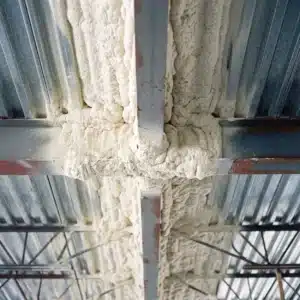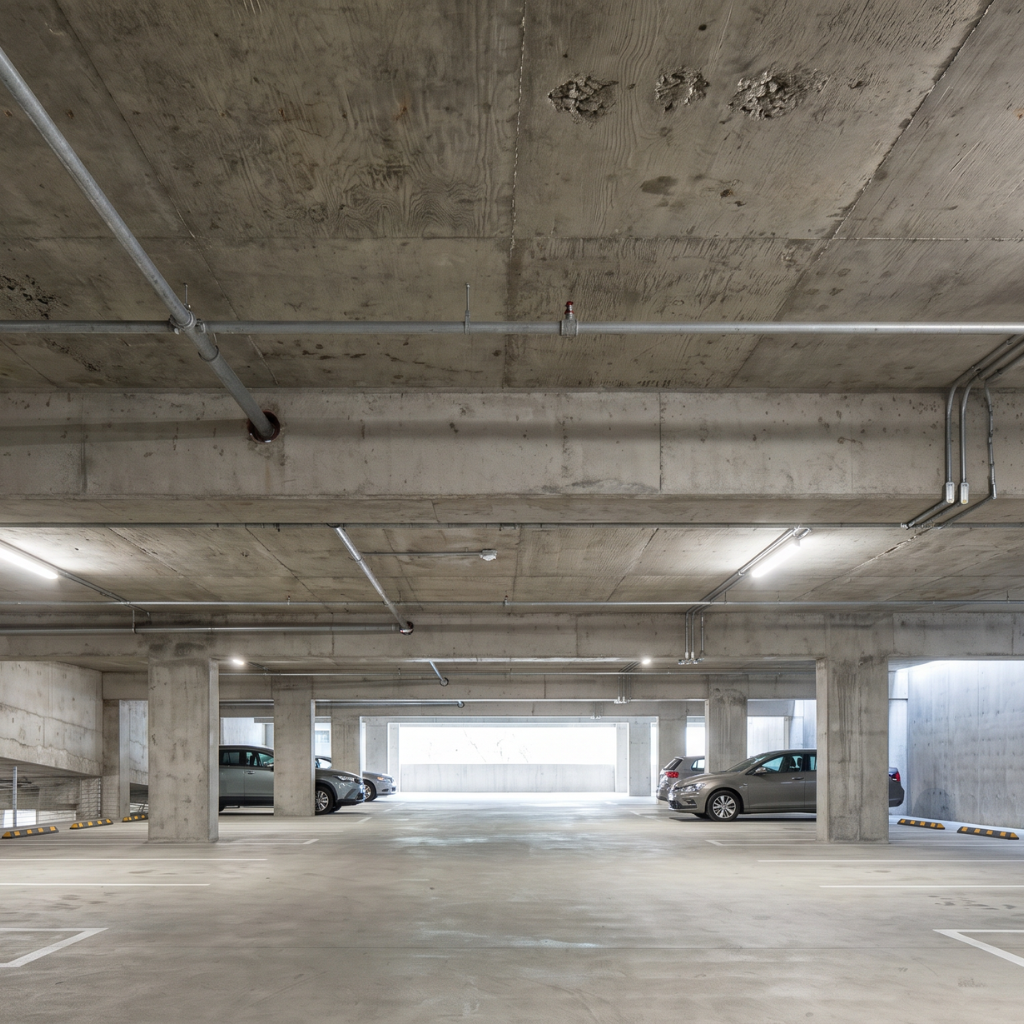
Spray foam insulation in a parking structure is a thermal-control choice, not a fire-protection one. This guide walks general contractors, architects, developers, and facility owners through what closed-cell spray polyurethane foam actually does on a podium deck, what the 2021 International Building Code requires of the assembly around it, and how we approach parking structure insulation across Texas, Kansas, and Oklahoma.
TLDR: Parking structure insulation reduces heat transfer, vapor migration, and air leakage between a parking garage and the conditioned space next to or above it. Closed-cell spray foam is the standard parking structure insulation choice, but it is not recognized by the IBC as a fire-resistive material on its own. Per IBC (2021) Section 2603.4, foam plastic in occupied areas must be separated from the interior by an approved thermal barrier, typically ½-inch gypsum wallboard or a material meeting the NFPA 275 acceptance criteria. The fire-rated separation between a Group S-2 parking garage and the residential or office space it supports comes from a tested and listed horizontal assembly (typically the concrete slab and any rated steel protection), not from the insulation.
Code note: unless otherwise stated, code references on this page are to the 2021 International Building Code. Code adoption is state and local. Across the states we serve, adopted IBC editions currently range from the 2012 edition to the 2024 edition, some states have no statewide commercial building code, and several enforce NFPA 1 or NFPA 101 rather than the International Fire Code. Minnesota and Wisconsin publish state-amended code books whose numbering and requirements differ from the model code. This is general technical information, not a code determination for your project. Confirm the adopted edition and any local amendments with your authority having jurisdiction.
Nothing in this article is a substitute for project-specific engineering, architectural, or code analysis; always consult the licensed architect or engineer and authority having jurisdiction for final decisions on assemblies and details.
I have spent the better part of two decades working on the underside of parking decks across Texas. Most of that work has been on the building type that increasingly defines our urban skylines: four or five stories of wood-frame apartments stacked over a concrete podium with one or two levels of parking below. Designers call them podium projects. Insurance carriers learned to call them frequent flyers after Winter Storm Uri. Either way, the assembly between the parking and the apartments above is one of the most consequential interfaces in the whole project, and spray foam comes up in the conversation almost every time.
The conversation usually starts with energy code, drifts into condensation, then runs straight into fire code, and somewhere in the middle a value engineer asks whether closed-cell spray foam can replace the gypsum on the underside of the deck. The honest answer is no, but the longer answer is more useful, and that is what this guide will work through.
What follows covers the code framework, the material science, the regional realities of climate and code adoption across Texas, Kansas, and Oklahoma, and the specific way we coordinate the insulation scope with the fireproofing scope when both show up in the same set of drawings.
What Parking Structure Insulation Actually Is, and What It Isn’t
Parking structure insulation is a thermal control layer applied to floors, ceilings, or walls separating a parking garage from adjacent occupied spaces. Per IBC §406 and §510.2, parking structure insulation must coordinate with required fire-resistance ratings; spray foam is not recognized by the IBC as a fire-resistive material on its own and requires an approved thermal barrier per IBC (2021) Section 2603.4 in occupied areas.
That definition deliberately puts two ideas next to each other that are easy to confuse: thermal control and fire-resistance rating. They are not the same thing. They are not measured the same way. They are not delivered by the same products.
A thermal control layer slows the movement of heat, air, and water vapor through an assembly. We measure it in R-values, perm ratings (per ASTM E96), and air permeance (per ASTM E2178). Closed-cell spray polyurethane foam is one of the more capable thermal control materials available for the underside of a parking deck because it does all three jobs in a single application.
A fire-resistance rating is a property of an assembly, tested per ASTM E119 or UL 263 in a furnace at a defined time-temperature curve, and expressed in hours: 1-hour, 2-hour, 3-hour, or 4-hour. The rating belongs to the assembly, not to any one product inside it. The concrete deck above the parking garage carries the assembly’s rating. The applied fireproofing protecting any exposed structural steel carries the rating. Spray foam does not provide an hourly fire-resistance rating on its own; any fire-resistance rating for a parking podium assembly must come from a tested and listed horizontal assembly, not from the insulation.
That distinction is the single most important point in this guide. Once you see it clearly, every other parking structure insulation decision becomes easier to make. Spray foam is also categorized as a foam plastic under IBC Chapter 26, which means it is combustible and tightly regulated in occupied buildings. ASTM E84 Class A is a surface-burning classification only; it does not mean the product is noncombustible and does not confer any hourly fire-resistance rating under ASTM E119 or UL 263. Anyone who tells you otherwise is conflating two test methods that measure entirely different things.
Open Versus Enclosed Parking Garages: IBC §406.5 and §406.6
The IBC draws a hard line between open and enclosed parking garages, and that line affects everything from ventilation to sprinklers to the kind of insulation strategy that makes sense.
Per IBC §406.5, an open parking garage qualifies as “open” only when exterior wall openings on each tier total at least 20 percent of the perimeter wall area, with an aggregate length of at least 40 percent of the perimeter, distributed on two or more sides. Open parking garages are limited to higher construction types as defined in IBC §406.5 (typically Type I, II, or IV under the 2021 edition). They do not require mechanical ventilation. Vehicle repair, fuel dispensing, and bus or truck parking are prohibited.
Per IBC §406.6, any garage that does not meet that openness threshold is an enclosed parking garage. Enclosed garages must have mechanical ventilation per the International Mechanical Code and require NFPA 13 sprinklers per IBC §903.2.10. The 2021 IBC also added §406.6.4 covering mechanical-access enclosed garages, with 2-hour fire barriers or horizontal assemblies separating them from other occupancies.
NFPA 88A, the Standard for Parking Structures, sits alongside the IBC. The 2023 edition requires all new parking structures to be fully sprinklered in accordance with NFPA 13, including open garages, but only where that edition has been adopted by the authority having jurisdiction. Whether that requirement applies on your project depends on which edition your AHJ has adopted.
Why does the open-versus-enclosed distinction matter for parking structure insulation? Two reasons. First, the ventilation regime determines exhaust concentration. Vehicle exhaust contains nitrogen oxides, sulfur oxides, soot, and brake dust, and those compounds attack exposed coatings over the service life of the building. Enclosed garages with mechanical ventilation tend to concentrate that exposure on the ceiling surface, which means the topcoat protecting any spray foam needs to be specified with that durability in mind. Second, open garages have a much harder vapor environment. The underside of a podium deck above an open garage is exposed to outdoor humidity year-round, while the apartments above are conditioned and dehumidified. That dewpoint differential drives condensation risk, and the only insulation strategies that handle it reliably are closed-cell or rigid-board systems with controlled vapor permeance.
The Horizontal Assembly Between Parking and the Apartments Above
If you are working on a podium project, IBC §510.2 is the section that controls. The horizontal building separation allowance lets the design team treat the parking levels and the apartments above as separate buildings for code purposes, but only if every condition is met.
The conditions are specific. A 3-hour fire-resistance-rated horizontal assembly must separate the two buildings. The building below and the assembly itself must be Type IA construction. Shafts and stairs passing through the assembly must be 2-hour rated. The building below must be fully sprinklered to NFPA 13. The building above is limited to A (with under 300 occupant load), B, M, R, or S occupancies. When all of that is in place, the wood-frame apartments above can be designed under their own height and area limits, separate from the concrete podium below.
Once you use IBC §510.2, the required 3-hour fire-resistance rating for the horizontal assembly between the podium and the building above controls, and it effectively supersedes the default floor ratings in IBC (2021) Table 601 (which would otherwise be 2 hours for Type IA) and the occupancy-separation values in IBC (2021) Table 508.4 for that interface. For the typical Texas five-over-one project, the 3-hour rating is the number that drives the design of the horizontal assembly.
What delivers that rating? In nearly every case, it is the structural concrete podium slab itself, sized and reinforced to achieve a 3-hour rating per ASTM E119, sometimes augmented by applied fireproofing on exposed steel members or a rated ceiling membrane below. The fire-resistance rating comes from the tested and listed assembly. If you add closed-cell spray foam to the underside of the slab to control thermal transfer and air leakage between the garage and the apartments, you are adding a thermal layer to an already-rated assembly. You are not creating the rating. You are also not allowed to compromise the rating, which is where IBC §2603.4 comes in.
For projects that do not use the §510.2 podium pathway, IBC §508.4 and IBC (2021) Table 508.4 govern the separation. Between a sprinklered S-2 parking garage and an R-1 or R-2 occupancy, the typical requirement is 2 hours, reducible to 1 hour under the private-vehicle footnote. Between S-2 and a B or M occupancy, no separation is required when both are sprinklered. The exact value for your project depends on adjacency, sprinkler status, and any state amendments. Verify with the AHJ and the project’s licensed architect or engineer before assuming.
Why Closed-Cell Spray Foam, Almost Never Open-Cell
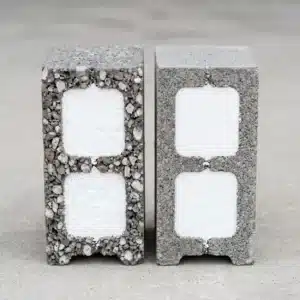
For the underside of a parking deck or the perimeter walls of an enclosed garage, closed-cell spray polyurethane foam is the right answer in nearly every case. Open-cell foam is wrong for this application, and the reasons are straightforward once you put the technical data side by side.
| Performance Factor | Closed-Cell SPF | Open-Cell SPF |
|---|---|---|
| Density | ~2.0 lb/ft³ (ASTM C1029 Type II) | ~0.5 lb/ft³ |
| Aged R-value per inch | R-6.3 to R-7.4 (HFO-blown) | R-3.6 to R-3.9 |
| Vapor permeance | Less than 1.0 perm at 1.25 to 1.875 inches (Class II vapor retarder per ASTM E96) | 16 to 20 perms (vapor-open, not a vapor retarder) |
| Water absorption | Less than 2 percent (ASTM D2842) | Absorbs liquid water |
| Closed-cell content | Greater than 90 percent (ASTM D6226) | Less than 30 percent |
| Compressive strength | 25 to 35 psi (ASTM D1621) | Less than 5 psi |
| Air permeance | Less than 0.02 L/s·m² at 75 Pa (ABAA-qualified at ~1 inch) | Air-impermeable only at greater thickness |
| ASTM E84 | Class I (flame spread index ≤25, smoke developed ≤450) | Class I |
What that table is really saying is that closed-cell foam handles the conditions a parking deck imposes. It controls vapor drive between humid garage air and conditioned space (especially critical in Houston, San Antonio, and the Gulf Coast). It resists liquid water from washdown, snow-melt drip, and condensation. It tolerates incidental impact and maintenance contact at typical parking ceiling heights of seven to eight feet. It seals air leaks at penetrations, which interrupts the stack-effect transfer of cold air, exhaust gases, and odors into apartments above. And it delivers more R-value per inch in the limited headroom that podium decks usually have to give.
Open-cell foam fails the vapor test categorically, absorbs water, and lacks the compressive strength to handle a parking environment. The few times I have been asked to specify open-cell foam in a parking podium have all been driven by budget, and in every case the licensed architect or engineer walked it back when the moisture analysis came in. For a deeper look at this material decision in commercial settings generally, our closed-cell vs. open-cell spray foam comparison for commercial buildings walks through the trade-offs in detail.
Specific closed-cell products commonly specified on commercial podium projects include Huntsman Heatlok HFO Pro (under IAPMO UES ER-0565), BASF Walltite Max (under ICC-ES ESR-2642), Carlisle SealTite PRO HFO, and SES Foam Nexseal 2.0. All four are HFO-blown, which improves long-term R-value retention and reduces global warming potential compared to older HFC-245fa formulations.
The Thermal Barrier Requirement (IBC §2603.4)
Once closed-cell foam is selected and installed, IBC §2603.4 controls what has to go on top of it. The section requires foam plastic to be separated from the building interior by an approved thermal barrier. The 250°F average temperature rise after 15 minutes that gets quoted in product literature is an NFPA 275 acceptance criterion, not language in IBC (2021) Section 2603.4, and it is not an ASTM E119 requirement.
The prescriptive solution is ½-inch gypsum wallboard. That is the option specifications fall back to when nothing else has been worked out. Heavy timber construction that meets IBC §602.4 is also recognized as satisfying the thermal barrier requirement where it complies with IBC §2603.4. Beyond those prescriptive options, IBC §2603.4 allows any material tested to NFPA 275 (which combines a temperature transmission test and an integrity test, both at 15 minutes), and IBC §2603.9 opens a separate special approval pathway based on full-scale fire testing per NFPA 286, FM 4880, UL 1040, or UL 1715.
The thermal barrier requirement is what distinguishes IBC (2021) Section 2603.4 from the ignition barrier provisions in Section 2603.4.1.6, which apply only to attics and crawl spaces accessed for utility servicing. A parking garage is not a utility-access attic or crawl space. It is an accessible occupied area, which means the thermal barrier requirement applies in full. None of the §2603.4.1 exceptions cover parking garages.
For projects where ½-inch gypsum is impractical (overhead application, complex deck geometry, or coordination with existing MEP), the alternative is an ICC-ES-listed thermal barrier coating applied directly over the foam under IBC §2603.9. Three coatings carry the relevant evaluation reports:
The most widely specified is DC315 by International Fireproof Technology, listed under ICC-ES ESR-3702. The ESR catalogues approved use over BASF Walltite, Carlisle SealTite, Demilec Sealection 500, Icynene-Lapolla, Johns Manville, Gaco, and several other foam systems. Coverage runs around 14 to 20 mils wet film at typical specification, and the coating is intumescent under fire exposure.
Fireshell F10E (and the related Blazelok TBX) is manufactured by TPR2 / ICP Construction and listed under ICC-ES ESR-3997. It carries approvals over Demilec Sealection 500, BASF, Bayseal, JM Corbond, and Carlisle systems.
No-Burn Plus ThB is listed under IAPMO UES ER-305 and is approved over BASF Walltite/Spraytite, Icynene, Lapolla, Johns Manville, and SWD foams.
Each of those listings is specific. The thermal barrier coating is approved over particular foam products at particular thicknesses for particular assembly configurations. You cannot mix and match outside the listed combinations and expect the assembly to comply with §2603.9. Because ICC-ES and IAPMO reissue and occasionally withdraw evaluation reports, always reference the latest ESR or ER for the specific foam and coating combination on your project before specifying or installing.
How Parking Structure Insulation Looks on a Real Texas Podium Deck
The most common parking structure insulation scope I see across our Texas commercial work is the underside of an 8 to 12 inch post-tensioned concrete podium slab above one or two levels of parking, with four or five floors of wood-frame multifamily above. The Texas Doughnut variant, which wraps wood framing around a central concrete garage, is also common in Austin and Dallas.
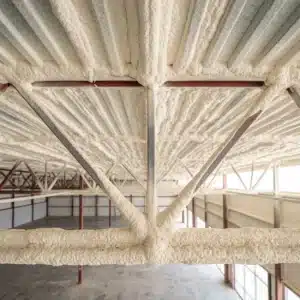
On a typical job, the foam crew arrives after the structural deck is poured, the post-tensioning is stressed, and the MEP rough-in below the deck is substantially complete. The deck soffit is masked and prepped, two inches of closed-cell foam is applied in two passes (one to fill irregularities and embed sleeves, a second to bring the cured assembly to specified thickness), and the thermal barrier coating is applied either by the same crew or a follow-on coating crew, depending on the GC’s scope split. Two inches of closed-cell at R-6.5 per inch yields roughly R-13 of effective thermal resistance, which often exceeds the 2021 IECC mass floor minimum in the zones we work in, where that edition is the one adopted. Three inches yields around R-19.
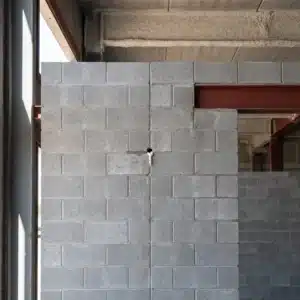
Perimeter walls of an enclosed garage adjacent to occupied space are a related but distinct scope. The closed-cell foam goes on the back of the masonry or concrete shaft wall facing the parking, the thermal barrier coating goes on top, and the air seal continues around any penetrations carrying plumbing, electrical, or low-voltage conduit between the two spaces. That air-seal continuity is where most of the energy savings actually comes from. R-value matters; air leakage matters more.
Plumbing routed in the podium ceiling is a different problem. Insulation slows heat loss; it does not generate heat. A water line in an unconditioned podium ceiling above conditioned space will eventually freeze in a sustained cold event no matter how thick the foam is, because there is no heat source on the cold side of the assembly. The right answer is heat-trace cabling on the pipe (UL 515 listed and properly sized for the pipe diameter and ambient minimum), with the closed-cell foam wrapped around the trace cable to retain the heat it generates. We have repaired enough Uri-damaged podium ceilings to have strong opinions about this.
Vehicle Exhaust, Freeze-Thaw, and What 2021 Uri Taught Us
Climate context matters for parking structure insulation across our service area, and Texas, Kansas, and Oklahoma span several IECC climate zones as mapped in Chapter 3 [CE], Section C301.
Across Texas, Oklahoma, and Kansas, IECC climate zones range from 2A along the Gulf Coast to 5A in parts of Kansas and the northern tier, with central Texas, most of Oklahoma, and the panhandles falling somewhere between. Use the IECC climate zone map at Figure C301.1 and Table C301.1, or the DOE zone lookup tool, for the exact zone at your project’s county or ZIP code. Under the 2021 IECC, Section C402.1 opaque assembly requirements, concrete podium decks are treated as mass floors, and the prescriptive continuous insulation requirement for floors over unconditioned space ranges from roughly the mid-single-digit R-values in Climate Zone 2 to the mid-teens in Climate Zone 5 (typical prescriptive values for mass floors are around R-6.3 continuous insulation in Zone 2 and R-14.6 continuous insulation in Zone 5). Always verify the exact R-value in the opaque assembly table for your construction type and climate zone, and note that the table number changed between editions, so confirm it against the edition your jurisdiction has adopted.
Then there is the freeze-thaw history. February 2021 saw temperatures fall below freezing across the entire state of Texas, with Amarillo and other Panhandle cities recording some of their lowest temperatures on record, well below 0°F. Multifamily-over-parking podium projects across our service area lost domestic water lines in their podium ceilings, sometimes catastrophically. Winter Storm Elliott in December 2022 and the January 2024 cold snap both repeated the pattern at smaller scale, with renewed insurance claims each time. Anyone planning a podium project anywhere in our service area now needs to assume a similar event will recur within a 10-year window and design accordingly.
The implication for parking structure insulation is twofold. First, closed-cell spray foam combined with continuous air sealing provides the best practical envelope between the parking deck and the apartments above, because it controls both heat loss and the air leakage that accelerates heat loss during cold-soak events. Second, plumbing freeze protection requires more than insulation. Heat-trace cabling, properly specified and powered through emergency or standby circuits, is what actually keeps water flowing during a multi-day grid event. The insulation extends the runtime of that heat trace and reduces its energy demand. It does not replace it.
Vehicle exhaust is the slower problem. Over a 20- or 30-year service life, a parking ceiling accumulates exposure to nitrogen oxides, sulfur oxides, soot, brake dust, and the chemicals used to pressure-wash the deck. Closed-cell foam with a properly specified thermal barrier coating handles this better than any exposed open-cell or fibrous insulation would, because the closed-cell skin and the topcoat together resist absorption and chemical attack. Specify the topcoat with that exposure in mind, particularly in enclosed garages where exhaust concentrates at the ceiling.
How Much Parking Structure Insulation Costs (With Caveats)
The honest answer to parking structure insulation cost is that it depends on project size, deck access, foam thickness, regional labor rates, and whether the thermal barrier coating is in your scope or carried separately. With those caveats stated up front, here are the ranges we typically see in 2025 and 2026.
| Item | Typical Range | Notes |
|---|---|---|
| Closed-cell SPF, installed, per board foot | $1.00 to $2.00 (national); $2.50 to $3.25 (Texas/Oklahoma regional, large commercial) | Higher end reflects HFO-blown product premium and overhead application complexity |
| Closed-cell at 2-inch thickness | $2.00 to $5.00 per square foot | Yields approximately R-13 |
| Closed-cell at 3-inch thickness | $3.00 to $7.50 per square foot | Yields approximately R-19 |
| Thermal barrier coating (DC315 or equivalent), installed | Approximately $0.50 to $1.50 per square foot (estimate based on coverage rate and typical labor) | Verify against current manufacturer coverage data |
| Mobilization minimum | $1,500 to $2,500 | Applies to small projects regardless of square footage |
Small jobs trigger mobilization minimums that disproportionately affect per-square-foot cost; large commercial projects benefit from economies of scale and crew efficiency. New construction generally falls toward the lower end because the deck is unobstructed, mocked-up, and mobilization is shared with other scopes. Retrofit work climbs toward the higher end because it requires masking, occupant or operations coordination, and frequently lift or scaffold access. Pricing in our Oklahoma and Kansas markets generally tracks Texas regional rates, with adjustments for trip and per-diem on the longer drives.
A bid for parking structure insulation should always come with the foam product specified by manufacturer and product line, the thickness, the thermal barrier system specified by ICC-ES report number, and the assumptions about access and schedule clearly written down. Anything less leaves too much room for change orders, and parking structure insulation is one of those scopes where the fine print decides whether the project finishes on schedule. These ranges are based on recent Bahl projects and typical industry pricing; material and labor volatility can move actual bids outside these bands, especially for small or highly constrained jobs.
Coordinating the Insulation and Fireproofing Scopes
One of the practical advantages we bring to a podium project is that we run both the parking structure insulation crew and the fireproofing crew under the same management. The same field supervisor walks the deck, coordinates with the GC, and resolves the inevitable scope-boundary questions that come up where closed-cell spray foam meets applied fireproofing on adjacent steel.
That matters because podium projects often have both. The concrete deck delivers the §510.2 horizontal assembly rating, but the supporting steel beams, columns, and any exposed transfer girders typically need applied spray-applied fireproofing or intumescent coatings to achieve their hourly rating. The intumescent path, which we cover in detail in our intumescent fireproofing complete guide, is common when the steel is exposed and architectural treatment matters. The cementitious SFRM path, covered in our spray-applied fireproofing guide, is common when the steel is concealed above the parking ceiling.
When both scopes are on a project, scope split mistakes are easy. The fireproofing has to be installed before the insulation, because applying SFRM over closed-cell foam contaminates the bond and voids the rating. Penetrations and patches after MEP rough-in have to be handled by the right trade, on the right material. We have walked into projects where a foam crew had insulated over uncoated structural steel that was supposed to be fireproofed first, and the resolution involves removing the foam, cleaning the steel, applying the rated fireproofing, and reinstalling the foam. Avoiding that requires sequencing the trades properly, which is easier when one company holds both.
For projects where the parking ceiling needs an acoustic finish in addition to thermal control, K-13 sprayed fiber insulation is a separate option entirely. K-13 is a cellulose-based fiber product applied over a tested fireproofing assembly, not over spray foam, and it is not a substitute for either fire-rated construction or a thermal barrier. Our K-13 contractor guide covers when it makes sense.
Which Parking Structure Surfaces NFPA 285 Actually Reaches
A garage complicates this requirement because so little of it is wall. IBC (2021) Section 2603.5 applies to exterior walls containing foam plastic insulation in buildings of Type I, II, III or IV construction, of any height, and to multi-story cold storage buildings required to be of noncombustible construction. Inside that scope, IBC (2021) Section 2603.5.5 requires that the exterior wall assembly be tested in accordance with and comply with the acceptance criteria of NFPA 285.
In an open garage the requirement follows the solid wall segments, meaning the stair and elevator enclosures, the spandrel and screen walls, and any infill that is a genuine exterior wall rather than an opening. In an enclosed garage the perimeter walls are exterior walls in full, and foam plastic in them on a Type I through IV building puts 2603.5.5 in play.
The podium soffit is a different animal. An insulated deck between the parking level and the apartments above is a horizontal assembly, and 2603.5.5 addresses exterior walls, so it does not reach that soffit. The soffit answers instead to its required fire-resistance rating and to the thermal barrier provision, which is a separate obligation and no substitute for either.
What the Test Qualifies
NFPA 285 is the Standard Fire Test Method for Evaluation of Fire Propagation Characteristics of Exterior Wall Assemblies Containing Combustible Components, current edition 2025. The subject is a complete wall: cladding, foam, air and water-resistive barrier, framing and window head detail, all burned together. It is an assembly test and not a product test, so no closed-cell foam is NFPA 285 compliant on its own, and replacing any part of the tested build-up can cancel the listing.
The Numbers Underneath
IBC (2021) Section 2603.3 fixes the general foam plastic limits at a flame spread index of 75 or less and a smoke-developed index of 450 or less. Once the wall is an exterior wall on a Type I through IV building, IBC (2021) Section 2603.5.4 takes over at 25 or less flame spread and 450 or less smoke developed, tested at the intended thickness up to 4 inches per ASTM E84 or UL 723. The thermal barrier in IBC (2021) Section 2603.4 is its own item again: 1/2-inch gypsum wallboard, heavy timber complying with IBC (2021) Section 602.4, or a material meeting the acceptance criteria of both the Temperature Transmission Fire Test and the Integrity Fire Test of NFPA 275.
Outside the Requirement
- Type V exterior walls, which comply with IBC (2021) Sections 2603.2, 2603.3 and 2603.4 and go no further into 2603.5.
- Exception 1. One-story buildings complying with IBC (2021) Section 2603.4.1.4.
- Exception 2. Foam plastic covered on each face by not less than 1 inch of masonry or concrete, with either no airspace, or a flame spread index of 25 or less and an airspace not more than 1 inch. Precast and cast-in-place garage walls are worth measuring against that wording.
Which segments count as exterior walls on your particular structure, and how a garage beneath a podium is classified, are questions for the architect of record and the building official.
Frequently Asked Questions
Does a parking garage need to be insulated?
It depends on adjacent occupancy. A standalone open parking garage with no conditioned space attached generally does not require parking structure insulation under the energy code. A parking garage adjacent to or below conditioned space, including the podium ceiling under apartments or offices, is treated as an envelope assembly under the 2021 IECC opaque assembly requirements in Section C402.1, with a prescriptive mass-floor continuous insulation requirement that varies by climate zone. The fire-rated separation is a separate requirement governed by IBC §510.2 or §508.4 and is independent of the insulation.
What kind of insulation is used under a parking deck?
Closed-cell spray polyurethane foam is the most common choice for the underside of a podium deck because it controls heat, vapor, and air movement in a single application and tolerates the moisture and impact conditions of a parking environment. Polyiso and XPS rigid boards are sometimes used where the geometry is regular and mechanical attachment is feasible. Open-cell foam is generally not appropriate because of its vapor permeability and low compressive strength.
Do you need a thermal barrier over spray foam?
In a parking garage adjacent to occupied space, yes. IBC (2021) Section 2603.4 requires foam plastic to be separated from the building interior by an approved thermal barrier such as ½-inch gypsum wallboard or an NFPA 275-tested equivalent, or a IBC (2021) Section 2603.9 special-approval coating system listed under ICC-ES (DC315 under ESR-3702, Fireshell F10E under ESR-3997, or No-Burn Plus ThB under ER-305 are the common options).
Is spray foam combustible?
Yes. Spray polyurethane foam is a foam plastic regulated under IBC Chapter 26. It typically achieves Class A flame spread per ASTM E84, but Class A is a surface-burning rating, not a noncombustibility classification. Foam plastic must always be installed in a code-compliant assembly that includes a thermal barrier in occupied spaces.
Closed-cell or open-cell for a parking garage?
Closed-cell, in nearly every case. The reasons are vapor control, water resistance, R-value per inch, compressive strength, and resistance to vehicle exhaust over a long service life. Open-cell foam is vapor-open, water-absorbing, and lacks the compressive strength for a parking environment.
What R-value is required for a parking garage ceiling?
For a parking garage below conditioned space, the 2021 IECC opaque assembly requirements in Section C402.1 treat the concrete podium deck as a mass floor and set a prescriptive continuous insulation R-value for that assembly type that varies by climate zone, ranging from roughly the mid-single-digit R-values in Zone 2 to the mid-teens in Zone 5. Verify the exact value in the table for your construction type and climate zone, and confirm against the IECC edition adopted by your AHJ. Some jurisdictions require more under amendments, and projects pursuing energy ratings or certifications frequently exceed the prescriptive minimum.
How thick should spray foam be on a parking garage ceiling?
Thickness should match the R-value required by the adopted IECC edition for your climate zone and assembly, plus any project-specific dehumidification or condensation control allowance. Two inches of closed-cell HFO-blown foam yields approximately R-13. Three inches yields approximately R-19. The thickness must also match the ICC-ES-listed assembly when a thermal barrier coating is used in lieu of gypsum, because the listing is specific to thickness ranges.
Does spray foam fireproof structural steel?
No. Structural steel fire protection is delivered by spray-applied fire-resistive material (SFRM) or intumescent fire-resistive coatings (IFRM), each tested per ASTM E119 / UL 263 in a listed assembly. Spray foam is not recognized by the IBC as a fire-resistive material on its own and cannot substitute for SFRM or intumescent fireproofing.
How do you insulate a podium deck above a parking garage?
Apply closed-cell spray polyurethane foam to the underside of the deck after structural completion and MEP rough-in, in two passes to specified thickness. Apply an approved thermal barrier (½-inch gypsum wallboard or an NFPA 275-tested, ICC-ES-listed coating) over the foam. Coordinate sequence with any fireproofing scope on supporting steel, which must be completed before the foam is applied. The §510.2 3-hour fire-resistance rating is delivered by the rated horizontal assembly, not by the insulation.
What is the difference between an open and enclosed parking garage?
Per IBC §406.5, an open parking garage has exterior wall openings totaling at least 20 percent of the perimeter wall area on each tier, with at least 40 percent of the perimeter length, on two or more sides. Anything that does not meet that threshold is an enclosed garage under §406.6, requires mechanical ventilation, and requires NFPA 13 sprinklers under §903.2.10. NFPA 88A requires all new parking structures to be fully sprinklered in accordance with NFPA 13, including open garages, but only where the AHJ has adopted it. Confirm which edition your AHJ enforces, since NFPA 88A has been revised since the 2023 edition.
Key Takeaways
Spray foam is a thermal-control product, not a fire-protection product.
- Closed-cell spray polyurethane foam controls heat, vapor, and air leakage between a parking garage and adjacent occupied space.
- Spray foam is not recognized by the IBC as a fire-resistive material on its own and does not provide an hourly fire-resistance rating.
- Fire-rated separation is delivered by a tested and listed horizontal assembly, typically the concrete slab and any rated steel protection, not by the insulation.
The thermal barrier requirement under IBC §2603.4 is non-negotiable in a parking garage.
- Foam plastic in occupied spaces must be separated from the interior by an approved thermal barrier: ½-inch gypsum wallboard, heavy timber per IBC (2021) Section 602.4, or an NFPA 275-tested material.
- The prescriptive option is ½-inch gypsum wallboard.
- Approved alternatives include NFPA 275-tested products and ICC-ES-listed coatings such as DC315 (ESR-3702), Fireshell F10E (ESR-3997), and No-Burn Plus ThB (ER-305) under §2603.9, with the caveat that ESRs can be reissued or withdrawn and must be verified before specifying.
Closed-cell SPF is the right material; open-cell almost never is.
- Closed-cell at HFO-blown formulations delivers R-6.3 to R-7.4 per inch and acts as a Class II vapor retarder.
- Open-cell is vapor-open, absorbs water, and lacks the compressive strength for a parking environment.
- Specify by manufacturer and product line, with the thermal barrier system identified by ICC-ES report number.
Climate and code adoption vary across Texas, Kansas, and Oklahoma.
- 2021 IECC mass-floor continuous insulation requirements vary by climate zone; verify the exact R-value in the opaque assembly table of the IECC edition your jurisdiction has adopted, for your construction type and zone.
- Code edition and amendment adoption varies by city and state, and it changes over time. Always confirm the adopted IBC and IECC editions, plus any local amendments, with the AHJ before finalizing assemblies or R-values.
- Use the IECC climate zone map at Figure C301.1 and Table C301.1, or the DOE zone lookup tool, for the exact zone at your project’s county or ZIP code.
Plumbing freeze protection requires more than insulation.
- Insulation slows heat loss; it does not generate heat.
- Heat-trace cabling on parking-ceiling plumbing was the lesson many learned the hard way during Winter Storm Uri.
- Closed-cell foam plus continuous air sealing extends heat-trace runtime and reduces energy demand.
Fireproofing and insulation scopes have to be sequenced correctly.
- Applied fireproofing on supporting steel goes in before the foam.
- SFRM applied over closed-cell foam contaminates the bond and voids the rating.
- A single-source contractor handling both scopes reduces sequencing risk.
Related Reading
For a deeper look at the fire-protection side of parking projects, see our companion article on parking garage fireproofing for semi-exposed steel, which covers the SFRM and intumescent options for the structural members the deck depends on. For the broader spray foam material decision in commercial work, our closed-cell vs. open-cell spray foam guide walks through the trade-offs in detail. And for the full picture of how spray foam fits across commercial building types, the commercial spray foam insulation guide is the pillar reference.
For external code and technical references, IBC 2021 Section 2603 thermal barrier requirements is the primary source for the foam plastic provisions. Joe Lstiburek’s Building Science analysis of parking garage insulation strategies is the strongest third-party authority on the underlying physics. The DOE Building America guidance on insulating garages in multifamily buildings covers the heated-versus-unheated typology questions clearly, with specific diagrams for podium and plaza deck insulation strategies.
Get a Bid
If you have a podium project on the boards in Texas, Kansas, or Oklahoma and you need a bid that handles both the parking structure insulation scope and any applied fireproofing on the supporting steel, we are set up to do both under one mobilization. Send us the deck plans, the fire-rating schedule, and the energy code requirements, and we will work through the scope split and the sequencing with your GC. Call us at 512-387-2111 or contact Bahl Fireproofing to start the conversation.
This article provides general educational information about parking structure insulation, code requirements under the 2021 International Building Code, and material selection for commercial spray polyurethane foam applications. Code editions, jurisdictional amendments, and ICC-ES listings change over time. Project-specific assemblies, fire-resistance ratings, and thermal barrier configurations must be specified by a licensed architect or engineer and approved by the authority having jurisdiction. Bahl Fireproofing implements assemblies as specified; we do not act as the architect or engineer of record. Verify all code references and product listings against the current adopted code edition and current ICC-ES evaluation reports before specification.