If you are looking for “the Texas fire code” to find out what fireproofing your commercial project needs, the honest answer is that there is no single statewide code to look up. This guide explains how commercial fire and building code is actually set in Texas, why it changes from one city to the next, and how to find the fire-resistance and fireproofing requirements that govern your specific project.
TLDR: There is no single statewide Texas fire code for commercial construction that you can read once and apply everywhere. Texas is a home-rule state, so commercial fire and building code is adopted and amended city by city, each using its own edition of the International Building Code and International Fire Code, with counties holding limited authority and only certain requirements set at the state level. The fireproofing your project needs is driven by the adopted edition and local amendments where you are building, not by “Texas.” The first job on any project is identifying the authority having jurisdiction and its adopted code.
Here is the mistake that costs time. A general contractor or owner looks up “the Texas commercial building code,” designs to what they believe is the standard, and then learns at plan review that the city adopted a different IBC edition, or amended the fire-resistance or special-inspection provisions, and the fireproofing assumptions were wrong. Now there are review comments, a redesign, or field changes. The same thing happens in reverse out in the county, where a team assumes no code applies and finds the State Fire Marshal or an urban county does have jurisdiction. Getting “which code actually governs” wrong at the front of a Texas project is the expensive part, and it is entirely avoidable.
Is There a Statewide Texas Fire Code for Commercial Construction?
No. Texas does not have a single statewide commercial fire or building code that is uniformly enforced. Texas is a home-rule state, so cities adopt and amend their own editions of the International Building Code and International Fire Code. Only a few requirements, like accessibility and energy, are set at the state level. The rest, including fireproofing, is set locally.
It helps to separate two codes that often get lumped together as “the fire code.” The building code, the IBC, carries the fire-resistance-rated construction requirements that drive fireproofing: occupancy classification, construction type, required fire-resistance ratings, and the special inspection of those materials. The fire code, the IFC, covers fire prevention, suppression systems, and operational fire safety. Both are model codes published by the International Code Council that individual jurisdictions adopt. For a fireproofing question, the requirements almost always trace back to the adopted building code, which is the focus of our commercial fireproofing services.
How Commercial Code Is Actually Set in Texas
The structure is built on local control with a thin state floor underneath it. Texas municipalities with populations above 5,000 may adopt home-rule charters under the Texas Constitution, which gives them broad authority to adopt and amend building codes independently. That is why requirements vary from city to city, and why code adoption in Texas happens at the local level rather than through a single state code.
There is a state statutory baseline, but it operates at the municipal level. Under Senate Bill 1458 from 2005, the IBC is adopted as the municipal building code in Texas for commercial and multi-family construction, and House Bill 738 in 2021 updated the state-referenced edition to the 2012 IBC, effective January 1, 2022. In practice, most major cities have moved well past that statutory reference and adopted newer editions with their own amendments. A handful of requirements do apply statewide regardless of what a city does: the International Energy Conservation Code for energy, the National Electrical Code, and the Texas Accessibility Standards. Those form a floor that local code cannot drop below for covered work.
Counties are a different story. Texas counties have only limited building-code authority, granted to 253 counties through House Bill 2833 in 2009, and enforcement in unincorporated areas is inconsistent. Some large urban counties, such as Harris and Tarrant, have adopted building codes for their unincorporated areas, but many have not. Fire code in those areas often falls to the Texas State Fire Marshal’s Office, part of the Texas Department of Insurance, which adopts an edition of the International Fire Code that it enforces in unincorporated areas and for specific state-regulated occupancies, including jurisdiction over schools and daycares statewide.
What This Means for Fireproofing Specifically
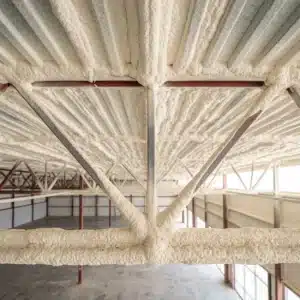
Whatever edition governs your project, the fireproofing requirements come from the building code’s fire-resistance-rated construction provisions, and that chain is the same everywhere. Occupancy classification under IBC Chapter 3, combined with the construction type, sets the required fire-resistance ratings in IBC (2021) Table 601. Those ratings are what the spray-applied fireproofing or intumescent coating has to achieve, and the work is verified through the special inspection requirements in IBC Chapter 17. Because those passive fire protection provisions in the IBC are substantively similar across recent editions, the two variables that actually change your fireproofing scope are which edition the city adopted and what it amended.
Code note: unless otherwise stated, code references on this page are to the 2021 International Building Code. Code adoption is state and local. Across the states we serve, adopted IBC editions currently range from the 2012 edition to the 2024 edition, some states have no statewide commercial building code, and several enforce NFPA 1 or NFPA 101 rather than the International Fire Code. Minnesota and Wisconsin publish state-amended code books whose numbering and requirements differ from the model code. This is general technical information, not a code determination for your project. Confirm the adopted edition and any local amendments with your authority having jurisdiction.
Over the past 20 years bidding and applying fireproofing on commercial projects across Texas, the single most common code mistake I see is not getting a fire-resistance detail wrong. It is assuming there is one Texas code. A project in Houston, one in Dallas, and one in a smaller home-rule city can each be under a different IBC edition with different local amendments, and the fireproofing requirements follow whichever one the city adopted. The teams that get surprised are the ones who designed to a generic standard instead of confirming the adopted edition for that jurisdiction. The fire-resistance ratings are rarely the hard part. Knowing which code book to open is.
City by City: Why Houston, Dallas, and Austin Are Not the Same
The clearest way to see the patchwork is to look at the major markets. The editions below reflect recent adoption surveys, and because cities adopt on their own schedules, the current edition should always be confirmed with the jurisdiction.
| City | Adopted IBC edition (recent surveys) | Note |
|---|---|---|
| Austin | 2021 IBC | With Austin amendments and stricter energy and green requirements |
| Dallas | 2021 IBC | With Dallas amendments |
| Houston | 2015 IBC | With Houston amendments and the Houston Fire Code |
| San Antonio | Adopted IBC edition, confirm with city | Local amendments apply |
A design built to the 2015 IBC for a Houston project does not automatically satisfy a 2021 IBC jurisdiction, and the local amendments, on everything from fire apparatus access to special inspection, are legally binding additions to the base code. This is why the first step on any project is finding the adopted edition rather than assuming one.
Counties and Unincorporated Areas: The Coverage Gap
Outside city limits, the picture is genuinely inconsistent, but “no city code” does not mean “no code.” A county may have adopted building codes for its unincorporated area, as Harris and Tarrant have, or it may not have. Even where the county has not, the State Fire Marshal’s Office may be the fire authority, the statewide accessibility and energy requirements still apply, and insurers and lenders frequently require documented code compliance regardless of whether an AHJ demands it. On a commercial project in an unincorporated area, the practical task is to confirm whether the county adopted codes and who holds fire jurisdiction before assuming anything is exempt.
How to Find the Code That Governs Your Project
The process is the same whether the project is in a major city or a rural county. It takes a few calls, and it prevents the redesign.
- Identify the authority having jurisdiction. In a city, that is the building and fire departments. In an unincorporated area, it is the county and possibly the State Fire Marshal’s Office.
- Get the adopted IBC and IFC editions and their effective dates from the AHJ.
- Pull the local amendments, which the city publishes as ordinances, paying attention to fire-resistance, special inspection, and fire access provisions.
- Confirm the occupancy classification and construction type, which set the required fire-resistance ratings in IBC (2021) Table 601.
- Confirm the special inspection requirements in Chapter 17 for the spray-applied fireproofing or intumescent coating.
- For a renovation, check whether the jurisdiction adopted the International Existing Building Code, which governs alterations and changes of occupancy.
Specifying Fireproofing Across Texas Jurisdictions
For a contractor or owner working several Texas markets, the multi-jurisdiction reality is the whole challenge. A fireproofing scope that satisfies a 2015 IBC city may need adjustment in a 2021 IBC city, and tracking divergent editions and amendments is part of the job. The provisions that actually move the fireproofing scope are the fire-resistance ratings and the special inspection requirements, so those are the ones to confirm first on each project. That is how we approach fireproofing work across Texas, and the same discipline carries into our work in Kansas and Oklahoma, where the adopted editions and local amendments are equally worth confirming up front.
Common Misconceptions About Texas Commercial Fire Code
The myths repeat, and each one leads to a real mistake. That there is one Texas commercial code, when adoption is a home-rule patchwork. That Texas adopted the 2021 IBC statewide, when the state statutory reference is the 2012 IBC and cities adopt their own editions, newer or older. That unincorporated county land is code-free, when the State Fire Marshal, accessibility and energy mandates, and county codes may all apply. That the fire code, the IFC, sets the fireproofing, when fireproofing requirements come mainly from the building code’s fire-resistance provisions. And that a design approved in one city passes everywhere, when local amendments differ. Treat each project as its own jurisdiction and these stop being problems.
Frequently Asked Questions
Is there a statewide Texas fire code for commercial construction? No. Texas is a home-rule state with no single, uniformly enforced statewide commercial fire or building code. Cities adopt and amend their own editions of the IBC and IFC, while a few requirements like accessibility and energy are set at the state level. The code governing your project is the one your jurisdiction adopted.
What building code does Texas use for commercial construction? The International Building Code, adopted and amended locally. State statute references the IBC as the municipal commercial building code, with the state-referenced edition set to the 2012 IBC, but most cities have adopted newer editions with amendments. Confirm the specific edition with the jurisdiction.
Which IBC edition is in effect in Houston, Dallas, or Austin? As of recent adoption surveys, Houston enforces the 2021 IBC and 2021 IFC effective January 1, 2024, Dallas the 2021 IBC effective May 12, 2023, and Austin the 2024 IBC and 2024 IFC effective July 10, 2025, each with local amendments. Editions change on each city’s schedule, so verify the current adoption with the building department before designing.
Who enforces the fire code in unincorporated Texas? It varies. Some urban counties such as Harris and Tarrant have adopted codes for their unincorporated areas. Where a county has not, the State Fire Marshal’s Office may be the fire authority. Confirm jurisdiction with the county before assuming a project is exempt.
Where do commercial fireproofing requirements come from in Texas? From the adopted building code’s fire-resistance-rated construction provisions: occupancy classification and construction type set the required ratings in IBC (2021) Table 601, which the fireproofing must achieve, verified under IBC Chapter 17 special inspection. The fire code complements these but does not replace them.
Do Texas counties enforce building codes? Only with limited authority granted to 253 counties in 2009, and enforcement is inconsistent. Some large urban counties have adopted building codes for unincorporated areas, but many counties have not, which is why confirming jurisdiction matters.
Does the State Fire Marshal’s Office set a statewide commercial fire code? It adopts an edition of the International Fire Code that it enforces in unincorporated areas and for specific state-regulated occupancies such as schools and daycares. That is not the same as a single commercial fire code mandated for every jurisdiction in the state.
How do I find the code that governs my project? Identify the authority having jurisdiction, get its adopted IBC and IFC editions and effective dates, pull the local amendments, and confirm the occupancy classification and construction type that set your fire-resistance ratings. For renovations, check whether the jurisdiction adopted the International Existing Building Code.
Key Takeaways
- There is no single statewide commercial code. Texas is a home-rule state, and commercial fire and building code is adopted and amended city by city, so the governing code depends on the jurisdiction.
- The state floor is thin. A state statutory reference sets the IBC as the municipal commercial building code at the 2012 edition, and accessibility, energy, and electrical requirements apply statewide, but the rest is local.
- Editions vary by city. Houston is on the 2021 IBC, Dallas on the 2021 IBC, and Austin on the 2024 IBC, each with local amendments. Always confirm the adopted edition with the AHJ.
- Counties have limited authority. Some urban counties adopted codes for unincorporated areas; many have not, and the State Fire Marshal may hold fire jurisdiction there.
- Fireproofing requirements come from the building code. Occupancy and construction type set the fire-resistance ratings in IBC (2021) Table 601, achieved by SFRM or intumescent coatings and verified under IBC Chapter 17, regardless of which edition governs.
- Confirm the adopted edition and amendments first. The two variables that change your fireproofing scope are the edition the city adopted and what it amended.
- Treat every project as its own jurisdiction. A design approved in one Texas city does not automatically comply in the next one.
Related Reading
- Want the requirements behind the code? Our commercial fireproofing code compliance guide covers how fire-resistance ratings drive a project.
- Building owner trying to get oriented? Start with fireproofing code compliance for building owners.
- Wondering what inspection looks like? See the fireproofing inspection process for the verification side.
If your next commercial project is anywhere in Texas and you want the fireproofing scope built to the code that actually governs it, the work starts with confirming the adopted edition, reading the local amendments, and tying the fire-resistance ratings to the right special inspection. That is how our crew approaches projects throughout Texas, Oklahoma, Kansas, Nebraska, Minnesota, and Wisconsin. Reach me directly at 512-387-2111 or ross@bahlfireproofing.com, or Contact Bahl Fireproofing to make sure your fireproofing matches the jurisdiction before the project goes to plan review.
This article provides general educational information about commercial building and fire code in Texas and how it relates to fireproofing. It is not legal, engineering, or code-compliance advice and does not replace project-specific direction from a licensed architect or engineer. Texas code adoption is jurisdiction-specific, and adopted editions, local amendments, and enforcement authority change over time and vary by city and county, so the specific code, edition, and amendments for any project must be confirmed with the authority having jurisdiction. The city editions noted here reflect recent adoption surveys and are subject to change. Always confirm current code requirements with the local building and fire departments and a licensed architect or engineer before designing or building.