Spray foam for pole barns in Minnesota is a condensation job before it is an R-value job. This article covers why warm air drips off cold steel, how foam sprayed directly to the panels stops it, what Minnesota’s agricultural exemption does and does not remove, and what a commercial shop owes the code in climate zones 6A and 7.
TLDR: The water dripping off a pole barn roof in January is not a leak, and more insulation thickness alone does not fix it. The fix is keeping interior air off the cold steel and keeping the surface that air can reach above its dew point. Minnesota’s farm exemption takes away the building code on a true agricultural building, not the physics or the fire risk of foam. Read on before you insulate.
Dripping Steel Is the Problem You Are Paying to Solve
Picture a machine shed in northern Minnesota with a steel roof on wood purlins and a heater running so the owner can work on equipment in February. By afternoon it is raining inside, onto the planter and the workbench. The owner calls it a roof leak.
It is not. Warm shop air carrying moisture from melting snow reaches steel far colder than its dew point, and the water comes out on contact. Insulate it the wrong way and the water still forms, just out of sight, inside the insulation and on the purlins.
Why Pole Barn Insulation Fails in a Minnesota Winter
I have been in this trade for over forty years. Insulated metal buildings that drip almost never fail because the insulation was too thin. They fail because air got past it.
Fiberglass hung under the steel, torn facers, or boards with open joints at every purlin all let warm air reach the panel, where it condenses and soaks the insulation. The fix is an air-tight layer in direct contact with the steel, thick enough to keep its own inside face warm.
What Causes Condensation Under a Metal Roof?
Condensation forms when moist air touches a surface colder than the air’s dew point. A bare steel roof panel in a Minnesota winter runs close to outdoor temperature, well below the dew point of a heated shop under it, and every gap that lets air reach it delivers more water.
Building Science Corporation’s BSD-106: Understanding Vapor Barriers says “water vapor moves from the warm side of building assemblies to the cold side,” and that when air moves under a pressure difference, “the vapor moves with it.” For roofs, its design conditions in zone 6 use 70 F inside at 30 percent relative humidity, a dew point of 37 F. Zone 7 uses 70 F at 25 percent, a dew point of 32 F. For an unvented roof in zones 5 through 7, it calls for a Class II or lower vapor retarder on the interior of the insulation, and says “the condensing surface shall be maintained above the dew point temperature of the interior air.”
Those dew points are the numbers that matter here, and they assume a fairly dry interior. A shop full of snowy equipment or a barn full of livestock runs wetter and raises them.
How Spray Foam for Pole Barns Controls Condensation
BSD-106 defines the condensing surface in an unvented roof as “either the interior surface of the structural roof deck or the interior surface of an air-impermeable insulation applied in direct contact to the underside/interior of the structural roof deck.” On a pole barn, the steel panel is the deck.
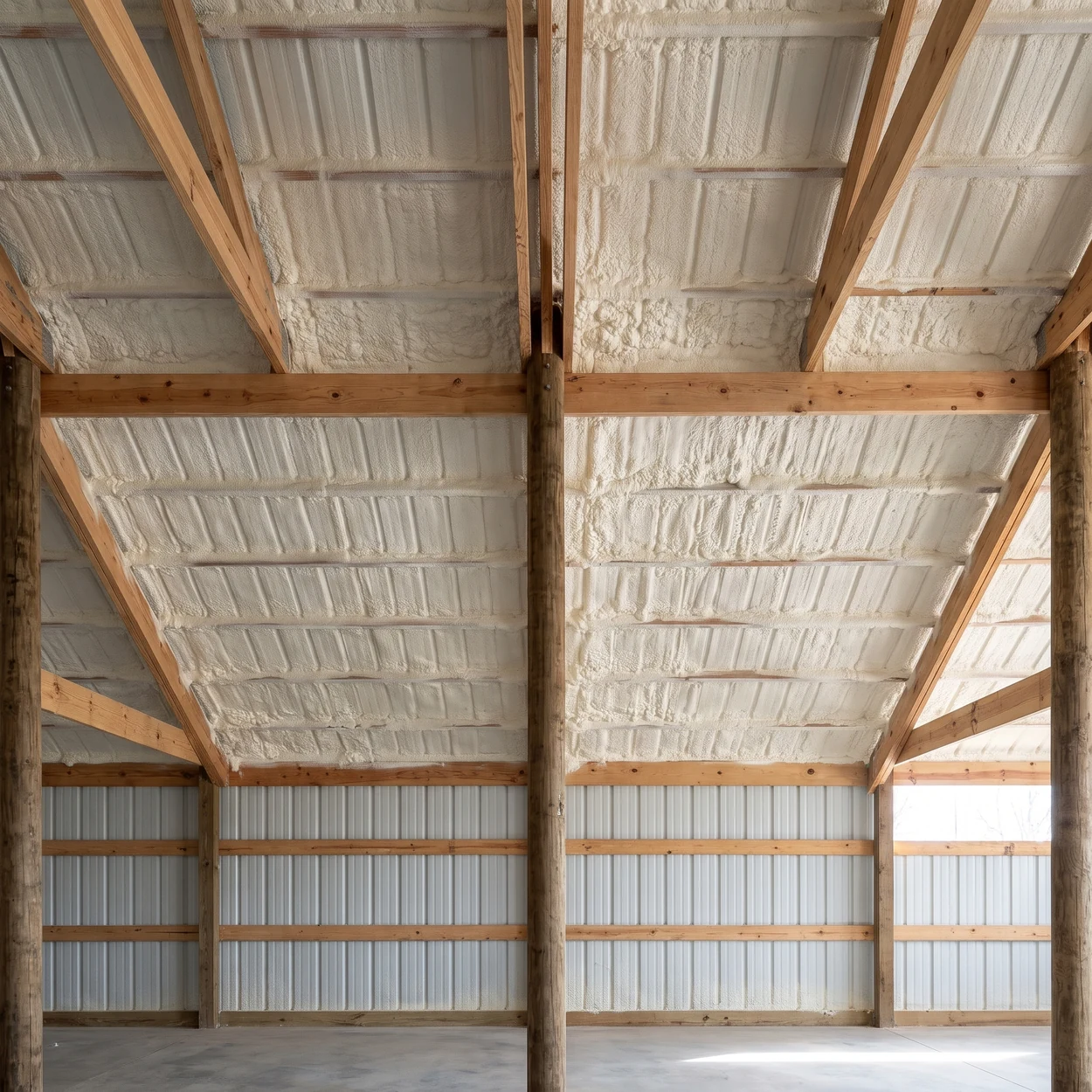
That is why spray foam for pole barns works when it is done right. Sprayed directly to the panels and wall steel, it bonds to the metal and closes the laps, fastener lines and purlin edges where air got through. Interior air now reaches only the inside face of the foam, and with enough thickness that face stays above the dew point.
Two details decide it:
- Vapor control. Open cell and closed cell foams differ widely in vapor permeance, so the product’s tested permeance at the installed thickness decides whether it meets the Class II target or needs a separate retarder.
- Continuity. Foam that stops short at an eave, end wall or door header leaves cold steel that drips.
For animal buildings, Illinois Extension adds that “ventilation is the primary means of reducing condensation potential,” and that design belongs to the owner’s ag engineer or equipment supplier.
Is a Pole Barn Exempt From the Minnesota Building Code?
A true agricultural building is. Minnesota Statutes section 326B.121 says “the State Building Code does not apply to agricultural buildings,” with narrow exceptions. Every other building is covered, “whether local code enforcement exists or not,” in DLI’s words.
The definition in section 326B.103, subdivision 3, has three parts. The structure sits on land the assessor classifies as agricultural. It is designed, built and used to house farm implements, livestock or agricultural products. And it is used by the owner or tenant, their immediate families and employees, and people picking up or delivering agricultural products. Miss one part and it is not agricultural.
The exemption removes the building code’s structural, fire and foam plastic rules, plus the commercial energy code, which is part of the State Building Code. It does not remove:
- State electrical inspection under section 326B.36, or floodplain rules
- The statute’s load rule for translucent panels and curbless skylights
- The fact that spray foam is a combustible foam plastic, installed to the manufacturer’s instructions
- Any conditions your insurer or lender sets, so ask them before the foam goes on
A contractor’s shop, a truck repair shop, or a building the public comes into can fall outside the definition. A shop with living quarters is a single-family dwelling under the residential code, per DLI’s barndominium fact sheet, and outside this article.
What a Commercial Shop Owes the Code
A shop that is not agricultural falls under the Minnesota Building Code, which adopts the 2018 IBC through Minnesota Rules part 1305.0011. Minnesota’s old foam plastic amendment, part 1305.2603, has been repealed, so Section 2603 applies as written.
For spray foam, that means a thermal barrier. ICC Evaluation Service reports for spray foam routinely require the foam to be “separated from the interior of the building by an approved thermal barrier of 1/2-inch-thick” gypsum, or an equivalent complying with IBC Section 2603.4. Some list tested alternatives, so the report for the exact product decides, and we hand it over with the submittals.
The energy code applies too. Minnesota Rules part 1323.0514 puts 23 northern counties, including Beltrami, Crow Wing, Itasca and St. Louis, in climate zone 7. Every other county is zone 6A.
A lightly heated shop may qualify as semiheated, with lighter envelope requirements, if the building official approves and a sign posts the heating limit. DLI’s rulemaking record caps that heating at 14 Btu per hour per square foot in the southern zone and 16 in the northern. Minnesota also deleted the national exemption that let semiheated space in zone 6 skip the continuous air barrier, so the shop still needs the air-tight envelope that stops the dripping.
The four building types owners ask about most sort out like this.
| Building | State Building Code | Foam covering rules come from | What controls condensation |
|---|---|---|---|
| Machine shed on farm land, farm use only | Exempt (326B.121) | Manufacturer instructions, insurer | Air-tight foam on the steel |
| Livestock barn on farm land | Exempt (326B.121) | Manufacturer instructions, insurer | Foam plus designed ventilation |
| Contractor or truck repair shop | Applies, with the energy code | IBC 2603.4 and the product’s ICC-ES report | Air-tight foam on the steel |
| Shop with living quarters | Residential code | Residential code | Outside this commercial scope |
Find your building’s row before anyone prices the foam.
Planning a Winter Spray Foam Install
We work year round. On winter jobs the GC provides temporary heat as needed, our floor is 40 F, and the product data sheet governs the exact substrate and air limits. Foam needs a clean, dry substrate, so the steel gets checked for frost, moisture and dirt first.
Bahl Fireproofing is an approved applicator for the fireproofing and spray foam manufacturers whose products we install, and our own crews apply every product to the manufacturer’s application instructions.
Frequently Asked Questions
Will spray foam stop condensation in a pole barn? It can, as a continuous, air-tight layer directly on the steel, thick enough to keep its inside face above the dew point. Livestock barns still need ventilation.
Is a Minnesota pole barn exempt from the building code? One that meets the agricultural definition in section 326B.103 is exempt under section 326B.121, though electrical inspection still applies. A shop that is not agricultural is covered.
Does spray foam in an agricultural building need a thermal barrier? The building code’s rule does not reach a true agricultural building. The foam is still combustible, so check the manufacturer’s instructions and your insurer before leaving it exposed.
Does spray foam in a commercial shop need a thermal barrier? Generally yes. ICC-ES reports for spray foam typically require 1/2-inch gypsum or an equivalent complying with IBC Section 2603.4.
What climate zone is my Minnesota shop in? Minnesota Rules part 1323.0514 lists 23 mostly northern counties in zone 7. The rest are zone 6A.
Should I use open cell or closed cell foam on a pole barn? They differ widely in vapor permeance, so compare each product’s tested permeance at the planned thickness against the Class II target BSD-106 sets for unvented roofs in zones 6 and 7.
Key Takeaways
Condensation is the problem.
- Warm, moist air condenses on steel colder than its dew point.
- Moving air carries vapor to every gap.
Foam works by contact and continuity.
- Sprayed on the steel, it moves the condensing surface to the foam’s warm face.
- Breaks at eaves, laps and doors keep dripping.
The numbers are dew points.
- BSD-106 designs roofs at a 37 F dew point in zone 6 and 32 F in zone 7.
- Wetter buildings raise it.
The farm exemption is narrow.
- Section 326B.121 exempts true agricultural buildings from the State Building Code.
- Foam stays combustible, and electrical inspection still applies.
Commercial shops follow the code.
- The IBC 2603.4 thermal barrier applies, per the product’s ICC-ES report.
- Semiheated space still needs an air barrier.
Winter work is normal.
- The GC provides temporary heat; our floor is 40 F.
- The data sheet governs the exact limits.
Related Reading
- Agricultural Insulation in Texas: A Practical Spray Foam Guide covers farm buildings in a hot climate.
- Vapor Barrier vs Vapor Retarder: The Critical Difference explains vapor retarder classes for metal buildings.
If you want a crew that puts the foam directly on the steel, carries it unbroken from wall to roof, checks the product’s permeance and evaluation report, and knows whether your building is agricultural or commercial, that is the spray foam work we do throughout Texas, Oklahoma, Kansas, Nebraska, Minnesota, Wisconsin, Arizona, Missouri, and Iowa. Call me at 512-387-2111, email ross@bahlfireproofing.com, or Contact Bahl Fireproofing. See our commercial spray foam insulation service, our Minnesota service page and our service areas.
This article provides general educational information about spray foam insulation, condensation control and code applicability for Minnesota pole barns and shops, and it is not engineering, legal, or code-compliance advice. It does not replace project-specific direction from a licensed architect or engineer. Agricultural status depends on land classification and use, and code editions vary by jurisdiction, so confirm with your building official and county assessor. Thermal barrier, vapor permeance and temperature limits depend on the product, so confirm them against its current data sheet and evaluation report, and ask your insurer before leaving foam exposed.