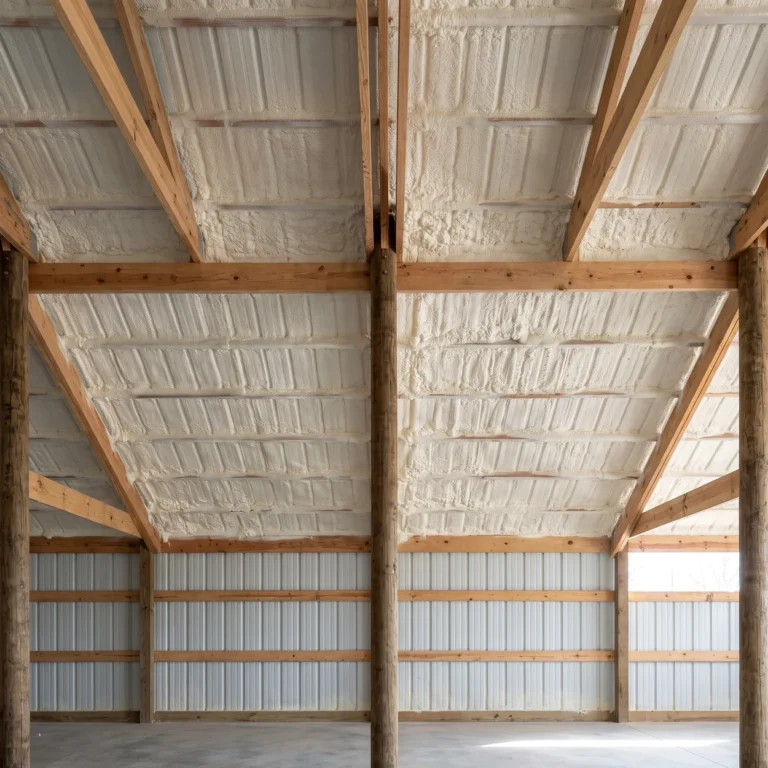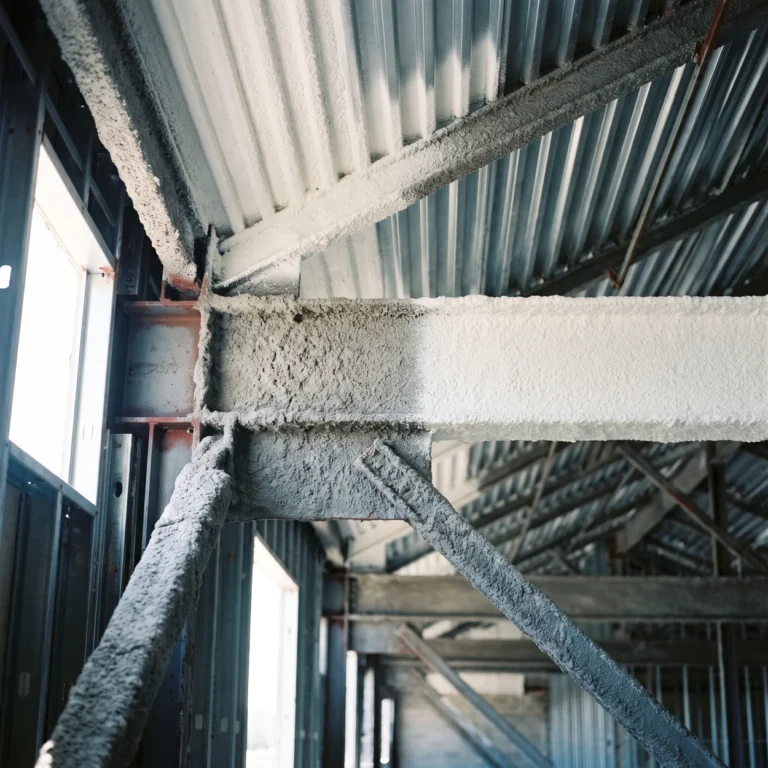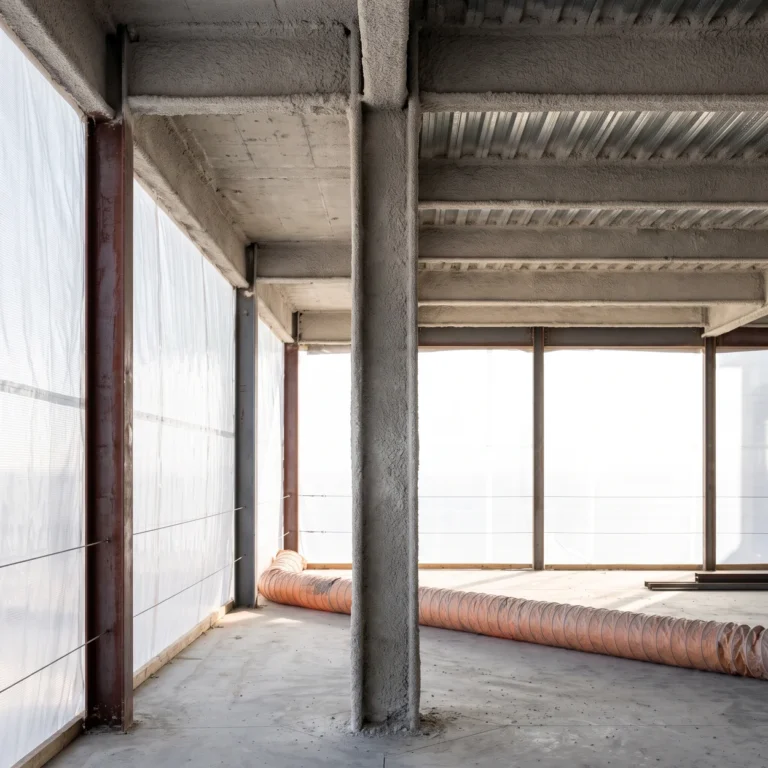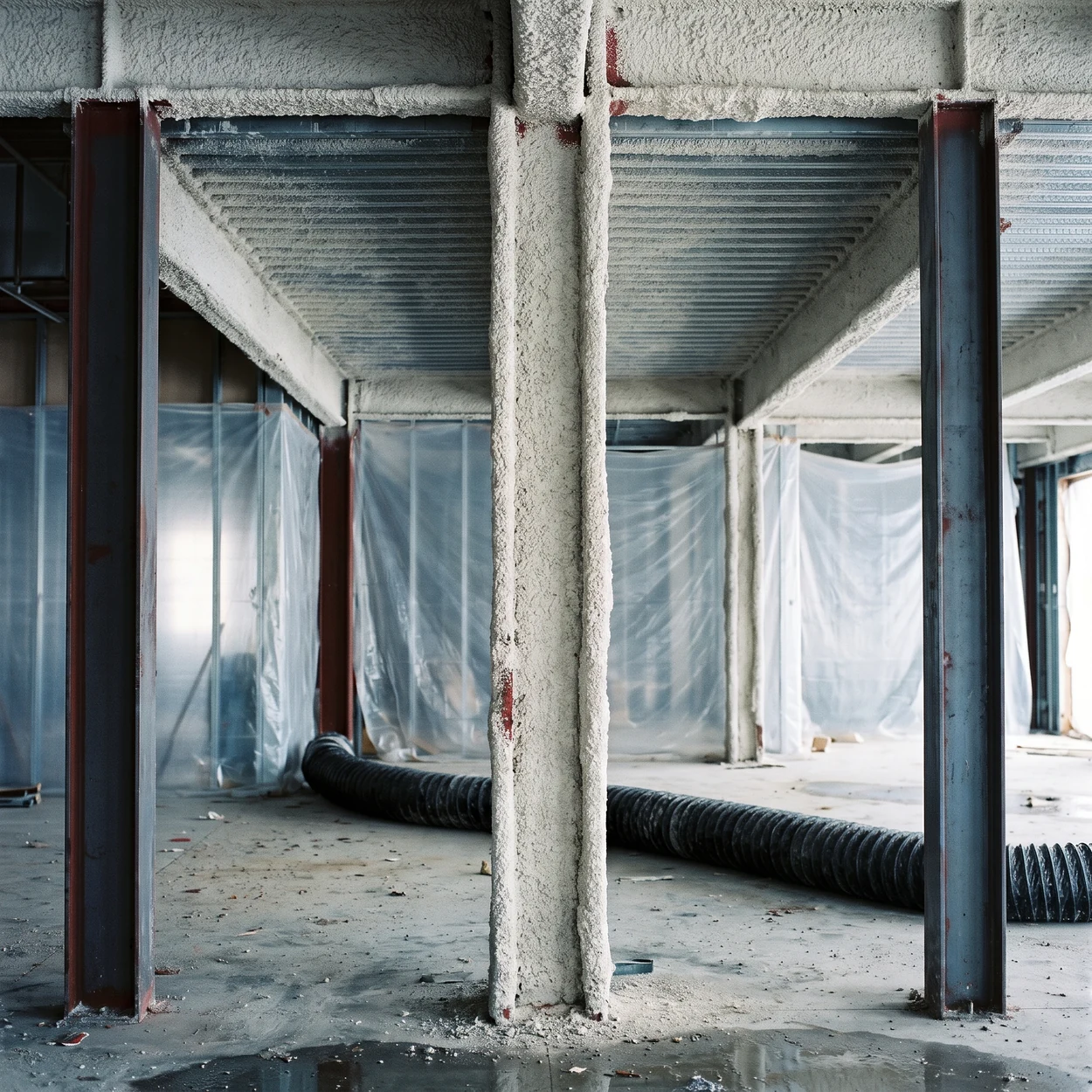
Winter steel schedules put spray fireproofing and intumescent coatings into buildings that are not closed in or heated yet. This article lays out the cold weather fireproofing limits on current Isolatek, GCP Monokote and Carboline data sheets, product by product. It explains why the hours after application matter most, and what the general contractor’s temporary heat plan has to carry.
TLDR: Cold weather fireproofing is decided by the hours after the crew leaves, not the hours it sprays. The cementitious data sheets below hold 40°F for at least 24 hours after application, and one water-based intumescent holds 50°F for 72 hours. A heat plan that covers the work day and shuts off overnight puts fresh material outside its published limits. The table shows which number belongs to which product.
Picture a GC on a January steel package. The level is tarped, temporary heat is running, and the fireproofing crew finishes the last bays Friday afternoon. The heaters come down Saturday to save fuel, and by Sunday night the steel is well below freezing.
Nobody can look at that material Monday and say whether it cured the way its fire test assumed. It sat below its data sheet temperature inside the window that matters. Now the manufacturer, the special inspector’s results and the licensed architect or engineer decide what happens to it, and that costs more schedule than two more days of heat.
What Winter Fireproofing Calls Sound Like
I have been in this trade for over forty years, and winter problems almost never come from a crew spraying into a cold building. A crew checks the steel before it starts. What goes wrong is the plan around the crew.
The first pattern is heat that follows the work day. People assume the hard part is getting warm enough to start. The hard part is staying warm through the night and the weekend after, because that is when the material sets and dries.
The second pattern is one number applied to every product. Someone hears that fireproofing needs 40 degrees and schedules a water-based intumescent into a 40-degree enclosure. That product may need 50°F for three days. Both mistakes are preventable from the data sheet, before anyone prices the heat.
What Is the Minimum Temperature for Spray Fireproofing?
For the cementitious spray fireproofing data sheets in this article, the minimum is 40°F at the steel and in the surrounding air. That temperature holds before application, during it, and for at least 24 hours after. Isolatek CAFCO 300, GCP Monokote MK-6/HY and Carboline Southwest Type 5GP all print that floor. Intumescent coatings vary more.
SFRM, short for spray-applied fire resistive material, is the cementitious material sprayed onto structural steel. NFCA 100, the standard practice for applying sprayed fire-resistive material, sets the same 40°F and 24 hours “unless otherwise recommended by the material manufacturer.” The data sheet governs, and the sheets start the clock in different places.
- Monokote MK-6/HY wants the steel at 40°F for at least one hour before application.
- Southwest Type 5GP wants air and substrate held at 40°F for 24 hours before.
- CAFCO 300 says “prior to” with no hour count, once the outdoor temperature is below 40°F.
Our own floor is 40°F on every commercial fireproofing scope, SFRM or intumescent. We do not spray below it, and when a data sheet sets a higher number, that number governs. Bahl Fireproofing is an approved applicator for the fireproofing and spray foam manufacturers whose products we install, and our own crews apply every product to the manufacturer’s application instructions.
Cold Weather Fireproofing Limits, Product by Product
Each row comes from that maker’s current data sheet. Read the row for the product on your submittal, not the one next to it.
| Product (maker) | Type | Minimum temperature | Held for | Ventilation | Humidity and dew point |
|---|---|---|---|---|---|
| CAFCO 300 (Isolatek) | Gypsum-based SFRM | 40°F steel and air | Before, during, 24 hours after | 4 air changes per hour until dry | GC holds proper humidity |
| BLAZE-SHIELD II (Isolatek) | Portland cement-based SFRM | 40°F steel and air | Before, during, 24 hours after | 4 air changes per hour until dry | GC holds proper humidity |
| Monokote MK-6/HY (GCP) | Cementitious plaster | 40°F; steel 1 hour first | During, 24 hours after | 4 per hour in enclosed areas | Not stated |
| Southwest Type 5GP (Carboline) | Gypsum-based SFRM | 40°F material, steel, air | 24 hours before, during, 24 after | Air circulation until dry | Up to 95% |
| SprayFilm WB 3 (Isolatek) | Water-based intumescent | 50°F steel and air | Before, during, 72 hours after | 4 per hour in enclosed areas | 85% or less |
| Thermo-Sorb VOC (Carboline) | Solvent-based intumescent | 41°F steel and air; material 70°F | Shore DO check before topcoat | Solvent vapor control | 85% or less; 5°F over dew point |
| Thermo-Sorb HB (Carboline) | Hybrid intumescent, moisture cure | 5°F air | Topcoat at 24 to 48 hours | Solvent vapor control | 15% to 95%; 5°F over dew point |
Thermo-Sorb HB lists 5°F, but our 40°F floor still applies. Thermo-Sorb VOC allows cooler material only with strict hose limits.
Why the Hours After Spraying Matter More Than the Spray Day
Cementitious fireproofing goes on wet. CAFCO 300 is a wet-mix product, Monokote is mixed with water at the job site, and NFCA 100 says plainly that SFRMs are susceptible to damage while they cure.
Steel also carries cold. A heavy column that sat at 15°F overnight does not reach 40°F because the air did. That is why Monokote asks for the substrate, not just the air, at 40°F an hour before the first pass.
Then count forward. A cementitious product sprayed at 3 p.m. Friday needs heat through at least 3 p.m. Saturday. SprayFilm WB 3 applied Thursday needs 50°F held into Sunday. Write the heat plan around those clocks, not the crew’s shift.
Ventilation and Humidity: The Half of the Heat Plan That Gets Skipped
A tight winter enclosure keeps heat in, and it keeps in the water coming off fresh fireproofing. Isolatek’s CAFCO 300 technical data sheet calls for not less than 4 complete air exchanges per hour until the material is dry, with more in basements, stairwells, shafts and small rooms. NFCA 100 says natural ventilation is usually enough, but enclosed areas get forced ventilation at four air exchanges per hour, from the GC or construction manager.
Intumescent coatings add dew point and humidity limits, because steel colder than the dew point collects condensation. NFCA 400, the field quality assurance procedure for intumescent fire-resistive material, says surfaces should be free of frost. Ambient temperature should sit at least 5°F above the dew point and rising, and relative humidity should not exceed 80%. The product sheets set their own numbers, and the sheet for your product wins.
Heater choice, fuel and carbon monoxide are the GC’s call. What matters to the product is what reaches the steel: temperature, moving air and humidity inside the data sheet limits.
Intumescent Coatings in the Cold: One Number Does Not Fit
NFCA 400 splits intumescent coatings by chemistry: 50°F for water-based and epoxy materials, 40°F for solvent-based, each held 24 hours after application “except as permitted by the manufacturer’s application instructions.”
The sheets do move it. SprayFilm WB 3 stretches the water-based hold to 72 hours. Thermo-Sorb VOC wants the material itself at 70°F, so the pails need warm storage, not a cold trailer. Thermo-Sorb HB cures by reacting with moisture in the air, and its sheet says to make sure hoses and pumps are dry before use. SprayFilm WB 3 must be protected from freezing in storage.
What the Building Code Adds, and the Section Numbers That Move
The code does not print a minimum temperature. It points to the data sheet. In the 2024 IBC, Section 1705.15.3 says the substrate shall have a minimum ambient temperature before and after application as specified in the written instructions of approved manufacturers. It requires ventilation the same way.
That makes winter conditions an inspection item. The special inspector who checks SFRM thickness and density is a fully independent third party, never Bahl, and ICC-ES evaluation reports for intumescent coatings have the inspector verify site conditions too.
The section numbers are where people trip. In the 2024 IBC, Section 1705.15 covers sprayed fire-resistive materials. In the 2018 and 2015 editions, Section 1705.15 is the intumescent coating section, and the 2021 edition moved intumescent coatings to Section 1705.16. A spec quoting “1705.15” on an intumescent job may be reading an older book, so confirm the adopted edition with the authority having jurisdiction.
Who Provides the Heat for Cold Weather Fireproofing
We work year round, and on winter jobs the general contractor provides temporary heat as needed. CAFCO 300 has the GC provide enclosures and heat when job progress needs them, and NFCA 100 puts heat and weather protection during curing on the owner, GC or construction manager.
A heat plan that holds up covers six things:
- Name the product at award. Our submittals go out at award with the product data, so the limits are known before heat is priced.
- Heat the steel ahead of the start. One hour for Monokote, 24 hours for Southwest Type 5GP.
- Carry heat through the hold window. 24 hours for the cementitious products, 72 for SprayFilm WB 3, nights and weekends included.
- Plan air exchanges with the enclosure. Four per hour until dry is the common cementitious number.
- Store material warm and dry. Water-based intumescent cannot freeze.
- Measure and record. NFCA 400 calls for substrate temperature at the start of each day, monitored through the day.
January in Dallas Is Not January in Minneapolis, and Both Need a Plan
Cold weather fireproofing is not only a northern problem. NOAA’s 1991 to 2020 climate normals put the January normal low at Dallas Fort Worth International Airport at 36.1°F, and the December low at 38.3°F, both under the 40°F floor. A Dallas job sprayed on a mild afternoon still runs its 24-hour window through a colder night. The Texas mistake is reading the afternoon and skipping the night.
Minneapolis is a different job. The same normals put the January normal high at Minneapolis-St. Paul International Airport at 23.6°F and the low at 8.8°F. Heat runs the whole job there, and the questions become heater capacity, how long the steel takes to warm, and whether the enclosure still moves four air exchanges an hour.
January normal highs at the Omaha, Des Moines and Milwaukee airports run 30.9°F to 33.6°F, under the floor at midday. North of Kansas, plan winter work as enclosed, heated and ventilated from day one. Farther south, plan for the night.
Frequently Asked Questions
Can spray fireproofing be applied in winter? Yes, when the steel and air stay at the product’s minimum temperature before, during and after application. On our jobs the general contractor provides temporary heat as needed.
What is the minimum temperature for intumescent fireproofing? It depends on the product. NFCA 400 calls for 50°F for water-based and epoxy materials and 40°F for solvent-based materials, unless the manufacturer permits otherwise. SprayFilm WB 3 holds 50°F for 72 hours.
How long does fireproofing need heat after it is sprayed? At least 24 hours for CAFCO 300, BLAZE-SHIELD II, Monokote MK-6/HY and Southwest Type 5GP. SprayFilm WB 3 needs 72 hours at 50°F. Count the window across nights and weekends.
Who is responsible for temporary heat on a fireproofing job? Typically the general contractor or construction manager, under both the CAFCO 300 guide specification and NFCA 100. The fireproofing contractor confirms the conditions match the data sheet before and while it sprays.
What happens if fireproofing freezes before it cures? It sat outside its data sheet conditions, and nobody should judge it by eye. The manufacturer, the special inspector’s results and the licensed architect or engineer decide whether it stays.
Does the building code set a minimum fireproofing temperature? No. In the 2024 IBC, Section 1705.15.3 points to the approved manufacturer’s written instructions for ambient temperature and ventilation. That puts the data sheet number into special inspection.
Key Takeaways
The hold window decides winter jobs.
- The cementitious sheets here hold 40°F before, during and at least 24 hours after application.
- Heat that shuts off overnight or over a weekend breaks the window.
The data sheet governs, and our floor is 40°F.
- NFCA 100 sets 40°F for 24 hours unless the manufacturer says otherwise.
- A higher data sheet number, like 50°F for SprayFilm WB 3, wins.
Heat the steel, not just the room.
- Monokote MK-6/HY wants the substrate at 40°F an hour before application; Southwest Type 5GP wants 24 hours.
- Measure the steel with a surface thermometer, not the room air.
Ventilation is half the heat plan.
- CAFCO 300 and NFCA 100 call for four air exchanges per hour in enclosed areas until dry.
- Intumescent coatings add humidity limits and a 5°F margin over dew point.
The code points to the manufacturer.
- 2024 IBC Section 1705.15.3 ties ambient temperature and ventilation to the manufacturer’s instructions.
- Section 1705.15 means SFRM in 2024 but intumescent coatings in 2018.
Texas winters need a plan too.
- The DFW January normal low is 36.1°F, under the 40°F floor.
- Minneapolis January normal highs sit in the twenties, so heat runs the whole job.
Related Reading
- Intumescent Coating DFT, Cure Time, and Performance Factors explains how dry film thickness and cure time are set once a coating is on the steel.
- Intumescent Coating Maintenance and Inspection: A Field Guide for Building Owners covers what to check on applied coatings after the building is in service.
If your steel package lands in winter and you want a crew that reads the data sheet for the exact product, holds the 40°F floor through the full hold window, and plans air exchanges and dew point with your temporary heat, that is the cold weather fireproofing work we do throughout Texas, Oklahoma, Kansas, Nebraska, Minnesota, Wisconsin, Arizona, Missouri, and Iowa. Call me at 512-387-2111 or email ross@bahlfireproofing.com with the product and schedule, or Contact Bahl Fireproofing. Our service areas page shows where we work.
This article provides general educational information about spray-applied fireproofing and intumescent coatings and is not engineering, legal, or code-compliance advice. It does not replace project-specific direction from a licensed architect or engineer. Temperature, ventilation and humidity limits come from manufacturer data sheets that are revised over time; confirm them on the latest sheet for the exact product. Code citations reference a specific IBC edition, the adopted edition varies by jurisdiction, and inspection requirements are set by the authority having jurisdiction and the approved construction documents. Installation must follow the manufacturer’s written application instructions, and fire-resistance ratings depend on the listed design and correct installation.