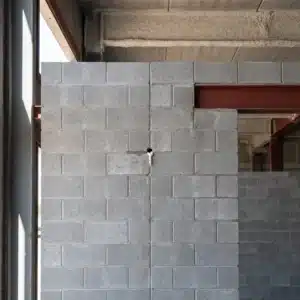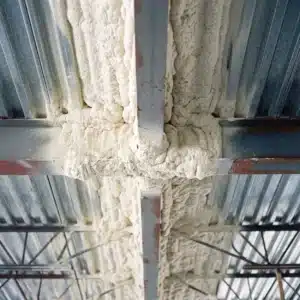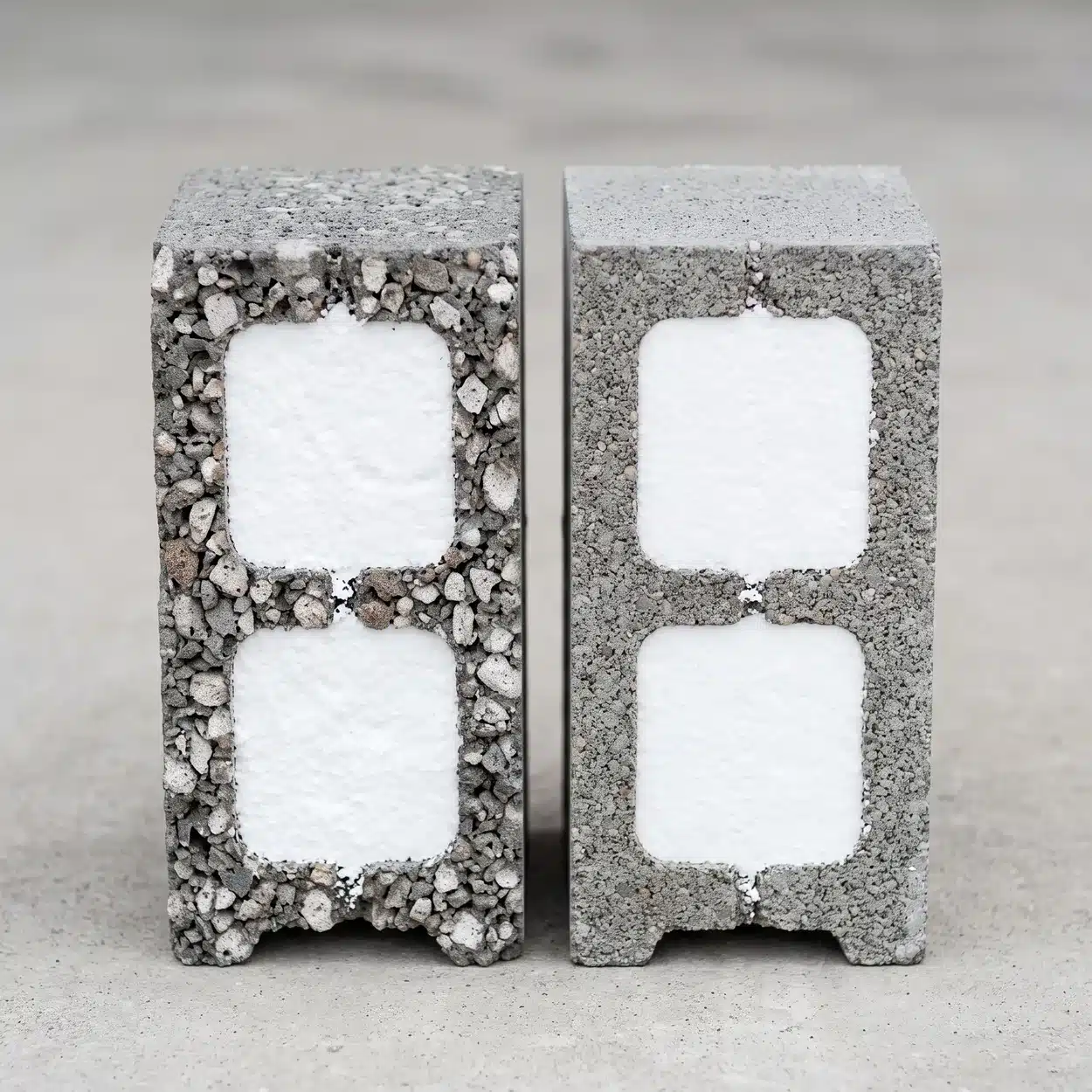
Two figures follow this masonry foam everywhere it is written about: an R-value per inch and a Class A fire result. Both are real test results, and both get quoted at conditions that do not match the question being asked. This article works through the published Core-Fill R-value data and the fire data, names the test condition attached to each number, and shows which number belongs in a submittal.
TLDR: Both headline numbers for this masonry foam are real test results, and both are routinely quoted at the wrong condition. Every published Core-Fill R-value is a measurement taken at a stated mean temperature, and most specification errors come from repeating it at a different one. The same habit turns a surface-burning classification into a fire-resistance claim it was never able to support.
The Two Numbers That Fail at Two Different Desks
Picture one drawing set. The architect fills the cores of an 8-inch block exterior wall and writes that wall into the energy compliance form using a figure lifted off a product page. The same set shows a 2-hour rated masonry corridor, and the specification calls the fill Class A, which reads in the job trailer like fire protection. Neither statement is a lie. Both are unsubstantiated.
The thermal one fails early and cheap, when a plans examiner asks how the wall R-value was calculated. The fire one fails late, because nobody argues with the words “Class A.” That claim sits in the project record until an inspector asks which listed assembly the two hours comes from, and whether that listing describes the cores as empty, grouted, or filled. Both failures are one failure: a measurement moved out of the condition it was measured under.
What Is the Core-Fill R-Value per Inch?
The dated technical data sheet from Tailored Chemical Products, Inc. reports R-4.5 per inch at a 74F mean temperature and R-4.9 per inch at a 32F mean temperature, measured under ASTM C518-21. United States design R-values are stated at a 75F mean. For a commercial building in Texas, Kansas, or Oklahoma, the Core-Fill R-value that belongs in a submittal is 4.5 per inch.
Mean temperature is not a footnote. In a heat flow meter apparatus the sample sits between a hot plate and a cold plate, and the mean is the average of the two. Change that average and you change the measured conductivity, so one foam legitimately produces more than one R-value.
The direction explains why the higher number exists. Heat crosses a foam cell three ways: conduction through the solid cell walls, conduction through the gas in the cell, and radiant exchange between cell walls. Gas conduction falls as the gas gets colder, radiant exchange falls off steeply as absolute temperature drops, and solid conduction barely moves. So an air-filled foam measures less conductive as the mean drops, and its R-value rises.
The foam does perform a little better on the coldest nights of the year. That benefit is real, it is small, and no compliance table is written against it. Publish 4.5 and design to nothing else.
The Core-Fill R-Value Mistake on Almost Every Masonry Package
More than twenty years of this work across Texas, Kansas, and Oklahoma has taught me that masonry numbers fail in one direction. Nobody gets caught overstating the chemistry. They get caught having stripped the condition off a measurement somebody else took correctly.
The pattern repeats. A value moves from a web page into a specification, from the specification into an energy model, and from the model into a stamped compliance form. At each step the qualifier falls off, because it lives in small type and the number lives in a headline. By the time a Core-Fill R-value reaches us in a bid package, it carries no mean temperature, no calculation method, and no block density.
What people assume goes wrong on masonry jobs is the product. What actually goes wrong is the sentence wrapped around it, and the fire version is worse, because almost nobody challenges “Class A.” Prevention is free: an R-value gets a mean temperature, a flame spread index gets a test method, and a fire-resistance rating gets a listed design.
Why the Manufacturer’s Construction Table Does Not Survive Plan Review
Because it does not account for thermal bridging through the block webs. That single objection disqualifies it from a code submittal.
The manufacturer publishes construction values alongside the material data. Its 8-inch row reads R-14.2 for a 60 pound per cubic foot lightweight unit and R-9.1 for a 100 pound per cubic foot normal weight unit. Those are not arithmetic errors. They are the wrong arithmetic, because the webs of a concrete masonry unit are solid concrete running face to face, a parallel path for heat straight around the insulation.
The recognized method is the series-parallel calculation, also called isothermal planes. TEK 06-02C from the Concrete Masonry and Hardscapes Association publishes values calculated that way for single wythe concrete masonry walls, including rows for filled cores, and states that the method accounts for energy loss through the webs. Construction tables are an industry convenience, useful for rough comparison and useless in front of somebody who asks how a Core-Fill R-value was produced.
The Code-Recognized Core-Fill R-Value Table for Filled Block Cores
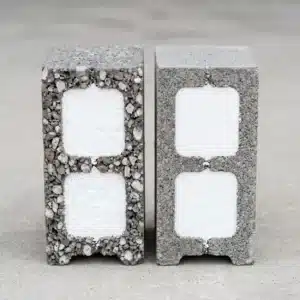
Start with the two numbers that carry this article. One 8-inch concrete masonry unit, cores filled with foamed-in-place insulation, by the series-parallel method: R-8.58 in 85 pound per cubic foot lightweight block, and R-4.08 in 135 pound per cubic foot normal weight block. A 2.1 times swing, identical insulation in both walls. The block the architect specified moved the wall more than the foam did.
Below is the full foamed-in-place set from Table 2 of TEK 06-02C, published 2013, in calculated wall R-values.
| Unit size | 85 pcf | 95 pcf | 105 pcf | 115 pcf | 125 pcf | 135 pcf |
|---|---|---|---|---|---|---|
| 6 inch | 6.38 | 5.54 | 4.80 | 4.17 | 3.63 | 3.16 |
| 8 inch | 8.58 | 7.40 | 6.38 | 5.49 | 4.73 | 4.08 |
| 10 inch | 10.47 | 8.98 | 7.69 | 6.57 | 5.62 | 4.82 |
| 12 inch | 12.99 | 11.10 | 9.47 | 8.07 | 6.87 | 5.86 |
Read the columns, not just your one cell. The density penalty is consistent: moving from 85 pcf to 135 pcf costs about half the calculated value at every size. Thickness only pays in light block, because a 6-inch to 12-inch jump gains 6.61 points in 85 pcf block and 2.70 points in 135 pcf block. And a 6-inch lightweight unit at 85 pcf calculates to 6.38, while a 12-inch normal weight unit at 135 pcf calculates to 5.86. The wall twice as thick calculates lower. Density is the lever, not thickness.
Reading the Table Honestly: Where the Core-Fill R-Value Actually Lands
One qualifier belongs with every number above, and it is the one competitors leave out. That column in TEK 06-02C is calculated for foamed-in-place polyurethane, which carries a higher R per inch than an aminoplast foam does. Core-Fill 500 at R-4.5 per inch is not that material. It sits between the perlite column of the same table and the polyurethane column, nearer the polyurethane one.
Those perlite rows are the lower bound, same units and method.
| Unit size | 85 pcf | 95 pcf | 105 pcf | 115 pcf | 125 pcf | 135 pcf |
|---|---|---|---|---|---|---|
| 6 inch | 5.20 | 4.66 | 4.16 | 3.70 | 3.29 | 2.92 |
| 8 inch | 6.92 | 6.17 | 5.47 | 4.83 | 4.26 | 3.75 |
| 10 inch | 8.56 | 7.57 | 6.65 | 5.83 | 5.10 | 4.45 |
| 12 inch | 10.53 | 9.29 | 8.15 | 7.12 | 6.19 | 5.38 |
Now measure the bracket. On an 8-inch unit in 85 pcf block the two rows are 6.92 and 8.58, a spread of 1.66. In 135 pcf block they are 3.75 and 4.08, a spread of 0.33. On a 12-inch unit the spread runs 2.46 in light block and 0.48 in heavy block.
That collapse is the useful finding. In lightweight block the fill material is worth arguing about. In heavy block it is worth almost nothing, because the webs carry so much heat that what sits between them barely registers. Anyone selling core fill as a thermal upgrade on 135 pcf block is selling a third of a point.
The working rule for an aminoplast fill: the foamed-in-place row is the top of the band, the perlite row is the floor, and the top row is never a guaranteed Core-Fill R-value. For compliance, use the calculation path in the adopted energy code, or the Standard 90.1 tables where they apply.
Core-Fill 500 and Fire: What ASTM E84 Measured and What It Did Not
Tested to ASTM E84 surface burning characteristics of building materials, the foam produced a flame spread of 0, a smoke developed of 5, and fuel contributed of 0. That is a surface-burning result, describing how flame travels along the face of a sample in a ten-minute tunnel test.
Class A is a threshold, not a score. Under Section 803.1.2 of the 2021 and 2024 IBC, a Class A interior finish is a flame spread index of 0 to 25 together with a smoke developed index of 0 to 450. The tested result sits well inside that band. Keep the two ideas in separate sentences, because a threshold and a measurement are different objects.
The class definitions have held steady across editions. What moved is the table assigning classes by occupancy: Section 803.11 and Table 803.11 in the 2015 IBC became Section 803.13 and Table 803.13 in the 2018, 2021, and 2024 editions. A specification still citing 803.11 was copied forward from a 2015 job. Confirm the adopted edition with the authority having jurisdiction.
Then the sentence that matters most, which is the manufacturer’s own. The product is not intended and should never be used to increase the fire rating of a concrete masonry unit.
A Surface Classification Is Not a Fire-Resistance Rating
| Factor | Surface burning classification | Fire-resistance rating |
|---|---|---|
| Test method | ASTM E84, also run as UL 723 | ASTM E119, also run as UL 263 |
| What is tested | A material sample | A complete assembly, as built |
| Duration | Ten minutes | Until acceptance criteria stop being met |
| What is measured | Flame travel along a surface, plus smoke | Load capacity, flame passage, heat transmission |
| Reported as | Two dimensionless indices | A time, in hours |
| Result names | Class A, Class B, Class C | 1-hour through 4-hour |
| Where the IBC uses it | Chapter 8, interior finish | Chapter 6 and Chapter 7, including Table 601 |
| Can a core fill add to it? | The fill carries its own index | No, the rating belongs to the listed assembly |
Read the “reported as” row twice. One column produces an index with no units, the other produces hours, and no arithmetic converts the first into the second. That is why a Class A fill cannot add time to a wall.
We get this call regularly on rated masonry. An owner wants the cores of a corridor or demising wall filled, somebody has told them the foam is Class A, and the room assumes the wall improves in both directions at once. We ask three questions before quoting. Which listed design or code-recognized calculation is the rating coming from? Does that documentation describe the cores as empty, grouted, or filled? Who confirms that filling them keeps the assembly inside that documentation? Those are calls for the licensed architect or engineer of record and the authority having jurisdiction, and we have walked away from rated-wall scope where nobody could answer the second one.
We also looked for a third-party evaluation report and could not find one. There is no ICC-ES, BOCA, SBCCI, or ICBO report number we can produce, so we cite none, and if a submittal references one, ask to read it. The same goes for claims about the foam’s behavior at a stated temperature that carry no test method.
The Rest of the Published Data and What Each Number Answers
Dry density is approximately 0.8 pounds per cubic foot, with wet density between 2.7 and 3.3 as it goes in, so the fill adds no meaningful dead load and the difference is water that has to leave the wall. Cured shrinkage is reported at less than 1 percent under the D.O.E. (E)(11) and H.U.D. 6.2.5 references, which separates a set foam from a gravity-dependent fill that settles.
Corrosion is the question engineers actually raise, and almost nobody answers it in context. A masonry wall is full of metal: joint reinforcement, veneer ties, anchors, conduit, and reinforcing steel in grouted cells. Testing under the D.O.E. (e)(3) and H.U.D. 6.2.8 references showed no perforations on aluminum, copper, or steel, no pitting on galvanized steel, and mass loss under 0.1 gram. The product is still not for use underground as a vapor barrier.
The manufacturer reports STC 53 and OITC 44 in 8-inch concrete block under ASTM E90-90. Name the 8-inch block whenever you quote those, because sound transmission class belongs to an assembly and never to a material. The last check costs nothing: the foam should not be used where sustained temperatures are likely to exceed 190F, which is 88C. Boiler enclosures, kiln surrounds, flue chases, and masonry behind cooking equipment can all run past it.
What the Energy Code Does With These Numbers in Texas, Kansas, and Oklahoma
The three states we work in do not share an energy code, and on masonry that decides which document a Core-Fill R-value has to survive.
Texas is on the 2015 IECC, effective November 1, 2016 under 34 Texas Administrative Code 19.53(a), and the State Energy Conservation Office stayed there deliberately, saying that edition best serves statewide energy conservation while supporting local compliance training. None of that is ASHRAE’s doing. ASHRAE Standard 90.1, the energy standard for buildings except low-rise residential buildings is a standards developer’s document. It reaches your wall only where a jurisdiction adopted it or the design elected the 90.1 path the adopted IECC permits. Where it applies, its tabulated assemblies are recognized in a way no manufacturer table is.
Oklahoma is on the 2006 IECC with ASHRAE 90.1-2003 and state amendments, effective September 14, 2022, a 2022 effective date on a 2006 edition, so an Oklahoma submittal can be judged against a 90.1 vintage older than the crew. Kansas names the 2006 IECC as its standard for new commercial and industrial structures under K.S.A. 66-1227, but as a home-rule state adoption and enforcement sit locally, which is why the calculation method and source table belong in the submittal narrative there.
The sharpest case is not even across a state line. Dallas enforces the 2021 IECC. Fort Worth is still on the 2015. The same block wall and the same Core-Fill R-value get reviewed against two editions twenty miles apart. The edition question is a jurisdiction question, not a state one.
One regional temptation is worth naming. A Wichita or Panhandle wall spends more hours near the cold test point than a Houston wall does, and somebody will argue the colder figure should apply there. It should not. Compliance values are stated at the standard mean temperature wherever the building sits, and the zone comes from Table C301.1 in the adopted edition, never a map graphic. The 2021 IECC carried the first zone map update since 2003 and roughly ten percent of US counties changed, nearly all to warmer zones, but a jurisdiction on the 2015 IECC is judged against the 2015 map.
How to Put These Numbers Into a Submittal Without Getting Them Sent Back
- State the mean temperature with every Core-Fill R-value. Write “R-4.5 per inch at 74F mean, ASTM C518-21” and the number stops being arguable.
- Name the calculation method and cite the source table, publication and table number spelled out.
- Pull block density and unit size off the approved masonry submittal, not off the specification’s generic call for concrete masonry units.
- Show the band, not the best cell. Foamed-in-place value as the upper bound, perlite value as the floor, same unit.
- Pick the compliance path before the block ships. Foam inside block webs is not continuous insulation, which points toward a U-factor or tabulated-assembly path.
- Keep the fire paperwork in two piles. The surface-burning report covers the material, the listed design covers the hours.
- Check the exposure against the 190F limit and the rest of the manufacturer’s stated limitations.
- Get a project-specific bid. There is no citable published installed price for masonry cavity fill in this market, and any per-square-foot figure circulating as an industry number came from a lead-generation site.
Related Reading
- ASTM E119 versus UL 263 in fireproofing goes deeper into the test methods that produce hours.
- IBC Table 601 fire-resistance rating requirements covers where a wall’s required hours come from.
- K-13 insulation energy performance guide applies the same discipline to sprayed fiber on steel frames.
Our Core-Fill 500 masonry insulation overview and our upcoming installation guide cover the product and the injection process in full.
Frequently Asked Questions
What is the Core-Fill R-value per inch at design conditions? R-4.5 per inch at a 74F mean temperature under ASTM C518-21. United States design R-values are stated at a 75F mean, so that is the submittal figure. The published R-4.9 per inch value was measured at a 32F mean temperature.
What is the wall R-value of an 8-inch block wall with filled cores? By the series-parallel method in TEK 06-02C it runs from 8.58 in 85 pcf block down to 4.08 in 135 pcf block. Aminoplast foam sits between the perlite and polyurethane rows, nearer the polyurethane row.
Does Core-Fill 500 increase the fire rating of a CMU wall? No. The manufacturer states the product is not intended and should never be used to increase the fire rating of a concrete masonry unit. A wall’s rating comes from a tested and listed assembly or a code-recognized calculation.
Is the foam a Class A material? Its ASTM E84 result was a flame spread of 0, a smoke developed of 5, and fuel contributed of 0. Class A under Section 803.1.2 of the 2021 and 2024 IBC is a flame spread index of 0 to 25 with a smoke developed index of 0 to 450. That classification carries no fire-resistance time.
Does the foam settle the way loose fill does? Cured shrinkage is reported at less than 1 percent under the D.O.E. (E)(11) and H.U.D. 6.2.5 references, unlike a gravity-dependent fill that can settle and bridge. Voids trace to obstructed cells that stopped the injection.
What temperature limit applies? It should not be used where sustained temperatures are likely to exceed 190F, which is 88C. That rules it out of boiler enclosures, kiln surrounds, flue chases, and masonry behind cooking equipment.
Key Takeaways
Every Core-Fill R-value carries a test condition.
- R-4.5 per inch at a 74F mean temperature is the design figure under ASTM C518-21.
- The 4.9 figure is the 32F mean test point and never belongs in a document without that qualifier.
Block density decides the wall, not the foam.
- Same 8-inch unit, same fill: R-8.58 in 85 pcf block, R-4.08 in 135 pcf block.
- A 6-inch lightweight unit at R-6.38 out-calculates a 12-inch normal weight unit at R-5.86.
Use the series-parallel table, not the construction table.
- Manufacturer construction values ignore thermal bridging through the block webs.
- Aminoplast foam sits between the perlite and polyurethane rows of TEK 06-02C, nearer polyurethane.
A surface classification cannot become a fire-resistance rating.
- Tested result on ASTM E84: flame spread 0, smoke developed 5, fuel contributed 0.
- Class A per Section 803.1.2 of the 2021 and 2024 IBC is a flame spread index of 0 to 25 and a smoke developed index of 0 to 450.
- The manufacturer states the foam is not intended to raise a masonry unit’s rating.
The three states do not share an energy code.
- Texas is on the 2015 IECC, Oklahoma on the 2006 IECC with ASHRAE 90.1-2003, Kansas on the 2006 IECC under home rule.
- Dallas enforces the 2021 IECC while Fort Worth holds the 2015, so the edition is a jurisdiction question.
If you are specifying a masonry wall and you want a crew that reads the mean temperature off the data sheet before quoting an R-value, calculates the wall by the series-parallel method instead of a construction table, keeps the surface-burning report separate from the listed assembly that carries the hours, and checks the 190F exposure before anyone drills a hole, that is the work we do throughout Texas, Kansas, and Oklahoma. Call me at 512-387-2111 or email ross@bahlfireproofing.com, or Contact Bahl Fireproofing to get a masonry scope reviewed. Our K-13 sprayed fiber insulation page covers the steel-frame side of this work, and our Texas service area page shows where we work.
This article provides general educational information about masonry insulation, thermal performance, and passive fire protection, and it is not engineering, legal, or code-compliance advice. It does not replace project-specific direction from a licensed architect or engineer. Manufacturers revise their data sheets, so confirm current values and product suitability against the latest published sheet before specifying. Fire-resistance ratings depend on the tested or listed assembly and correct installation and must be confirmed against the applicable listing; a surface-burning classification is not a fire-resistance rating. Code citations reference a specific edition and the adopted edition varies by the authority having jurisdiction, so confirm requirements with your local building department and obtain a project-specific bid.