Hiring one fireproofing and insulation subcontractor can take a handoff out of the schedule, or it can leave a hole in the fire protection budget that nobody finds until the walls are up. This article covers when a single scope makes sense, when two subs are the better call, and which trades a combined sub does not carry.
TLDR: One fireproofing and insulation subcontractor pays off when both scopes land on the same steel and deck before anything hangs below them, because the handoff between two trades is where those jobs lose time. It does not buy you a fire protection package. Firestopping, sprinklers, and asbestos abatement are separate trades with their own spec sections, and they still need their own subs. The scope letter is where that gets settled.
The Two Ways a Split Scope Costs You
Picture a general contractor buying out a three-story medical office building. The fireproofing and insulation come in from one sub, the buyout sheet says fire protection, and everyone moves on. Months later the rated-wall inspection finds open penetrations at every corridor wall. Nobody carried firestopping, and the GC is buying it at the worst price of the job.
The other version costs time. Two subs share one exposed roof deck. The insulation sub arrives early to protect its own schedule, and the cellulose goes over fireproofing the special inspector has not measured yet. Test areas get cut back open while the mechanical trades wait.
Both problems start in the same place. Somebody decided how to buy the scope before anyone decided what the scope was.
What Goes Wrong Between Two Trades on the Same Steel
I have been in this trade for over forty years, and when a combined fireproofing and insulation job goes sideways, people blame the products or the crew. It is almost never either one. What fails is the handoff between one trade finishing on a surface and the next trade starting on it. The other failure is the gap between what a scope letter says and what it means.
Fire protection is the phrase behind that second gap. To an owner it means everything that keeps a fire from spreading. To a fireproofing sub it means material on the steel. The difference shows up when someone goes looking for the firestopping.
Can One Subcontractor Handle Both Fireproofing and Insulation?
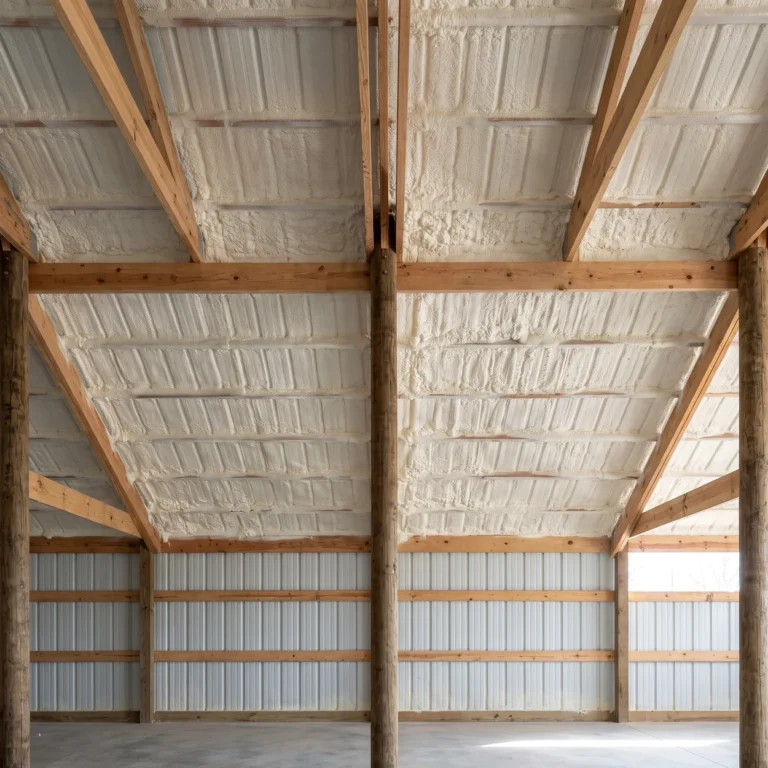
Yes, when one company self-performs both trades with its own crews and holds the manufacturer approvals for each product. That is how we run Bahl Fireproofing. Our crews apply spray-applied fireproofing, intumescent coatings, K-13 and SonaSpray “fc”, commercial spray foam, and Core Foam.
Ask any sub offering both whether it self-performs each one. A scope handed to another company puts the handoff right back into the job.
Our fireproofing materials are spray-applied fire-resistive material (SFRM) from Isolatek International (CAFCO), Carboline, and GCP Monokote, plus intumescent coatings from Carboline and Isolatek. Our insulation materials are K-13 and SonaSpray from International Cellulose Corporation, commercial spray foam, and Core Foam Masonry Foam Insulation from cfiFOAM, Inc., which goes only into hollow concrete block cores. Bahl Fireproofing is an approved applicator for the fireproofing and spray foam manufacturers whose products we install, and our own crews apply every product to the manufacturer’s application instructions.
Where a Fireproofing and Insulation Subcontractor Saves the Schedule
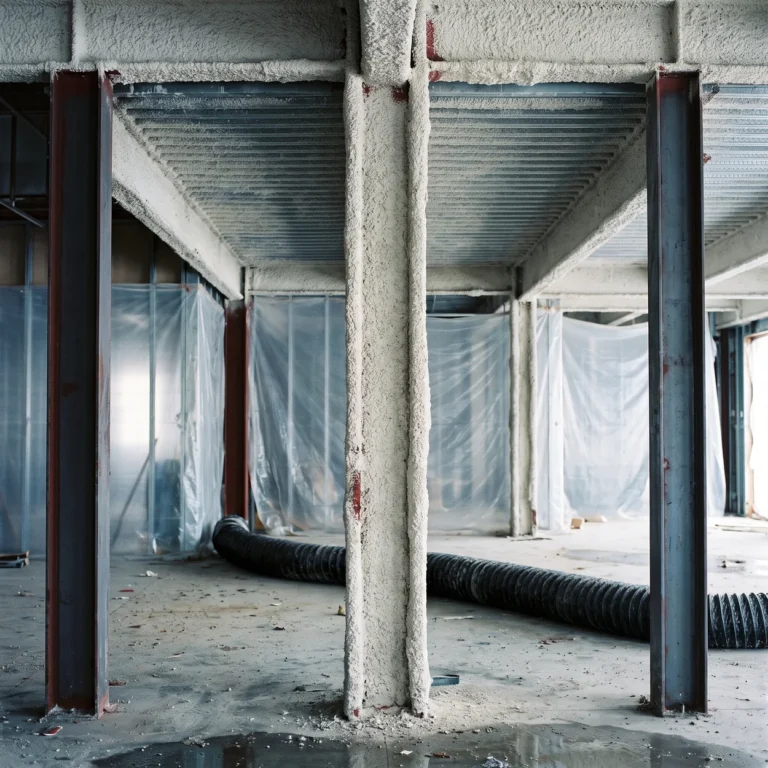
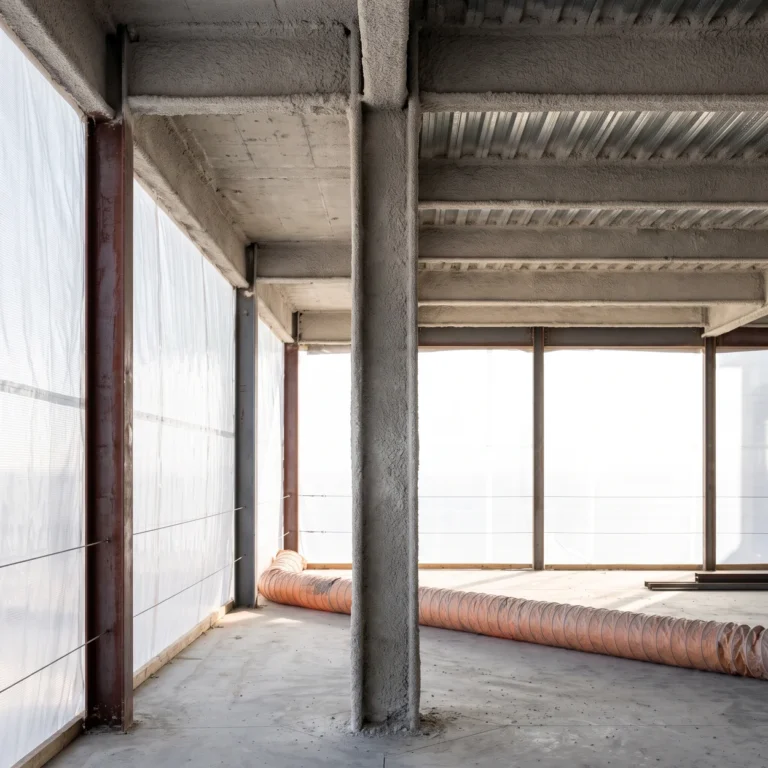
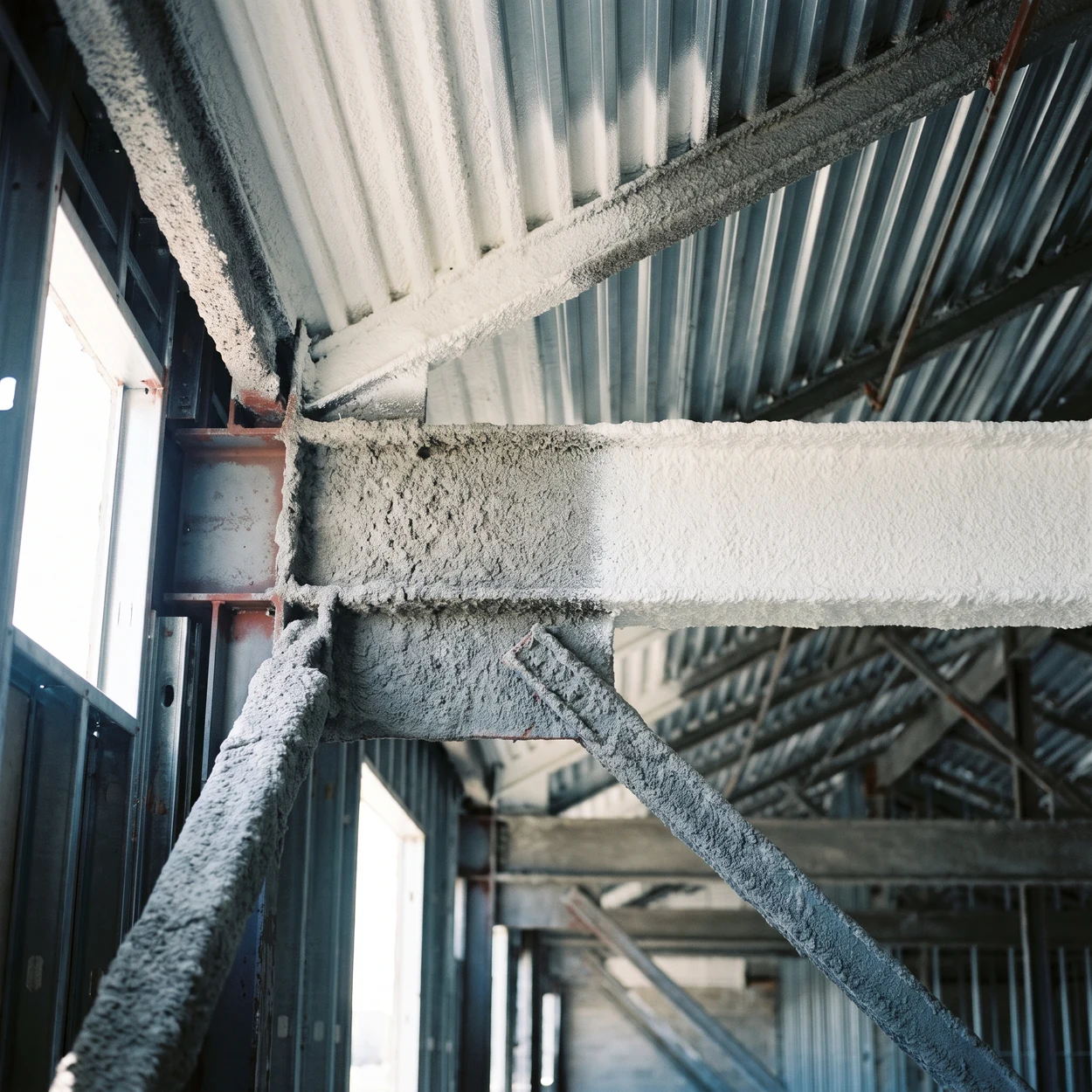
The payoff is biggest where both products go on the same surface before anything hangs below it. K-13 over SFRM on an exposed deck is the clearest case. International Cellulose lists K-13 and SonaSpray “fc” in 16 UL BXUV design assemblies as sprayed fiber for application over SFRM, so the pairing is tested and listed.
Both products need a clear surface. NFCA 100, the standard practice for applying sprayed fire-resistive material, says ducts, piping, and other suspended material shall not be positioned until the fireproofing work is complete. The K-13 Spray-On System Specification Guide keeps ducts, piping, and conduit out until after the sprayed insulation goes on.
Together, those rules close the deck to the mechanical trades from the first pass of fireproofing to the last pass of K-13. With two subs, that window holds the cure, the inspection, the patch-back, and a second mobilization. With one sub, a single crew plans it.
The sequence on a K-13 over SFRM deck runs like this:
- Attachments first. Clips, hangers, and sleeves go in before either product (NFCA 100 Section 11.3.2).
- Roof tight. Fireproofing under a metal roof deck waits until the roofing is tight and roof traffic has stopped (Section 11.3.4).
- Fireproofing to the UL design. Thickness and density come from the listed design.
- Independent inspection. A special inspector, a fully independent third party and never us, measures thickness and density. Section 15.8 calls for inspection as each floor is sprayed and before rough mechanical work.
- Patch and re-check while the fireproofing is still exposed.
- K-13 over the fireproofing, with continuous ventilation until it cures.
- Mechanical trades in.
Steps four and five are the hold point, and the second sub always has a reason to start early.
What a Fire Protection Package Includes That One Sub Does Not Carry
A combined fireproofing and insulation scope covers material on the steel and insulation in the building. It does not cover firestopping, sprinklers, asbestos abatement, or special inspection. Each is its own trade with its own spec section, and a GC who buys a fire protection line from us still buys those elsewhere.
The spec book draws the lines. In the federal Unified Facilities Guide Specifications, Section 07 81 00 covers spray-applied fireproofing, and Section 07 84 00 covers firestopping: tested and listed systems that keep rated walls and floors intact at through-penetrations, joints, and gaps. Fireproofing protects the structural members. Firestopping keeps fire and smoke from passing through the openings.
| Scope | Where it is usually specified | Does Bahl self-perform it? |
|---|---|---|
| Spray-applied fireproofing (SFRM) | Section 07 81 00 | Yes |
| Intumescent fireproofing | Division 07 fireproofing sections | Yes |
| K-13 thermal and acoustical | Sections 07 21 29 and 09 83 16 | Yes |
| Spray foam and Core Foam | Division 07 thermal insulation | Yes |
| Firestopping | Section 07 84 00 | No, a separate trade |
| Sprinklers | Division 21, Fire Suppression | No, a separate trade |
| Asbestos abatement | Section 02 82 00 | No, a separate licensed contractor |
| Special inspection of SFRM | IBC Chapter 17 special inspections | No, an independent third party |
The asbestos row matters on renovations. EPA banned spray-applied surfacing asbestos-containing material for fireproofing and insulating in 1973, so older steel may carry material from before the ban. The EPA overview of the asbestos NESHAP says the regulations require a thorough inspection where a renovation or demolition will occur. Removal belongs to a licensed abatement contractor, and new fireproofing goes on after.
One Sub or Two: A Factor-by-Factor Comparison
| Factor | One sub self-performing both | Separate fireproofing and insulation subs |
|---|---|---|
| Submittals at award | One package for every product | Two packages, tracked separately |
| UL design coordination | One sub checks the design lists both products | Each sub checks only its own product |
| Window before ductwork | One sequence | Two schedules sharing one window |
| Inspection hold point | Held by the crew spraying both | The second sub has a reason to start early |
| Patching before cover | One party patches, then insulates | Who patches gets argued later |
| Temporary heat and ventilation | One continuous plan | Two requests, possibly with a gap |
| Price check | One number for both scopes | Each scope bid competitively |
Two things do not change either way. Each product keeps its own warranty, and neither setup picks up firestopping, sprinklers, or abatement.
When One Subcontractor Does Not Make Sense
A single scope helps when the two scopes share surfaces and timing. Otherwise you mostly give up a price check. I would bid them separately when:
- The scopes are months apart. The frame gets fireproofed early and the spray foam goes on the walls long after the windows are in.
- The insulation belongs to another package. A VA master specification sends insulation in connection with roofing to Section 07 22 00 and metal building insulation to Section 13 34 19, Metal Building Systems.
- The sub cannot staff both at once. Ask about current workload before you award.
- The scope is a small patch. That needs a clear answer on who caused the damage, not a combined award.
- The owner wants one name on every fire protection trade. No fireproofing and insulation subcontractor delivers that, and Bahl does not carry firestopping, sprinklers, or abatement.
Two Typical Situations Where the Contracting Decision Changes the Job
A district sets the scope for a new gymnasium over the winter. The roof is exposed joists and deck, the UL design calls for SFRM, and the architect wants K-13 over it for reverberation control. Bought as two scopes, the fireproofing sub sprays and leaves, and the K-13 sub waits for a slot on its own calendar while the ductwork schedule slides. Bought as one scope, the same crew sprays, holds for inspection, patches, and follows with K-13 while the area is still set up.
Now picture a hospital adding a floor over an older wing. The GC wants one fire protection number. We can carry the SFRM on the new steel, intumescent on exposed lobby steel, and the insulation. The firestopping and the sprinkler modifications still need their own subs. The older wing needs an asbestos survey before anyone disturbs its existing fireproofing, and any removal goes to a licensed abatement contractor first. One sub still fits the fireproofing and insulation lines. It does not make the other lines go away.
Winter Jobs in the Northern States: One Heat Window or Two
On a winter job in Minnesota, Wisconsin, Nebraska, or Iowa, temporary heat is a real line item. We work year round, the GC provides temporary heat as needed, and our floor is 40 degrees F, with the product data sheet governing the exact limits.
NFCA 100 Section 10.1 holds SFRM at 40 degrees F or more, ambient and substrate, through application and for 24 hours after, unless the manufacturer says otherwise. It puts heat on the GC. Section 10.2 adds forced ventilation in enclosed areas, and the K-13 guide wants continuous ventilation until the cellulose cures. With two subs, the GC can end up heating for one scope, standing down, then heating again. With one sub, it is one continuous window.
How to Write the Scope So One Sub Actually Covers It
These are the lines I want in the subcontract before we mobilize:
- List the spec sections by number, and exclude firestopping, sprinklers, and abatement by name so each gets assigned to another sub.
- Name the UL designs. Where K-13 goes over SFRM, the design must list both products.
- Schedule the hold point: fireproofing, inspection, patch, then insulation.
- Settle damage responsibility up front. NFCA 100 Section 14.2 says the responsible party is determined before patching.
- Ask for submittals at award. We send product data, the UL design, shop drawings, and the product test reports for each product.
- Agree on closeout. We provide a warranty of 1 to 5 years based on the product specifications, plus certified payroll and OCIP (owner-controlled insurance program) documents on the jobs that require them, which is not every job.
Frequently Asked Questions
Can one subcontractor handle both fireproofing and insulation? Yes, when the sub self-performs both with its own crews and holds the manufacturer approvals for each product. Bahl Fireproofing self-performs both sides.
Does a fireproofing subcontractor install firestopping? Not ours. Firestopping is a separate trade, usually Section 07 84 00, covering seals at penetrations, joints, and gaps in rated walls and floors.
Who checks the fireproofing before the insulation covers it? A special inspector who is a fully independent third party. The fireproofing sub never inspects its own work.
Is one subcontractor cheaper than two? No published figure answers that, and we will not invent one. One sub can remove mobilizations, heat gaps, and patching arguments, while two subs give you a competitive price on each scope.
When should fireproofing and insulation be bid separately? When the scopes are months apart, when the insulation belongs to the roofing or metal building package, or when the sub cannot staff both at once.
What if the existing fireproofing might contain asbestos? Test before anyone disturbs it. EPA’s asbestos NESHAP requires a thorough inspection where a renovation or demolition will occur, and removal is work for a licensed abatement contractor.
Key Takeaways
The handoff is what fails.
- Products and crews are rarely the problem.
- Time goes in the gap between two trades on the same steel.
One sub pays off where scopes share a surface and a window.
- K-13 over SFRM is a listed combination in 16 UL BXUV designs.
- NFCA 100 and the K-13 guide both keep ductwork off the surface until their product is down.
The inspection hold point protects the job.
- An independent special inspector measures the fireproofing before anything covers it.
- Patching happens while it is still exposed.
A fire protection line is not every fire protection trade.
- Firestopping, sprinklers, and abatement have their own spec sections.
- Bahl does not carry any of the three.
Sometimes two subs are the better call.
- Scopes months apart, insulation in another package, and stretched crews favor separate bids.
- One sub does not merge warranties or replace a price check.
The subcontract language decides whether it works.
- Name the spec sections, the UL designs, the hold point, and the exclusions.
- Settle damage responsibility and temporary heat before mobilizing.
Related Reading
- K-13 Over Spray Fireproofing: The Combined System explains the UL designs behind K-13 over SFRM.
- Spray Foam Insulation: Energy Savings and Comfort covers how spray foam air sealing affects commercial energy use.
When your fireproofing and insulation share the same steel and deck, give them to one crew that sequences the SFRM, the inspection hold point, and the K-13 as a single window. That crew should send submittals for every product at award and name in writing the trades it does not carry. That is the work we self-perform throughout Texas, Oklahoma, Kansas, Nebraska, Minnesota, Wisconsin, Arizona, Missouri, and Iowa. Call me at 512-387-2111, email ross@bahlfireproofing.com, or Contact Bahl Fireproofing to send over a plan set. Our commercial fireproofing services page covers the fireproofing side, and our service areas page shows where we work.
This article provides general educational information about contracting fireproofing and insulation scopes, and it is not engineering, legal, or code-compliance advice. It does not replace project-specific direction from a licensed architect or engineer. Spec sections and code and standard citations reference specific editions that vary by jurisdiction, so confirm them with your project manual and building department. Fire-resistance ratings depend on the listed UL design and correct installation to the manufacturer’s written instructions. Asbestos testing and removal are governed by federal, state, and local rules and must be performed by licensed professionals before existing fireproofing is disturbed.