Winter does not stop K-13 work, but it changes what can go wrong. This article covers what International Cellulose’s current documents say about temperature, storage, and cure, and why a K-13 cold weather job is mostly a drying problem. It also covers how temporary heat can help or hurt, and what a normal winter looks like across the states where we work.
TLDR: K-13 cold weather work fails on drying more often than on heat. K-13 goes on wet with a water-based adhesive, and International Cellulose ties its cure to continuous ventilation, not to a temperature. A sealed, heated building can stay warm and still not dry. A direct-fired heater even adds about a gallon of water to the air for every 100,000 Btu it burns. Plan the air, not just the heat.
A Warm Room Is Not a Dry Room
Picture a general contractor closing in a new gymnasium in Minnesota in January. Direct-fired heaters hold the room well above freezing, and every overhead door stays shut to keep the heat in. The K-13 goes on the deck on schedule and looks finished by the end of the shift.
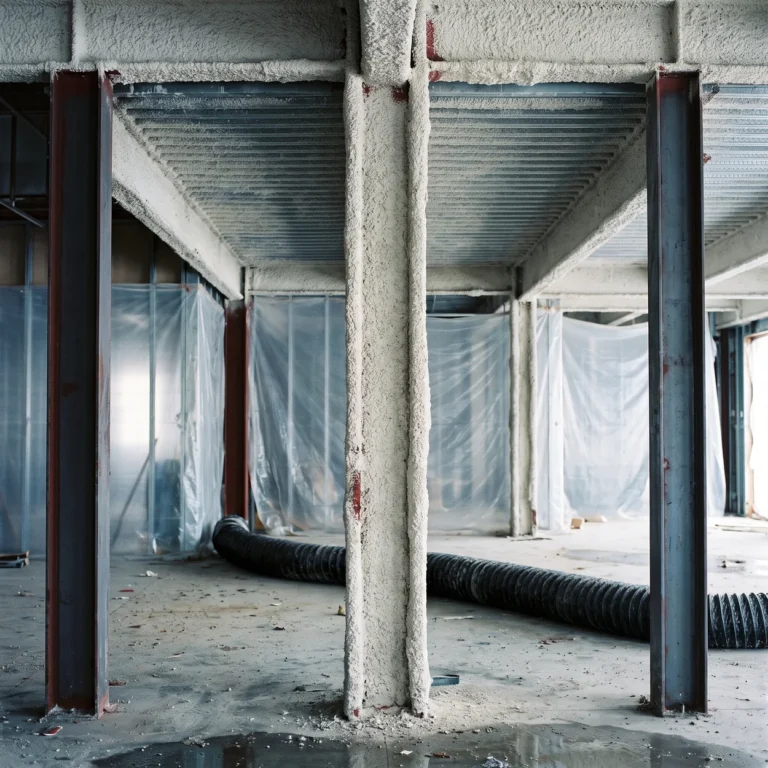
It is not finished. The material went on wet, the room has nowhere to send that water, and the heaters are adding more. Days later the thick areas are still damp and a roofing crew is walking the deck overhead. The ceiling is being asked to hold on before it has its full bond. Any section that lets go gets scraped and resprayed, in the same cold, on a schedule that already slipped.
What Goes Wrong on Winter K-13 Jobs
I have been in this trade for over forty years, and the winter K-13 job that goes sideways rarely fails because the room was too cold to spray. Temperature gets everybody’s attention, so it gets managed. What gets missed is the air.
People close a building up to hold heat, and that is exactly the condition that keeps a water-based ceiling wet. The fix is not more heat. It is a heat plan that also moves air across the ceiling and out of the building for as long as the material takes to cure.
What Temperature Does K-13 Need to Be Applied?
International Cellulose’s current K-13 specification guide, dated 07-25, does not print a minimum air or substrate temperature. It sets the conditions around temperature instead: protect the liquid adhesive from freezing, store materials dry, off the ground and under cover, use potable water, and cure with continuous ventilation. Our floor is 40 degrees F. On winter jobs the general contractor provides temporary heat to hold it, and a stricter limit in the project specification or in International Cellulose’s written instructions governs.
You can read those requirements in the International Cellulose K-13 specification guide. The 40 degree floor is deliberate margin. Water freezes at 32, and until it cures, a K-13 ceiling is cellulose fiber held in place by a water-based adhesive.
Why a K-13 Cold Weather Job Is a Drying Problem
K-13 is sprayed wet. During application the fibers combine with a patented water-based adhesive, according to International Cellulose, and the adhesive ships as a concentrate in 50-gallon drums. ASTM C1149, the material specification K-13 meets, classes sprayed cellulose applied with a liquid adhesive and suitable for exposed work as Type I. That standard covers the material only and leaves application methods to the manufacturer.
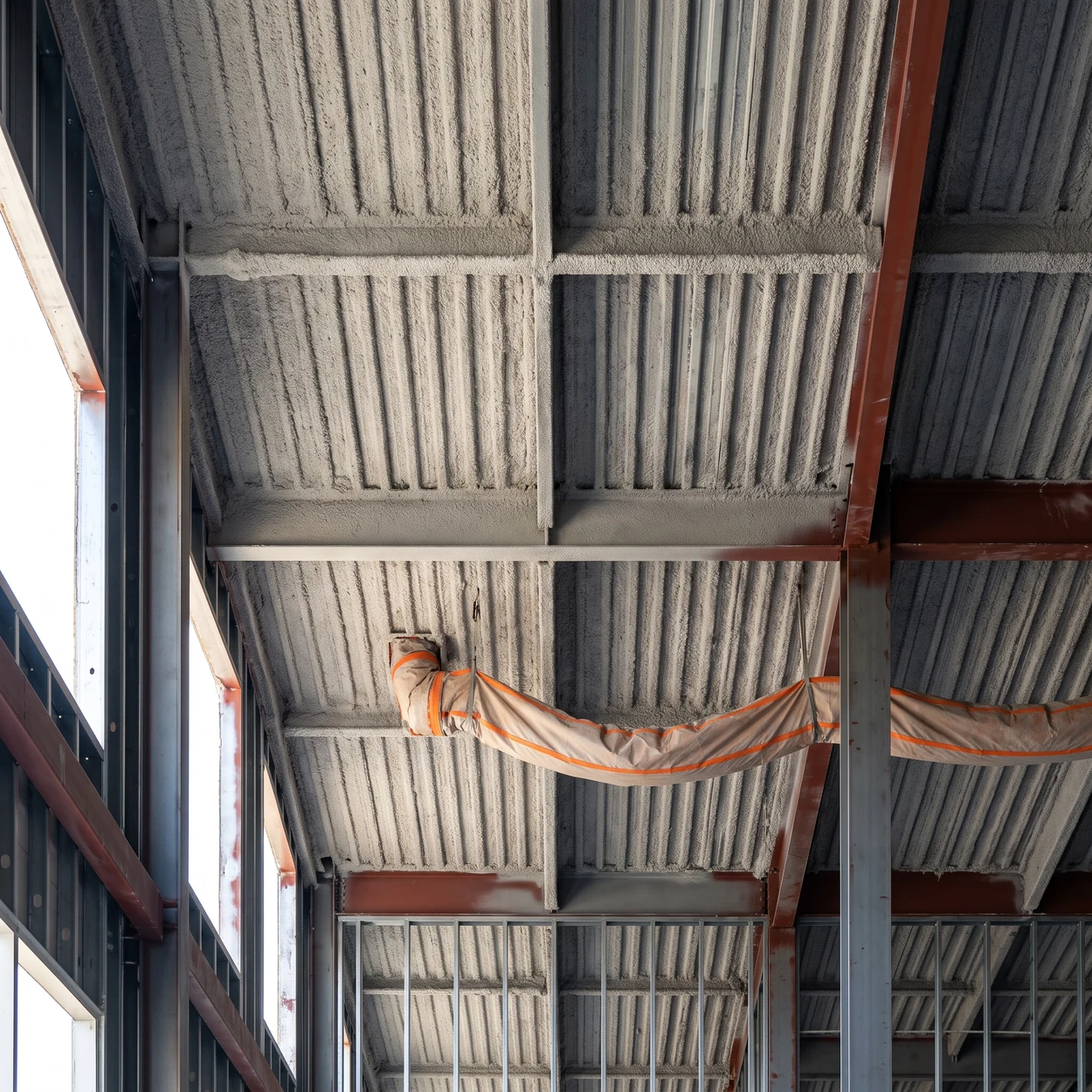
That water has to leave. The K-13 guide says to cure the insulation with continuous natural or mechanical ventilation, maintained until the material has properly cured. The High-R system guide is blunter: use fans to keep air moving across the material and force moisture-laden air outside, ventilating continuously until dry. International Cellulose says curing time varies with the thickness of the application and the degree of ventilation.
Winter makes that hard in one specific way. Ventilation means bringing in outside air, outside air in January is cold, and the heaters have to keep up with it. A crew that shuts the vents to save heat has traded a cold room for a wet one.
The Bond Number on the Submittal Describes a Cured Ceiling
The K-13 data sheet publishes a bond strength greater than 150 pounds per square foot under ASTM E736. That number goes in the submittal, and it is best read as a property of cured material. International Cellulose says the spray does not reach its highest compression and bond strength until it is fully cured. It also asks that no traffic be allowed on the rooftop during curing.
That changes the winter sequence. A slow cure stretches the window when the ceiling sits below its rated bond, so keep roof traffic off the deck until the material has cured. The specification guide also puts roof penetrations, clips, hangers, and sleeves before the spray. A late curb or drain should never mean cutting into a fresh ceiling.
Heat That Adds Water
The general contractor chooses the temporary heat, and the choice reaches the ceiling. A direct-fired heater burns fuel inside the space and leaves its combustion products there. The Department of Energy’s Building America guidance on unvented combustion appliances puts the water at about 1 gallon for every 100,000 Btu burned. That water lands in the same air the K-13 is trying to dry into.
An indirect-fired heater keeps the flame inside a heat exchanger and sends combustion products outside, so it heats without adding that moisture. Electric heat adds none either. Whatever the general contractor runs, OSHA’s temporary heating rule, 29 CFR 1926.154, already requires enough fresh air for the workers, with mechanical ventilation where natural air falls short. Moving that air across the ceiling and out of the building serves the K-13 cure, too.
What the Documents Say and What Winter Changes
This is the checklist we walk with a general contractor before a winter spray date. The middle column comes from International Cellulose’s published documents; the right column is what cold weather does to each item.
| Factor | International Cellulose’s documents | What winter changes |
|---|---|---|
| Adhesive storage | Protect liquid adhesive from freezing | Drums need a heated place overnight |
| Fiber storage | Store dry, off the ground, under cover | Snowmelt and tracked water at the laydown area |
| Water | Potable water | Temporary water lines can freeze |
| Air temperature | No numeric minimum in the 07-25 guide | Our 40 degree floor, held by the GC’s heat |
| Substrate | Examine surfaces; do not proceed until unsatisfactory conditions are corrected | Frost or condensation on a cold deck belongs on that report |
| Sequence | Clips, hangers, sleeves, and roof penetrations before spraying | Late roof work means cutting into fresh ceiling |
| Ventilation | Continuous natural or mechanical ventilation until cured | Outside air is cold, so heat has to keep up |
| Cure time | Varies with thickness and ventilation | Thick layers in still, damp air take longest |
| Bond | Over 150 psf under ASTM E736; full bond only when fully cured | A longer window below the rated bond |
| Roof traffic | None during curing | Hold roofers off the deck until cure |
| Heater type | Not addressed | Direct-fired heat adds about a gallon of water per 100,000 Btu |
Read the table from the bottom up on a winter job. The last four rows are where the schedule slips, and none of them is fixed by turning up the thermostat.
What a Normal Winter Looks Like Across Our Territory
NOAA’s 1991 to 2020 U.S. Climate Normals make the regional point better than any rule of thumb. At Minneapolis-St. Paul International Airport, the normal January high is 23.6 degrees F, and the normal daily low sits below our 40 degree floor every month from November through April. Milwaukee’s normal January day runs from 17.2 to 30.9 degrees.
Then look south. Oklahoma City’s normal January low is 27.0 degrees. Even Dallas-Fort Worth, with a normal January high of 56.5, has a normal January low of 36.1, below our floor.
So the plan changes by state, not just by season. In Minnesota and Wisconsin, a winter K-13 ceiling is sprayed in a closed, heated shell, and the ventilation has to be designed into the heat plan from the start. In Texas and Oklahoma, the afternoon may be fine while the night is not. An unheated shell can drop below our floor overnight while the material is still wet, so the heat stays on after the crew leaves.
Planning a Winter K-13 Schedule
- Settle the heat plan before the spray date. Heater type, fuel, and where the exhaust goes are the general contractor’s decisions. Tell us before we mobilize.
- Hold the space at 40 degrees F or above. Plan to hold it through the cure, not just through the spray.
- Ventilate continuously. Move air across the ceiling and push moist air outside, as the specification guide requires.
- Keep the liquid side from freezing. Adhesive drums and water need a heated place overnight.
- Examine the deck. Frost or condensation goes on the report, and work does not proceed until it is corrected.
- Finish roof penetrations and hangers first. Anything cut in later is a patch.
- Keep traffic off the roof until the material has cured. The rated bond belongs to cured material.
Frequently Asked Questions
Can K-13 be sprayed in winter? Yes. We work year round, and on winter jobs the general contractor provides temporary heat. Our floor is 40 degrees F, and the manufacturer’s written instructions govern the exact limits.
What is the minimum temperature for applying K-13? International Cellulose’s 07-25 specification guide does not print a numeric minimum. It requires the liquid adhesive to be protected from freezing and the material to cure with continuous ventilation. We hold a 40 degree F floor, and a stricter project specification governs.
How long does K-13 take to cure in cold weather? International Cellulose publishes no fixed cure time. It says curing time varies with the thickness of the application and the degree of ventilation. Plan by the condition of the material, not by a set number of days, and keep air moving the whole time.
Can roofers work on the deck while K-13 cures? International Cellulose asks that no traffic be allowed on the rooftop during curing. The spray does not reach its highest compression and bond strength until it is fully cured, so hold roof traffic until it has.
Does propane heat help K-13 dry? It warms the room, but a direct-fired heater also adds water to the air, about a gallon for every 100,000 Btu by the Department of Energy’s figure. Indirect-fired and electric heat do not add that moisture. Either way, the material still needs continuous ventilation to cure.
What if the K-13 adhesive freezes in storage? The specification guide says to protect the liquid adhesive from freezing and publishes no procedure for adhesive that has frozen. Treat frozen adhesive as a question for International Cellulose before it goes into the pump.
Key Takeaways
Winter K-13 is a drying problem.
- K-13 goes on wet with a water-based adhesive and cures with continuous ventilation.
- Curing time depends on thickness and ventilation, by International Cellulose’s account.
The current specification guide sets no numeric temperature.
- It requires protecting the adhesive from freezing, potable water, and ventilation until cure.
- Our floor is 40 degrees F, with the general contractor providing temporary heat.
The bond on the submittal belongs to cured material.
- Over 150 psf under ASTM E736, but full bond only arrives at full cure.
- Keep roof traffic off the deck until then.
Heat can add water.
- Direct-fired heat adds about a gallon of water per 100,000 Btu burned.
- Indirect-fired and electric heat do not add that moisture.
Normal winters differ across our states.
- Minneapolis-St. Paul’s normal January high is 23.6 degrees F.
- Dallas-Fort Worth’s normal January low of 36.1 degrees still falls below our floor.
Sequence matters more in the cold.
- Hangers, sleeves, and roof penetrations go in before the spray.
Related Reading
- Professional K-13 Application Methods for Commercial Projects walks through equipment, surface preparation, and the spray sequence.
- K-13 Spray-Applied Insulation: The Complete Contractor Guide covers thermal, acoustic, and fire performance in one place.
Maybe your schedule puts a K-13 ceiling in the cold months, and you want a crew that holds the 40 degree floor, plans the ventilation with your heat, and keeps the roof clear until the material cures. That is the K-13 cold weather work we do throughout Texas, Oklahoma, Kansas, Nebraska, Minnesota, Wisconsin, Arizona, Missouri, and Iowa. Call me at 512-387-2111 or email ross@bahlfireproofing.com with your heat plan and spray dates. You can also Contact Bahl Fireproofing to get on the schedule. Our K-13 sprayed fiber insulation page covers the material, and our service areas page shows where we work.
This article provides general educational information about applying K-13 spray-applied insulation in cold weather. It is not engineering, safety, legal, or code-compliance advice and does not replace project-specific direction from a licensed architect or engineer. Installation must follow the manufacturer’s current written instructions and the project specification, which govern temperature, storage, ventilation, and cure, and manufacturers revise their documents, so confirm current requirements with International Cellulose. Temporary heat, ventilation, and worker safety belong to the general contractor’s site plan and the applicable OSHA rules. Climate figures are 30-year averages, not forecasts.