When an architect leaves structural steel visible instead of hiding it behind drywall, that steel still has to meet the same fire-resistance requirements as steel nobody ever sees. The problem is that the standard gray, textured spray fireproofing would bury the very look the design was built around. Intumescent coating solves that. It protects the steel while keeping it visible and finished. This guide explains what intumescent coating is, how it works, and what owners, architects, and GCs need to understand before specifying it on exposed steel.
TLDR: Architecturally exposed structural steel (AESS) is steel meant to be seen, and when it is load-bearing it still needs fire protection under the building code. Intumescent coating is a paint-like passive fire protection that swells into an insulating char when heated, so it preserves the appearance of the steel while delivering a fire-resistance rating. The required thickness is specific to each steel member and its UL design, it cannot be improvised, and the finish, topcoat, and inspection all follow rules tied to the product’s listing.
What Is Architecturally Exposed Structural Steel (AESS)?
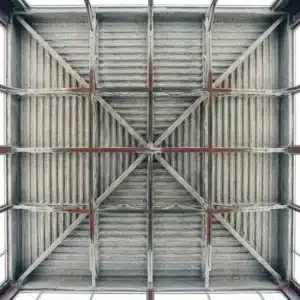
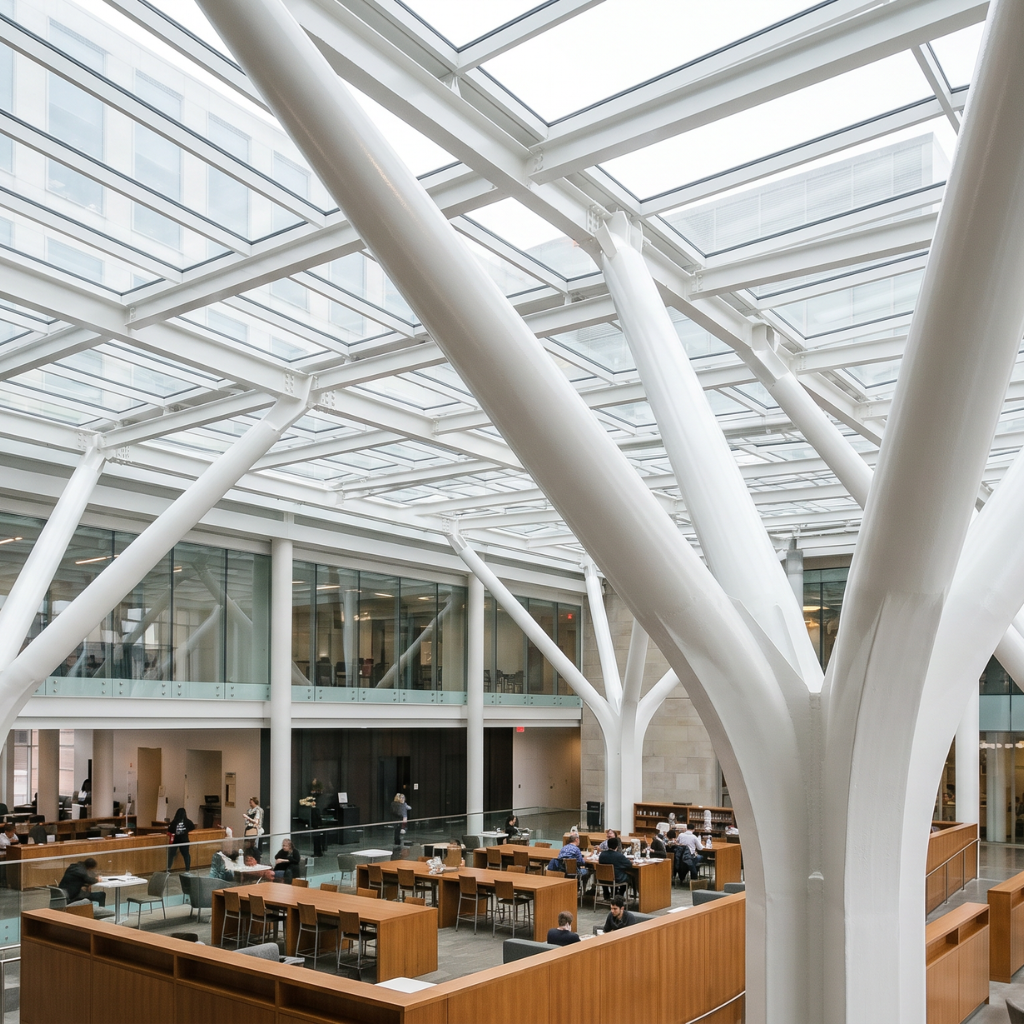
Architecturally exposed structural steel, or AESS, is structural steel that is designed to be seen. Architects and engineers choose to leave it visible rather than concealing it behind drywall, ceilings, or cladding. It has become common in modern commercial design: open-web trusses in airport and transit terminals, exposed wide-flange columns in retail, canopy structures at stadiums, and interior frames in museums and academic buildings.
The AISC Code of Standard Practice (ANSI/AISC 303), Section 10, establishes a tiered system of five AESS categories based on viewing distance and finish expectations. Verify against the current edition adopted for your project, since the standard is periodically updated.
| Category | Description |
|---|---|
| AESS 1 | Basic elements, minimum treatment beyond standard fabrication |
| AESS 2 | Feature elements not in close view, greater than 20 feet away |
| AESS 3 | Feature elements in close view, closer than 20 feet |
| AESS 4 | Showcase elements, special surface and edge treatment |
| AESS C | Custom elements |
As the category number rises, fabrication and erection requirements, time, and cost typically increase. A similar category system was adopted in the Canadian Code of Standard Practice in 2009. One important point: the AESS category defines the aesthetic expectation. It does not by itself decide whether a member needs fire protection. Those are two parallel, separate determinations.
Why Exposed Structural Steel Still Requires Fire Protection
When steel is both load-bearing and exposed, it still requires fire protection. The IBC fire-resistance requirements apply regardless of whether the steel is visible. Leaving a primary structural member exposed for design reasons does not exempt it from the fire rating its construction type and occupancy demand.
That requirement traces back to how steel behaves in a fire. Structural steel reaches a critical temperature, generally accepted at around 1,000 to 1,100 degrees Fahrenheit depending on the member type, at which it has lost roughly 50 percent of its yield strength, and above that point its load-carrying capacity continues to drop rapidly. Fire protection exists to keep the steel below that threshold for the rated duration, whether the protection is hidden or part of the finished architecture. For the bigger picture on how this fits the overall fire strategy, structural fireproofing is one piece of a building’s passive fire protection system, which works alongside active systems such as sprinklers and alarms.
Why SFRM Doesn’t Work for AESS
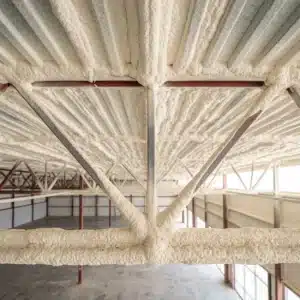
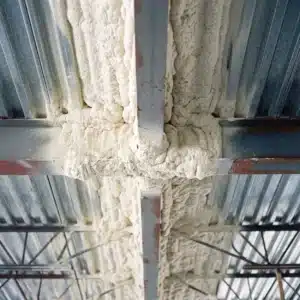
Spray-applied fire-resistive material (SFRM), the cementitious or mineral-fiber spray fireproofing used on most concealed steel, has a rough, textured surface and goes on relatively thick. On exposed steel it reads as a gray, fibrous coating that hides the profile of the member, which defeats the entire purpose of leaving the steel visible.
That is why intumescent coating is the standard solution for exposed AESS surfaces where appearance matters. This is not an absolute rule against SFRM on an AESS member. SFRM is sometimes used on the back side of a member that is not in view, or in adjacent concealed areas. The point is narrower and practical: for the surfaces people actually see, intumescent coating is what lets the steel stay expressed while still being protected.
What Intumescent Coating Is and How It Works
Intumescent fire-resistive material is a coating that provides passive fire protection through a chemical reaction triggered by heat. In its normal state, it looks and behaves like ordinary paint. When heat reaches a threshold, typically in the range of about 300 to 400 degrees Fahrenheit depending on the formulation, the coating undergoes its intumescent reaction. It swells and expands dramatically, forming a thick, low-density, insulating char layer over the steel.
Quality intumescent coatings expand significantly when activated. UL’s published guide reports typical expansion for mastic and intumescent coatings of roughly 15 to 30 times the original thickness, and industry literature cites figures up to about 50 times for some products, so a fair general framing is that these coatings expand typically 15 to 50 times their dry film thickness depending on formulation. The expanded char protects the steel in two ways: it creates an insulating thermal barrier between the fire and the steel, and its very low density slows heat conduction through the layer.
The reaction depends on three functional ingredients working together: an acid source (commonly ammonium polyphosphate) that produces an acid when heated, a carbon source (such as a polyol like pentaerythritol) that provides the charring material, and a blowing agent (commonly melamine) that releases gases to expand the char. Intumescent coatings can deliver fire-resistance ratings of 1 to 4 hours depending on the product, member size, and UL design, with most commercial office, retail, and institutional projects targeting 1- or 2-hour ratings.
The value proposition for architects and owners is straightforward: intumescent coatings let structural steel be expressed architecturally, visible and finished in a range of colors, while still meeting IBC fire-resistance requirements. As Sherwin-Williams puts it, the arrival of smooth intumescent fire-resistive materials “finally allowed for that expression of exposed steel in new and creative ways.” For the full range of products and selection guidance, see our intumescent fireproofing selection guide.
Thickness, Section Size, and UL Listings: Why Every Member Is Different
This is the part that surprises people who think of intumescent as just a special paint: the required thickness is not a single number. The dry film thickness (DFT) needed to achieve a given fire rating varies with the size and shape of each structural member. Smaller, lighter sections need a higher DFT; larger, heavier sections need less.
The reason is mass. A heavier section has a higher mass-to-perimeter ratio, so it heats up more slowly in a fire and needs less insulation. A lighter section heats up faster and needs more coating to stay below its critical temperature for the rated duration. For wide-flange beams and columns, this is expressed as the W/D ratio, where W is the weight of the section in pounds per foot and D is the heated perimeter in inches. A larger W/D ratio means the steel heats more slowly and needs less coating; a smaller W/D ratio needs more. For hollow structural sections, the equivalent figure is the A/P ratio, cross-sectional area divided by perimeter.
The governing listing is ANSI/UL 263 (the same fire test as ASTM E119), and UL’s guide publishes the required DFT for each steel member shape and size to reach a specified rating. Two rules matter enormously here. First, the DFT must match the UL design exactly. Second, UL prohibits extrapolating that thickness data; in UL’s own words, “extrapolated thicknesses that are beyond the scope of the published UL design without additional supporting test data are not considered acceptable.” You cannot assume a thicker coat on a small section behaves like a listed thicker section, and you cannot thin a coat on a small member by borrowing data from a larger one. Over-applying can actually cause the char to delaminate under fire conditions, leaving the steel unprotected.
To give a sense of scale only, industry sources cite rough DFT ranges climbing from tens of mils for short ratings to a couple hundred mils or more for 2-hour ratings, with HSS columns generally needing significantly higher DFTs than equivalent W-shapes. Treat those as illustrative, not specifications. Always verify the required thickness against the UL-listed design for the specific member, product, and rating; the project engineer and coatings supplier determine the correct number for each piece of steel.
Types of Intumescent Coatings
Three formulation types are used in commercial practice, and the choice comes down to environment, durability, and budget.
| Type | Characteristics | Typical use |
|---|---|---|
| Water-based | Lower VOC, easier cleanup, more environmentally friendly | Interior commercial, shop application, climate-controlled buildings |
| Solvent-based | More durable, better moisture resistance | Interior or sheltered exterior, more demanding environments |
| Epoxy-based | Highest durability, hardest finish, highest cost | Industrial, petrochemical, exterior high-exposure, premium AESS |
For most AESS work in commercial interiors, water-based or solvent-based systems are standard, with water-based typically the least expensive and epoxy the most. Epoxy systems show up more often in industrial and exterior-exposed applications. One caution worth stating plainly: do not assume a standard interior intumescent product is fine outdoors. Exterior-rated intumescent coatings require additional UL environmental conditioning and are a separate product category, so verify with the manufacturer that the specific product is listed for exterior exposure before specifying it outside.
Surface Preparation and Priming
Surface preparation drives intumescent adhesion and performance, and the requirements come from the product’s UL listing and the manufacturer’s data sheet rather than from a general rule of thumb. In general terms, the surface must be clean, dry, and free of oil, grease, dirt, loose scale, and incompatible coatings, and a primer is typically required.
The primer is not interchangeable. It must be the primer specified in the product certification, and UL lists approved primers for structural steel under its own product category. The primer also has to establish the correct surface profile for adhesion. For blast cleaning, most commercial intumescent systems specify SSPC-SP 6 (commercial blast cleaning) as a minimum, with higher-performance systems sometimes calling for SSPC-SP 10 (near-white metal blast cleaning). Some manufacturers permit application over an existing shop primer if its thickness is within limits and a bond test passes, while others require removal, and that has to be resolved before fabrication based on the specific product. The safe rule: surface preparation requirements are product-specific, so verify against the manufacturer’s data sheet and the UL-listed design, and never assume primer compatibility without manufacturer confirmation.
Shop Application vs. Field Application
Intumescent coatings can be applied at the fabricator’s shop before erection or in the field afterward, and both are common.
Shop application happens in a controlled environment where temperature, humidity, and dust are managed and the work can be inspected at close range. Wet film thickness is checked during application and electronic DFT gauges confirm the cured result, producing consistent quality that is increasingly favored for AESS. Connection plates and field-weld areas are normally left uncoated in the shop and finished in the field after the connections are made. Sherwin-Williams notes the industry is realizing “lower costs and enhanced safety, quality and aesthetics” from the shift toward shop-applied fire protection.
Field application happens after erection and covers connections, field welds, and any missed or damaged areas. It is required for AESS connections regardless of whether the primary strategy was shop or field. It must be done in enclosed, well-ventilated conditions within the manufacturer’s temperature and humidity limits, and it requires third-party inspection for DFT verification. For how this coordination plays out on a live site, the same trade-sequencing discipline that governs how spray-applied fireproofing is applied applies to intumescent work too.
Topcoats and Finish Colors
A major aesthetic advantage of intumescent coating for AESS is that it accepts a topcoat in a specified finish color, giving exposed steel a smooth, painted look that integrates with the interior design. But the topcoat follows rules.
The topcoat must be tested and listed as compatible with the intumescent base coat, so only manufacturer-approved topcoat products are acceptable. There is a maximum topcoat DFT, and exceeding it can prevent the intumescent layer from activating properly in a fire. Generic household paints, varnishes, and unapproved finishes must not be used over an intumescent base coat. And because added layers accumulate over time, repainting down the road can cumulatively exceed the maximum thickness, so the existing buildup has to be checked before any repaint. UL has indicated that an approved topcoat at the correct thickness does not push the member out of specification, but it cannot be so thick that it blocks activation.
Inspection, Field Quality Control, and Maintenance
During application, the applicator confirms wet film thickness with a comb-type gauge. After cure, DFT is measured with an electronic magnetic gauge following SSPC-PA 2, the procedure for determining conformance to dry coating thickness requirements. That procedure builds up from a single gage reading, to a spot measurement (the average of three readings within a 1.5-inch circle), to an area measurement (the average of five spot measurements per 100 square feet). Third-party independent inspection is required for DFT verification, and UL requires that the finished application show no cracks, voids, spalls, delamination, or any exposure of the underlying steel.
Once properly applied to manufacturer guidelines, intumescent coatings are generally considered maintenance-free for the life of the building, but inspection still matters because impact, construction activity, renovation, or water infiltration can cause damage. Minor chips and scrapes usually do not affect fire protection unless moisture reaches them, while larger damaged areas, generally cited at about 150 square millimeters or more, are considered substantial and should be repaired promptly. Moisture at a damaged spot is the real enemy, since it can seep in, degrade the intumescent layers over time, and reduce performance. Repairs must be made by a qualified contractor using the same listed product system. As a general guideline, industry guidance recommends inspection at least every two years, with the specific interval determined by the product, the building’s use, and environmental conditions; always follow the product data sheet and consult a qualified fire protection specialist.
Frequently Asked Questions
Q: What is intumescent coating and how does it work?
A: Intumescent coating is a paint-like passive fire protection applied to structural steel. In normal conditions it looks like ordinary paint. When heat reaches roughly 300 to 400 degrees Fahrenheit, it expands many times its original thickness, typically 15 to 50 times depending on the product, forming an insulating char that keeps the steel below its critical temperature for the rated duration.
Q: Is intumescent coating the same as spray-applied fireproofing (SFRM)?
A: No. Both are passive fire protection, but SFRM is a thick, rough cementitious or mineral-fiber spray used mostly on concealed steel, while intumescent coating is a thin, smooth, paint-like film used where the steel is exposed. SFRM works as a passive thermal barrier; intumescent coating reacts chemically and expands when heated.
Q: Why can’t you use regular SFRM on exposed structural steel?
A: SFRM has a rough, gray, textured surface and is applied thickly, which hides the profile of the steel and defeats the purpose of leaving it exposed. Intumescent coating preserves the steel’s appearance, which is why it is the standard choice for visible AESS surfaces.
Q: How thick does intumescent coating need to be?
A: It depends on the specific member. Thickness is set by the steel section’s W/D or A/P ratio and the UL-listed design, with lighter sections needing more coating than heavier ones. There is no single universal thickness, and the required DFT must come from the UL listing for that exact member, product, and rating.
Q: Can you paint over intumescent coating?
A: Only with a manufacturer-approved, compatible topcoat applied within the listed maximum thickness. Generic paints or excessive topcoat layers can prevent the coating from activating in a fire. Before repainting an existing finish, the accumulated thickness has to be checked.
Q: How long does intumescent coating last?
A: When properly applied and undamaged, it is generally considered maintenance-free for the life of the building. Inspection is still recommended, generally at least every two years, with the interval depending on the product, building use, and environment. Damaged areas, especially where moisture can enter, should be repaired promptly by a qualified contractor.
Q: What is architecturally exposed structural steel (AESS)?
A: AESS is structural steel intentionally left visible as part of the architecture rather than hidden behind finishes. AISC defines five AESS categories based on viewing distance and finish expectations. When AESS is also a primary structural member, it still requires fire protection under the building code.
Q: Does intumescent coating work for exterior steel?
A: Yes, but only with a product specifically listed for exterior use. Exterior-rated intumescent coatings undergo additional UL environmental conditioning and are a separate product category from interior products. Always verify with the manufacturer that the specific product is listed for the exposure conditions on your project.
Related Reading
- For the foundational material comparison, see our complete spray-applied fireproofing guide.
- Choosing between systems on a project? Review SFRM density categories explained for how concealed-steel fireproofing is specified.
Key Takeaways
AESS is steel meant to be seen, and it still needs fire protection.
- AISC defines five AESS categories by viewing distance and finish, but the category is an aesthetic spec, not a fire-rating decision.
- A primary structural member that is exposed still has to meet the IBC fire-resistance requirement for its construction type and occupancy.
Intumescent coating is the standard solution for exposed steel.
- It looks like paint until heat triggers it, then expands roughly 15 to 50 times into an insulating char.
- It preserves the steel’s appearance and color while delivering 1- to 4-hour ratings, which SFRM’s rough texture cannot.
Thickness is member-specific and cannot be improvised.
- Required DFT depends on each section’s W/D or A/P ratio and the UL-listed design, with lighter sections needing more.
- UL prohibits extrapolating thickness data, and over-application can cause the char to delaminate in a fire.
Surface prep, primer, and topcoat all follow the listing.
- Primers are not interchangeable, blast-cleaning levels are specified by the system, and only approved topcoats at the listed thickness may be used.
- The wrong primer or too much topcoat can compromise adhesion or block activation.
Quality control is measured, documented, and inspected.
- DFT is verified per SSPC-PA 2, third-party inspection is required, and the finished coating must show no cracks, voids, spalls, or exposed steel.
- Intumescent coating is largely maintenance-free but should be inspected on a regular interval and repaired with the same listed system.
If you are specifying or building with architecturally exposed structural steel and need intumescent fire protection that keeps the steel looking the way the architect intended, we can help. We have been applying fireproofing and intumescent coatings on commercial steel across Texas, Kansas, and Oklahoma for more than 20 years. Contact Bahl Fireproofing at 512-387-2111 or email ross@bahlfireproofing.com to schedule a consultation or request a bid. Learn more about our intumescent fireproofing services throughout Texas, Kansas, and Oklahoma.
This article provides general educational information about intumescent coatings and fire protection for structural steel. It is not a substitute for project-specific engineering, code analysis, or professional consultation. Building codes, material specifications, and installation requirements vary by jurisdiction, building type, and project conditions. Always consult with a licensed fire protection engineer and your local authority having jurisdiction before making specification or purchasing decisions. Bahl Fireproofing is not responsible for decisions made based on general information provided in this article.