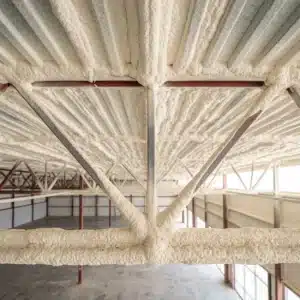
Spray-applied fireproofing looks simple from the outside: mix it, spray it, move on. Every general contractor who has run a commercial steel project knows it is not. The sequence, the environmental controls, the pass limits, and the trade coordination behind sprayed fire-resistive material decide whether you pass special inspection on the first try or shut down a floor for re-spray. This guide walks the full field process, from steel verification to final patching, and points out exactly where projects go sideways.
TLDR: SFRM application runs in a fixed order: verify the UL design, prepare and inspect the steel, confirm temperature and ventilation, mix and spray in controlled passes to design thickness, then cure, protect, and inspect. The general contractor owns more of this than most expect, including power, heat, access, and putting fireproofing on the construction schedule. Rushing passes or letting trades back in early is the fastest way to fail a bond test and lose days you did not budget.
What Spray-Applied Fireproofing Actually Does
Spray-applied fire-resistive material (SFRM) is a cementitious or mineral-fiber coating sprayed onto structural steel, metal deck, and assemblies to deliver fire-resistance ratings of 1 to 4 hours. Those ratings are proven through standardized fire tests under ASTM E119 or UL 263, which expose the assembly to a controlled time-temperature curve and measure how long the member holds its load.
SFRM does not stop a fire. It slows heat transfer into the steel. Structural steel retains about 50 percent of its yield strength at approximately 1,100 degrees Fahrenheit, and above that threshold its load-carrying capacity drops rapidly. SFRM insulates the steel so it stays below these temperatures for the rated duration, buying time for evacuation and response. IBC Chapter 7 governs where fire-resistance-rated construction is required, and the product, thickness, and method must match the tested UL or ASTM design exactly.
For the broader picture of SFRM types, density classes, and where they fit in commercial work, see our complete spray-applied fireproofing guide.
How Is Spray-Applied Fireproofing Installed on Structural Steel?
Spray-applied fireproofing is installed by verifying the UL design, cleaning and inspecting the steel, confirming temperature and ventilation, then spraying SFRM in controlled passes to the listed thickness using wet-spray or dry-spray equipment, and finally curing, protecting, and inspecting the work. Thickness, density, and bond strength are verified per ASTM E605 and ASTM E736. The whole job depends on tight coordination between the fireproofing crew, the steel erector, and the MEP trades.
Here is the step-by-step sequence every GC should understand before commercial fireproofing begins on your project.
Step 1: Verify the UL/ASTM Design, Fire Ratings, and Submittals
Before any material touches steel, the fireproofing contractor confirms which UL design assembly applies to each structural element. The UL design fixes the SFRM product, the thickness for the required rating, the steel section type (column, beam, joist, or deck), and whether the assembly is restrained or unrestrained.
This is not a formality. Spraying the wrong product or thickness voids the rating. The architect and structural engineer of record identify the required ratings. The fireproofing contractor matches them to published UL designs from the manufacturer.
Most commercial specifications also require submittals and a pre-installation conference before work starts: product data, shop drawings showing the extent of fireproofing and the hourly rating by element, the UL design designations, and proof of installer qualifications. A manufacturer’s willingness to sell a product does not make a crew qualified to apply it.
Step 2: Inspect and Prepare the Substrate
Substrate condition is the single most common reason SFRM fails a bond test, so the code is specific. Under the International Building Code, substrates must be free of dirt, oil, grease, release agents, loose scale, and anything else that prevents adhesion. They must also be free of primers, paints, and encapsulants other than those fire-tested and listed for that assembly. (Verify the section number against the edition adopted in your jurisdiction; in recent editions this is IBC 704.13.)
This is the detail that catches GCs: most UL fire tests are run on bare, unprimed steel. If your fabricator shop-primed the steel, you are not automatically compliant. Primed steel is allowed only when bond testing demonstrates adhesion is maintained, and even then only within size limits.
The Primed-Steel Question GCs Ask Most
When SFRM is applied over a primer other than one named in the listing, the IBC requires the material to be field-tested per ASTM E736. The result must show an average bond strength of at least 80 percent and an individual bond strength of at least 50 percent of the SFRM applied to clean, uncoated steel plate, based on at least five tests. Industry code commentary notes that adhesion over some primers can drop by as much as a factor of 10 versus bare steel, which is why this testing matters.
Passing the bond test is only the first gate. The code also limits which primed wide-flange sections can be sprayed at all, based on member size, with larger sections requiring a mechanical key (typically metal lath) or an approved bonding adhesive such as a manufacturer’s bond-seal product. The specific size limits vary by code edition, so verify them against the edition adopted in your jurisdiction and with your local authority having jurisdiction. Here is the practical decision frame for a GC:
| Steel condition | What the code requires |
|---|---|
| Bare, clean, unprimed | Preferred. Apply per the UL design |
| Primed with a listed, tested primer | Apply per the UL design for that primer |
| Primed with a generic shop primer, within code size limits | ASTM E736 bond test first; apply only if it passes |
| Primed, larger sections beyond the code size limits | Bond test plus mechanical lath or approved adhesive |
One more sequencing point that protects the rating: clips, hangers, support sleeves, and any attachment that will penetrate the fireproofing must already be in place before spraying starts, per NFCA 100.
I have seen projects lose a week because steel showed up with an incompatible primer nobody flagged. The fix is coordination, not heroics: get the manufacturer’s approved primer list to the steel fabricator before shop-drawing approval, not after the steel is standing.
Step 3: Confirm Temperature, Ventilation, and GC Site Conditions
The IBC sets a minimum ambient and substrate temperature of 40 degrees Fahrenheit, maintained during application and for at least 24 hours after, unless the manufacturer’s written instructions allow otherwise. Below that, the water in cementitious SFRM can freeze before the binder hydrates, which produces soft material, poor adhesion, and eventual delamination. The special inspector also confirms surface conditions and temperature before application begins.
Ventilation is a requirement, not a nicety. Manufacturer guides and NFCA 100 call for a minimum of four complete air exchanges per hour during and after application until the material is dry. Trapped moisture slows the cure and causes sagging and soft spots.
This step is where the general contractor carries real responsibility. NFCA 100 assigns the GC or construction manager a defined set of site conditions:
- Power and water to the staging area
- Heat and weather protection so conditions hold through the cure window
- Clear, unobstructed access from floor to the area being fireproofed
- SFRM shown on the construction progress schedule, which the standard treats as mandatory
- Protection of finished or non-structural surfaces from overspray
Sequencing of other trades is part of this too. Ducts, piping, and conduit should not be installed until SFRM is complete in that area, both to avoid masking steel and to keep overspray off finished equipment. Roof-deck application should not begin until roofing is complete and tight, penthouses and rooftop units are set, and construction roof traffic has stopped, because deflection from foot traffic above can delaminate the material below. And SFRM should not be applied to a steel floor deck before the concrete work on that deck is finished, or the rating can be compromised. These sequencing rules trace to manufacturer installation guidance from Isolatek and to NFCA 100.
In projects across Texas, Oklahoma, Kansas, Nebraska, Minnesota, and Wisconsin, the 40-degree rule is a scheduling problem more than a technical one. Texas summers rarely struggle to hit temperature. Kansas and Oklahoma winter projects in unheated shells can drop below 40 overnight even after a fine afternoon. I have watched bond tests fail on a Kansas warehouse because the steel cooled below the minimum after the crew left, and the material that looked perfect the day before never bonded. We removed and re-sprayed two floors. Redundant temporary heat, temperature monitoring at the steel surface rather than just the air, and conservative scheduling are what prevent that.
Step 4: Set Up Equipment and Mix the Material
SFRM arrives as dry powder in bags, stored off the ground and kept dry. It is applied by one of two methods.
Wet-spray is the common method for commercial interiors. The powder is mixed with potable water into a slurry in a paddle or ribbon mixer, pumped through a hose to the nozzle, and atomized by compressed air into a fan pattern. It is fast and delivers consistent density, but it is sensitive to freezing and high humidity.
Dry-spray conveys dry material pneumatically with water introduced at the nozzle. It suits cold or exposed conditions where slurry could freeze in the hose and gives the operator more control over water content, at the cost of more rebound on the floor.
The mix is not improvised. Each product has a specified water ratio measured with a calibrated water meter, not a five-gallon bucket. For Isolatek’s CAFCO 300, that is 10.0 to 11.5 gallons of potable water per bag, mixed for about two minutes and used within a working window before it sets, per the CAFCO 300 application guide. Nozzle distance and pump type are equally specified by the manufacturer. Where multiple passes are needed in one day, an in-line accelerator can cut set time from the unaccelerated 4-to-7-hour range down to roughly 10 to 20 minutes, depending on temperature and humidity. Only the listed equipment, nozzles, and procedures are approved; deviating from them voids the published performance.
Step 5: Spray in Passes to Design Thickness
Here is the constraint GCs most often want to negotiate and cannot: you cannot build full design thickness in one heavy pass.
Cementitious SFRM is applied in multiple thinner passes, each allowed to set before the next, with the per-pass thickness set by the product’s application manual. There is also a hard daily cap. For CAFCO 300, the manufacturer prohibits applying more than 1-1/4 inches of material in any 24-hour period. So a 2-hour rating that needs, say, 1-1/2 inches on a column cannot be completed in a single shift. Trying to over-build a single pass causes the wet material to sag, crack, or slough, and even when it stays put it cures unevenly, ending in low density and a failed bond test.
Two more application rules matter at inspection. Do not tamp SFRM to force density, which the federal guide specification (UFGS 07 81 00) prohibits. And every deck flute, long bay and short bay, must be filled to match the UL design. Overspray onto surfaces not receiving SFRM must be protected beforehand and cleaned up promptly.
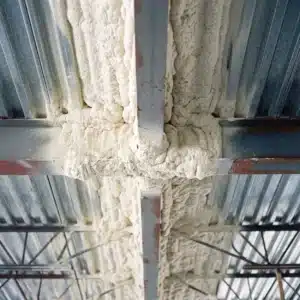
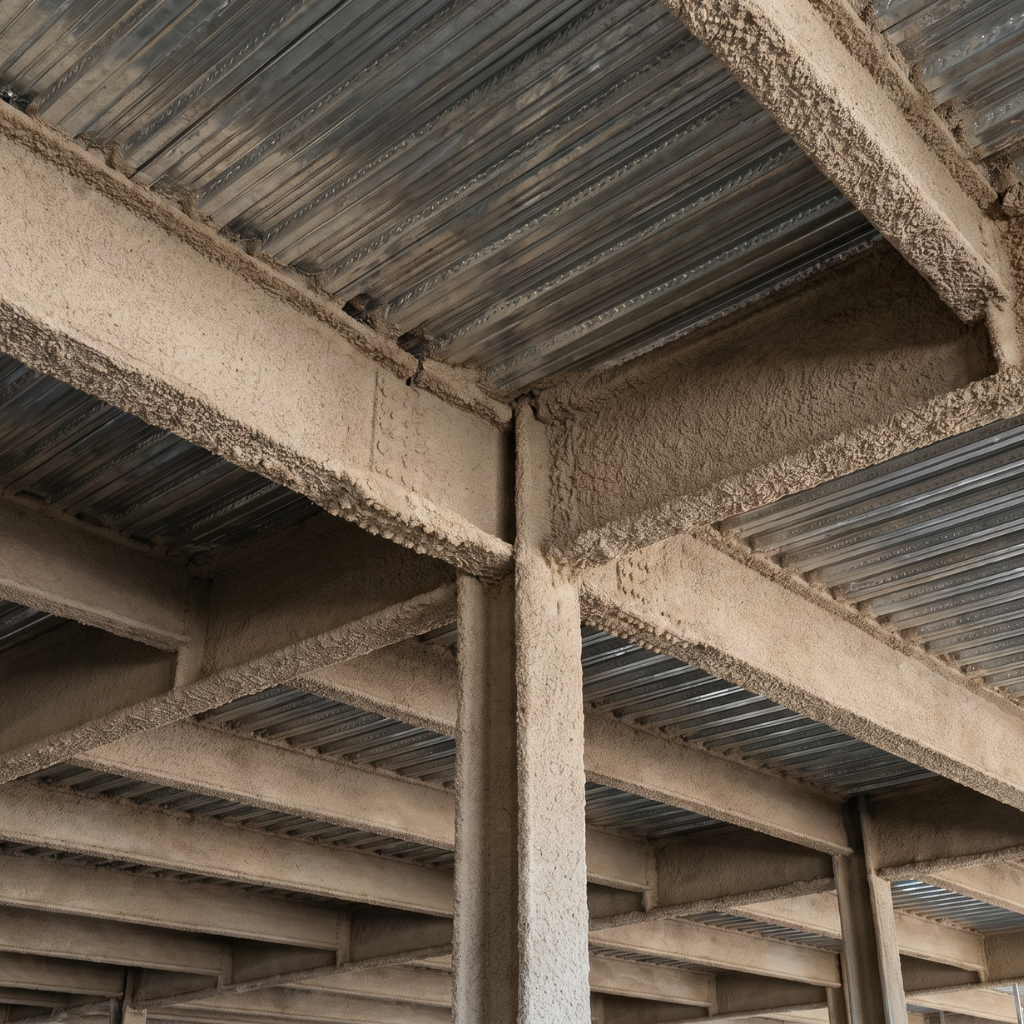
The applicator works methodically across beams, columns, and deck, varying gun angle and distance on complex profiles, connections, stiffeners, and wide-flange webs to avoid thin spots and heavy corners.
Step 6: Cure, Protect, and Control Trade Re-Entry
After the final pass, SFRM needs an initial cure, typically a minimum of 24 to 48 hours, before it can tolerate moisture or contact. Full cure takes longer. Depending on product, thickness, humidity, and ventilation, full cure on a cementitious SFRM can run from roughly two to four weeks, so treat any single number with caution and defer to the manufacturer’s data sheet for the specific product.
During curing, the material must be protected from water, vibration, and mechanical damage, and no construction roof traffic should occur over freshly sprayed deck. Under NFCA 100, damage that happens during the cure period is the responsibility of the GC or construction manager. This is the point where coordination pays off, because MEP crews hanging conduit, ductwork, seismic bracing, or sprinkler drops will eventually need to work around the steel. That work belongs after the SFRM has cured and been inspected, not before.
When trades do damage cured SFRM, and they will, the fireproofing contractor returns to patch. Small areas can sometimes be hand-applied, but larger areas typically require re-spraying, and patching method should be verified against the specific UL listing and AWCI repair guidance. Patches must restore the design thickness over clean, intact material; patching over dust or loose SFRM is not acceptable, and the patch is held to the same inspection standard as the original. The schedule and cost impact of fireproofing repair after MEP trades is one of the most underestimated line items on a steel job.
Wet Spray vs. Dry Spray vs. Trowel Application
The method depends on product, conditions, and access. Here is how they compare in commercial practice.
| Factor | Wet Spray | Dry Spray | Trowel |
|---|---|---|---|
| Typical use | Most commercial interior work | Cold or exposed conditions | Patching, connections, tight access |
| Production rate | Higher | Moderate | Lowest |
| Density control | Consistent (pre-mixed slurry) | Operator-dependent (water at nozzle) | Consistent (hand-placed) |
| Rebound and waste | Moderate | Higher | Minimal |
| Temperature sensitivity | High (slurry can freeze in hose) | Lower (dry conveying) | Low |
| Finish | Rough, textured | Rough, textured | Smooth to semi-smooth |
On most projects, wet-spray does the bulk of the production work, dry-spray covers specific cold or exposed conditions, and trowel work handles patching, connection details, and areas the gun cannot reach cleanly.
What Is the Process of Applying Spray-On Fireproofing?
Spray-applied fireproofing is applied in six steps: verify the UL design and fire ratings; prepare and inspect the substrate; confirm temperature, around 40 degrees Fahrenheit minimum, and ventilation; mix the material with potable water and set up the spray equipment; spray in controlled passes to the design thickness; then cure and protect the applied material before inspection. Each step has code and manufacturer requirements behind it, and skipping any of them puts the fire rating and the schedule at risk.
Thickness, Passes, and Curing: Why You Cannot Rush the Schedule
When a GC under pressure asks whether the crew can just spray it thicker and faster, the answer is no, and the reasons are structural rather than procedural.
SFRM products are tested and listed at specific thicknesses for specific ratings. Deviate from the tested parameters and the assembly no longer matches the design, so the rating is no longer valid. Pass limits exist because cementitious SFRM depends on proper hydration and cohesion within each layer. A single heavy pass cannot release internal moisture evenly, bonds more weakly to the substrate, and develops drying stress that leads to cracking and delamination. The daily cap, 1-1/4 inches per 24 hours for CAFCO 300, is a published manufacturer limit, not a crew preference.
The field tolerance at inspection is tight, too. Not more than 10 percent of thickness readings may fall below the design thickness. For design thicknesses of 1 inch or greater, no individual reading may be less than the design minus 1/4 inch; for thicknesses under 1 inch, no reading may be less than the design minus 25 percent.
Field Quality Control and the Five Required SFRM Inspections
Inspection is not one event at the end. Under IBC Chapter 17 special-inspection requirements (verify the section against your adopted edition; in recent editions this is IBC (2021) Section 1705.15 (Section 1705.14 in the 2018 and earlier editions)), the special inspector must verify five things for SFRM, and timing is part of the rule.
| # | Required inspection or test | Standard or basis |
|---|---|---|
| 1 | Condition of substrates, inspected before application | IBC substrate provisions |
| 2 | Thickness of application | ASTM E605 |
| 3 | Density in pounds per cubic foot | ASTM E605 |
| 4 | Bond strength, adhesion and cohesion | ASTM E736 |
| 5 | Condition of the finished application | Visual, against the listing |
The code times these inspections after the rough installation of electrical, sprinkler, mechanical, and plumbing systems and ceiling suspension systems, where applicable, and before the SFRM is concealed by later construction. That timing is exactly why trade sequencing in Step 6 matters: if MEP rough-in is not done, the inspector cannot sign off, and if it happens after inspection, you are patching.
Measuring Thickness and Density (ASTM E605)
ASTM E605 covers field measurement of SFRM thickness and density. Inspectors and the crew use pin gauges through the material to the substrate to confirm thickness at multiple points on each member. Density is verified by cutting a known sample, weighing it, and calculating. Below the specified density, the material may not deliver the rated protection even at full thickness. The crew should self-check during every shift; catching a thin spot during application costs minutes, while catching it at final inspection costs days.
Bond Pull Testing and the Height-Based Minimum (ASTM E736)
ASTM E736 measures cohesion and adhesion. A disc is bonded to the SFRM surface and pulled with a calibrated device to the point of failure. The required minimum is not a single number; it rises with building height. The IBC requires 150 psf for buildings under 75 feet, roughly 430 psf for buildings from 75 to 420 feet, and about 1,000 psf for buildings over 420 feet. These higher demands were added after NIST findings on SFRM performance, so always confirm the value tied to your building’s height and adopted code.
Bond failures almost always trace to one of four causes: a dirty substrate, an incompatible primer, cold steel during application, or compressed material from over-thick passes. All four are preventable. A practical inspection note from NFCA guidance: do not test uncured material and do not flatten the surface before testing, since both produce false failures and needless rework.
Common Application Defects and How to Avoid Them
Every inspector has a short list of repeat defects, and most come back to coordination and discipline.
Uneven spray and undulations come from inconsistent gun distance, variable hand speed, or too shallow an angle. Holding 18 to 24 inches of distance with the nozzle perpendicular to the steel fixes it. Drips, sags, and heavy corners come from over-thick passes, too much water, or spraying onto an uncured layer; pass discipline and proper set times prevent them. Cracks develop when material is over-built, dries too fast in direct sun or strong air currents, or the substrate moves before full cure. Exposed mesh or bird’s nests happen when reinforcement sits too high relative to the finished surface and require removal and reinstallation, not a skim coat. Delamination, the most serious defect, means the SFRM is separating from the steel, usually from dirty or cold steel, incompatible primer, or impact before cure; delaminated material must be fully removed and re-applied.
Cold-Weather and High-Humidity Projects in TX, KS, and OK
Temperature and moisture cause most SFRM trouble in our territory, and they pull in opposite directions across the three states.
In Texas, humidity is the bigger concern. Gulf Coast summer projects can run 70 to 80 percent ambient humidity, which slows the cure and keeps the material soft and vulnerable to damage from other trades longer than the calendar suggests. Worse, in Texas summer heat the surface can skin over and look dry while the interior is still uncured, setting up a delamination risk if trades return too early. Ventilation and fan circulation through the cure window become more important here, not less, and the full cure tends toward the longer end of the typical range.
In Kansas and Oklahoma, cold is the primary risk. I have run winter projects with temporary heat on every floor, only to have a unit fail overnight, drop the steel below 40 degrees, and cost us two floors of re-spray when the bond tests came back short. Redundant heat, continuous surface-temperature monitoring, and conservative scheduling are the defense.
The practical rule holds in all three states: if you cannot keep both the steel surface and the ambient air at or above 40 degrees for the full 24 hours after application, do not spray. Waiting on conditions is far cheaper than removal and re-application after a bond failure.
Related Reading
- Before SFRM goes on, the steel has to be right. See why surface preparation determines fireproofing performance.
- Specifying the right material class for the rating and section? Review SFRM density categories explained.
- Want the owner’s view of what happens after application? Read our fireproofing inspection process guide.
Frequently Asked Questions
Q: Can spray fireproofing be applied to primed steel?
A: Only when bond testing proves it. Most UL designs are tested on bare steel. If the steel carries a primer that is not listed in the design, the IBC requires an ASTM E736 field test showing at least 80 percent average and 50 percent individual bond strength versus bare steel, across at least five tests. The code also limits which primed sections can be sprayed based on member size, and larger sections need metal lath or an approved adhesive. Those size limits vary by code edition, so verify them against your adopted edition and local authority having jurisdiction.
Q: How long does spray-applied fireproofing take to dry?
A: Initial cure is typically 24 to 48 hours before the material can tolerate moisture or contact. Full cure on a cementitious SFRM can take roughly two to four weeks depending on thickness, humidity, and ventilation, and high humidity in Texas pushes it toward the long end. Always defer to the product’s data sheet for the controlling timeline.
Q: Who is responsible if MEP trades damage fireproofing?
A: The fireproofing contractor performs the patching, but under NFCA 100 the GC or construction manager carries responsibility for damage that occurs during the cure period. The cleanest approach is to determine the responsible trade before patching begins and to schedule SFRM inspection before releasing MEP access to that area.
Q: What are the special inspection requirements for SFRM?
A: Under IBC Chapter 17, a special inspector must verify five items: substrate condition before application, thickness per ASTM E605, density per ASTM E605, bond strength per ASTM E736, and the condition of the finished application. These occur after MEP and ceiling rough-in and before the SFRM is concealed.
Q: How many passes does SFRM take to apply?
A: As many as the design thickness requires, applied in thinner controlled passes with set time between them. There is a daily cap; CAFCO 300, for example, prohibits more than 1-1/4 inches in any 24-hour period. A thick rating on a heavy section is a multi-day activity, not a single shift.
Q: What temperature is required for spray fireproofing application?
A: A minimum ambient and substrate temperature of 40 degrees Fahrenheit during application and for at least 24 hours after, unless the manufacturer’s instructions allow otherwise. Monitor the steel surface, not just the air, since steel cools faster than ambient overnight.
Q: What is the difference between restrained and unrestrained fire ratings?
A: In a restrained assembly, surrounding construction resists the member’s thermal expansion. In an unrestrained assembly, the member is free to expand and typically needs thicker SFRM to carry its load longer. The design engineer specifies which condition applies, and the UL design sets the matching thickness.
Q: What is NFCA 100?
A: NFCA 100 is the Standard Practice for the Application of Sprayed Fire-Resistive Materials, published by the National Fireproofing Contractors Association. It covers applicator qualifications, surface and environmental conditions, the GC’s site responsibilities, application, inspection, and repair, and most commercial specifications reference it as the governing application standard.
Key Takeaways
SFRM application runs in a fixed sequence that cannot be compressed.
- Verify the UL design, prepare and inspect the substrate, confirm conditions, spray in passes, cure, and inspect.
- Combining or skipping steps to save time is the fastest route to a failed inspection.
Substrate and primer coordination is the top failure point.
- Bare steel is preferred; primed steel needs an ASTM E736 bond test and falls under flange-width size limits.
- Get the manufacturer’s approved primer list to the fabricator before shop drawings, not after steel is on site.
Pass and daily-thickness limits exist for structural reasons.
- Cementitious SFRM goes on in thinner passes with set time between them, and products such as CAFCO 300 cap the day at 1-1/4 inches.
- Over-built passes sag, crack, lose density, and fail bond tests.
The general contractor owns more of this job than most realize.
- NFCA 100 puts power, water, heat, access, and the schedule line on the GC, and damage during cure is the GC’s responsibility.
- The 40-degree minimum and ventilation are code-and-manufacturer requirements, not suggestions.
Inspection is five tests, timed around MEP rough-in.
- Substrate, thickness, density, bond strength, and finished condition, verified after rough-in and before concealment.
- Self-checking thickness and density during every shift turns days of rework into minutes of correction.
Climate drives the failures in our territory.
- Texas humidity slows cure and hides soft interiors under a dry skin; Kansas and Oklahoma cold causes overnight bond failures.
- If you cannot hold 40 degrees on the steel and in the air for 24 hours, do not spray.
If your next commercial project needs SFRM applied by a crew that runs the full process, from UL design verification through final inspection, we can help. We have been applying spray-applied fireproofing on structural steel across Texas, Kansas, and Oklahoma for more than 20 years. Contact Bahl Fireproofing at 512-387-2111 or email ross@bahlfireproofing.com to schedule a consultation or request a bid.
This article provides general educational information about spray-applied fireproofing application processes and procedures. It is not a substitute for project-specific engineering, code analysis, or professional consultation. Building codes, material specifications, and installation requirements vary by jurisdiction, building type, and project conditions. Always consult with a licensed professional and your local authority having jurisdiction before making specification or purchasing decisions. Bahl Fireproofing is not responsible for decisions made based on general information provided in this article.