Retail construction in Texas is moving faster and at a larger scale than at any point in recent memory, and the open-ceiling design trend has pushed fireproofing decisions out of the back-of-house and into clear architectural view. This article walks through how IBC Group M occupancy, construction type, and building size determine whether the structural steel in a retail building actually needs fireproofing, and how to handle that protection on exposed steel without sacrificing the design. It is written for general contractors, retail developers, architects, and building owners working in the TX, KS, and OK markets.
TLDR: Whether retail steel needs fireproofing depends on construction type, building size, and occupancy mix, not on the fact that it is a retail building. Type IIB shells require zero-hour structural protection. Type IIA pushes that to one hour. When steel is exposed in an open-ceiling retail design, intumescent coatings are the only practical way to meet the rating without losing the look. Tenant improvements and added mezzanines can change everything.
I have spent more than two decades applying spray-applied fireproofing and intumescent coatings to commercial steel, and the most expensive mistakes I see on retail jobs almost always trace back to assumptions made before the steel was ever erected. A general contractor assumes the shell needs an hour rating because “all retail does.” A developer assumes a Type IIB warehouse-style power center never needs fireproofing on the structural frame. A tenant fit-out crew assumes that because the space was unprotected before, it can stay unprotected after the new mezzanine goes in. Every one of those assumptions can be wrong on the same project, and the cost of being wrong shows up at inspection, not at design.
The retail construction wave in Texas right now makes these decisions higher stakes than they used to be. Texas leads the country in retail space under construction, with Dallas-Fort Worth, Houston, and Austin all ranking among the top retail construction markets nationally per recent CoStar reporting. The volume is real, the schedules are tight, and the codes have not gotten simpler.
What Is Retail Fireproofing?
Retail fireproofing is the application of passive fire protection systems, including spray-applied fire-resistive material (SFRM) and intumescent coatings, to the structural steel of Group M mercantile buildings. Required fire-resistance ratings depend on the building’s construction type, height, and area under IBC (2021) Table 601, and must be verified by a licensed architect or engineer for the specific project.
Code note: unless otherwise stated, code references on this page are to the 2021 International Building Code. Code adoption is state and local. Across the states we serve, adopted IBC editions currently range from the 2012 edition to the 2024 edition, some states have no statewide commercial building code, and several enforce NFPA 1 or NFPA 101 rather than the International Fire Code. Minnesota and Wisconsin publish state-amended code books whose numbering and requirements differ from the model code. This is general technical information, not a code determination for your project. Confirm the adopted edition and any local amendments with your authority having jurisdiction.
The IBC defines Group M (Mercantile) in IBC (2021) Section 309 as a use that includes the display and sale of merchandise, including department stores, drug stores, markets, and retail stores, and the National Fire Sprinkler Association’s overview of IBC occupancy classifications explains why mercantile occupancies carry specific fire and life-safety attention in the code. The reason matters: Group M combines three risk factors that few other occupancy groups carry at the same time: a public occupant population unfamiliar with the building, large quantities of combustible merchandise serving as a fire load, and high occupant densities concentrated in sales areas during peak hours.
The job of fireproofing in this environment is not to prevent fire. Fireproofing exists to delay the structural failure of steel long enough for occupants to evacuate and the fire department to respond. Unprotected structural steel begins to lose strength in the temperature range a typical retail fire can reach within minutes, which is why the code does not leave protection of the primary structural frame to discretion when a rating is required.
How IBC Group M Drives Fire-Resistance Requirements
The fire-resistance rating for a retail project comes out of a code path with three steps, taken in order. First, the licensed architect or engineer classifies the occupancy under IBC Chapter 3. For retail, that is almost always Group M. Second, the project’s height, area, and occupancy mix determine the construction type from IBC Chapter 6, which sorts buildings into Types I through V. Third, IBC (2021) Table 601 assigns required fire-resistance ratings to specific building elements, including the primary structural frame, bearing walls, floor construction, and roof construction, based on that construction type.
The simplified ratings look like this:
| Construction Type | Primary Structural Frame | Floor Construction | Roof Construction |
|---|---|---|---|
| Type IA | 3 hours | 2 hours | 1.5 hours |
| Type IB | 2 hours | 2 hours | 1 hour |
| Type IIA | 1 hour | 1 hour | 1 hour |
| Type IIB | 0 hours | 0 hours | 0 hours |
| Type IIIA | 1 hour | 1 hour | 1 hour |
| Type IIIB | 0 hours | 0 hours | 0 hours |
| Type VA | 1 hour | 1 hour | 1 hour |
| Type VB | 0 hours | 0 hours | 0 hours |
A critical Group M nuance lives in the footnotes to IBC (2021) Table 601. In most occupancies, footnote b allows the roof structure to remain unprotected when every part of the roof construction sits 20 feet or more above any floor immediately below. That allowance is a meaningful cost saver in big-box construction, where ceiling heights often exceed 20 feet by design. The footnote explicitly excludes Group F-1, H, M, and S-1 occupancies. In a Group M building, even roof framing more than 20 feet above the sales floor remains subject to the rating required by the construction type. Many developers and even experienced general contractors miss this exclusion and discover it during plan review, which is the wrong time to find out.
One additional nuance in the same footnote analysis applies in every occupancy, not just Group M. The 20-foot exclusion, even where it is allowed, has never applied to columns. Per ICC’s published interpretation, the 2018 edition expressly broadened the footnote to cover primary structural frame members at the roof level, including beams, girders, and trusses, in addition to roof framing and decking. Columns, however, must still meet their full IBC (2021) Table 601 fire-resistance rating regardless of how high above the floor they sit. So even in a non-Group-M project where the roof beams and decking might legitimately come off the protected list under footnote b, the columns supporting that roof still receive their rating.
IBC (2021) Table 601 itself sits in IBC Chapter 6, Types of Construction, and the International Building Code Chapter 6 types of construction text on the ICC Digital Codes site documents the table along with the footnotes that govern roof-construction protection allowances.
Sprinkler protection adds another layer. IBC (2021) Section 903.2.7 requires automatic sprinklers in any building containing a Group M occupancy when specific fire-area, story-location, or aggregate-area thresholds are exceeded. High-piled storage triggers separate sprinkler requirements regardless of fire area. The exact thresholds depend on the code edition adopted by the local Authority Having Jurisdiction and should be confirmed against the controlling IBC edition for any specific project. The interaction between sprinklers and fire-resistance ratings is not direct, but a sprinklered building can sometimes use construction type substitutions that reduce or eliminate certain rated assemblies, which is a trade-off only a licensed architect or engineer can evaluate for a given project.
The bottom line: there is no single answer to the question “does this retail building need fireproofing?” The answer comes out of the code path, applied to a specific project, by a licensed architect or engineer. What I can tell you with confidence is that the path itself is consistent, and understanding it before the steel goes up saves money.
The Open-Ceiling Retail Trend Changes the Math
For most of my career, retail buildings hid their structural steel above a hung acoustic ceiling. The fireproofing got applied to bare beams and decking, the appearance never mattered, and cementitious SFRM was the obvious answer. That is no longer the default specification.
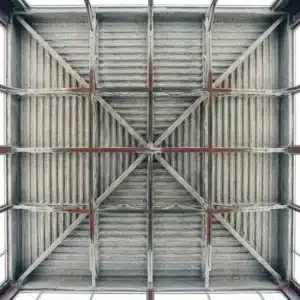
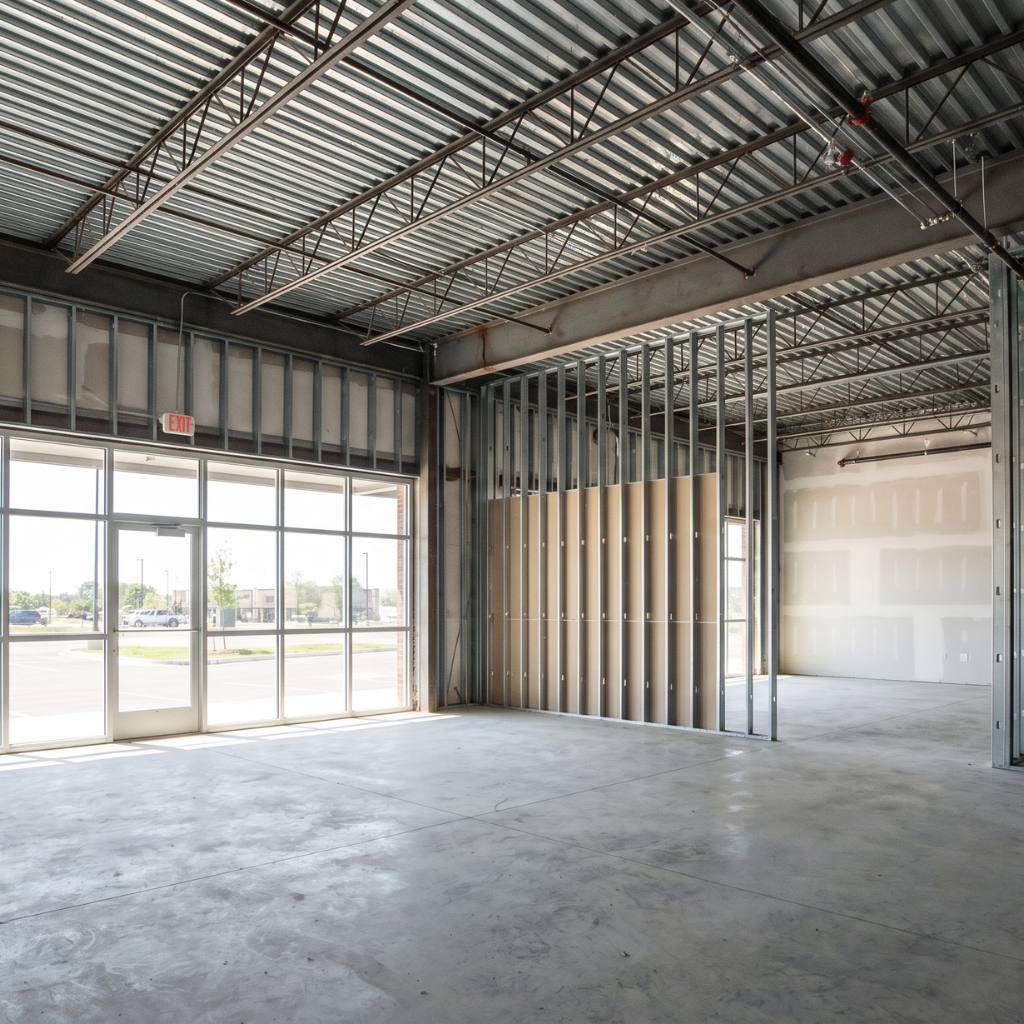
Modern retail design has moved hard toward open ceilings. Lifestyle centers, mixed-use developments, urban infill projects, and even big-box anchors are exposing the structural deck, painting the plenum black, leaving ductwork and conduit visible, and turning the structural frame into part of the architectural language. The reasons are real: the look is cleaner and more contemporary, the higher ceiling adds perceived volume, and there is one less trade in the schedule.
The complication is that exposed steel does not exempt itself from IBC (2021) Table 601. If the construction type assigns a rating to the primary structural frame, that rating still applies whether the beam is concealed above a ceiling or hanging six feet over a gondola shelf. What changes is the system you can use to deliver that rating, because cementitious SFRM has a rough, granular texture that does not belong in a customer-facing space.
This is where intumescent coatings come into the conversation. Intumescent fireproofing is a paint-like coating that, when exposed to heat, expands many times its original dry film thickness to form an insulating char layer that protects the steel underneath. The cured coating has a smooth or lightly textured finish, can be topcoated in any color the architect specifies, and reads as paint rather than fireproofing. For exposed retail steel that needs a rating, intumescent fireproofing for exposed retail steel is typically the only system that delivers both the code-required protection and the design intent.
The level of finish quality required from the steel itself before coating goes on is governed by ANSI/AISC 303, the AISC Code of Standard Practice. That standard defines a series of Architecturally Exposed Structural Steel (AESS) categories that scale with how prominently the steel is featured and how closely it will be viewed, ranging from basic exposed elements through showcase elements with project-specific surface and edge treatment. Most big-box retail and warehouse-style retail with exposed steel sits at the lower-category end. Lifestyle centers and architecturally featured retail can move into a higher AESS category when columns and beams are at customer eye level. The AESS category drives both the steel fabrication cost and the surface preparation expectations for the intumescent coating, and it should be specified in the contract documents per the current edition of ANSI/AISC 303 before fabrication starts. A pre-construction mock-up panel is the cheapest way to align the architect, the steel fabricator, and the fireproofing contractor on what “looks right” actually means for a given project. We do these regularly when the steel is on display.
For a deeper look at how intumescent works in this exact application, see our companion post on intumescent fireproofing for open-ceiling retail and restaurants. For the technical specifier view of how dry film thickness drives the fire-resistance rating, including how ANSI/UL 263 and ASTM E119 listings actually translate into project specifications, The Construction Specifier published a guide on specifying intumescent coating film thicknesses that walks through the section-factor methodology architects and engineers use.
Do Retail Buildings Always Need Fireproofing on Structural Steel?
Not always. It depends on the construction type. Under IBC (2021) Table 601, a Type IIB retail building carries a 0-hour fire-resistance rating for the primary structural frame, meaning no applied fireproofing is required on the steel. Type IIA requires 1-hour protection. Type IIIA and VA are also typically 1-hour. A licensed architect or engineer determines which type applies based on building size, height, and occupancy mix.
A lot of new big-box retail and power-center anchor space gets built as Type IIB precisely because, when the building footprint and height fit within the allowable area and height limits for unprotected non-combustible construction, the developer saves real money on fireproofing. That is a legitimate code-compliant outcome. The trap is that Type IIB only stays Type IIB if the building stays inside those height and area limits, and if the occupancy mix does not push the project into a higher classification. A multi-story retail project, a mixed-use building with apartments above the ground-floor retail, or a center that adds an A-2 restaurant tenant with a substantial occupant load can all change the math. I have walked into plenty of Type IIB shells with one-hour-rated steel installed at the corner where a future restaurant pad was planned, because the licensed architect or engineer saw that future tenant coming. I have walked into others where the shell was Type IIB everywhere and the developer is now trying to figure out how to fit a chain restaurant into the lease without redoing the structural protection. Catching that question at the design stage is dramatically cheaper than catching it after steel erection.
The other failure mode I see is the opposite. A general contractor assumes a retail shell is Type IIA because it is “a commercial building,” specifies one-hour fireproofing on the primary structural frame, and absorbs the cost on a project that the code did not actually require to be protected. That is money that did not need to be spent, and it usually means the architect, the GC, and the fireproofing contractor never had a coordinated conversation about construction type before bid.
The right answer in both directions is the same: bring the fireproofing contractor into the conversation early, work from the construction type the licensed architect or engineer has classified, and verify the assumptions in the construction documents before pricing the project.
Protecting Exposed Steel in Retail: System Selection
Once the code path identifies a fire-resistance rating for the structural frame, the question becomes which system delivers it. In retail buildings, the choice generally comes down to cementitious SFRM for concealed or back-of-house steel and intumescent coating for exposed steel in customer-facing areas. Each has a clear best-fit application.
| Factor | Intumescent (IFRM) | Cementitious SFRM |
|---|---|---|
| Appearance | Smooth, paint-like, topcoatable in any color | Rough, textured, typically not finished to view |
| Best location in retail | Sales floor, lobbies, exposed structural columns and beams | Back-of-house, mechanical rooms, concealed structure above ceilings |
| Fire rating range | Typically up to 2 hours for exposed columns and beams; higher ratings available for specific tested assemblies | Higher ratings available per ANSI/UL 263 listings, depending on density and assembly |
| Application sequence | Before MEP finals and before topcoats | Before MEP rough-in, with curing window |
| Installed cost | Higher per square foot than cementitious; varies by section size, rating, and project access | Lower per square foot than thin-film intumescent; varies by density, rating, and project size |
| Special inspection | Required per IBC §1705.16 (mastic and intumescent coatings) in 2021 IBC | Required per IBC §1705.15 (sprayed fire-resistant materials) in 2021 IBC |
For exposed steel in a customer-facing retail environment, the products we install most often are thin-film water-based intumescent coatings designed for interior steel beams, columns, tubes, and pipes. These products carry UL and other recognized listings for fire ratings up to several hours depending on the specific design assembly and steel section, with 2-hour ratings being typical for exposed wide-flange columns and beams in retail applications. On the cementitious side, the workhorse products are Portland-cement-based commercial-density SFRMs, classified by Underwriters Laboratories in accordance with ANSI/UL 263, with medium-density variants available for areas where limited physical contact is anticipated, such as mechanical rooms, parking levels, and elevator shafts. The decision between these systems is not a preference call. It is driven by location in the building, exposure to view, fire rating required, and physical durability needs. Specific product selection should be confirmed against the current manufacturer technical data sheets and the project’s UL design assemblies.
The required dry film thickness (DFT) for an intumescent coating depends on the steel section size, the required rating, and the manufacturer’s UL listing. Hollow structural sections (HSS) at the same fire rating as a wide-flange beam typically require higher coating thicknesses because of their lower section factor. These thickness values are not numbers a contractor estimates from experience. They are pulled from the specific UL design assembly and verified during special inspection, which is why the assembly number itself belongs in the project specifications, not just a generic rating.
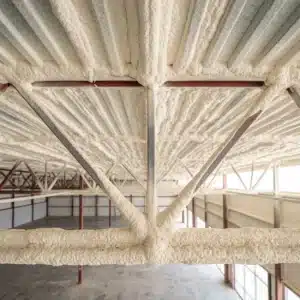
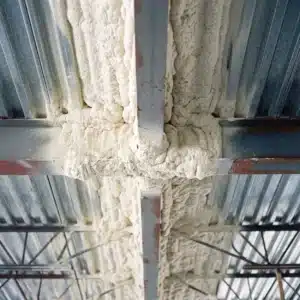
There is also a system that retail design teams underuse: K-13 spray-applied insulation installed over SFRM. K-13 is a cellulose-fiber spray-applied insulation listed in multiple UL BXUV Guide Design Assemblies as an allowable sprayed fiber for application over spray-applied fire-resistive materials. In a retail open-ceiling setting, that means the deck and structural members can receive SFRM first to deliver the required fire-resistance rating, then K-13 is applied over the cured fireproofing to provide acoustic absorption and thermal performance. The K-13 surface is the visible finish, and the material is available in multiple colors for exposed applications. This is one of the few systems where you can hand a developer a rated assembly and a finished, sound-absorbing ceiling at the same time, with one contractor coordinating both layers. We install both systems, which removes the trade-coordination friction that comes from running the fireproofing scope and the acoustical scope as separate contracts.
Tenant Improvements and the IEBC: Where Fireproofing Liability Lives
The fire protection conversation does not end when the shell receives a Certificate of Occupancy. Retail spaces churn tenants, and every tenant fit-out is a potential code event under the International Existing Building Code (IEBC).
Under the IEBC’s work-area method, alteration scope is classified into levels based on how much of the building area the work affects, and the fire-protection upgrade triggers expand as the alteration level increases. Change of occupancy is a separate IEBC pathway with its own requirements. The exact percentage thresholds, level numbering, and triggered upgrades depend on the IEBC edition adopted by the local AHJ and should be confirmed for each project. The most common triggers I see in retail tenant work include adding a mezzanine for storage or office use, which can introduce an S-1 storage occupancy on the upper level; adding an A-2 restaurant or food hall tenant inside what was originally a straight retail box, which is a change of occupancy that triggers its own analysis; and high-piled or rack storage, which can trip the IBC (2021) Section 903.2.7 sprinkler thresholds and, depending on jurisdiction, change the construction type or rating analysis.
Three things happen in tenant fit-outs that affect existing fireproofing on a regular basis. MEP trades cut through, knock off, or scrape away SFRM where they need to penetrate or attach. Signage and demising-wall installation damages exposed intumescent coating in the sales area. Old SFRM on roof deck above a new dropped ceiling gets disturbed, falls in chunks, and never gets restored. None of these is a code-compliant outcome. Damaged fireproofing must be patched by qualified applicators using compatible materials, and the rating must be restored before the assembly is closed up. We get called into existing buildings regularly to patch and restore SFRM that other trades disturbed during fit-out, and in many cases the GC did not realize the rating had been compromised until the special inspector caught it.
The clear advice for owners and GCs working tenant improvements is to involve the architect or engineer of record at the front end of any fit-out that touches structural steel, modifies the occupancy, or adds a mezzanine. The IEBC framework is workable, but it does not run itself. For a broader walk-through of how the code applies to commercial fireproofing decisions, see our IBC commercial fireproofing code compliance guide.
Fast-Track Retail Construction and Sequencing Fireproofing Right
Retail schedules are not negotiable. Lease commencement dates, grand-opening events, and seasonal merchandising windows drive critical path decisions. That pressure is real, and it lands hardest on the trades that cannot be compressed without losing code compliance.
Fireproofing sits in the middle of that schedule. SFRM has to be applied after steel erection and decking are complete, and before MEP rough-in goes in over the deck and around the beams. Intumescent coating sits later in the schedule, after the rough-in is largely complete, but it still requires clean conditions, controlled temperatures, and dry surfaces to bond and cure properly. If either system gets squeezed by the schedule, the failure mode shows up at special inspection, not at the visual walkthrough.
IBC (2021) Section 1705.15 (Section 1705.14 in the 2018 and earlier editions) (for sprayed fire-resistant materials) and Section 1705.16 (for mastic and intumescent fire-resistant coatings) in the 2021 IBC require special inspections for these systems. Older code editions number these sections differently. The 2018 and 2015 IBC placed SFRM at §1705.14 and intumescent at §1705.15, so the controlling section numbers depend on the edition adopted by the local Authority Having Jurisdiction. The required physical and visual tests for SFRM cover five conditions: substrate condition before application, thickness of application, density (in pounds per cubic foot), bond strength (adhesion and cohesion), and condition of the finished application after drying and curing. The code also explicitly states that special inspections must be performed after the rough installation of electrical, automatic sprinkler, mechanical, and plumbing systems, and suspension systems for ceilings where applicable. That sequencing is in the code for a reason. SFRM that is sprayed onto a clean substrate before MEP gets installed gets damaged by the same MEP trades it was supposed to protect, then has to be patched and re-inspected. The patching is allowed. The volume of patching that some retail jobs accumulate is not.
The single most expensive sequencing failure I see on retail projects is when a GC sends mechanical contractors into a freshly sprayed area before the SFRM has cured, in an effort to reclaim a few schedule days. The duct hangers go in, the dampers get installed, and by the time the inspector walks the building, half the SFRM on the affected beams has been scraped off. The resulting rework, including patching, re-inspection, and any schedule penalty for the failed inspection, costs more than the days the GC saved. The fix is not heroic. It requires the schedule to allow a curing window between SFRM application and MEP rough-in, the GC to enforce that window, and the special inspector to walk before MEP starts so any application defects get caught before they get covered up. That conversation belongs in the pre-construction meeting, not the recovery meeting.
In Texas specifically, the heat and humidity in spring and summer are an additional sequencing factor. Cementitious SFRM cures slower in high humidity, and intumescent water-based coatings are sensitive to dew point and substrate temperature. In our experience working DFW, Houston, and Austin retail projects, the realistic curing windows are not the ones in the manufacturer’s lab data sheet. They are the ones we know from applying the same products in 95-degree, high-humidity conditions on a Texas job site.
Retail Construction in Texas and the Service-Territory Reality
The retail construction wave in Texas is the biggest reason this article is more than an academic exercise. Texas dominates the national retail construction pipeline, with Dallas-Fort Worth, Houston, and Austin all consistently ranking among the top retail construction markets in the country in recent CoStar reporting. The volume is concentrated in master-planned community retail, grocery-anchored neighborhood centers, lifestyle centers in the high-growth northern suburbs, and big-box build-to-suit projects for national tenants. The pipeline is not all going up as Type IIB warehouses with the steel hidden away, and the open-ceiling architectural treatment has become a dominant design language. That is precisely the situation this article is about.
For projects in Oklahoma City, Tulsa, and Wichita, the same dynamics apply at smaller scale. Suburban grocery-anchored retail is leading the volume, with mixed-use lifestyle centers behind it. The construction-type and tenant-mix issues read identically. The TX-specific scheduling pressures around heat and humidity moderate as you move north, but the IBC code path is the same. Across all these markets, the through-line is consistent: get the construction type confirmed early, sequence the work around real curing requirements, and document the special inspection compliance from substrate prep through finished application.
Frequently Asked Questions
Do all retail stores require fireproofing on exposed steel? No. Whether structural steel needs fireproofing depends on the building’s IBC construction type, height, area, and occupancy mix, not on the fact that it is a retail building. A Type IIB retail shell carries zero required hours on the primary structural frame. A Type IIA shell typically carries a one-hour rating. The construction type is determined by the licensed architect or engineer based on the specific project parameters.
What is intumescent fireproofing and why is it used in retail open ceilings? Intumescent fireproofing is a paint-like coating that, when exposed to heat, expands many times its original dry film thickness to form an insulating char layer that protects the steel. It is preferred for exposed retail steel because the cured coating has a smooth, decorative finish that can be topcoated in any color, unlike cementitious SFRM, which has a rough texture not appropriate for customer-facing spaces.
Can K-13 acoustical insulation be applied over fireproofing in an open retail ceiling? Yes. K-13 spray-applied cellulose insulation is listed in multiple UL BXUV Guide Design Assemblies as an allowable sprayed fiber for application over spray-applied fire-resistive materials. In a retail open ceiling, SFRM is applied to the deck and structural members first to deliver the required fire-resistance rating, then K-13 is applied over the cured fireproofing for acoustic and thermal performance. Project specifications should reference the specific UL assembly number, not just “K-13 over fireproofing.”
Does a sprinkler system eliminate the need for fireproofing in a retail building? Sometimes, indirectly. Sprinkler systems can enable changes to allowable building height and area under IBC Chapter 5 provisions, which may allow a less-restrictive construction type that carries lower or no fire-resistance ratings on the structural frame. However, the current IBC does not contain a provision that directly reduces a IBC (2021) Table 601 fire-resistance rating in exchange for a sprinkler system. A provision that existed in older code editions was deleted in the 2015 IBC. This is a code analysis a licensed architect or engineer must perform for the specific project under the controlling code edition. Sprinklers do not categorically eliminate fireproofing requirements.
How does a tenant improvement affect existing fireproofing? Tenant improvements can affect existing fireproofing in two ways. First, the alteration scope may trigger requirements under the IEBC to upgrade fire protection to current IBC standards. Second, the physical work itself, including MEP rerouting, mezzanine construction, signage installation, and demising-wall work, frequently damages existing SFRM that must be patched and re-inspected. The architect or engineer of record should review tenant improvement scope before construction starts.
When should a fireproofing contractor be brought into a retail project? Pre-construction, before steel is erected. Bringing the fireproofing contractor in at the design and pre-construction phase allows the construction type, fire ratings, system selections, and sequencing to be coordinated with the GC’s schedule and the special inspection plan. Late involvement after steel is up almost always creates avoidable cost from re-specification, sequencing conflicts, or rework.
How long does intumescent fireproofing last in a retail store? Properly applied and topcoated intumescent coating in a controlled interior retail environment can perform for the service life of the building, provided the topcoat and intumescent layer are not damaged by tenant fit-outs, signage installation, or impact. The coating should be inspected during any tenant turnover that affects the protected steel, and damaged areas must be restored to maintain the rating.
What special inspections are required for spray-applied fireproofing? IBC Section 1705.15 in the 2021 IBC (or §1705.14 in the 2018 and 2015 editions) requires special inspections for sprayed fire-resistant materials covering condition of the substrate before application, thickness of application, density of the cured material, bond strength (adhesion and cohesion), and condition of the finished application. Mastic and intumescent fire-resistant coatings are inspected under the parallel section, §1705.16 in the 2021 IBC. Inspections must be performed after rough installation of electrical, sprinkler, mechanical, and plumbing systems, and a final special inspection report is typically required before the building official issues the Certificate of Occupancy.
Related Reading
- For the construction-type-by-construction-type breakdown of the rating requirements referenced above, see our IBC (2021) Table 601 fire resistance ratings reference.
- For the technical companion on what 1-hour through 4-hour ratings actually mean for structural steel, see fire ratings for structural steel: 1-hour to 4-hour explained.
Key Takeaways
Group M occupancy alone does not determine whether retail steel needs fireproofing.
- The required fire-resistance rating comes from the construction type assigned by a licensed architect or engineer based on building size, height, and occupancy mix.
- Type IIB shells require zero hours on the primary structural frame. Type IIA requires one hour.
- IBC (2021) Table 601 footnote b excludes Group M occupancies from the 20-foot roof-exclusion allowance that applies in many other occupancy groups, and the same footnote has never exempted columns in any occupancy.
Open-ceiling retail design changes the system selection, not the rating obligation.
- Exposed steel that requires a rating typically calls for intumescent coating rather than cementitious SFRM, because of the finish appearance.
- AESS categories under ANSI/AISC 303 should be specified in the contract documents before steel fabrication begins.
- A pre-construction mock-up panel aligns the architect, fabricator, and fireproofing contractor on what acceptable looks like.
Tenant improvements are the most common source of fire protection failure in retail buildings.
- Alterations under the IEBC can trigger fire protection upgrades to current IBC standards, depending on scope and alteration level.
- Adding mezzanines, restaurants, or high-piled storage can change the rating analysis or sprinkler requirement.
- MEP work, signage installation, and demising-wall work routinely damages existing SFRM and must be repaired and re-inspected.
Fast-track retail schedules require early coordination with fireproofing scope.
- SFRM must be applied before MEP rough-in, with a curing window before trades return.
- IBC (2021) Section 1705 special inspections cover substrate condition, thickness, density, bond strength, and finished condition.
- Special inspections must be performed after MEP rough-in but before the assembly is concealed.
Texas retail construction volume makes early planning more valuable, not less.
- Texas dominates the national retail construction pipeline, with DFW, Houston, and Austin consistently ranking among the top markets nationally.
- The high-volume markets are producing both Type IIB warehouse-style retail and Type IIA / open-ceiling lifestyle and mixed-use projects.
- Heat and humidity in TX/OK summer conditions affect realistic curing windows for both SFRM and water-based intumescent coatings.
If your next retail build-out, lifestyle center, big-box anchor, or tenant improvement project in Texas, Kansas, or Oklahoma needs fireproofing handled correctly the first time, let’s talk before steel is in the air. Our team has 20+ years applying SFRM, intumescent coatings, and K-13 over fireproofing across the markets you are building in. Contact Bahl Fireproofing to schedule a pre-construction consultation or request a project bid. Call 512-387-2111 or email ross@bahlfireproofing.com. We work on commercial projects across our service area in Texas, Oklahoma, Kansas, Nebraska, Minnesota, and Wisconsin.
Disclaimer: This article provides general educational information about commercial fireproofing for retail buildings and does not constitute professional engineering advice or product specification. Fire-resistance ratings for retail buildings vary based on building size, height, construction type, occupancy classification, and tenant use. A licensed architect or engineer must evaluate IBC Group M requirements for any specific project. Tenant improvements may affect existing fire ratings and require review by the architect or engineer of record and the Authority Having Jurisdiction (AHJ). Code requirements vary by jurisdiction and code edition. Bahl Fireproofing installs per approved construction documents and does not determine code-required ratings. Always verify UL design assemblies, IBC code references, and manufacturer technical data sheets before finalizing specifications.