Commercial building owners face mounting pressure to reduce operating costs while meeting increasingly strict energy codes. K-13 spray-applied cellulose insulation addresses both challenges through proven thermal performance and seamless installation that eliminates the energy-wasting gaps plaguing conventional insulation systems. This guide examines K-13’s verified thermal specifications, explains how its monolithic application reduces HVAC loads, documents typical energy cost reductions in commercial facilities, and demonstrates how K-13 supports code compliance and sustainable building certifications across Texas, Kansas, and Oklahoma.
TLDR: K-13 spray-applied insulation delivers R-3.7 per inch thermal resistance through seamless cellulose application that fills cracks and eliminates thermal bridging. Commercial buildings upgrading from an under-insulated baseline see meaningful heating and cooling reductions, but the size of the saving and the payback period depend on the existing envelope, HVAC efficiency, climate zone, and energy rates, so they should be confirmed with a project-specific energy model. The material’s Class A fire rating, 80 percent recycled content, and GREENGUARD Gold certification support LEED projects. Section 179D is terminated for construction beginning after June 30, 2026 and is no longer available on new work.
Why Energy Efficiency Matters More Than Ever
We’ve watched facility managers struggle with two competing demands over the past decade: rising energy costs and increasingly strict building codes requiring higher thermal performance. The facilities that succeed find insulation solutions delivering both immediate savings and lasting compliance.
Poor insulation shows up fast in operating budgets. HVAC systems run constantly. Utility bills spike. Equipment wears out prematurely from excessive cycling. These problems compound year after year, turning minor construction compromises into significant operational burdens.
The gap between adequate and exceptional insulation directly affects profitability. Buildings with seamless thermal barriers maintain stable temperatures with less energy, reduce equipment maintenance, and provide consistent comfort supporting productivity.
How K-13 Creates Superior Thermal Performance
K-13’s energy efficiency stems from three characteristics that minimize heat transfer and reduce HVAC loads in commercial buildings.
K-13 achieves R-3.7 per inch thermal resistance through its open-cell cellulose fiber structure. The hollow fibers create dead air spaces that resist heat transfer while maintaining structural integrity. Standard installations apply K-13 up to 5 inches thick without mechanical support (R-18.5), while the High-R System uses mechanical supports for applications up to 10 inches (R-37) in parking garages, event centers, or metal buildings requiring maximum energy performance.
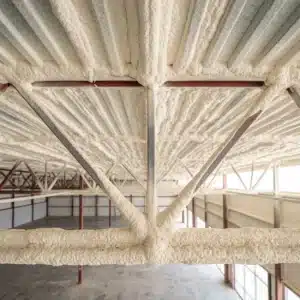
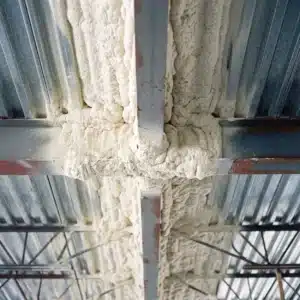
The spray application fills cracks, seams, and voids to form monolithic coating over substrates including metal deck, concrete, wood, and gypsum. This seamless coverage eliminates thermal bridges at structural connections in batt or board systems. Joists, beams, and metal framing that would create heat loss pathways become fully encapsulated, maintaining continuous thermal resistance across the entire envelope.
K-13’s open-cell structure creates dead air spaces while the spray-in-place installation reduces air infiltration through the building envelope. Unlike prefabricated products leaving gaps at edges and penetrations, K-13 conforms to irregular surfaces and wraps around HVAC penetrations, electrical conduits, and structural elements. This superior air sealing reduces uncontrolled air movement that, according to industry data, can account for 25 to 40 percent of heating and cooling loads.
Verified Energy Savings in Commercial Applications
Real-world performance demonstrates K-13’s impact on operating costs and HVAC efficiency.
Commercial buildings with comprehensive K-13 insulation upgrades reduce heating and cooling costs relative to previously under-insulated conditions, with the magnitude depending on the baseline envelope, HVAC efficiency, and climate zone. These savings result from reduced thermal transfer, decreased air infiltration, and lower HVAC runtime. Actual percentages vary based on climate zone, building use, and existing envelope performance before K-13 installation.
Office buildings benefit from stable indoor temperatures reducing HVAC cycling, while warehouses and industrial facilities see strong results because K-13’s high R-value addresses large surface areas and high ceilings. Educational facilities reduce energy consumption while improving acoustic quality, delivering dual benefits from single material installation.
Investment in K-13 typically generates return through reduced utility costs within 2 to 5 years. Payback depends on climate zone (extreme climates see faster returns), utility rates, building occupancy, and HVAC efficiency. Projects in Texas and Oklahoma generally achieve payback within 3 to 4 years due to substantial cooling loads.
Energy efficiency improvements also reduce equipment wear. HVAC systems with reduced runtime experience less mechanical stress, extending compressor life and reducing service intervals. Facility managers report fewer emergency repairs and lower annual maintenance budgets in buildings with properly installed thermal insulation.
Supporting Code Compliance and Sustainability Goals
K-13 helps commercial projects meet stringent energy codes while supporting green building certifications.
The IECC sets minimum envelope performance in Section C402, with opaque assembly values by climate zone. K-13 at R-3.7 per inch lets a licensed architect or engineer reach the value required by the adopted edition through thickness selection for the specific assembly. The material qualifies as continuous insulation when applied to roof decks or walls, addressing code provisions requiring continuous insulation to minimize thermal bridging.
LEED certification projects benefit from K-13’s contributions to multiple credit categories: 80 percent pre-consumer recycled content (Materials and Resources), GREENGUARD Gold certification (Indoor Environmental Quality), envelope efficiency improvements (Energy and Atmosphere), and Houston, Texas manufacturing location (Regional Materials).
Section 179D is no longer available for new projects. Under 26 U.S.C. 179D(i), added by Public Law 119-21, the section does not apply to property whose construction begins after June 30, 2026, and that date has passed. Buildings that began construction on or before June 30, 2026 remain eligible and can claim the deduction when placed in service. Where it did apply, it was never earned by insulation alone. It required certification that the work was part of a plan cutting the building’s total annual energy and power costs by at least 25 percent against an ANSI/ASHRAE/IES Standard 90.1 reference building, so K-13 counted as one measure among several. Bahl Fireproofing is a contractor, not a tax advisor. Consult your CPA.
The material’s 75-year reference service life ensures K-13’s energy efficiency benefits persist throughout the building’s operational lifetime, providing consistent savings without requiring replacement.
Fire Safety and Acoustic Performance
K-13 provides verified fire resistance and sound absorption complementing its thermal efficiency.
K-13 achieves Class A fire rating per ASTM E84 with flame spread 5 and smoke developed 5, far exceeding Class A requirements (flame spread 0 to 25, smoke developed 0 to 450). The fire retardant treatment penetrates each cellulose fiber, ensuring consistent fire performance that does not degrade over time.
It’s important to understand that K-13 provides excellent surface fire resistance but is not a replacement for structural steel fireproofing where ASTM E119 fire-resistance ratings are required.
The open-cell structure providing thermal resistance also delivers acoustic absorption. K-13 achieves Noise Reduction Coefficient values from 0.90 to 1.05 depending on thickness and substrate. Applications of 1.5 inches on ribbed metal deck achieve NRC 1.05, while 2-inch applications on solid backing achieve NRC 1.00. This acoustic performance proves valuable in gymnasiums, cafeterias, and offices where reverberation control improves comfort alongside thermal and fire protection.
Installation Requirements and Quality Verification
Professional installation by licensed applicators ensures K-13 delivers rated thermal performance.
K-13 requires application by International Cellulose Corporation licensed contractors using approved equipment controlling fiber-to-adhesive ratios. Licensed applicators receive training in substrate preparation, spray techniques, and quality verification preventing under-density or inadequate coverage compromising thermal performance.
Proper substrate preparation proves essential. Metal decks require cleaning to remove contamination. Some substrates need primers for long-term bonding. Moisture content verification confirms substrates fall within acceptable ranges, preventing adhesion problems.
Bahl Fireproofing’s certified applicators conduct in-process density testing using core samples verifying conformance throughout each project. Our process includes visual inspection, spot thickness measurements, and comprehensive documentation supporting warranty claims, code compliance, and LEED certification.
Frequently Asked Questions
How does K-13 compare to spray foam for energy efficiency?
K-13 provides R-3.7 per inch, comparable to open-cell spray foam while delivering superior acoustic performance and avoiding chemical off-gassing. K-13’s cellulose composition creates environmentally friendly installation using water-based adhesive. The 80 percent recycled content and lower embodied energy make K-13 preferable for sustainability-focused projects.
Can K-13 be installed in existing buildings?
K-13 works exceptionally well for retrofit applications. The spray-applied installation allows application to exposed roof decks, ceilings, and walls without extensive demolition. Retrofit projects benefit from K-13’s ability to fill gaps and provide continuous coverage over irregular surfaces. Proper containment allows installation in occupied facilities with minimal disruption.
What maintenance does K-13 require to maintain energy efficiency?
K-13 requires minimal maintenance to preserve thermal performance. The material does not settle or compress, maintaining consistent R-value throughout its service life. Periodic inspections following roof work verify K-13 remains intact. Damaged sections can be restored by applying new material to match existing thickness.
Does K-13 qualify for energy efficiency rebates?
K-13 may qualify for utility company rebates in jurisdictions offering incentives for commercial building envelope improvements, and those programs are set locally, so verify current terms with your utility. The federal Section 179D deduction is a separate item and is terminated for construction beginning after June 30, 2026. Only projects that began on or before that date remain eligible.
How does K-13 perform in humid climates like Texas and Oklahoma?
K-13’s open-cell structure provides excellent moisture tolerance. The cellulose fibers absorb and release water vapor without permanent damage or losing thermal resistance. The material allows drying in both directions, preventing condensation accumulation. Fire retardant treatments include mold inhibitors maintaining thermal performance and indoor air quality.
What thickness do most commercial projects require?
Most commercial roof deck applications use 2 to 3 inches of K-13 (R-7.4 to R-11.1) meeting or exceeding code requirements for climate zones throughout Texas, Kansas, and Oklahoma. Projects with higher performance targets may specify up to 5 inches (R-18.5) without mechanical support, or use the High-R System for applications up to 10 inches (R-37).
Key Takeaways
- K-13 spray-applied insulation delivers R-3.7 per inch thermal resistance through seamless cellulose fiber application that fills cracks, eliminates thermal bridging, and reduces air infiltration that accounts for substantial energy loss in commercial buildings
- Commercial facilities reduce heating and cooling costs relative to under-insulated baselines, with the size of the reduction and the investment payback depending on baseline conditions and occurring within 2 to 5 years depending on climate zone, utility rates, and building characteristics
- The monolithic spray application eliminates the gaps, compression, and thermal bridges inherent in batt or panel systems, providing continuous insulation across structural connections that would create heat loss pathways in conventional installations
- K-13 supports compliance with IECC Section C402 in the adopted edition and LEED certification through multiple credit categories; the Section 179D deduction is terminated for construction beginning after June 30, 2026 and no longer applies to new work
- Class A fire rating (flame spread 5, smoke developed 5) and acoustic performance (NRC 0.90 to 1.05) complement thermal efficiency, creating comprehensive building envelope performance from single material installation
- Professional installation by licensed applicators with in-process quality verification ensures K-13 delivers rated thermal resistance and maintains energy efficiency benefits throughout its documented 75-year service life
Transform Your Building’s Energy Performance
If rising energy costs and strict code requirements challenge your next commercial project, K-13 spray-applied insulation provides proven thermal performance backed by decades of successful installations and verified energy savings data. Our certified installation team at Bahl Fireproofing brings over 20 years of commercial insulation experience to projects throughout Texas, Kansas, and Oklahoma, ensuring proper substrate preparation, consistent application density, and comprehensive quality verification that delivers long-term energy efficiency. Contact Bahl Fireproofing today to discuss your project requirements and request a detailed energy efficiency analysis.
Disclaimer: This article provides general educational information about fireproofing and insulation systems and does not constitute professional engineering advice or product specification. System selection must be based on project-specific fire ratings, thermal requirements, acoustic performance needs, environmental conditions, substrate requirements, and budget constraints. Code requirements vary by jurisdiction and project type. Always consult with a licensed professional and verify UL or FM assembly listings before finalizing specifications.