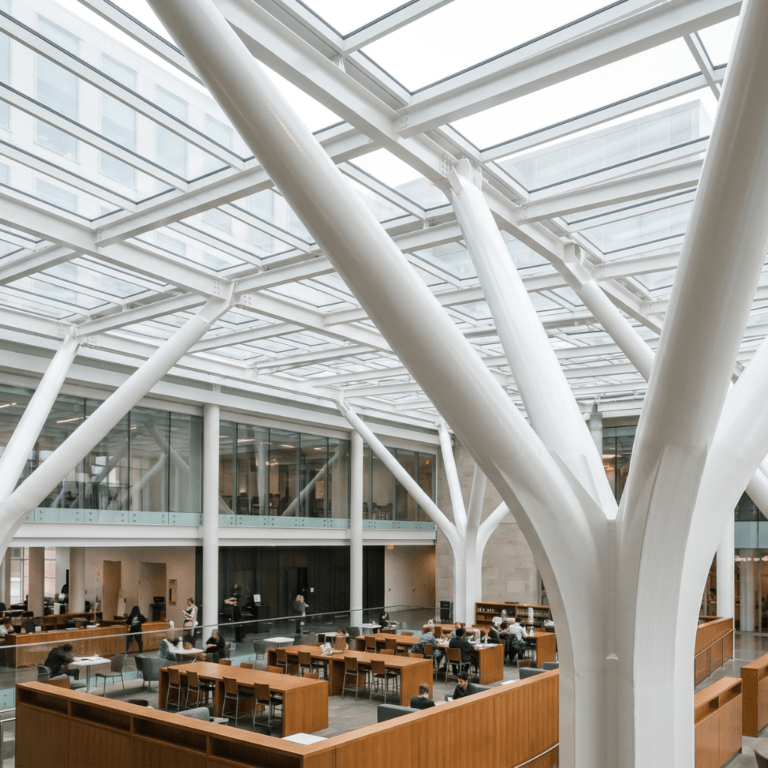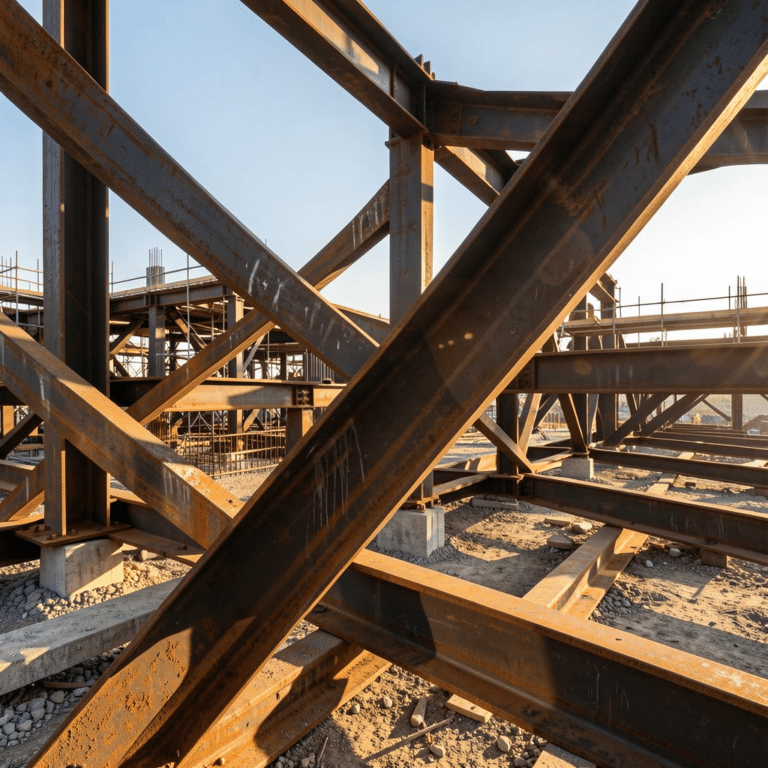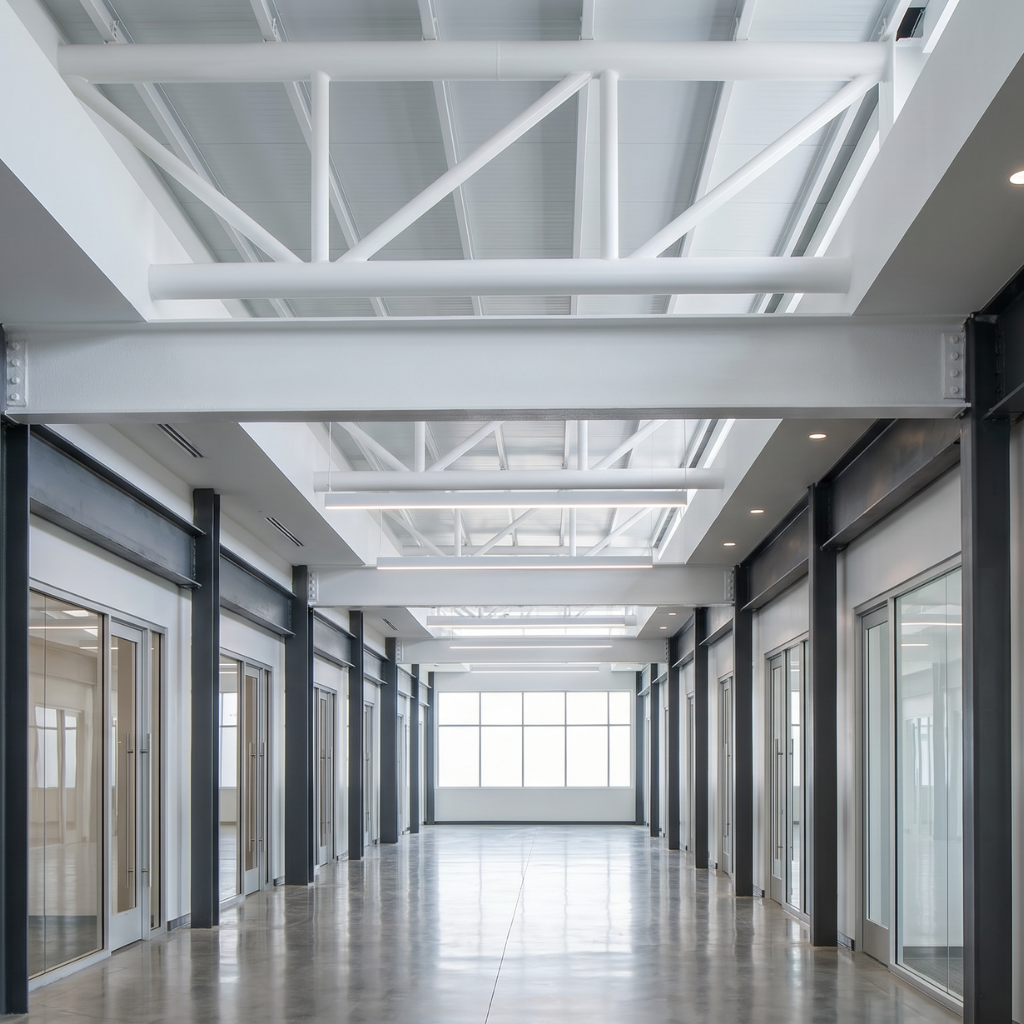
Specifying fire protection for steel that lives in a covered parking deck, a breezeway, or a loading dock with partial cover is not the same as specifying it for a climate-controlled office. Those semi-exposed spaces sit in a gray zone that trips up a lot of specs. This guide explains when solvent-based intumescent coating is the right call, why it outperforms water-based formulations in those conditions, and how to specify it correctly for commercial projects across Texas, Oklahoma, Kansas, Nebraska, Minnesota, and Wisconsin.
TLDR: Solvent-based intumescent coating is the practical choice for semi-exposed structural steel, meaning unconditioned spaces where condensation and humidity swings occur. It tolerates a wider application window and cures more reliably than water-based intumescent in those conditions. The most common field mistake is treating a covered, unconditioned space as “interior” and defaulting to water-based, which can lead to coating failure that does not show up at inspection.
Most general contractors and specifiers know the three intumescent chemistry families exist. What gets missed is the decision in the middle. Water-based intumescent is straightforward for a dry, conditioned interior. Epoxy intumescent is the obvious answer for a fully exterior or aggressive industrial environment. The trouble lives in between, in the semi-exposed spaces that look like interiors on a floor plan but behave like the outdoors when it comes to moisture and temperature.
Over the past 20 years applying intumescent coatings across commercial projects in Texas, Kansas, and Oklahoma, I have watched water-based systems specified for covered parking decks and breezeways struggle the moment Gulf Coast humidity climbed during the cure window. That is the gap this article fills. For broader context on chemistry selection across all three families, our complete guide to intumescent fireproofing covers the full picture. This article goes deep on one decision: solvent-based for semi-exposed steel.
What Is Solvent-Based Intumescent Coating?
Solvent-based intumescent coating uses alkyd resin dissolved in organic solvents as its binder, combined with intumescent additives that expand under heat. When fire raises the temperature, the coating swells into a thick carbonaceous char that insulates the steel and delays its rise toward critical failure temperature. The solvent carrier is what separates it from water-based systems.
That binder chemistry drives every practical difference. Because the carrier is an organic solvent rather than water, the coating is less sensitive to ambient moisture during application and cure. It dries faster and more consistently. The tradeoff is higher volatile organic compound (VOC) content and a stronger odor, which means application demands ventilation and care around ignition sources until the film fully cures.
Solvent-based sits in the middle of three intumescent families. Water-based intumescent uses acrylic resin suspended in water, carries very low VOC, and suits dry conditioned interiors. Epoxy intumescent is a two-component system built for the harshest exterior, offshore, and chemical-exposure environments. Solvent-based bridges the two, engineered for the semi-exposed conditions where water-based gets risky but full epoxy is more system than the project needs.
When heated, intumescent coatings expand roughly 15 to 50 times their applied thickness, depending on the specific product and formulation. That expansion forms the insulating char that does the protective work. The exact expansion ratio is a product-specific property, so it should never be treated as a universal number across coatings.
What Does “Semi-Exposed” Actually Mean?
Semi-exposed describes structural steel in unconditioned spaces where condensation, humidity, and temperature cycling occur, but the steel is not fully weather-exposed. It is not a defined term in the International Building Code. It comes from the corrosion-protection world, specifically the ISO 12944 corrosivity categories, where these conditions land in category C2 or C3 rather than the C1 of a conditioned interior.
That distinction matters more than it sounds. Under ISO 12944, C1 covers heated buildings with clean atmospheres, the offices and conditioned spaces everyone pictures as “interior.” C2 covers unheated buildings where condensation can occur, the standard explicitly naming depots, warehouses, and sports halls. C3 covers urban and industrial atmospheres with moderate pollution, including high-humidity production spaces. Semi-exposed commercial steel almost always falls in the C2 to C3 band.
Here is where specs go wrong. A covered parking deck, a breezeway between two hospital wings, or a loading dock with an overhead canopy all read as “inside the building footprint” on a drawing. So the spec defaults to water-based intumescent, the standard interior choice. But none of those spaces are conditioned. Condensation forms on the steel on a humid morning. Temperatures swing with the outdoor air. By the ISO 12944 framework, these are C2 environments, not C1.
Practical semi-exposed applications I see repeatedly across Texas, Oklahoma, Kansas, Nebraska, Minnesota, and Wisconsin include covered and open parking structures, breezeways and covered walkways between buildings, loading docks with partial overhead cover, building entry canopies, and unconditioned mechanical levels in mixed-use buildings. Steel members tucked behind a curtain wall but still subject to condensation and temperature cycling belong here too.
The misconception is costly because it does not surface at inspection. A water-based coating applied in a marginal semi-exposed environment can pass its installation inspection and still degrade later, when repeated condensation and humidity cycling attack a film that was never engineered for those conditions. The failure shows up well into the building’s service life, long after the closeout documents are signed.
Why Solvent-Based Outperforms Water-Based in Semi-Exposed Conditions
Solvent-based intumescent outperforms water-based in semi-exposed conditions for one core reason: it cures reliably when ambient moisture and temperature are unpredictable. Water-based intumescent needs relatively dry, stable conditions to cure properly. In an unconditioned covered space, those conditions cannot be guaranteed, and that is exactly where solvent-based earns its place.
The table below compares the two chemistries across the factors that drive the semi-exposed decision. Specific values vary by manufacturer and product, so the application ranges should always be confirmed against the manufacturer’s technical data sheet for the exact coating used.
| Factor | Water-Based Intumescent | Solvent-Based Intumescent |
|---|---|---|
| Binder chemistry | Acrylic resin in water | Alkyd resin in organic solvents |
| Humidity tolerance during cure | Lower; needs drier conditions | Higher; more forgiving |
| Application temperature range | Narrower (warmer minimums typical) | Broader (lower minimums typical) |
| Drying and cure consistency | Slower, more condition-dependent | Faster, more consistent |
| Weather exposure tolerance after cure | Limited without topcoat | Better; can tolerate exposure after full cure |
| VOC content | Very low | Higher; ventilation required |
| Odor during application | Low | Stronger; ventilation required |
| Best-fit ISO 12944 environment | C1 (conditioned interior) | C2 to C3 (semi-exposed) |
| Relative material cost | Lower | Typically somewhat higher |
Note: Manufacturer guidance confirms water-based intumescent can be specified through C3 under controlled conditions. Solvent-based is the reliable choice when application and cure conditions in those environments cannot be actively managed.
The practical takeaway: when a space cannot be conditioned during application and cure, solvent-based removes the moisture variable that makes water-based a gamble. The faster, more consistent dry also reduces weather-dependent scheduling risk, which is its own line item on a tight commercial timeline.
Climate makes this a regional argument, not just a technical one. Houston and the Gulf Coast routinely see relative humidity above 80 percent, and water-based intumescent generally requires conditions below about 85 percent for a proper cure. That buffer disappears fast on a humid morning in an unconditioned parking deck where there is no HVAC to control the air. Kansas and Oklahoma bring a different version of the same problem: spring and fall temperature swings drive condensation onto cold steel, which water-based formulations do not reliably tolerate.
I have seen this play out as remediation cost. On covered exterior steel in humid Texas conditions, a water-based system specified as if the space were a conditioned interior is a bet against the weather during the cure window. Specifying solvent-based from the start removes that bet. Getting the chemistry right the first time costs less than stripping and recoating a failed system after the fact.
Product Systems and Specifications
Solvent-based intumescent products are formulated specifically for internal and semi-exposed structural steelwork, and the right system depends on fire rating, steel profile, and whether the coating is applied in the shop or in the field. Always specify from a manufacturer’s current technical data sheet and the matching UL-listed assembly, never from a general range. Selecting and applying the right system is the core of our intumescent fireproofing services, where matching the product to the exposure condition comes before anything goes on the steel.
Manufacturers offer dedicated solvent-based lines for the semi-exposed segment. Nullifire’s SC600 range, for example, includes on-site and off-site solvent-based products formulated for internal and semi-exposed steelwork, with typical single-coat fire resistance in the 60-minute range and limited higher ratings available depending on the assembly. These products are commonly applied to I-sections, hollow sections, and similar profiles, with the specific rating tied to the tested design. Treat any single product’s published values as illustrative; the controlling document is always the listing for your exact steel section.
For more demanding semi-exposed and exterior conditions, multi-component fast-cure intumescent systems are an upgrade path worth knowing. Sherwin-Williams FIRETEX FX6002 is one example: a three-component, ultra-fast-drying intumescent rated for interior and exterior commercial steel. It is certified to ASTM E119, UL 263, and UL 2431, and can tolerate weather exposure within hours of application. Note that FX6002 is a multi-component reactive system, not a traditional solvent-based alkyd, so it belongs in the conversation as an adjacent option rather than a like-for-like substitute.
The certifications matter more than any brand name. A coating specified for semi-exposed use should be tested to ASTM E119 or UL 263 for its fire rating and should carry UL 2431 durability classification, which confirms the coating maintains fire performance after accelerated weathering and environmental cycling. As UL Solutions explains in its overview of mastic and intumescent coatings, these reactive coatings are classified as intumescent fire-resistive materials, distinct from spray-applied fire-resistive materials. UL 2431 is the standard that separates a product engineered for semi-exposed durability from one that simply passed a fire test in a lab.
Application Requirements and Surface Preparation
Solvent-based intumescent demands proper surface preparation and controlled application conditions, and skipping either step compromises both fire performance and durability. The non-negotiables are a clean blasted substrate, a compatible primer, application within the manufacturer’s temperature and humidity window, and ventilation throughout cure.
Surface preparation starts with abrasive blasting. The standard target is SSPC-SP 10, also written as Sa 2.5 (near-white metal blast), with all mill scale removed and a clean, dry, contaminant-free surface. A proper blast profile gives the primer and coating the anchor pattern they need to bond. Galvanized steel requires manufacturer guidance, because not every primer and coating system is compatible with a galvanized substrate.
Primer selection is its own trap. The intumescent must go over a compatible primer, and some common primer chemistries are not approved, thermoplastic primers such as chlorinated rubber being a frequent example of an incompatible choice. Using the wrong primer can undermine adhesion and, in a fire event, interfere with the char expansion the system depends on. Confirm the primer is on the coating manufacturer’s approved list before anything gets sprayed.
Application conditions follow the data sheet. Solvent-based intumescent is typically applied by airless spray within a defined ambient temperature range, with relative humidity generally kept below about 85 percent and the substrate held a few degrees above the dew point. The exact numbers vary by product, so cite the technical data sheet for the coating in hand rather than a generic range. Because the coating is solvent-borne, it stays flammable until fully cured, so ventilation and distance from ignition sources are mandatory during application and dry. For the detail on how film build and cure scheduling drive the final result, dry film thickness and cure time requirements deserve their own close read on any project with a tight rating tolerance.
How Dry Film Thickness and Fire Ratings Are Determined
The required dry film thickness (DFT) for intumescent coating is determined by the specific steel section and the target fire rating, not by a universal chart. It comes from the manufacturer’s certified loading tables for the exact product and UL-listed assembly. There is no shortcut around the listing.
The driver is the section’s Hp/A ratio, the heated perimeter divided by the cross-sectional area. A slender member with a high Hp/A ratio heats faster and needs more coating to reach the same rating than a chunky member with a low ratio. Two beams carrying the same hourly rating on the same job can require different thicknesses purely because their profiles differ. This is why DFT is read from loading tables, not estimated.
General reference ranges exist in the industry, where 60-minute ratings often land in a low-single-digit millimeter band and higher ratings build from there, but those are orientation only. They are not specification values. IBC Section 703.2 establishes that the fire resistance of steel protected with intumescent or mastic coatings is determined on the basis of fire-resistance tests in accordance with ASTM E119 or UL 263. The number that goes on the drawing comes from that tested data for your specific member.
One rule carries real liability weight: thickness cannot be extrapolated beyond the tested design. Sherwin-Williams and UL both caution explicitly against applying a listed assembly’s thickness to a steel profile that was not part of that test. The published listings state that extrapolation of member size or material thickness beyond the individual designs has not been investigated and voids the rating. If your member is not in the listing, you do not interpolate. You find a listing that covers it or you get the assembly evaluated. Final thickness and system selection must always be set by a licensed architect or engineer using current code editions, ASTM E119 or UL 263 data, and manufacturer documentation.
How Much Does Solvent-Based Intumescent Cost?
Solvent-based intumescent typically costs somewhat more per square foot installed than water-based, with installed pricing for intumescent fireproofing generally falling in a broad range that varies heavily by project. Material and labor both move with the fire rating, the steel profile, project access, and regional labor rates, so any single number is only a starting point.
Several factors push solvent-based toward the higher end of the intumescent range. The fire rating drives DFT, and more required thickness means more material and more passes. Complex steel profiles with high Hp/A ratios need more coating. VOC handling and ventilation requirements add to the labor and site setup compared with low-odor water-based work. A topcoat, often specified for semi-exposed durability, adds material and a coat. None of these are padding; they are the real cost of building a system that lasts in a C2 or C3 environment.
The value argument is straightforward for semi-exposed steel. The cost difference between water-based and solvent-based on the front end is small next to the cost of remediating a failed coating. Stripping, reblasting, reprimering, and recoating structural steel in an occupied or completed building, often at height and around finished work, dwarfs the original premium. Specifying the right chemistry for the environment the first time is the cheaper path, even when the line-item material cost looks higher on the bid.
Topcoat Requirements and Service Life
A topcoat is generally recommended for solvent-based intumescent in semi-exposed conditions because it extends weathering life and protects the intumescent film from moisture and UV. Whether it is required depends on the product, the exposure, and the manufacturer’s specification, but for C2 to C3 environments it is usually the right move.
Topcoat selection is constrained, not open. The topcoat must come from the coating manufacturer’s approved list, because it has to allow the intumescent char to expand freely in a fire event. A topcoat that is too rigid or incompatible can restrain the char and defeat the entire protective mechanism. Compatibility and timing both follow the data sheet, with topcoat application typically scheduled after the intumescent reaches a defined cure state.
Service life in semi-exposed conditions depends on the system staying intact, which makes routine inspection and maintenance part of the specification, not an afterthought. Solvent-based systems are more durable than water-based in these environments, but no thin-film intumescent is maintenance-free outdoors or in a humid unconditioned space. Periodic inspection per the applicable special-inspection requirements, plus topcoat upkeep, is what carries the rating through the building’s service life.
Is Solvent-Based Intumescent Right for Your Project?
Solvent-based intumescent is the right specification when structural steel sits in an unconditioned, semi-exposed space, classified C2 or C3 under ISO 12944, where condensation or humidity swings make water-based cure unreliable, but conditions are not aggressive enough to require full epoxy. That is the decision in one sentence. The detail below sharpens it.
Specify solvent-based when the steel is in a covered parking structure, a breezeway, a loading dock with partial cover, an entry canopy, or a similar unconditioned covered space; when the project sits in a humid or temperature-swinging climate where water-based cure conditions cannot be guaranteed; and when aesthetics still matter, since intumescent keeps a thin, paint-like profile that SFRM cannot match. These are the conditions solvent-based was built for.
Escalate to epoxy intumescent when the steel is fully weather-exposed, when the environment is genuinely aggressive (heavy industrial, chemical exposure, coastal salt, ISO 12944 C4 and above), or when the project demands hydrocarbon-fire performance. Step down to water-based only when the space is truly conditioned interior, a real C1 environment, where its low VOC and lower cost are genuine advantages. The whole point is matching chemistry to the actual environment rather than to how the space looks on a floor plan.
When the decision is close, that is the moment to bring in a licensed architect or engineer and the coating manufacturer’s technical team. The fire rating, the steel profile, and the exposure category together determine the system, and getting all three right is what separates a durable specification from a callback. Bahl Fireproofing works across Texas, Kansas, and Oklahoma, and we are glad to walk a semi-exposed condition with your design team before it gets locked into a spec.
Related Reading
- Weighing all three chemistry families for a project? Start with Types of Intumescent Fireproofing: Which Coating Fits Your Project?
- Choosing between coating and spray-applied systems? See Cementitious vs. Intumescent Fireproofing
- Need a real-world semi-exposed example? Read Intumescent Fireproofing in Parking Garages
Frequently Asked Questions
Q: What is the difference between water-based and solvent-based intumescent coating? A: Water-based intumescent uses acrylic resin in water, carries very low VOC, and suits dry conditioned interiors. Solvent-based uses alkyd resin in organic solvents, tolerates a broader application range, and cures more reliably in semi-exposed spaces where humidity and condensation occur. Solvent-based carries higher VOC and stronger odor, so it requires ventilation during application and cure.
Q: Can intumescent coating be used in parking garages? A: Yes. Covered and open parking structures are a classic semi-exposed application, where structural steel faces humidity, temperature swings, and vehicle exhaust without conditioning. Solvent-based intumescent is commonly specified for these spaces because it cures reliably in unconditioned conditions. The specific product and dry film thickness must match a UL-listed assembly for the steel profile and required fire rating.
Q: What fire rating can solvent-based intumescent achieve? A: Solvent-based intumescent products commonly provide fire resistance in the 60-minute range, with higher ratings available depending on the product, the steel section, and the tested assembly. The achievable rating is always tied to a specific UL-listed design and the coating thickness applied. A licensed architect or engineer should confirm the rating against current ASTM E119 or UL 263 data for your project.
Q: How long does solvent-based intumescent take to dry? A: Solvent-based intumescent dries faster and more consistently than water-based, which is one of its main advantages in semi-exposed conditions. Actual dry and cure times depend on film thickness, temperature, ventilation, and the specific product, so the manufacturer’s technical data sheet is the source of record. Faster cure reduces weather-dependent scheduling risk on commercial timelines.
Q: Does solvent-based intumescent need a topcoat? A: In semi-exposed conditions, a topcoat is usually recommended to extend weathering life and protect the film from moisture and UV. Whether it is strictly required depends on the product, the exposure, and the manufacturer’s specification. Any topcoat must come from the manufacturer’s approved list so it allows the intumescent char to expand freely in a fire.
Q: What is semi-exposed structural steel? A: Semi-exposed structural steel sits in an unconditioned space where condensation and humidity swings occur, but the steel is not fully weather-exposed. Examples include covered parking decks, breezeways, and loading docks with partial cover. Under ISO 12944, these conditions fall in corrosivity categories C2 to C3, distinct from the C1 of a conditioned interior.
Q: What is the IBC code requirement for intumescent coatings? A: IBC (2021) Section 703.2 establishes that the fire resistance of steel protected with intumescent or mastic coatings is determined on the basis of fire-resistance tests in accordance with ASTM E119 or UL 263. The code does not assign thicknesses; those come from the tested, UL-listed assembly for the specific steel member. Local jurisdictions may adopt different code editions, so verify the current requirement with the authority having jurisdiction.
Key Takeaways
The semi-exposed gap is real
- Semi-exposed steel sits between conditioned interior and fully exterior, in unconditioned covered spaces.
- Under ISO 12944, these are C2 to C3 environments, not the C1 of a true interior.
- Covered parking, breezeways, loading docks, and entry canopies are the common examples.
The classification mistake is the costly one
- The frequent error is treating a covered, unconditioned space as “interior” and defaulting to water-based.
- A water-based coating can pass installation inspection and still fail later from humidity and condensation cycling.
- Matching chemistry to the actual environment, not the floor-plan label, prevents that failure.
Solvent-based fits the middle
- Solvent-based intumescent cures reliably when ambient moisture and temperature are unpredictable.
- It tolerates a broader application window and dries faster than water-based.
- The tradeoff is higher VOC and odor, requiring ventilation during application and cure.
Specifications must be product-specific and tested
- Dry film thickness comes from manufacturer loading tables tied to the steel section’s Hp/A ratio.
- Thickness cannot be extrapolated beyond the tested UL-listed design.
- A coating specified for semi-exposed use should carry UL 2431 durability classification.
Regional climate sharpens the decision
- Gulf Coast humidity in Texas regularly erodes the water-based cure window.
- Kansas and Oklahoma temperature swings drive condensation onto cold steel.
- Solvent-based removes the weather bet that water-based represents in these conditions.
Get the close calls professionally specified
- Final system and thickness must be set by a licensed architect or engineer.
- Bring in the coating manufacturer’s technical team when the exposure category is borderline.
- The right chemistry chosen up front costs far less than remediating a failed system.
If your next project puts structural steel in a covered parking deck, a breezeway, a loading dock, or any unconditioned space that looks like an interior but does not behave like one, the chemistry choice deserves more than a default. We have specified and applied intumescent systems for these exact conditions across Texas, Kansas, and Oklahoma for more than two decades, and we are happy to review a semi-exposed condition with your team before it locks into the spec. Contact Bahl Fireproofing to talk through your project, or reach Ross directly at 512-387-2111 or ross@bahlfireproofing.com.
This article provides general educational information about fireproofing and intumescent coatings. It is not a substitute for project-specific engineering, code analysis, or manufacturer specifications. Fire-resistance ratings, coating thicknesses, and system selection must be determined by a licensed architect or engineer using current code editions, ASTM E119 or UL 263 test data, and manufacturer documentation for the specific products and steel members involved. Verify all code requirements with the authority having jurisdiction.