School acoustic insulation is a quieter conversation than school fireproofing, but it determines whether a teacher can hold a fourth-grade class together in a gymnasium that doubles as the cafeteria, or whether a high school PE coach loses her voice by Thursday because the room is bouncing every word back at her three times. K-13 spray-applied cellulose is the product I see specified most often for these spaces in the K-12 schools we work on across Texas, Oklahoma, Kansas, Nebraska, Minnesota, and Wisconsin. This article walks general contractors, district facilities managers, and architects through what K-13 actually does in a school environment, what the building code requires for it as an interior finish in Group E occupancies, and how it sequences with the spray-applied fireproofing that has to come first.
TLDR: K-13 is a spray-applied cellulose insulation that delivers acoustic absorption, thermal insulation, and a Class A surface burning rating in one application. In a school gym at 1.5 inches on a ribbed metal deck, the product reaches NRC 1.05 per ASTM C423, which is the level acoustic consultants target for spaces where speech intelligibility matters. The material is not fire-resistive. It is governed by IBC Chapter 8 as an interior finish, not by Chapter 7 as a fire-rated assembly. The structural steel above the cellulose ceiling must already be protected with SFRM before K-13 goes on as the exposed ceiling finish.
Does K-13 Replace Fireproofing in a School Gymnasium?
No. K-13 is a spray-applied cellulose insulation that controls reverberation and adds thermal performance as an exposed ceiling finish. It does not provide an hourly fire-resistance rating and cannot substitute for spray-applied fireproofing on structural steel. In a Type IIA school gymnasium, the SFRM must be installed on the steel to satisfy the IBC (2021) Table 601 requirement before K-13 is applied as the visible ceiling material. The two products do completely different jobs: SFRM is a fire-resistive assembly governed by IBC Chapter 7, and K-13 is an interior finish material governed by IBC Chapter 8.
Code note: unless otherwise stated, code references on this page are to the 2021 International Building Code. Code adoption is state and local. Across the states we serve, adopted IBC editions currently range from the 2012 edition to the 2024 edition, some states have no statewide commercial building code, and several enforce NFPA 1 or NFPA 101 rather than the International Fire Code. Minnesota and Wisconsin publish state-amended code books whose numbering and requirements differ from the model code. This is general technical information, not a code determination for your project. Confirm the adopted edition and any local amendments with your authority having jurisdiction.
The reason this distinction matters is that K-13 carries a Class A flame spread rating, which sometimes leads people to assume it is providing fire protection on the steel. It is not. Class A is a surface burning classification under ASTM E84, which describes how the material itself behaves when flame is applied to its face. It does not describe an hourly rating that would protect the structural steel underneath from collapse during a fire. The school gym I just walked yesterday with a general contractor had the SFRM completely missing from the deepest beams in the corner because the GC had assumed the K-13 ceiling was doing the work. The architect’s life-safety drawings made it clear the structural frame needed one-hour protection. K-13 was not on those drawings as a fire-rated assembly because it cannot be on those drawings.
What K-13 Actually Is
K-13 is a spray-applied thermal and acoustical cellulose insulation manufactured by International Cellulose Corporation in Houston, Texas. The product is more than 80 percent pre-consumer recycled cellulose fiber, applied wet to substrates ranging from ribbed metal deck to barrel vaults to flat concrete, and used as an exposed ceiling finish in commercial and educational buildings. Per the February 2025 ICC technical data sheet, K-13 delivers an R-value of 3.7 per inch tested under ASTM C518, a flame spread index of 5 and smoke developed index of 5 under ASTM E84 for a Class 1, Class A rating, bond strength greater than 150 psf under ASTM E736, and bond deflection of 6 inches over a 10-foot span without spalling under ASTM E759. The product is rated and approved by Factory Mutual Research for use in Categories I through IV. Standard colors include black, gray, light gray, white, and tan, with custom color matching available at a price premium.
The fact that K-13 is one product doing three jobs at once is what makes it economical for school applications. A gym ceiling specified for both acoustic absorption and thermal performance with separate products would require batt insulation above the deck, a separate acoustic ceiling treatment below the deck, and a separate finish material. The product collapses all three layers into one spray application with a textured surface that reads as a finished aesthetic. For a 22 to 28 foot clear-height gym at 1.5 inches thickness, that single application delivers an R-value of about 5.5 and an NRC at the ceiling of acoustic-consultant quality.
K-13 Acoustic Performance: NRC Values for School Substrates
The single most important specification for school acoustic insulation is the noise reduction coefficient (NRC), which is the average sound absorption coefficient across 250, 500, 1000, and 2000 Hz tested under ASTM C423. The actual NRC of the product depends on two variables: thickness applied, and substrate type. The current ICC technical data sheet publishes the following ASTM C423 values:
| Substrate | Thickness | NRC |
|---|---|---|
| Solid backing | 1 inch | 0.80 |
| Solid backing | 1.5 inches | 0.90 |
| Solid backing | 2 inches | 1.00 |
| Solid backing | 4 inches | 1.05 |
| 1.5 inch ribbed metal deck | 1.5 inches | 1.05 |
| 1.5 inch ribbed metal deck | 3 inches | 1.05 |
| 2 inch metal deck | 1 inch | 0.90 |
| 2 inch metal deck | 2 inches | 1.05 |
| 3 inch metal deck | 1.5 inches | 1.00 |
The lesson hidden in that table is that ribbed metal deck substrates produce significantly higher NRC at lower thicknesses than solid backing. K-13 sprayed at 1.5 inches into a 1.5-inch ribbed metal deck delivers NRC 1.05, which is essentially the practical maximum for the ASTM C423 test. The same product at the same thickness on solid concrete delivers NRC 0.90. The reason is that the air cavity created by the deck flutes acts as a low-frequency absorber that supplements the cellulose fibers. School gyms almost always have ribbed metal deck above the structural steel, which means the gym ceiling is the easiest space in the building to push to the upper end of the material’s acoustic range. Cafeterias with concrete deck or solid backing need slightly more thickness to reach the same NRC.
Specifiers should always include the substrate description and the thickness in the K-13 specification on the architectural drawings. NRC 1.05 by itself is meaningless without context. NRC 1.05 at 1.5 inches on 1.5-inch ribbed metal deck per ASTM C423 is what an acoustic consultant or general contractor needs to verify the installation matches the design intent.
Why Classroom and Gym Acoustics Matter
ANSI/ASA S12.60-2010/Part 1 (reaffirmed 2020) is the United States standard for acoustical performance criteria, design requirements, and guidelines for schools. The standard sets two binding criteria for core learning spaces. For rooms of 10,000 cubic feet or less, reverberation time at 500, 1000, and 2000 Hz averaged together must not exceed 0.6 seconds, and unoccupied background noise must not exceed 35 A-weighted decibels from all sources combined. ANSI/ASA S12.60-2019/Part 4 covers gymnasia and physical education spaces specifically, recognizing that PE instruction is still a teaching activity that depends on speech intelligibility between coach and students.
ANSI S12.60 is not a federal mandate. It is a voluntary standard that gets pulled into projects through state school design manuals, LEED for Schools, CHPS certification, and acoustic consultant specifications. But the underlying research is unambiguous about why these targets matter. Children require approximately +15 decibels signal-to-noise ratio to achieve the same word-recognition score that adults achieve at +6 decibels. A gym with a five-second reverberation time is not just unpleasant for the coach, it actively prevents kids in the back row from understanding instructions. Students with hearing impairments, English language learners, and students with auditory processing differences are disproportionately affected by reverberant learning environments. The 0.6-second reverberation limit in ANSI S12.60 represents what is achievable with practical construction materials, not what would be acoustically optimal, which would be lower still.
A bare metal deck gym ceiling, with the steel painted but no acoustic treatment, will produce reverberation times of 3 to 5 seconds in the middle of a 10,000 to 25,000 square foot gym. K-13 at 1.5 inches on the underside of that deck typically pulls the gym down into the 1.5 to 2.5 second range, depending on wall treatments and floor materials. The exact reverberation calculation belongs to the project acoustic consultant, who will model the room geometry, surface absorption coefficients across frequency, and target use cases. The cellulose finish’s role in the calculation is to deliver the high-frequency and mid-frequency absorption on the largest surface in the room.
K-13 in School Gyms and Physical Education Spaces
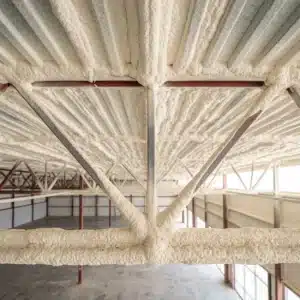
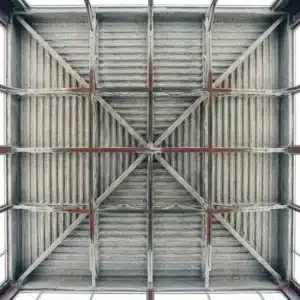
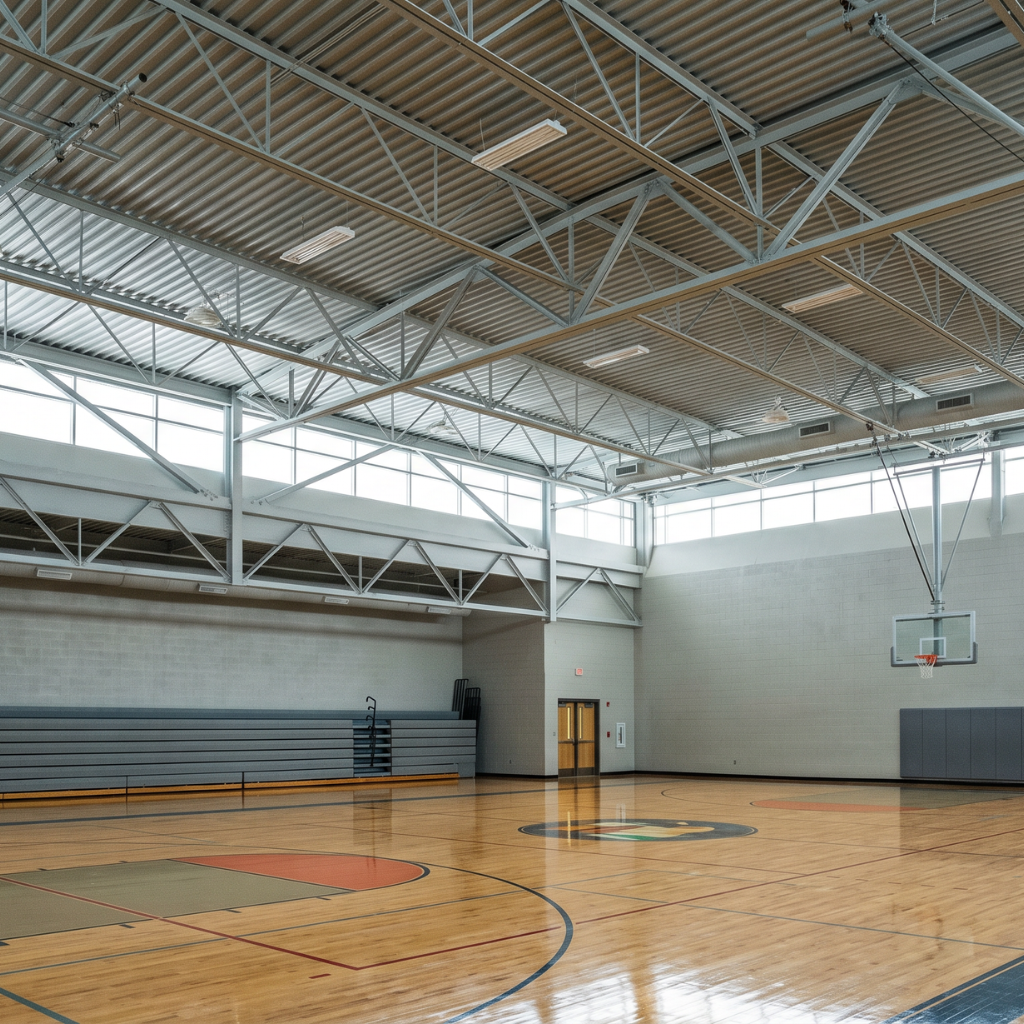
The school gymnasium is the single most common application I see for K-13 in K-12 buildings across Texas, Oklahoma, Kansas, Nebraska, Minnesota, and Wisconsin. The geometry is consistent across districts: ribbed metal deck spanning between bar joists or wide-flange purlins, structural steel painted or fireproofed depending on the construction type, ceiling height between 22 and 28 feet, hard reflective floor and walls. The product sprayed at 1.5 inches into the ribbed metal deck flutes delivers the maximum NRC the cellulose can produce, with a textured surface that reads as a finished architectural ceiling rather than as visible insulation.
Color selection matters more in a school gym than it does in most commercial buildings, because the ceiling is part of the school’s identity. Light gray and white are the most common school selections because they reflect light from the gym fixtures and keep the space from feeling cave-like. Tan and gray work well in gyms with wood floors and warmer color palettes. Black is occasionally specified to make the ceiling visually disappear, which is an aesthetic choice rather than a functional one. Custom color matching to school colors is available but adds to the per-square-foot installed cost.
For natatoria and indoor pool decks, the application logic is similar but the moisture environment is more aggressive. K-13 in those applications should be specified after consultation with the manufacturer’s technical group on the specific environmental conditions. For weight rooms, dance rooms, and fitness rooms attached to the gym, the cellulose insulation typically continues across the same ceiling plane to maintain a consistent acoustic and visual treatment.
K-13 in Cafeterias, Classrooms, and Multipurpose Rooms
School cafeterias have the same acoustic problem as gyms, just at a smaller scale. Hard reflective surfaces, parallel walls, and a high concentration of bodies producing speech and dish noise generate reverberation that makes lunchroom announcements unintelligible and turns conversation into shouting. Cafeteria ceilings are typically lower than gym ceilings, around 12 to 16 feet, and the deck above is more variable: some cafeterias sit under concrete deck, some under metal deck, some under suspended tile that can be removed. The product specified at 1.5 to 2 inches on whatever the actual structural deck is brings the cafeteria reverberation down into a range where ordinary conversation works without rising voice.
Multipurpose rooms that double as cafeteria and assembly space, which are common in elementary schools to save square footage, are an even more demanding acoustic case because the same room has to support both lunch service and morning assembly. The cellulose finish sprayed across the full ceiling plane at the upper end of the practical thickness range gives the acoustic consultant the room to tune the rest of the surfaces.
Classroom applications for K-13 are less common in new construction because most new classrooms are designed with suspended acoustical tile ceilings, which deliver acoustic absorption and run conduit and lighting in the same plane. The product shows up most often in classroom spaces during high-school renovation projects where suspended tile is being removed for an open-to-structure aesthetic, or where the existing building has structural conditions that make tile installation impractical. In those cases, spray-applied cellulose directly on the underside of the deck provides acoustic and thermal performance in one application without needing a separate ceiling system.
Covered exterior learning spaces, breezeways, and outdoor PE pavilions are an underappreciated application. The product is rated for covered exterior environments per the manufacturer’s published basic-use description, which means it can be applied in semi-enclosed school spaces that would not tolerate suspended tile.
IBC Chapter 8 Compliance: K-13 as Interior Finish in Group E
K-13 is governed by IBC Chapter 8 as an interior finish material, not by Chapter 7 as a fire-resistive assembly. That distinction drives the entire compliance analysis. Per IBC 2021 Table 803.13, the interior wall and ceiling finish requirements for Group E (which is grouped with B, M, and R-1 in the table) are Class B for interior exit stairways and ramps, Class C for corridors, and Class C for rooms and enclosed spaces in sprinklered buildings. For nonsprinklered Group E buildings, the requirements escalate to Class A for stairways, Class B for corridors, and Class C for rooms.
K-13’s flame spread index of 5 and smoke developed index of 5 produce a Class A rating per ASTM E84. Class A satisfies every cell in the IBC (2021) Table 803.13 (Section 803.11 in the 2015 edition) row for Group E, sprinklered or not. That is the cleanest part of the compliance case in a school: the product is more than sufficient under IBC Chapter 8 for any location in a K-12 school building, including the most restrictive nonsprinklered exit stairway condition.
The two installation provisions that matter for K-13 are §803.15 and §808.1.1.2. IBC §803.15 covers the application of interior finish materials on walls, ceilings, or structural elements that are required to be of fire-resistance-rated or noncombustible construction. The general rule under §803.15.1 is that the finish material must be applied directly against the rated construction or to furring strips not exceeding 1-3/4 inches. When the ceiling is dropped or set out farther than that 1-3/4 inch threshold, §803.15.2 requires Class A finish materials, which the product satisfies. IBC §808.1.1.2 covers acoustical ceiling systems that are part of fire-resistance-rated construction and requires that they be installed in the same manner as the assembly tested. The cellulose finish is not part of any UL-listed fire-resistance-rated assembly under IBC (2021) Table 601. It is the exposed ceiling finish below the rated assembly. The fire-resistance rating sits with the SFRM applied directly to the structural steel.
Sequencing: SFRM First, K-13 Second
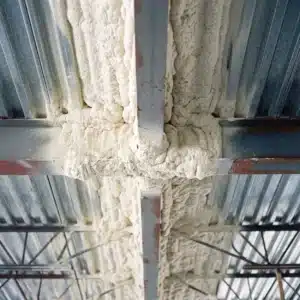
The single most important practical point for any school project that includes both fireproofing and K-13 is the sequencing rule. SFRM goes on the structural steel first, before the cellulose finish is applied as the exposed ceiling. This sequence is non-negotiable for three reasons. First, K-13 sprayed directly over unprotected structural steel does not create a fire-resistance-rated assembly. The steel is unprotected regardless of what the ceiling looks like, and the building fails IBC (2021) Table 601. Second, once the cellulose is in place, the SFRM behind or beneath it is much harder to inspect, patch, or verify against the ASTM E605 and ASTM E736 criteria that govern SFRM thickness, density, and adhesion under IBC (2021) Section 1705.15. Third, SFRM applied on top of K-13 is not a valid installation because the bond to the steel is compromised by the cellulose layer between.
For more on the SFRM side of the sequence, our school fireproofing guide covers IBC (2021) Table 601 ratings, NFCA 100 application requirements, and the occupied-building scheduling realities that affect any school project where both products are in scope. When Bahl Fireproofing handles both the SFRM and the K-13 work on the same project, sequencing is managed under one supervisor and one mobilization, which prevents the inspection-coordination problems that occur when separate trades own each scope.
Indoor Air Quality and GREENGUARD Gold for Schools
One of the strongest cases for K-13 in school applications is the indoor air quality credential. Per the current ICC technical data sheet, K-13 carries both UL GREENGUARD and UL GREENGUARD Gold certification. GREENGUARD Gold is the tier specifically developed for schools, healthcare facilities, and homes where children are present. It tests finished products for chemical emissions and sets stricter limits on total volatile organic compounds and individual contaminants than the standard GREENGUARD certification. Specifically, Gold caps total VOC emissions at 0.22 milligrams per cubic meter and formaldehyde emissions at 9 micrograms per cubic meter, compared to 0.50 mg/m³ TVOC under standard GREENGUARD.
The other IAQ-relevant specifications: K-13 contains no asbestos, no glass fibers, no mineral fibers, no silica dust, no PCBs, and no urea-formaldehyde resins per the manufacturer’s published material composition. The product is also CDPH/California Section 01350 compliant for emissions in classroom and office environments. For a school district pursuing CHPS (Collaborative for High Performance Schools) certification or LEED for Schools, K-13 delivers verifiable contributions toward the acoustic performance credit, the recycled content credit (greater than 80 percent pre-consumer cellulose), and the low-emitting materials credit. The product’s GREENGUARD Gold certification status should always be verified against the current UL GREENGUARD listing for the project’s submittal package, since manufacturer certifications are renewed periodically.
Cost Considerations for K-13 in School Applications
K-13 installed cost varies meaningfully across school project types. The drivers are accessibility, ceiling height, project size, and color selection. A new-construction school gym during the active build phase, with the lift access easy and the deck clear of MEP, typically falls into the lower end of the per-square-foot range. The same scope retrofit into an occupied school during summer break, with phased access and existing equipment to work around, sits at the upper end. Higher-than-standard thickness above 2 inches, custom color matching, and natatorium-style environmental specifications all add to the per-square-foot installed cost.
For school districts pricing K-13 against suspended acoustic tile alternatives in renovation projects, the comparison should account for the fact that K-13 delivers acoustic, thermal, and finish performance in a single application, while a tile system needs a grid, tile, often a vapor retarder above, and separate insulation. The Related Reading section below points to our cost and acoustic control article for the per-square-foot ranges in more detail, with the caveat that all 2025 to 2026 pricing should be confirmed for the specific project at bid time.
Frequently Asked Questions
Is K-13 fire-resistant? K-13 carries a Class 1, Class A rating under ASTM E84 with a flame spread index of 5 and a smoke developed index of 5. That is a surface burning classification, not an hourly fire-resistance rating. K-13 cannot substitute for SFRM or any other fire-resistive assembly required under IBC (2021) Table 601 or Chapter 7.
What NRC does K-13 deliver in a school gym? At 1.5 inches on a 1.5-inch ribbed metal deck (the most common school gym substrate), K-13 delivers NRC 1.05 per ASTM C423. Solid backing substrates require additional thickness to reach equivalent NRC values, with K-13 at 4 inches on solid backing reaching NRC 1.05.
Is K-13 safe for use in schools where children spend time? K-13 carries UL GREENGUARD Gold certification, which is the tier specifically developed for schools, healthcare facilities, and homes with children. The product contains no asbestos, glass fibers, mineral fibers, silica dust, urea-formaldehyde resins, or PCBs per the manufacturer’s published material composition.
Can K-13 be applied directly over fireproofed steel? Yes. The standard sequence is SFRM first on the structural steel to satisfy IBC (2021) Table 601, then K-13 over the deck and exposed surfaces as the architectural finish. K-13 should never be applied over unprotected steel that requires a IBC (2021) Table 601 rating, because it does not provide fire resistance and the building would fail inspection.
What R-value does K-13 deliver? K-13 delivers R-3.7 per inch under ASTM C518. At 1 inch the assembly R-value is 3.7, at 1.5 inches it is 5.55, at 2 inches it is 7.4, and the thickness can be increased without mechanical support up to 5 inches for an unsupported R-value of 18.5.
What colors are available for K-13? The standard color palette includes black, gray, light gray, white, and tan, with custom color matching available at a price premium. Most school gyms specify light gray or white for light reflectance, while tan and gray are common in spaces with warmer palettes.
Does K-13 require a topcoat or sealer? K-13 is applied as a finished product with a natural cellulose texture and does not require a topcoat or sealer for performance. The published surface burning, NRC, and durability values are for K-13 as installed, without additional coatings.
How does K-13 compare to suspended acoustical tile in a school gym? K-13 delivers comparable or better NRC at a substantially higher ceiling location, eliminates the suspended grid that can be damaged by errant balls in a gym, and provides thermal insulation that suspended tile does not. Suspended tile remains the right choice for classrooms with regular plenum access requirements and easier replacement.
Key Takeaways
K-13 is an interior finish, not a fire-resistive material
- ASTM E84 Class A is a surface burning rating, not an hourly fire-resistance rating
- IBC Chapter 8 governs K-13; Chapter 7 governs SFRM
- K-13 cannot substitute for SFRM on structural steel that requires a IBC (2021) Table 601 rating
Acoustic performance is substrate-specific and thickness-specific
- 1.5 inches on 1.5-inch ribbed metal deck delivers NRC 1.05 per ASTM C423
- Solid backing requires more thickness (4 inches) to reach NRC 1.05
- Always specify substrate and thickness together, not NRC alone
ANSI/ASA S12.60 is the school acoustic benchmark
- Part 1 sets RT60 ≤ 0.6 seconds and background noise ≤ 35 dBA for core learning spaces
- Part 4 covers gymnasium and PE space acoustics
- Children require +15 dB SNR to match adult word recognition at +6 dB
IBC (2021) Table 803.13 compliance for Group E is straightforward
- Sprinklered: Class B stairways, Class C corridors, Class C rooms
- Nonsprinklered: Class A stairways, Class B corridors, Class C rooms
- K-13 at Class A satisfies every Group E location and condition
Sequencing is non-negotiable
- SFRM applied to structural steel first to satisfy IBC (2021) Table 601
- MEP rough-in below the protected steel
- K-13 applied last as the exposed ceiling finish
- Single contractor for both scopes simplifies inspection coordination
Indoor air quality credentials are documented
- UL GREENGUARD Gold certified for chemical emissions
- TVOC ≤ 0.22 mg/m³, formaldehyde ≤ 9 µg/m³
- Contains no asbestos, glass fibers, silica dust, urea-formaldehyde, or PCBs
- CHPS and LEED for Schools acoustic and recycled content credits available
Related Reading
For projects pricing K-13 against budget alternatives, our K-13 cost and acoustic control article walks through the per-square-foot ranges and decision drivers across our service area. The K-13 insulation soundproofing article covers the acoustic principles in more depth for specifiers comparing absorption versus transmission control. For an example of K-13 in a similar code-sensitive building type where speech intelligibility matters, see our hospital acoustic insulation guide on K-13 for patient recovery environments.
Get a Bid for Your Next School Project
Bahl Fireproofing has applied K-13 in K-12 school gymnasiums, cafeterias, and classroom renovations throughout Texas, Oklahoma, Kansas, Nebraska, Minnesota, and Wisconsin since I started the company. If you are a general contractor pricing a school addition that needs both SFRM on the structural steel and K-13 on the gym ceiling, an architect specifying K-13 thickness against an acoustic consultant’s RT target, or a school district facilities manager planning a phased acoustic retrofit, we can walk through the substrate, the thickness specification, the color selection, and the sequencing with you before bid day. Call 512-387-2111, email ross@bahlfireproofing.com, or reach out through our contact page to schedule a project walk or request a bid. For more on K-13 specifications, application methods, and substrate compatibility across the educational, healthcare, warehouse, and data center markets we serve in Texas, see our K-13 spray-applied insulation service page.
This article provides general educational information about K-13 spray-applied cellulose insulation in K-12 school applications and is not a substitute for project-specific design or code analysis. Acoustic performance targets, interior finish classification requirements, and indoor air quality credentials vary by jurisdiction, building geometry, and the specific edition of the IBC and referenced standards in effect at your project location. A licensed architect or engineer must verify the assembly-specific requirements for each project, and the project acoustic consultant should confirm reverberation and background noise targets against the actual room geometry and use case. Always confirm code editions, certification status, and life-safety requirements with the local fire marshal and the authority having jurisdiction before relying on any reference in this article.