School fireproofing sits at the intersection of two pressures that don’t show up on most other commercial projects: a code section that treats the gym, the cafeteria, and the auditorium differently from how the rest of the world treats assembly spaces, and an occupancy schedule where the building is full of students nine months a year. This article walks general contractors, district facility managers, and architects through what the IBC actually requires for K-12 educational buildings, how Group E classification changes when a space is associated with educational uses, and how SFRM application gets sequenced when most of the work has to happen during a ten-week summer window.
TLDR: K-12 schools are classified as Group E under IBC §305 and most are built as Type IIA noncombustible steel, which requires one-hour fire-resistance protection on the structural frame per IBC (2021) Table 601. The biggest planning issues for school fireproofing are the §303.1.3 rule that lets associated assembly spaces stay within Group E, the 12,000 square foot fire area trigger for sprinklers under §903.2.3, and the simple fact that SFRM application has to be timed around the school year. Higher education classrooms are Group B, not Group E, which changes the analysis entirely.
Code note: unless otherwise stated, code references on this page are to the 2021 International Building Code. Code adoption is state and local. Across the states we serve, adopted IBC editions currently range from the 2012 edition to the 2024 edition, some states have no statewide commercial building code, and several enforce NFPA 1 or NFPA 101 rather than the International Fire Code. Minnesota and Wisconsin publish state-amended code books whose numbering and requirements differ from the model code. This is general technical information, not a code determination for your project. Confirm the adopted edition and any local amendments with your authority having jurisdiction.
What Counts as a School Under the IBC
IBC §305.1 defines Educational Group E as the use of a building or structure, or a portion thereof, by six or more persons at any one time for educational purposes through the 12th grade. That language matters in two ways. First, it stops at 12th grade, which means colleges, universities, technical schools for adult learners, and most career training centers are classified as Group B (Business), not Group E. The fire-rating analysis, sprinkler thresholds, and corridor requirements all change when the occupancy shifts to Group B. Second, the “through the 12th grade” framing pulls in elementary schools, middle schools, high schools, kindergartens, and most preschools serving children older than two and a half years. Daycare for children under two and a half years rolls into Group I-4 instead.
The reason I’m spending time on this distinction is that I’ve watched general contractors quote a school project assuming Group E and then discover the building is actually a community college campus that should have been priced as Group B. The construction type assumptions, the structural frame ratings, and the sprinkler analysis can all shift when that misclassification surfaces during plan review. Confirm the occupancy with the architect or the AHJ before pricing the fireproofing scope.
Does a School Gymnasium Need to Be Fireproofed Like an Assembly Space?
A school gymnasium that is used for educational purposes associated with the school stays classified as Group E under IBC §303.1.3, which means the structural steel above the gym follows the same IBC (2021) Table 601 ratings as the rest of the school building rather than separate Group A assembly requirements. The exact code language is that “a room or space used for assembly purposes that is associated with a Group E occupancy is not considered a separate occupancy.” That covers PE classes, school assemblies, intramural games, and pep rallies.
The nuance code commentary draws out is that §303.1.3 only applies when the assembly use is genuinely associated with the school’s educational function. If the gym is regularly rented out for weekend craft fairs, public concerts, community basketball leagues open to non-students, or other uses that go beyond the Group E educational program, the space crosses into Group A territory and has to be analyzed separately for occupancy classification, fire ratings, and separations. The same logic applies to school cafeterias used as community event venues and school auditoriums that double as town meeting halls. Verify with the architect what the actual programmed use of each space is, because that determines whether §303.1.3 covers it or not.
Construction Type and IBC Table 601 Ratings for Schools
Most K-12 school buildings in Texas, Oklahoma, and Kansas are built as Type IIA or Type IIB construction. Both types are noncombustible, which means the structural frame is steel, masonry, or concrete with fire-retardant-treated wood permitted only in limited locations. The difference between IIA and IIB comes down to fire-resistance ratings on the structural elements per IBC (2021) Table 601.
| Element | Type IA | Type IB | Type IIA | Type IIB | Type IIIA | Type IIIB |
|---|---|---|---|---|---|---|
| Primary structural frame | 3 hours | 2 hours | 1 hour | 0 hours | 1 hour | 0 hours |
| Floor construction | 2 hours | 2 hours | 1 hour | 0 hours | 1 hour | 0 hours |
| Roof construction | 1.5 hours | 1 hour | 1 hour | 0 hours | 1 hour | 0 hours |
| Exterior bearing walls | 3 hours | 2 hours | 1 hour | 0 hours | 2 hours | 2 hours |
A Type IIA school requires one-hour fire-resistance protection on the structural frame, which is where SFRM comes in. A Type IIB school requires no protection on the structural frame from IBC (2021) Table 601 alone, though other code sections such as Chapter 7 fire barriers, Chapter 10 corridor requirements, or §704.10 exterior structural members can still trigger ratings on specific assemblies. Even when IBC (2021) Table 601 reads zero hours, individual columns or beams supporting fire-rated walls, shaft enclosures, or rated horizontal assemblies still need protection consistent with those assemblies. The structural engineer’s plan notes and the architect’s life safety drawings tell you which steel needs SFRM and which does not.
Sprinkler Thresholds That Change the Fireproofing Conversation
IBC §903.2.3 requires an automatic sprinkler system in Group E occupancies under two conditions. First, throughout all Group E fire areas greater than 12,000 square feet. Second, throughout every portion of educational buildings below the lowest level of exit discharge serving that portion of the building, with an exception that waives the basement sprinkler requirement when every classroom in the building has at least one exterior exit door at the level of exit discharge. Most modern schools easily exceed 12,000 square feet of Group E fire area, which means most are sprinklered throughout under NFPA 13.
When the building is fully sprinklered under NFPA 13, the corridor fire-resistance rating in IBC (2021) Table 1020.2 (Table 1020.1 in the 2018 and earlier editions) drops to zero hours for Group E corridors regardless of occupant load. Without sprinklers, Group E corridors serving more than 30 occupants typically require one-hour rated corridor walls. Some local jurisdictions amend this trade-off, so confirm with the AHJ whether the local code preserves or removes the corridor rating waiver for sprinklered Group E.
SFRM Products Specified for School Structural Steel
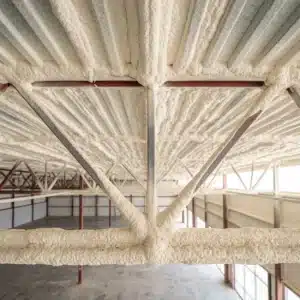
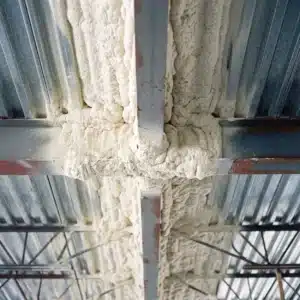
For concealed steel above ceiling lines in Type IIA schools, the standard product is Isolatek CAFCO 300 or its commercial equivalent. CAFCO 300 is a gypsum-based wet-mix commercial-density SFRM that carries UL 263 fire-resistance ratings up to four hours on floor assemblies, beams, columns, joists, and roof assemblies. Most schools require one-hour or two-hour ratings, so the actual installed thickness on a typical wide-flange column or beam is well below the maximum the product can deliver.
For semi-exposed conditions, including gymnasium underdeck, mechanical rooms, and elevator shafts where the steel may face indirect contact or limited physical abuse, CAFCO BLAZE-SHIELD HP is the medium-density Portland cement-based product I specify most often. It carries UL Investigated for Exterior Use designation, which means it can stay exposed during construction without an enclosing finish, and it meets the IBC bond strength requirement of 430 psf referenced for buildings in the 75 to 420 foot height range. For full exterior exposure or genuinely high-abuse environments, CAFCO BLAZE-SHIELD II is the Portland cement dry-mix product with the broadest exterior listing.
K-13 spray-applied insulation is a frequent companion specification in school gymnasiums and cafeterias as an exposed ceiling finish for acoustic and thermal performance. K-13 is not a fire-resistive material and does not substitute for SFRM on the structural frame. When a school gym needs both fire protection on the steel and acoustic absorption on the underside of the deck, the SFRM goes on first as the rated assembly and the K-13 follows as the exposed finish.
Occupied-Building Installation: The Real School Fireproofing Constraint
The biggest difference between a school SFRM project and almost any other commercial fireproofing scope is that the building has students in it nine months of the year. New construction handed over before the August move-in date is straightforward. Renovation, addition, and partial-floor SFRM work on an occupied campus is what compresses the schedule into the ten to twelve weeks of summer break, and what forces phasing decisions that affect the bid.
NFCA 100, the National Fireproofing Contractors Association Standard Practice for the Application of Sprayed Fire-Resistive Material, sets the operational baseline for SFRM installation. NFCA 100 requires a minimum of four complete air exchanges per hour in enclosed areas during SFRM curing when natural ventilation is not sufficient. The same standard specifies that ductwork, piping, and suspended framing must not be installed until fireproofing is complete, and that SFRM on metal roof decks cannot begin until roofing is fully installed and construction roof traffic has ceased. On an occupied school renovation, all of these clauses interact with the school district’s facilities calendar and the general contractor’s summer phasing plan.
In practice, this means fireproofing in a partial-renovation scope on an occupied school typically gets sequenced into a single summer window with hard physical containment between the work zone and the rest of the building. The general contractor or construction manager has to provide power and water at the staging area, heat and weather protection during application and curing, communication of inspection results between floors, and clear ingress and egress for movable scaffolds. SFRM thickness and density verification under IBC (2021) Section 1705.15 follows ASTM E605, with bond strength to ASTM E736; AWCI Technical Manual 12-A is a widely used industry guide to those field tests. The school district’s facility maintenance team is often using the same building during the same window for floor refinishing, paint, and HVAC work, and the SFRM contractor’s schedule has to coordinate with all of it.
Texas, Oklahoma, and Kansas Considerations
Code adoption varies meaningfully across our service area, and assuming a uniform IBC edition is one of the easier ways to misprice a school project. Texas does not have a single statewide IBC for traditional commercial school construction. The state statutory baseline under HB 738 references the 2012 IBC, but most major Texas cities including Houston, Dallas, Fort Worth, Austin, and San Antonio have adopted more current editions independently with local amendments. Texas SB 1177, effective September 1, 2025, added AED inspection requirements to the scope of annual school fire safety inspections at public and private schools, requiring verification of working batteries and unexpired defibrillator pads with reporting to school administrators. Oklahoma adopted the 2018 IBC as the statewide minimum for commercial construction effective September 14, 2021. The OUBCC adopted the 2024 editions on January 13, 2026, and they take effect September 14, 2026. Kansas does not have a statewide commercial building code. Kansas cities adopt independently: Wichita and Sedgwick County are on the 2024 IBC, Overland Park moved to the 2024 IBC and 2024 IFC on July 1, 2026, and Topeka adopted the 2024 IBC effective April 14, 2026. Confirm the adopted edition with the Unified Government for Kansas City, Kansas. The Kansas State Fire Marshal enforces the Kansas Fire Prevention Code statewide for all occupied buildings, and that’s what governs school life-safety regardless of which IBC the local jurisdiction has adopted. For projects throughout Texas and Oklahoma, confirm the adopted edition with the AHJ before relying on any specific code section in this article.
Texas heat and humidity also matter for SFRM application timing, particularly on Gulf Coast school projects where summer humidity can sit above 80 percent for weeks. Curing times stretch, and the four-air-exchanges-per-hour ventilation requirement gets harder to meet in older school buildings with limited HVAC capacity. Build a contingency window into the schedule.
Frequently Asked Questions
Is fireproofing required on every steel beam in a school? Not necessarily. Whether a particular beam needs SFRM depends on the construction type per IBC (2021) Table 601, the building’s height and area calculations, and any Chapter 7 fire barriers or rated assemblies that pass through that beam. A Type IIB school with no rated walls penetrating the structural frame may need no SFRM at all. A Type IIA school requires one-hour protection on the entire primary structural frame.
How long does school SFRM take to install? Application rates vary by product, density, and geometry, but a typical school addition or renovation with 15,000 to 25,000 square feet of structural steel requiring one-hour SFRM can be completed in the ten to twelve week summer window when the GC sequences the work properly. The variable that drives schedule risk is access, not application rate.
Can SFRM be applied with students in the building? Yes, but only when the work zone is physically isolated from occupied spaces with hard containment, ventilation is engineered to prevent overspray and dust migration, and the school district approves the phased work plan. Most districts prefer to schedule SFRM during summer break specifically to avoid these complications.
What’s the difference between SFRM and K-13 in a school project? SFRM is the fire-resistive material that protects structural steel and contributes to IBC (2021) Table 601 ratings. K-13 is a spray-applied cellulose insulation that delivers acoustic and thermal performance but is not fire-rated and does not substitute for SFRM. Many school gym ceilings have both: SFRM on the steel, K-13 on the deck for acoustics.
Does sprinkler protection eliminate the need for SFRM? No. Active fire protection through sprinklers and passive fire protection through SFRM are separate code requirements that work together. Sprinklers can permit larger fire areas and change corridor ratings under IBC (2021) Table 1020.2, but they do not waive the structural frame ratings required by IBC (2021) Table 601 for the building’s construction type.
Who is responsible for special inspection of SFRM on a school project? The owner or owner’s agent retains a special inspection agency under IBC Chapter 17 to verify thickness and density per ASTM E605 and adhesion per ASTM E736, with AWCI Technical Manual 12-A as a widely used industry guide to those field tests. The SFRM contractor does not perform the special inspection; the contractor coordinates access and provides documentation.
What products do you typically specify for school fireproofing? For concealed structural steel in Type IIA schools, CAFCO 300 is the standard. For semi-exposed gym underdeck and mechanical rooms, CAFCO BLAZE-SHIELD HP. For full exterior exposure or genuinely high-abuse conditions, CAFCO BLAZE-SHIELD II. The actual product selection follows the architect’s specification and the UL Design referenced in the construction documents.
Are higher education buildings classified as Group E? No. IBC §305 defines Group E as educational use through the 12th grade. Colleges, universities, technical schools for adults, and most career training centers are classified as Group B (Business). The construction type, fire ratings, sprinkler thresholds, and corridor requirements all change when the occupancy is Group B instead of Group E.
Key Takeaways
Group E classification is K-12 only
- Use through 12th grade is Group E under IBC §305
- Higher education is Group B, not Group E
- Daycare for children under 2.5 years is Group I-4, not Group E
- Verify the occupancy with the architect before pricing the SFRM scope
Associated assembly spaces stay in Group E
- IBC §303.1.3 keeps gyms, cafeterias, and auditoriums within the school’s Group E classification when used for educational purposes
- Spaces regularly used for non-school events shift to Group A and require separate analysis
Construction type drives IBC (2021) Table 601 ratings
- Type IIA schools require 1 hour on the primary structural frame, floors, and roof
- Type IIB schools require no IBC (2021) Table 601 frame rating, though other code sections may still trigger SFRM on specific assemblies
- Type IIIA exterior bearing walls require 2 hours regardless of occupancy
Sprinkler thresholds are well-defined
- IBC §903.2.3 requires NFPA 13 sprinklers when Group E fire areas exceed 12,000 square feet
- Sprinklers also required throughout educational buildings below the lowest level of exit discharge with a limited exterior-exit-door exception
Occupied-building installation is the operational reality
- NFCA 100 §10.2 requires 4 air exchanges per hour in enclosed areas during SFRM curing
- ASTM E605 and ASTM E736 set the code criteria for SFRM thickness, density, and adhesion; AWCI Technical Manual 12-A is an industry field-test guide
- Most school SFRM work compresses into the 10 to 12 week summer break window
- Containment, ventilation, and inspection coordination are the GC’s responsibility per NFCA 100
Regional code variation matters
- Texas has no uniform statewide IBC for traditional school construction; major cities adopt independently
- Oklahoma adopted 2018 IBC as the statewide minimum effective September 14, 2021
- Kansas has no statewide commercial code; Wichita and Overland Park are on the 2024 IBC; verify Kansas City KS with the Unified Government
- Verify the adopted edition with the AHJ before relying on specific section references
Related Reading
For projects evaluating fireproofing budgets, our commercial fireproofing cost guide covers per-square-foot ranges for cementitious and intumescent systems across our Texas, Oklahoma, Kansas, Nebraska, Minnesota, and Wisconsin service area. The companion commercial fireproofing requirements article walks through the IBC framework that drives rating selection on any commercial occupancy. For school gymnasium and cafeteria acoustic scopes, the K-13 spray-applied insulation service page covers the typical NRC and thermal performance ranges.
Get a Bid for Your Next School Project
Bahl Fireproofing has applied SFRM to K-12 and college projects throughout Texas, Oklahoma, Kansas, Nebraska, Minnesota, and Wisconsin since I started the company. If you’re a general contractor pricing a Type IIA school renovation that has to fit inside a summer window, an architect specifying SFRM on a new educational campus, or a school district facility manager planning a phased fire protection upgrade, we can walk through the scope, the products, and the sequencing with you before bid day. Call 512-387-2111, email ross@bahlfireproofing.com, or reach out through our contact page to schedule a project walk or request a bid. For more on Bahl’s complete fireproofing capabilities across the educational, healthcare, warehouse, and data center markets we serve, see our fireproofing service page.
External references for the code sections discussed in this article: the 2021 International Building Code Chapter 3, the NFCA 100 Standard Practice for the Application of Sprayed Fire-Resistive Material, and the Isolatek CAFCO 300 product technical data.
This article provides general educational information about commercial fireproofing for K-12 educational buildings and is not a substitute for project-specific design or code analysis. Fire-resistance requirements vary by construction type, building height, area, occupancy, sprinkler protection, and the specific edition of the IBC adopted by your local jurisdiction. A licensed architect or engineer must verify the code framework and the assembly-specific requirements for each school project. Always confirm code editions, special inspection scope, and life-safety requirements with the local fire marshal and the authority having jurisdiction before relying on any reference in this article.