Choosing the wrong spray foam for a commercial building does not just waste money. It creates moisture problems, code compliance failures, and insulation that underperforms for the life of the structure. This guide breaks down exactly where closed-cell and open-cell spray foam belong in commercial construction, what the building code actually requires, and how to make the right call for your project in Texas, Kansas, or Oklahoma.
TLDR: Closed-cell spray foam delivers higher R-value per inch, acts as a vapor barrier, and adds structural rigidity. It belongs on roof decks, exterior walls, and moisture-sensitive assemblies. Open-cell foam costs less and absorbs more sound, making it the better choice for interior partitions. Most commercial projects use both. Read on for the building-type decision guide and IBC thermal barrier requirements that most contractors overlook.
The Real Question Behind “Closed-Cell vs. Open-Cell”
Here is what I have learned after 20 years of spraying foam in warehouses, data centers, cold storage facilities, and medical buildings across Texas, Kansas, and Oklahoma: the question is almost never “which one is better?” The question is “which one goes where?”
General contractors and facility managers call me all the time asking whether they should spec closed-cell or open-cell spray foam for their next commercial project. My answer is usually the same: you probably need both, applied in different locations for different reasons.
Closed-cell and open-cell spray polyurethane foam (SPF) are not interchangeable products. They have different densities, different R-values, different vapor characteristics, and different fire code implications. Using the wrong type in the wrong location leads to condensation damage, failed inspections, and energy performance that falls short of your design intent.
This comparison guide covers everything you need to make the right decision: verified technical specs, IBC (2021) Section 2603 thermal barrier requirements, installed cost ranges for 2025 and 2026, climate zone recommendations for our service territory, and a building-type decision matrix you can hand to your design team. For a broader overview of spray polyurethane foam types and applications, see our complete commercial spray foam insulation guide.
Code note: unless otherwise stated, code references on this page are to the 2021 International Building Code. Code adoption is state and local. Across the states we serve, adopted IBC editions currently range from the 2012 edition to the 2024 edition, some states have no statewide commercial building code, and several enforce NFPA 1 or NFPA 101 rather than the International Fire Code. Minnesota and Wisconsin publish state-amended code books whose numbering and requirements differ from the model code. This is general technical information, not a code determination for your project. Confirm the adopted edition and any local amendments with your authority having jurisdiction.
What Makes Closed-Cell and Open-Cell Spray Foam Different?
Cell Structure and Why It Matters
The core difference between closed-cell and open-cell spray foam comes down to cell structure. Closed-cell SPF contains billions of tiny cells that are fully enclosed and filled with a blowing agent gas. This creates a rigid, dense material that resists moisture, adds structural support, and delivers high thermal resistance per inch of thickness.
Open-cell SPF has cells that are intentionally left open, creating a soft, flexible material filled with air. It expands roughly 100:1 from liquid volume during application, compared to about 30:1 for closed-cell. That expansion rate makes open-cell foam excellent at filling irregular cavities and conforming to complex geometries. It also makes it a superior sound absorber.
Technical Specifications at a Glance
The following table compares the two foam types across the factors that matter most in commercial construction. All values are verified against manufacturer technical data sheets and industry standards from the Spray Polyurethane Foam Alliance (SPFA).
| Factor | Closed-Cell SPF | Open-Cell SPF |
|---|---|---|
| R-value per inch | R-6.0 to R-7.0 | R-3.5 to R-3.8 |
| Density | 1.7 to 2.0 lb/ft³ (standard); up to 3.0 lb/ft³ roofing grade | Approximately 0.5 lb/ft³ |
| Vapor permeance | Less than 1 perm at 1.5 to 2 inches (Class II vapor retarder) | 10 to 15 perms at 3.5 inches (vapor-permeable) |
| Structural contribution | Increases wall racking strength up to 300% per NAHB Research Center testing | None (soft and flexible) |
| Sound absorption (NRC) | Moderate | Greater than 0.80 (absorbs 80%+ of sound energy) |
| Expansion rate | Approximately 30:1 | Approximately 100:1 |
| Moisture resistance | High (closed cells reject liquid water) | Low (open cells can absorb and hold moisture) |
| Typical wall thickness | 2 to 3 inches | 3.5 inches |
| Typical roof deck thickness | 3 inches | 5.5 inches |
| Air sealing | Excellent | Excellent |
Both types provide outstanding air sealing when professionally installed. The U.S. Department of Energy estimates that envelope infiltration accounts for about 6% of the total energy consumed by commercial buildings, and about 21% of their heating and cooling energy. Spray foam of either type addresses this directly.
Which Is Better for a Commercial Building, Open Cell or Closed Cell Spray Foam?
Neither type is universally better. Closed-cell foam delivers higher R-value per inch, acts as a Class II vapor retarder, and adds structural strength, making it the standard choice for commercial roof decks, metal building exteriors, and moisture-sensitive environments. Open-cell foam is the right choice for interior partitions where sound control and lower installed cost matter more than vapor management.
The real answer depends on three factors: where the foam is going in the building envelope, what climate zone you are in, and what the building is used for.
Where Closed-Cell Spray Foam Excels Commercially
Closed-cell SPF is the default choice for any assembly that faces the exterior environment or needs moisture protection. This includes roof decks, exterior wall cavities in metal buildings, below-grade applications, and any facility with high interior humidity (food processing, cold storage, indoor pools).
The structural benefit also matters. That 300% increase in racking strength, documented by the NAHB Research Center, is significant for metal building panels that tend to loosen over time from thermal expansion and contraction cycles. Closed-cell foam bonds the panel to the framing and stiffens the entire assembly.
Where Open-Cell Spray Foam Makes Commercial Sense
Open-cell foam belongs on the interior side of the building, in locations where moisture drive is not a concern and where acoustic performance matters. Conference rooms, medical exam rooms, office partitions between tenant spaces, and interior demising walls are all ideal candidates.
Open-cell foam provides roughly twice the sound resistance of closed-cell in normal frequency ranges. Its NRC rating above 0.80 means it absorbs more than 80% of incident sound energy. For healthcare facilities, call centers, and multi-tenant offices, that acoustic advantage is worth the slightly lower R-value per inch.
Commercial Building Type Decision Guide
The following table covers the most common commercial building types in our service territory and the foam recommendation for each. This is based on the projects we complete across Texas, Oklahoma, Kansas, Nebraska, Minnesota, and Wisconsin, not textbook theory.
| Building Type | Recommended Foam | Key Reasoning |
|---|---|---|
| Metal buildings (walls and exterior) | Closed-cell | Prevents condensation on metal panels, adds structural support, provides vapor barrier |
| Metal building roof deck | Closed-cell | Highest R-value, wind uplift resistance, seamless moisture control |
| Interior office partitions | Open-cell | Superior sound absorption, cost-effective, vapor-permeable for interior use |
| Warehouse and distribution center | Closed-cell (exterior and roof) + open-cell (interior offices) | Hybrid approach is standard practice for large facilities |
| Cold storage and freezer | Closed-cell required | Moisture barrier is critical for refrigerated assemblies |
| Healthcare and medical facilities | Closed-cell (exterior) + open-cell (interior walls) | Vapor protection for the envelope, acoustic control for patient areas |
| Data centers | Closed-cell | Vapor and moisture protection for sensitive equipment environments |
| Food processing and high-humidity facilities | Closed-cell (minimum 2 inches) | Vapor drive control in humid interior environments |
The most common mistake I see on Texas and Oklahoma commercial projects is using open-cell foam on the exterior walls or roof deck of metal buildings. Metal surfaces experience dramatic temperature swings that cause condensation. Open-cell foam absorbs that moisture over time because it is vapor-permeable. The result is corrosion behind the foam, mold growth, and insulation that loses R-value as it gets wet. Closed-cell spray foam for commercial metal buildings is the only correct choice for those assemblies, regardless of climate zone.
Fire Code Compliance for Commercial Spray Foam
This section covers the IBC requirements that apply specifically to spray foam in commercial buildings. Most online guides written for residential projects skip these entirely, but they directly affect your project cost and inspection outcome.
IBC Section 2603.4: The Thermal Barrier Requirement
Spray foam thermal barrier requirements for commercial buildings are the most important code consideration for any SPF project, and they are almost entirely absent from competing content.
IBC (2021) Section 2603.4 requires that all foam plastic insulation, both closed-cell and open-cell, must be separated from the interior of a commercial building by an approved thermal barrier. The standard-compliant option is a minimum of 1/2-inch gypsum wallboard installed over the foam.
Alternative thermal barriers exist. Materials tested per NFPA 275 (Temperature Transmission Fire Test and Integrity Fire Test) can qualify. Intumescent coatings like DC315, tested per NFPA 286, UL 1715, UL 1040, or FM 4880, also meet the requirement in many jurisdictions.
The purpose of the thermal barrier is occupant safety. It delays involvement of the foam in a fire, providing critical egress time. This requirement applies to both foam types equally. It also adds cost to every commercial spray foam insulation project, so factor it into your budget from the start.
There are exceptions. Foam plastic that is part of a Class A, B, or C roof assembly does not require a thermal barrier. Certain applications in fully sprinklered buildings also have modified requirements under IBC (2021) Section 2603. IBC typically requires these standards; verify local requirements with a licensed professional.
ASTM E84 Surface-Burning Requirements
IBC (2021) Section 2603.3 requires that all foam plastic insulation achieve a maximum flame spread index (FSI) of 75 and a smoke-developed index (SDI) of 450 when tested per ASTM E84.
A more restrictive limit applies in specific locations. Foam plastic used in exterior wall assemblies per IBC (2021) Section 2603.5.4 must achieve an FSI of 25. The same stricter FSI of 25 applies to cooler and freezer wall applications under IBC (2021) Section 2603.4.1.2.
This distinction matters for cold storage and exterior wall projects. Verify that the specific spray foam product you are specifying meets the correct FSI limit for your application, not just the general threshold. Your spray foam contractor and the manufacturer technical data sheet should confirm compliance.
Cost Comparison for Commercial Projects (2025 to 2026)
Open-Cell vs. Closed-Cell: Installed Cost Ranges
All costs below are ranges that vary by project scope, thickness, geographic region, and market conditions. These figures reflect commercial pricing in our service territory for 2025 and 2026 projects.
| Factor | Open-Cell SPF | Closed-Cell SPF |
|---|---|---|
| Material cost per board foot | $0.40 to $0.75 | $1.00 to $1.75 |
| Installed cost per square foot (commercial thickness) | $1.50 to $3.50 | $3.00 to $5.00 |
| Thickness needed for R-21 wall | Approximately 5.7 inches | Approximately 3.2 inches |
| Separate vapor retarder required | Yes (in cold climates) | No (built-in at 1.5 to 2 inches) |
| Thermal barrier (IBC 2603.4) | Required | Required |
True Cost of Ownership: Why Closed-Cell Is Often More Economical
The per-board-foot price difference tells an incomplete story. When you compare commercial spray foam insulation cost per square foot at the same R-value target, the gap between closed-cell and open-cell narrows significantly.
Closed-cell requires less thickness to achieve the same R-value. For a wall assembly targeting R-21, open-cell needs roughly 5.7 inches of foam, while closed-cell needs about 3.2 inches. In commercial stud cavities, that thickness difference can matter.
Closed-cell also eliminates the need for a separate vapor retarder layer. In Kansas commercial projects (Climate Zones 4A through 5A), open-cell foam in exterior wall cavities requires a separate Class II vapor retarder on the warm side of the assembly. That means additional material, additional labor, and an additional inspection point. Closed-cell foam achieves less than 1 perm at 1.5 to 2 inches, qualifying as the vapor retarder itself.
Then there is the HVAC sizing benefit. When architects and engineers design HVAC systems for new commercial buildings using spray foam instead of fiberglass, the drastically reduced air infiltration load can allow smaller equipment specification. The savings are not just operational. On new construction, they can reduce the capital cost of mechanical systems.
Commercial payback for spray foam insulation typically falls in the 3 to 7 year range, depending on climate zone, energy rates, and building type.
Climate Considerations for Texas, Kansas, and Oklahoma
Climate zone determines which foam type performs best in each part of our service territory. This is field-tested guidance from projects across all three states, not generic national recommendations.
Texas (Climate Zones 1A through 3A: Hot and Mixed Humid)
Texas spans from Zone 1A (deep South Texas, very hot and humid) through Zone 3A (Dallas area, mixed humid). In hot-humid climates, moisture drives from the hot, humid exterior inward during the summer cooling season.
For exterior walls and roof decks: closed-cell is the standard. In Bahl’s Gulf Coast and Central Texas service areas, a minimum of 2 inches of closed-cell on exterior walls is non-negotiable for vapor control in commercial buildings. Below that thickness, you are not achieving a true Class II vapor retarder, and moisture drives inward during summer cooling.
For interior wall cavities in commercial office spaces: open-cell works well. It delivers R-13 of cavity fill at 3.5 inches, which is the cavity component of the steel-framed wall assembly in the opaque envelope table for Zones 1 through 4, and provides superior sound control at a lower installed cost.
Kansas and Oklahoma (Climate Zones 3A through 5A: Mixed to Cold)
Oklahoma spans Zones 3A through 4A. Kansas spans Zones 4A through 5A. In these colder climates, the dominant vapor drive reverses: warm, moist interior air pushes outward through wall assemblies during winter heating season.
I have seen Kansas commercial projects where the vapor retarder was omitted from open-cell wall assemblies. The result was moisture accumulation inside the wall cavity and subsequent mold growth on the sheathing. Closed-cell eliminates that risk because it serves as the vapor retarder. On Kansas commercial projects, this simplification is a significant practical advantage that reduces material cost, labor, and inspection complexity.
In Climate Zone 5, the continuous insulation component of the wall assembly requirement is substantial enough to make closed-cell especially efficient. Fewer inches of foam achieve higher R-values, leaving more cavity depth for other assembly components.
The Hybrid Approach in Commercial Projects
Most commercial projects Bahl completes use both foam types in the same building. This is the field reality that generic “pick one” comparison articles miss entirely.
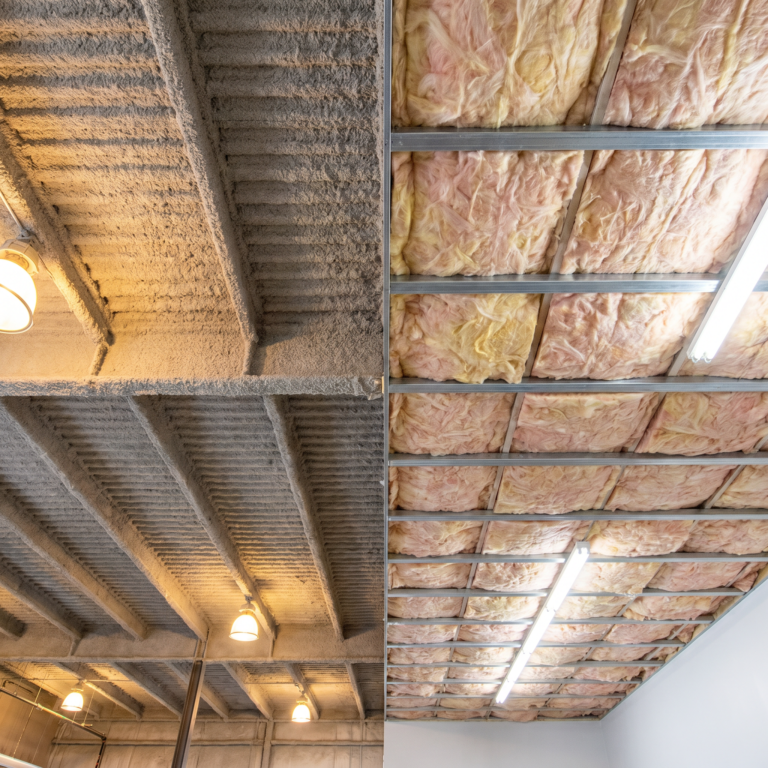
A typical Texas or Oklahoma warehouse project looks like this: closed-cell foam on the metal roof deck (3 inches for R-18 to R-21), closed-cell on exterior metal wall panels (2 to 3 inches for R-12 to R-21 plus vapor control), and open-cell in the interior office partitions and break rooms (3.5 inches for R-13 plus acoustic control). The exterior gets moisture protection and structural reinforcement. The interior gets sound control and lower cost.
For healthcare facilities, the same logic applies: closed-cell on the building envelope for vapor management, open-cell between patient rooms, exam rooms, and conference spaces for privacy and noise reduction. Understanding when to use spray foam for commercial metal buildings versus interior partition applications is what separates a good insulation specification from a costly mistake.
The Shift to HFO Blowing Agents: What Commercial Clients Need to Know
The spray foam industry completed a major transition in blowing agent chemistry that affects every closed-cell foam project. Under the AIM Act of 2020, the EPA finalized rules phasing out HFC blowing agents used in closed-cell SPF.
As of January 1, 2025, SPF manufacturers can no longer produce foam formulated with HFC blowing agents. Sales of existing HFC inventory can continue until January 1, 2028, but new production has stopped.
The replacement is HFO (hydrofluoroolefin) blowing agents. HFO-blown closed-cell foam has a global warming potential (GWP) of approximately 1, compared to approximately 1,000 for the old HFC formulations. That represents over a 99% reduction in climate impact per the SPFA’s HFO blowing agent update.
For commercial building owners and general contractors, the practical impact is minimal. HFO-era closed-cell foam delivers R-6.5 to R-7.0 per inch, comparable to former HFC products. Premium HFO formulations reach up to R-7.6 to R-8.1 per inch. Application methods, curing times, and contractor workflow remain the same.
The bigger implication is for LEED projects and sustainability-conscious clients. The HFO transition gives closed-cell spray foam a dramatically improved environmental profile that can contribute to green building certification credits.
Related Reading
Explore more about commercial spray foam insulation across our content library:
- For a complete overview of spray polyurethane foam types, applications, and specifications, see our closed-cell and open-cell spray foam guide.
- Working on an industrial or manufacturing insulation project? Read our guide on spray foam for industrial buildings.
- Want to understand the long-term ROI of commercial spray foam? See spray foam energy savings and comfort.
Neither Foam Passes NFPA 285 Alone: The Question Is Which Assembly
Everything above compares two foams against each other. An exterior wall asks something the foam choice cannot answer on its own. IBC (2021) Section 2603.5 reaches exterior walls containing foam plastic insulation in buildings of Type I, II, III or IV construction, of any height, and it also reaches multi-story cold storage buildings required to be of noncombustible construction. Inside that scope, IBC (2021) Section 2603.5.5 requires that the exterior wall assembly be tested in accordance with and comply with the acceptance criteria of NFPA 285.
The Listing Belongs to the Wall, Not to the Foam
NFPA 285 is the Standard Fire Test Method for Evaluation of Fire Propagation Characteristics of Exterior Wall Assemblies Containing Combustible Components, current edition 2025. The specimen is a two-story wall built the way it would be built on site, with cladding, insulation, air and water-resistive barrier, framing and window head detail all present. That makes it an assembly test rather than a product test. No closed-cell foam and no open-cell foam carries NFPA 285 compliance on its own, and pulling one component out of the tested build-up can void the listing for the whole wall.
So on a Type I through IV exterior wall, the comparison that decides the job stops being 2.0 pound closed cell against 0.5 pound open cell. It becomes which listed assembly you intend to build, and whether the foam you prefer already appears in it beside the cladding, barrier and window details the architect has drawn. A data sheet noting that a foam has been used in NFPA 285 assemblies proves nothing about the wall in front of you.
Two Surface-Burning Limits, Not One
IBC (2021) Section 2603.3 sets the general foam plastic limit at a flame spread index of 75 or less and a smoke-developed index of 450 or less. Exterior walls of Type I through IV buildings answer to IBC (2021) Section 2603.5.4 instead, which tightens flame spread to 25 or less at the same smoke limit, tested in the thickness intended for use up to 4 inches per ASTM E84 or UL 723. A foam that clears the general threshold can still miss the exterior wall one.
The interior side is separate again. IBC (2021) Section 2603.4 calls for an approved thermal barrier between the foam and the building interior: 1/2-inch gypsum wallboard, heavy timber complying with IBC (2021) Section 602.4, or a material meeting the acceptance criteria of both the Temperature Transmission Fire Test and the Integrity Fire Test of NFPA 275. Meeting that does nothing for 2603.5.5.
Where 2603.5.5 Stops
- Type V exterior walls. They comply with IBC (2021) Sections 2603.2, 2603.3 and 2603.4 only, so the NFPA 285 requirement never attaches to either foam type.
- Exception 1. One-story buildings complying with IBC (2021) Section 2603.4.1.4.
- Exception 2. Foam plastic covered on each face by not less than 1 inch of masonry or concrete, with either no airspace, or a flame spread index of 25 or less and an airspace not more than 1 inch.
Settle the construction type before you settle the foam, then ask the design team for the assembly listing that matches the wall being built. That determination belongs to your licensed architect or engineer and to the authority having jurisdiction.
Frequently Asked Questions
Q: Which is better for a commercial building, open cell or closed cell spray foam?
A: Neither is universally better. Closed-cell excels on exterior walls, roof decks, metal buildings, and moisture-sensitive environments. Open-cell is the right choice for interior partitions where acoustic control matters more than vapor management. Most commercial projects use both types in different locations within the same building.
Q: Is closed-cell spray foam required in commercial buildings?
A: Building codes do not require a specific foam type. However, closed-cell is typically the most practical choice in applications needing a vapor retarder (IBC (2021) Section 1404.3 (Section 1405.3 in the 2015 edition)), on metal building exteriors where condensation is a risk, and in cold storage facilities where moisture control is critical. The project conditions, not the code, drive the foam selection.
Q: Do both types of spray foam need a thermal barrier in commercial spaces?
A: Yes. IBC (2021) Section 2603.4 requires all foam plastic insulation to be separated from the building interior by an approved thermal barrier: 1/2-inch gypsum wallboard, heavy timber per IBC (2021) Section 602.4, or a material meeting the acceptance criteria of both the Temperature Transmission Fire Test and the Integrity Fire Test of NFPA 275. The SPFA guidance document SPFA-126 is a useful industry reference on thermal and ignition barriers, but it is not the code criterion. This applies to both closed-cell and open-cell foam equally. Exceptions exist for certain roof assemblies and fully sprinklered buildings.
Q: How much does commercial spray foam cost per square foot in Texas?
A: Installed commercial spray foam insulation cost per square foot in Texas typically ranges from $1.50 to $3.50 for open-cell and $3.00 to $5.00 for closed-cell at standard commercial thickness. Material costs, project size, access conditions, and thickness requirements all affect final pricing. Request project-specific quotes for accurate budgeting.
Q: Can I use open-cell foam on the exterior of a metal building?
A: No. Open-cell foam is vapor-permeable and will absorb moisture from condensation on metal panels. Metal buildings experience significant temperature swings that cause condensation on interior surfaces. Over time, open-cell foam in this application leads to moisture damage, corrosion, and degraded insulation performance. Always use closed-cell foam on metal building exteriors.
Q: What R-value should commercial spray foam achieve?
A: The required wall value comes from the opaque envelope table in the edition your jurisdiction adopted, which is the 2015 IECC in Texas and a 2006 IECC reference in Oklahoma and Kansas, and commercial steel-framed walls are stated as a cavity R-value plus a continuous insulation R-value, not as a single number. Roof deck assemblies typically target R-18 to R-30 depending on climate zone and local energy code adoption. Your project’s mechanical engineer specifies the target R-value based on the full assembly performance.
Q: What is the payback period for commercial spray foam insulation?
A: Commercial spray foam typically pays for itself in 3 to 7 years through reduced HVAC energy consumption. Payback depends on local energy rates, climate zone, building type, and baseline insulation being replaced.
Q: How does the HFO transition affect my commercial spray foam project?
A: As of January 1, 2025, manufacturers can no longer produce closed-cell foam using HFC blowing agents. The replacement HFO-blown foams deliver comparable R-values (R-6.5 to R-7.0 per inch) with over 99% less global warming potential. There is no performance penalty. The transition is complete and should not delay your project.
Key Takeaways
Closed-cell spray foam belongs on the outside of the building.
- Roof decks, exterior walls, metal building assemblies, and any moisture-exposed surface.
- Delivers R-6.0 to R-7.0 per inch and qualifies as a Class II vapor retarder at 1.5 to 2 inches.
- Adds up to 300% racking strength to wall assemblies per NAHB Research Center testing.
Open-cell spray foam belongs on the interior.
- Office partitions, conference rooms, medical exam rooms, and demising walls between tenant spaces.
- NRC above 0.80 provides superior acoustic control at a lower installed cost.
- Requires a separate vapor retarder in cold-climate exterior wall assemblies (Kansas Zone 4A through 5A).
Both types require a thermal barrier per IBC (2021) Section 2603.4.
- Minimum 1/2-inch gypsum wallboard or an NFPA 275-tested alternative.
- This requirement applies to both foam types in all commercial occupied spaces.
- Budget for this cost from the design phase, not as a field surprise.
Climate zone drives the recommendation in TX, KS, and OK.
- Hot-humid Texas (Zones 1A through 3A): Minimum 2 inches closed-cell on exterior walls for vapor control.
- Cold-climate Kansas (Zones 4A through 5A): Closed-cell eliminates the separate vapor retarder step.
- Hybrid approach (both types in one building) is standard practice for commercial projects.
The HFO blowing agent transition is complete.
- New closed-cell foam uses HFO agents with GWP of approximately 1, down from approximately 1,000.
- Performance unchanged: R-6.5 to R-7.0 per inch for standard HFO formulations.
- Relevant for LEED credits and sustainability-driven commercial clients.
Cost comparison requires full-assembly thinking.
- Closed-cell costs more per board foot but requires less thickness for the same R-value.
- Closed-cell eliminates the separate vapor retarder, reducing total assembly cost and inspection steps.
- HVAC right-sizing on new construction can offset the material cost premium.
- Typical commercial payback: 3 to 7 years.
If your next commercial project needs spray foam insulation that is specified correctly, applied by experienced professionals, and built to meet IBC requirements, let’s talk. We have been helping general contractors, architects, and facility managers across Texas, Kansas, and Oklahoma get the right foam in the right location for over 20 years. Contact Bahl Fireproofing at 512-387-2111 or email ross@bahlfireproofing.com to schedule a consultation or request a bid.
This article provides general educational information about spray foam insulation and commercial building applications. It is not a substitute for project-specific engineering, code analysis, or professional consultation. Building codes, material specifications, and installation requirements vary by jurisdiction, building type, and project conditions. Always consult with a licensed professional and your local authority having jurisdiction before making specification or purchasing decisions. Bahl Fireproofing is not responsible for decisions made based on general information provided in this article.