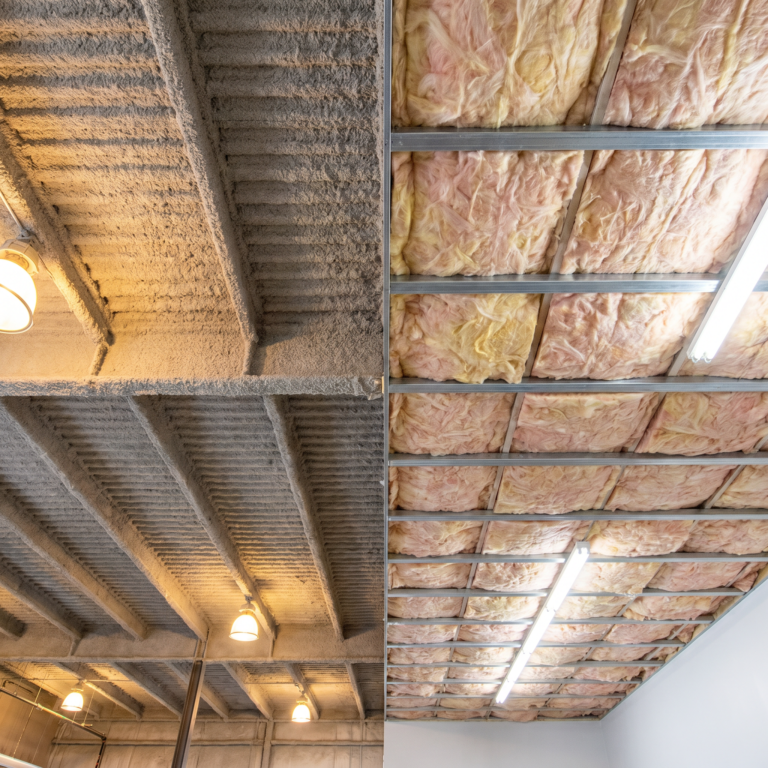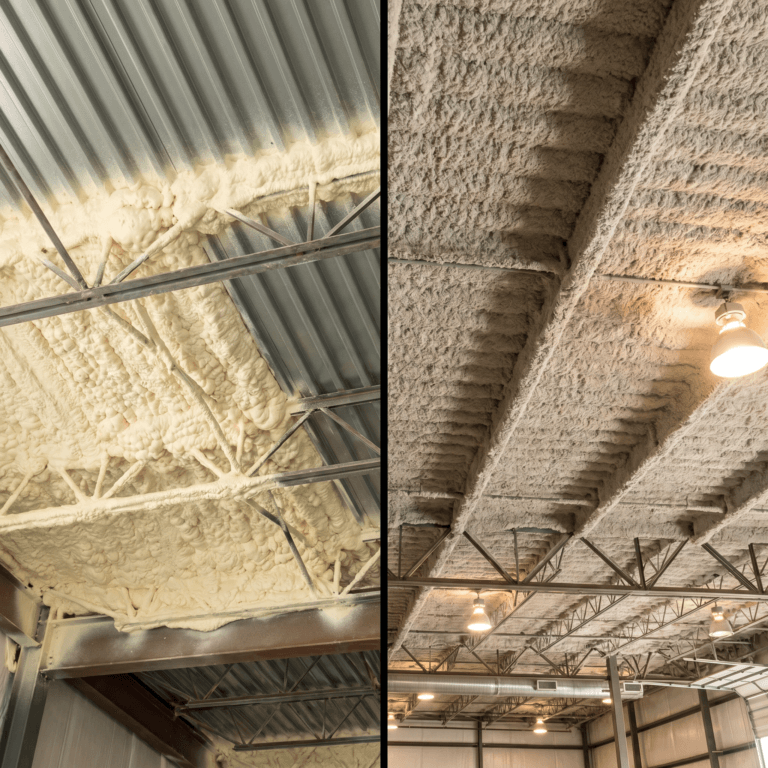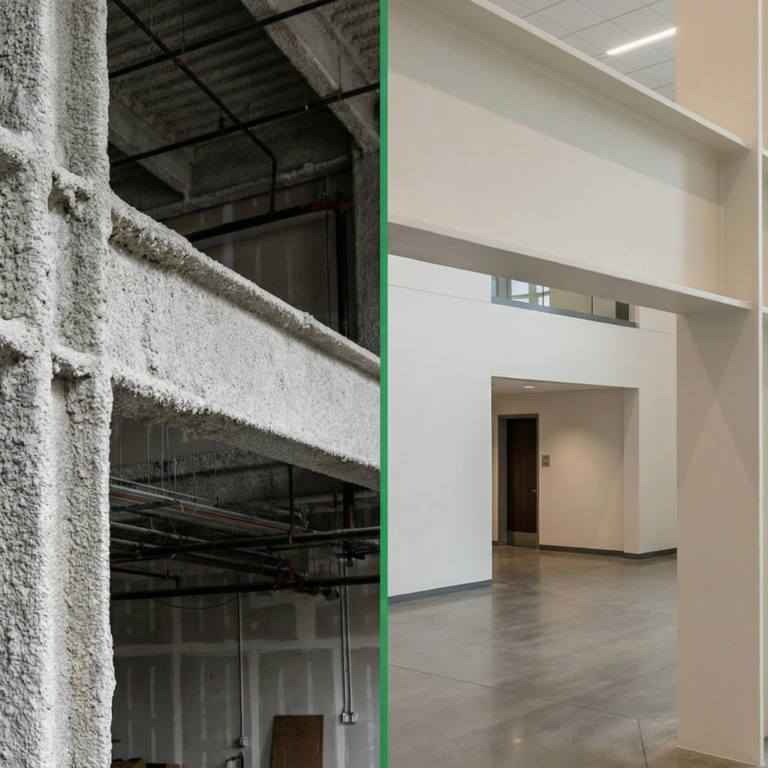
Fireproofing and fire retardant are not the same thing. They are governed by different IBC chapters, tested to different ASTM standards, applied to different building materials, and performed by different trades. If you are a building owner, general contractor, architect, or facility manager who has encountered both terms on a project and is not sure whether they overlap or are completely separate, this guide explains the distinction in plain language and connects it to the code requirements that determine which one your project actually needs.
TLDR: Structural fireproofing (SFRM) is applied to structural steel to achieve an hourly fire-resistance rating under ASTM E119, governed by IBC Chapter 7. Fire retardant coatings are applied to combustible materials like wood to reduce flame spread to a Class A rating under ASTM E84, governed by IBC Chapter 8. They measure completely different things. ASTM E84 measures how fast fire spreads across a surface. ASTM E119 measures how long a structural assembly holds up in a fire.
I get calls from building owners asking for “fire retardant spray” on structural steel at least once a month. What they actually need, and what the construction documents specify, is SFRM with a 1-hour or 2-hour ASTM E119 fire-resistance rating. The fire retardant product they found online achieves a Class A flame spread index on wood surfaces. It has no structural fire rating for steel and does not meet IBC (2021) Table 601 requirements.
That vocabulary confusion is not harmless. It creates wrong bids, failed inspections, and change orders that could have been avoided by understanding the difference before the spec goes out. In 20-plus years of applying spray-applied fireproofing on structural steel across Texas, Kansas, and Oklahoma, I have seen every version of this mix-up. This guide is designed to prevent the next one.
The Short Answer: They Are Not the Same Thing
Fireproofing and fire retardant are two separate systems governed by two separate IBC chapters, tested to two separate ASTM standards, and applied to two separate types of building materials. Fireproofing (SFRM and intumescent coatings) is applied to structural steel to achieve an hourly fire-resistance rating (1 hour, 2 hours, 3 hours) under ASTM E119. Fire retardant coatings and treatments are applied to combustible materials, primarily wood, to reduce surface flame spread to a Class A, B, or C rating under ASTM E84.
A fire retardant coating on wood does not create a structural fire-resistance rating. SFRM on steel is not specified for flame spread compliance under IBC Chapter 8, even though SFRM products are routinely tested to ASTM E84 and achieve Class A ratings. They serve different purposes under different code provisions for different building elements.
Why the Confusion Happens
The terminology overlap is the root of the problem. Both start with “fire.” Both involve coatings or sprays. Both are described as “protection.” And some manufacturers market intumescent coatings with language like “fire retardant paint” even though the product is actually a structural fire-resistive material with an ASTM E119 hourly rating.
The result is that building owners, facility managers, and even some GCs use the terms interchangeably in conversations, emails, and bid requests. A contractor who receives a request for “fire retardant spray on the structural steel” has to determine whether the owner means SFRM (which is what the code requires) or an actual fire retardant coating (which is a different product for a different substrate).
Five Terms You Need to Know
The IBC and NFPA use these terms with precise, distinct meanings. Understanding the five-term hierarchy clears up most of the confusion.
Combustible describes a material that will ignite and burn. Wood, paper, plastics, and most fabrics are combustible. You cannot make a combustible material non-combustible by applying a coating or treatment. Fire retardant treatment reduces flame spread, but the material underneath is still combustible.
Non-combustible describes a material that will not ignite, burn, or release flammable vapors when exposed to fire or heat. Steel, concrete, and masonry are non-combustible. But non-combustible does not mean fire-resistant. Steel retains only about 60 percent of its yield strength at 1,022°F (550°C), a temperature a standard building fire can reach within 10 to 20 minutes.
Fire retardant describes chemicals, coatings, and treatments applied to combustible materials to reduce their flame spread index. Fire retardant treated wood (FRTW) achieves a Class A flame spread index of 25 or less under ASTM E84. The treatment reduces how fast fire spreads across the surface. It does not create an hourly structural fire rating for the assembly.
Fire-resistant (or fire-resistance-rated) is the IBC term for the hourly fire ratings of structural elements. A fire-resistance rating is measured in hours (1, 2, 3, 4) based on ASTM E119 or UL 263 testing. It answers: how long will this assembly maintain structural integrity under fire? This is the performance standard behind SFRM and intumescent coatings on steel.
Fireproof is not a recognized IBC or NFPA category. The term does not exist in the building code. No building material is immune to fire. Steel is non-combustible but collapses structurally long before it melts. A 2-hour fire-resistance-rated column provides 2 hours of structural performance under ASTM E119 test conditions, not indefinite survival. The trade uses “fireproofing” as shorthand for structural fire-resistive materials, but informed specifiers use “fire-resistive.”
What Fire Retardant Coatings Actually Do
Fire retardant coatings are paints, sprays, or penetrant treatments applied to combustible materials, primarily wood products, to reduce the material’s flame spread index to Class A (FSI of 25 or less) per ASTM E84, the standard test for surface burning characteristics. Fire retardant treated wood (FRTW) is defined and specified under IBC (2021) Section 2303.2, with flame spread classifications governed by IBC Chapter 8. NFPA 703 is the separate industry standard governing fire retardant treated wood and fire retardant coatings for building materials.
When exposed to fire, fire retardant chemicals react with the combustible gases and tars generated by burning wood, converting them to a char layer that insulates the underlying material and slows flame spread across the surface. The result is reduced flame spread, not structural fire resistance.
Fire retardant treatment comes in two forms. Pressure-impregnated fire retardant treated wood (FRTW) is treated at an industrial plant under pressure, driving the chemicals deep into the wood fiber. This is the most durable form and is required by the IBC for many exterior applications. FRTW achieves an FSI of 25 or less per an initial 10-minute ASTM E84 test and shows no significant progressive combustion in an additional 20-minute ASTM E2768 extended test, meaning the flame front does not progress more than 10.5 feet from the centerline of the burners. Topically applied fire retardant coatings are field-applied sprays, paints, or brush-on products. In existing buildings, fire retardant coatings may be used to bring non-compliant interior finishes into compliance with flame spread requirements. Such applications must comply with NFPA 703, and the required properties must be maintained or renewed per manufacturer instructions. For new construction, interior finish materials must meet the required flame spread classification from the outset.
What fire retardant coatings do not do: they do not create an hourly structural fire rating for a beam, column, or floor assembly. They do not replace SFRM on structural steel. They do not meet the requirements of IBC Chapter 7 fire-resistance-rated construction.
What Structural Fireproofing (SFRM) Actually Does
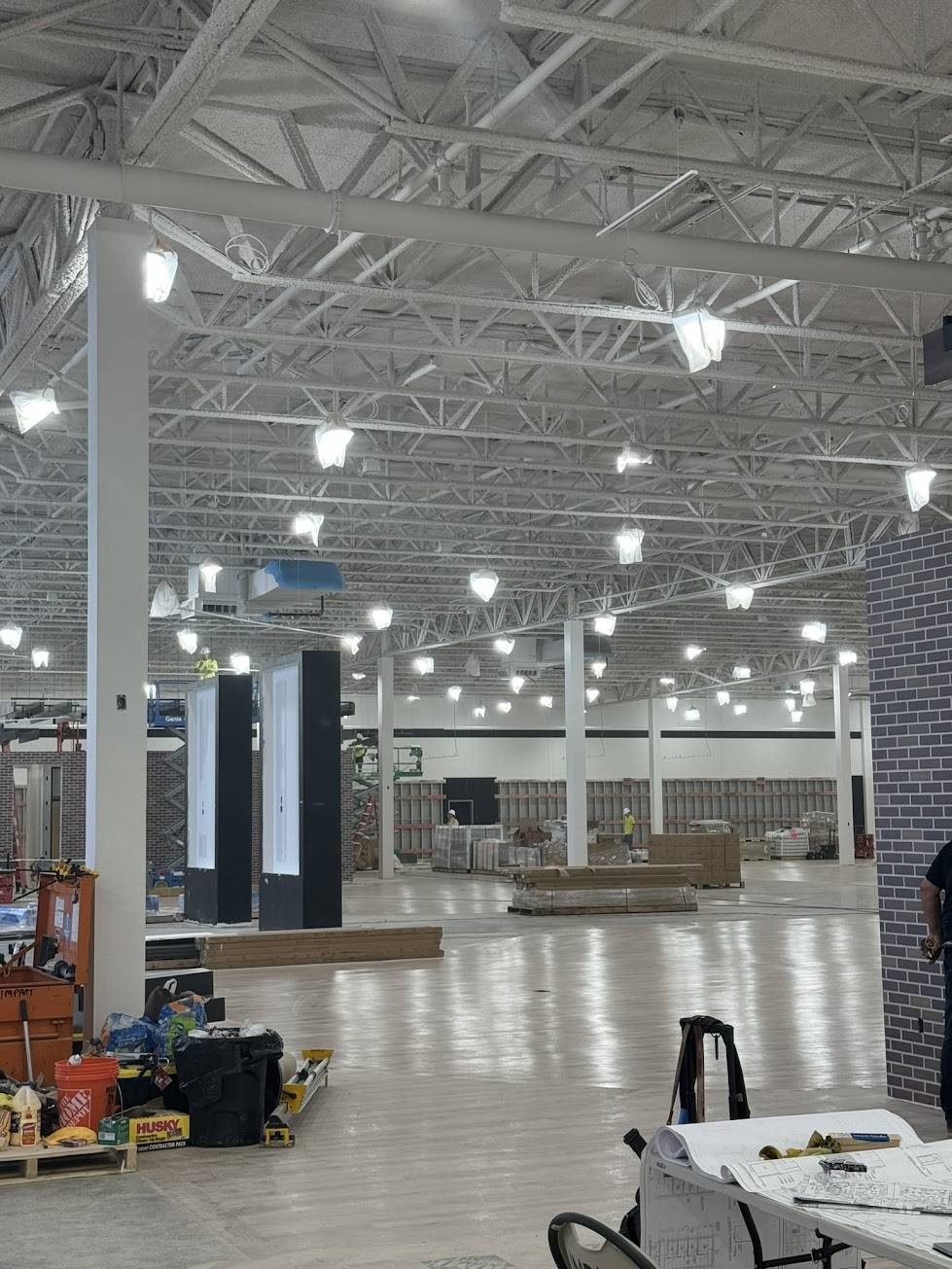
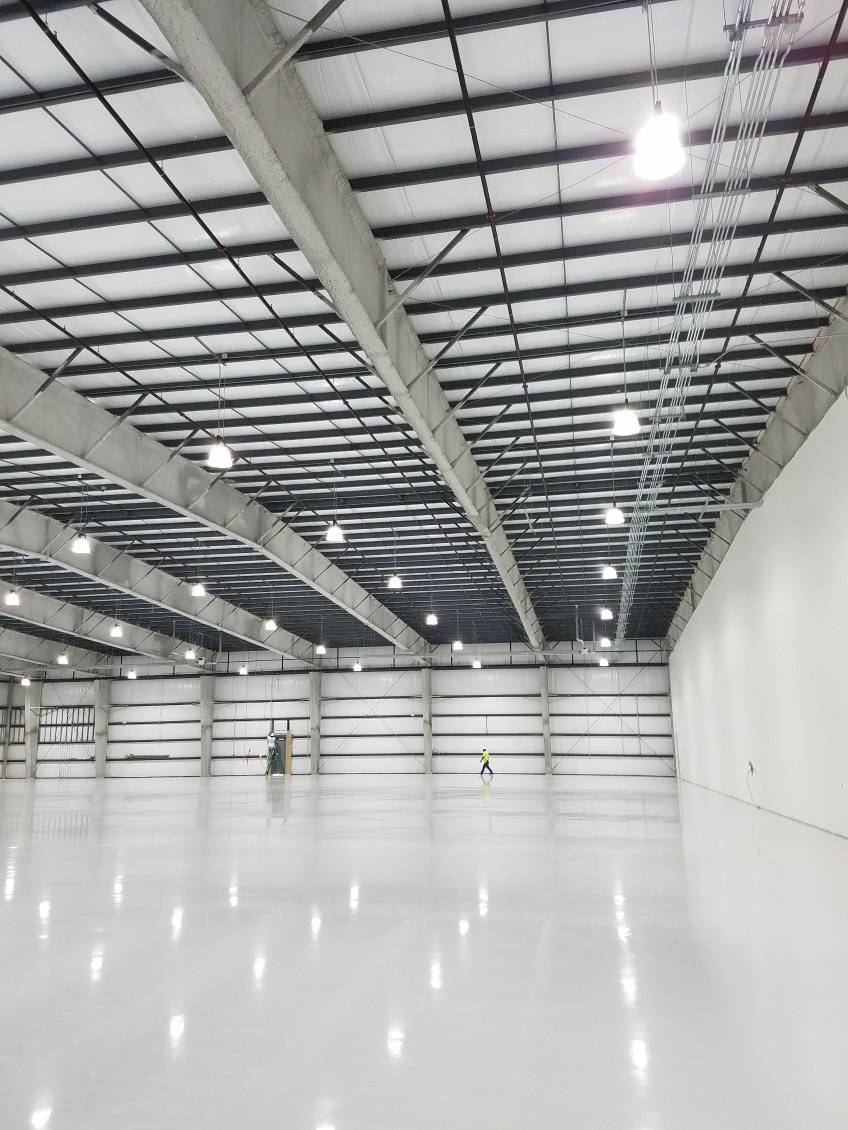
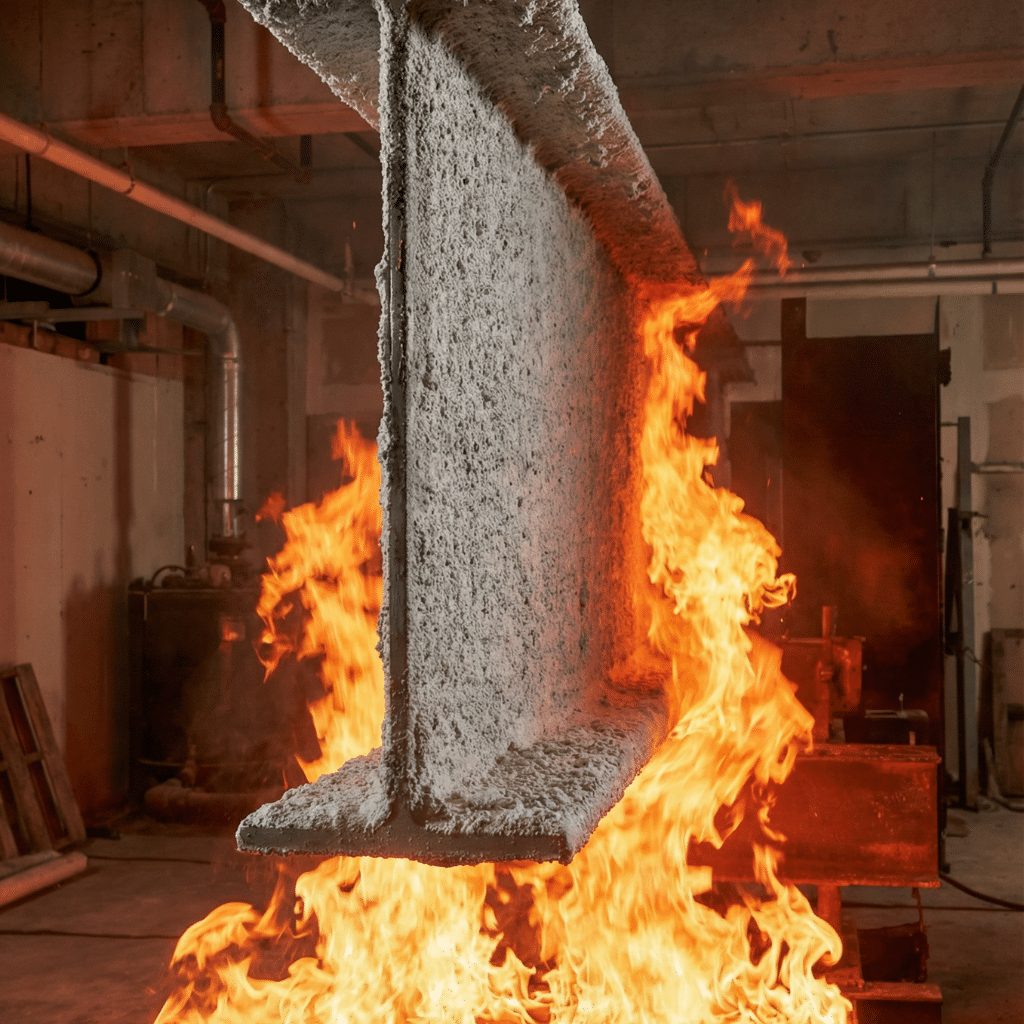
SFRM, which stands for spray-applied fire-resistive material, is applied to structural steel to achieve an hourly fire-resistance rating under ASTM E119 / UL 263. It works by thermal mass insulation: the SFRM absorbs and dissipates heat, slowing the rate at which the steel member reaches its critical failure temperature.
The product is applied at a specified thickness determined by the UL Design Assembly for the steel section’s W/D ratio (weight-to-heated-perimeter ratio) and the required fire rating. More hours means more thickness. SFRM is verified by special inspections under IBC (2021) Section 1705 for thickness, density, bond strength, and surface condition.
SFRM is governed by IBC Chapter 7 (fire-resistance-rated construction). It is classified by UL under CSI 07 81 00. It is not a fire retardant coating. It is a structural fire-resistance system that protects the building’s structural frame from collapse during a fire. For a complete technical overview, our spray-applied fireproofing guide covers the full SFRM specification process from product selection through inspection.
The Two IBC Chapters That Govern These Systems
This is the clearest way to understand the distinction. Fireproofing and fire retardant live in two completely separate sections of the building code, with different test standards, different rating systems, and different product categories.
| Dimension | IBC Chapter 7: Fire-Resistance-Rated Construction | IBC Chapters 8 & 23: Interior Finishes and FRTW |
|---|---|---|
| Test Standard | ASTM E119 / UL 263 | ASTM E84 / UL 723 |
| Rating Type | Hours (1, 2, 3, 4) | Class A, B, or C (flame spread index) |
| What It Measures | How long a structural assembly maintains integrity | How fast fire spreads across a surface |
| Products | SFRM, intumescent coatings (IFRM), fire-rated assemblies | Fire retardant coatings, fire retardant treated wood |
| Applies To | Structural steel, fire-rated walls, floor/ceiling assemblies | Interior finishes, wall coverings, wood surfaces |
| Governing Standard | IBC Chapter 7 (Sections 703-707), UL Design Assemblies, IBC (2021) Table 601 | IBC (2021) Section 2303.2 (FRTW), IBC (2021) Section 803 (flame spread) |
When construction documents specify “fire-resistance rating: 2-hour” on a structural steel column, that is a Chapter 7 requirement satisfied by SFRM or intumescent coating at the UL-listed thickness. When documents specify “interior finish: Class A” on a wood-paneled wall, that is a Chapter 8 requirement satisfied by fire retardant treated wood or a fire retardant coating achieving FSI of 25 or less per ASTM E84.
A contractor who quotes a “fire retardant spray” to satisfy a 2-hour structural rating is quoting the wrong product for the wrong code chapter.
Where Intumescent Coatings Fit (The Middle Ground That Creates Confusion)
Intumescent coatings are the category that causes the most confusion because they look like paint, are sometimes marketed as “fire retardant paint,” but are actually classified as intumescent fire-resistive materials (IFRM) providing hourly structural fire ratings under ASTM E119.
When an intumescent coating is applied to structural steel at the UL-listed dry film thickness for a given steel section and fire rating, it expands 15 to 50 times its dry film thickness depending on the product and fire conditions, forming a carbonaceous char that insulates the steel. This is structural fireproofing governed by IBC Chapter 7, not fire retardant surface treatment governed by Chapter 8.
The practical confusion: a building owner who sees “intumescent fire retardant paint” on a product website and interprets it as equivalent to a decorative fire retardant coating has made a dangerous misidentification. The paint-like appearance creates false equivalence with products that have no structural fire rating.
The rule is straightforward. Intumescent coatings on structural steel tested to ASTM E119 with UL-listed hourly ratings are structural fireproofing (IFRM). Fire retardant paints on wood or interior finishes tested to ASTM E84 with Class A/B/C ratings are surface flame spread treatments. Same-sounding chemistry, completely different regulatory scope and performance objective.
Three Real-World Scenarios Where Getting This Wrong Matters
Scenario 1: The “Fire Retardant Spray” Phone Call
A building owner calls asking for “fire retardant spray” on the structural steel in a new commercial building. They have seen a product online and want to know the price per square foot. What they actually need is SFRM with a 1-hour or 2-hour ASTM E119 rating. The fire retardant coating they found achieves Class A flame spread on wood surfaces. It has no structural fire rating for steel and does not satisfy IBC (2021) Table 601 requirements. The vocabulary confusion would have sent them down the wrong procurement path entirely.
Scenario 2: The Bid That Compares Apples to Oranges
A GC receives competing bids on structural fireproofing. One subcontractor quotes SFRM at $7 per square foot. Another quotes “fire retardant paint” at $2 per square foot. The second number looks attractive. But fire retardant paint applied to structural steel at 2 to 3 mils dry film thickness does not achieve an ASTM E119 structural fire rating. It achieves a surface burning characteristic rating for wood substrates. It will fail inspection under IBC (2021) Section 1705. The $2 number is not a cheaper alternative. It is a different product for a different purpose.
Scenario 3: The Renovation Where Both Apply
A historic downtown building renovation, comparable to adaptive reuse projects in Tulsa’s Deco District or Wichita’s Douglas Design District, might require both systems on the same project. The structural steel members need SFRM or intumescent coating to meet fire-resistance ratings under IBC Chapter 7. The exposed wood elements and decorative interior finishes need fire retardant treatment to meet flame spread requirements under IBC Chapter 8. Two separate trades, two separate specifications, two separate test standards, two separate inspections. Understanding how commercial fireproofing requirements work under IBC Chapter 7 helps the project team keep these two scopes properly separated.
Nothing Is Truly Fireproof: The Correct Terminology
The term “fireproof” is not a recognized IBC or NFPA category. It implies immunity to fire, which no building material has. Steel is non-combustible, meaning it will not ignite or burn, but without SFRM it fails structurally in 10 to 20 minutes under standard fire conditions. A 2-hour fire-resistance-rated column provides 2 hours of structural performance under ASTM E119 test conditions, giving occupants time to evacuate and firefighters time to work. It is not indefinitely immune to fire.
The code-correct terminology uses three distinct categories: non-combustible (will not ignite or burn), fire-resistant or fire-resistance-rated (will maintain structural or containment performance for a specified time), and fire retardant (will reduce surface flame spread on combustible materials). Using the right term in the right context is not pedantic. It determines which IBC chapter governs your product, which test standard applies, and whether the product you are specifying will actually pass inspection for the requirement you are trying to meet.
Frequently Asked Questions
Q: What is the difference between fireproofing and fire retardant?
Fireproofing (SFRM and intumescent coatings) is applied to structural steel to achieve an hourly fire-resistance rating (1, 2, 3, or 4 hours) under ASTM E119, governed by IBC Chapter 7. Fire retardant coatings and treatments are applied to combustible materials like wood to reduce surface flame spread to a Class A, B, or C rating under ASTM E84, governed by IBC Chapter 8. They are different products, different test standards, different trades, and different code requirements.
Q: Is fire retardant the same as fireproof?
No. “Fireproof” is not a recognized IBC or NFPA category. Fire retardant treatment reduces flame spread on combustible materials. It does not make a material non-combustible or fire-resistant. A fire retardant treated wood beam still has no hourly structural fire rating from the treatment alone.
Q: What does fire retardant mean in construction?
In construction, fire retardant refers to chemicals, coatings, or treatments applied to combustible building materials (primarily wood) to reduce their flame spread index per ASTM E84. Fire retardant treated wood (FRTW) achieves a Class A rating (flame spread index of 25 or less). FRTW is defined under IBC (2021) Section 2303.2, with flame spread classifications governed by IBC Chapter 8. NFPA 703 is the separate industry standard governing fire retardant treated wood and fire retardant coatings for building materials.
Q: Does fire retardant coating make steel fireproof?
No. Fire retardant coatings are designed for combustible materials like wood. They achieve ASTM E84 flame spread ratings, not ASTM E119 structural fire-resistance ratings. Structural steel requires SFRM or intumescent coatings (IFRM) to achieve an hourly fire-resistance rating. Applying a fire retardant wood coating to structural steel does not meet IBC (2021) Table 601 requirements and will not pass a special inspection under IBC (2021) Section 1705.
Q: What is the difference between ASTM E84 and ASTM E119?
ASTM E84 (the Tunnel Test) measures surface burning characteristics: flame spread index and smoke developed index. It produces Class A, B, or C ratings for interior finishes and surface materials. ASTM E119 measures fire resistance of structural assemblies: how long a floor, wall, column, or beam assembly maintains structural integrity under a standardized fire. It produces hourly ratings (1, 2, 3, 4 hours). They measure completely different performance properties.
Q: Is fire resistant the same as fire retardant?
No. Fire-resistant (or fire-resistance-rated) describes structural assemblies that maintain integrity for a rated time period under ASTM E119 testing. It is an IBC Chapter 7 requirement for structural steel. Fire retardant describes treatments that reduce surface flame spread on combustible materials under ASTM E84 testing. It is an IBC Chapter 8 requirement for interior finishes and wood products.
Q: What is fire retardant treated wood (FRTW)?
FRTW is wood that has been pressure-impregnated with fire retardant chemicals at an industrial plant. The treatment drives chemicals deep into the wood fiber, achieving a Class A flame spread index (FSI of 25 or less) per an initial 10-minute ASTM E84 test and showing no significant progressive combustion in an additional 20-minute ASTM E2768 extended test, meaning the flame front does not progress more than 10.5 feet from the centerline of the burners. FRTW is required by the IBC for many exterior applications. It is not the same as a topically applied fire retardant coating, which is a field-applied surface treatment with different durability characteristics.
Key Takeaways
Two Different Systems for Two Different Purposes
- Structural fireproofing (SFRM/IFRM) protects structural steel under IBC Chapter 7 with hourly ratings (ASTM E119)
- Fire retardant coatings protect combustible materials under IBC Chapter 8 with Class A/B/C ratings (ASTM E84)
- They are not interchangeable, and using the wrong one creates compliance risk
The Test Standard Tells You Which System You Need
- ASTM E84 measures how fast fire spreads across a surface (flame spread index)
- ASTM E119 measures how long a structural assembly holds up in a fire (hourly rating)
- A Class A fire retardant coating on wood has no structural fire-resistance rating
- SFRM on steel is not specified for flame spread compliance, even though SFRM products achieve Class A ratings when tested to ASTM E84
Intumescent Coatings Look Like Paint But Are Structural Fireproofing
- Intumescent coatings on structural steel tested to ASTM E119 are IFRM (structural fire-resistive material)
- Fire retardant paints on wood tested to ASTM E84 are surface treatments
- The paint-like appearance of both creates false equivalence for non-technical buyers
“Fireproof” Is Not a Real Code Category
- Non-combustible means the material will not ignite or burn (steel qualifies)
- Fire-resistant means the assembly maintains structural integrity for a rated time (SFRM achieves this)
- Fire retardant means the surface treatment reduces flame spread (for wood and combustible materials)
- No building material is immune to fire
Some Projects Need Both Systems
- A renovation with exposed structural steel AND decorative wood finishes may require SFRM on the steel (Chapter 7) and fire retardant treatment on the wood (Chapter 8)
- Two separate trades, two separate specifications, two separate inspections
Related Reading
- For a comprehensive overview of SFRM types, density categories, and the full specification process, our spray-applied fireproofing guide covers everything from product selection through inspection.
- Comparing cementitious SFRM against intumescent coatings for your project? Our cementitious vs. intumescent comparison covers when each system makes sense based on cost, aesthetics, and exposure conditions.
- Need to understand whether your building requires structural fireproofing and how the IBC code path works? Our commercial fireproofing requirements guide walks through the full decision chain from occupancy through IBC (2021) Table 601.
Make Sure You Are Specifying the Right System
If you are unsure whether your project requires structural fireproofing (SFRM), fire retardant treatment, or both, I would like to help you sort it out before the wrong product gets specified. Bahl Fireproofing applies both cementitious SFRM and intumescent coating systems on commercial projects throughout our Texas, Kansas, and Oklahoma service area. Get in touch with our team at 512-387-2111 or email ross@bahlfireproofing.com to discuss your project.
This article provides general educational information about fireproofing and insulation services. It is not a substitute for professional engineering, architectural, or code-compliance advice. Fireproofing specifications, code requirements, and installation methods vary by project, jurisdiction, and building type. Always consult a licensed professional for project-specific guidance. Bahl Fireproofing is not responsible for decisions made based solely on the content of this article.
Code note: unless otherwise stated, code references on this page are to the 2021 International Building Code. Code adoption is state and local. Across the states we serve, adopted IBC editions currently range from the 2012 edition to the 2024 edition, some states have no statewide commercial building code, and several enforce NFPA 1 or NFPA 101 rather than the International Fire Code. Minnesota and Wisconsin publish state-amended code books whose numbering and requirements differ from the model code. This is general technical information, not a code determination for your project. Confirm the adopted edition and any local amendments with your authority having jurisdiction.