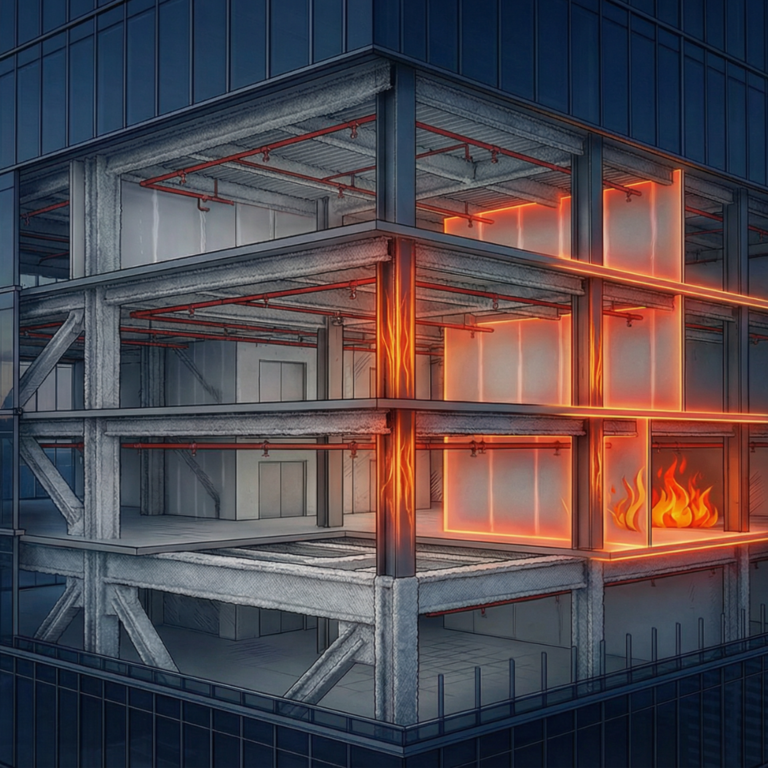
Fire ratings on structural steel is not a guarantee that the steel will survive a fire indefinitely. It is a time-defined performance standard: the number of hours a protected steel assembly maintained structural integrity under standardized furnace conditions per ASTM E119. If you are a general contractor, architect, specifier, or building owner trying to understand what a 1-hour, 2-hour, or 3-hour fire rating actually means, how the IBC assigns it, and how it translates to SFRM thickness on your specific steel sections, this guide walks through the full chain from code requirement to field application.
TLDR: Fire resistance ratings for structural steel are determined by IBC (2021) Table 601 based on the building’s construction type. Type I-A requires 3 hours for the structural frame (reduced to 2 hours for members supporting a roof only per Footnote a; roof structure is exempt entirely when 20 feet or more above any floor per Footnote b). Type I-B requires 2 hours. Type II-A requires 1 hour. Type II-B requires no rating. The required hour rating drives the SFRM thickness needed on each specific steel section through the W/D ratio (weight-to-heated-perimeter), which is why thickness varies across different beams on the same project.
Code note: unless otherwise stated, code references on this page are to the 2021 International Building Code. Code adoption is state and local. Across the states we serve, adopted IBC editions currently range from the 2012 edition to the 2024 edition, some states have no statewide commercial building code, and several enforce NFPA 1 or NFPA 101 rather than the International Fire Code. Minnesota and Wisconsin publish state-amended code books whose numbering and requirements differ from the model code. This is general technical information, not a code determination for your project. Confirm the adopted edition and any local amendments with your authority having jurisdiction.
Before we get into the code path and the math, one terminology point that matters. No building element and no SFRM product is “fireproof.” That term does not exist in the IBC, ASTM E119, or UL 263. The correct term is fire-resistant for a defined period. A 2-hour fire rating means the assembly maintained structural integrity for at least 2 hours under standardized furnace conditions. Steel does not melt in a standard building fire. It loses structural capacity long before that. SFRM exists to delay that loss of capacity for the time the code requires.
In 20-plus years of applying spray-applied fireproofing on commercial and industrial steel, I have worked on projects requiring every rating from 1 hour to 3 hours and occasionally 4-hour rated fire walls. Understanding what drives the hour rating, and how that hour rating translates to the actual SFRM thickness on each steel member, is the foundation of every fireproofing estimate I produce.
Why Structural Steel Needs Fire Protection
Structural steel is noncombustible. It will not ignite or feed flames. But it is highly thermally conductive, approximately 25 times more conductive than concrete. Under fire conditions, unprotected steel loses strength rapidly.
Strength loss begins around 572°F (300°C). At 752°F (400°C), yield strength has degraded significantly. At 1,022°F (550°C), steel retains approximately 60 percent of its room-temperature yield strength, the threshold most often cited as the critical point in fire resistance testing. Unprotected steel frames typically provide 20 to 30 minutes of fire resistance under standard ASTM E119 conditions, with small, fully loaded sections failing in as little as 12 minutes.
The ASTM E119 time-temperature curve, which is the standard fire test used in the United States, reaches 1,000°F at the 5-minute mark, 1,300°F at 10 minutes, 1,700°F at 1 hour, and 2,000°F at 4 hours. This is why unprotected steel fails so quickly. The fire curve reaches the critical steel temperature threshold within the first several minutes of a standard test.
The goal of SFRM is straightforward: delay the steel from reaching 1,100°F average or 1,300°F at any single thermocouple (for beams), or 1,000°F average and 1,200°F at any single thermocouple (for columns), long enough for the required fire resistance duration. The fire rating is simply how many hours the protected assembly achieves that before steel temperatures cross the threshold.
How the IBC Assigns the Hour Rating
The hour rating on your structural steel is not chosen arbitrarily. It flows from a specific IBC code logic chain that starts with how the building is used and ends at a specific row and column in IBC (2021) Table 601.
The chain runs: occupancy classification (IBC Chapter 3) determines the building’s hazard level. Height and area limits (IBC Chapter 5) determine which construction types are available. The assigned construction type (IBC Chapter 6) leads to IBC (2021) Table 601, which specifies the required fire-resistance rating in hours for each structural element.
For a complete walkthrough of how this code path works, including how sprinklers affect the calculation and how the construction type decision functions as a cost lever, our guide on commercial fireproofing requirements covers the full chain from occupancy through IBC (2021) Table 601.
IBC Table 601: The Complete Rating Chart
IBC Table 601 within Chapter 6 (Types of Construction) assigns minimum fire-resistance ratings (in hours) for building elements by construction type. The ratings are identical across the 2018, 2021, and 2024 editions of the IBC.
| Construction Type | Structural Frame | Bearing Walls (Exterior) | Bearing Walls (Interior) | Floor Construction | Roof Construction |
|---|---|---|---|---|---|
| Type I-A | 3 hr | 3 hr | 3 hr | 2 hr | 1.5 hr |
| Type I-B | 2 hr | 2 hr | 2 hr | 2 hr | 1 hr |
| Type II-A | 1 hr | 1 hr | 1 hr | 1 hr | 1 hr |
| Type II-B | 0 hr | 0 hr | 0 hr | 0 hr | 0 hr |
| Type III-A | 1 hr | 2 hr | 1 hr | 1 hr | 1 hr |
| Type III-B | 0 hr | 2 hr | 0 hr | 0 hr | 0 hr |
| Type V-A | 1 hr | 1 hr | 1 hr | 1 hr | 1 hr |
| Type V-B | 0 hr | 0 hr | 0 hr | 0 hr | 0 hr |
The legacy Type IV (HT) construction relies on mass timber charring rates rather than applied fireproofing. The 2021 IBC added IV-A, IV-B, and IV-C mass timber subcategories with their own fire-resistance requirements, which may involve protected assemblies. SFRM on mass timber is outside the scope of this article.
Two footnotes from IBC (2021) Table 601 have significant practical impact. Footnote a allows a 1-hour reduction in the structural frame rating for members supporting a roof only, meaning a Type I-A column that supports roof exclusively requires 2 hours, not 3. Footnote b exempts structural frame members in roof construction from any fire-resistance requirement when every part of the roof is 20 feet or more above any floor or mezzanine below.
One critical detail that many GCs miss: the structural frame and floor construction can have different required ratings within the same building. A Type I-A building requires a 3-hour structural frame but only a 2-hour floor construction rating. That means different SFRM thicknesses on different members in the same building, all using the same product. Understanding how IBC (2021) Table 601 fire resistance ratings map to your specific construction type and building elements is essential before any SFRM estimate can be accurate.
1-Hour Ratings: When They Apply
A 1-hour fire resistance rating for the structural frame is required in Type II-A, Type III-A, and Type V-A construction. In practice, Type II-A is the most common trigger for SFRM in Bahl’s service territory.
Type II-A applies to smaller commercial buildings, multi-story retail, schools under 55 feet, and any warehouse or industrial building that exceeds the Type II-B area or height limits for its occupancy classification. That transition from Type II-B (0 hours, no SFRM) to Type II-A (1 hour, SFRM required) is the threshold where the entire fireproofing scope enters the project budget.
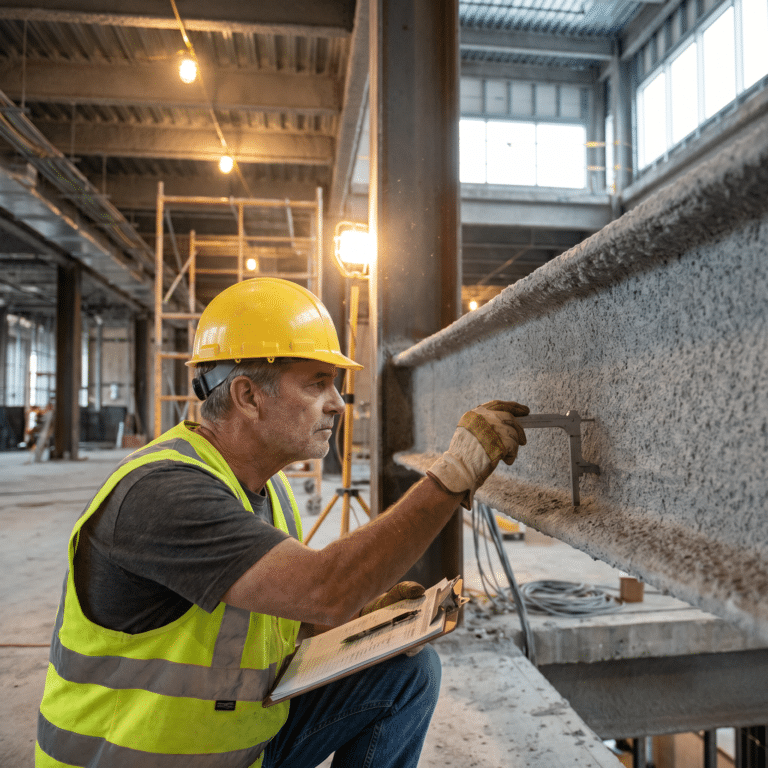
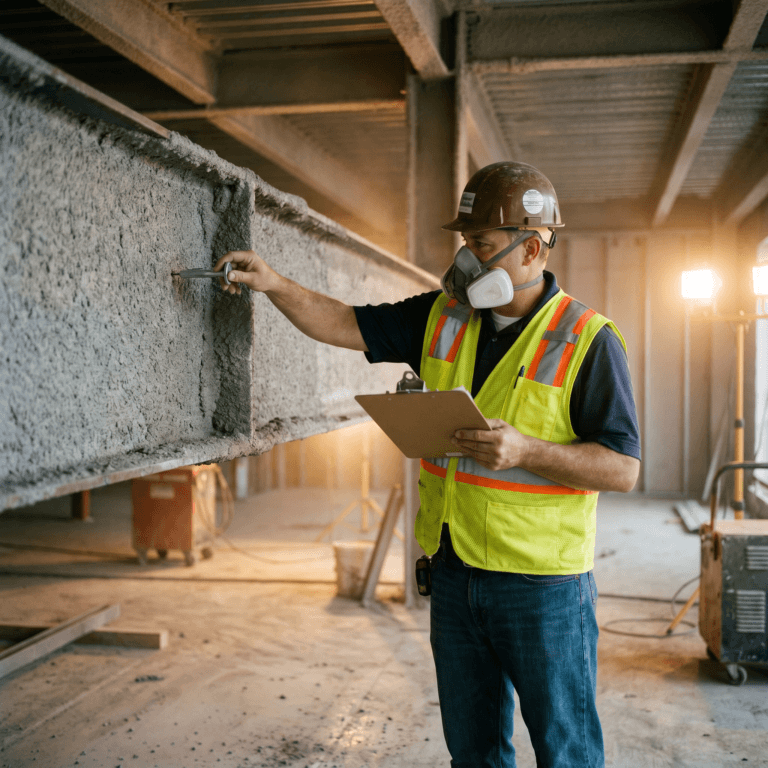
A 1-hour rating is the thinnest SFRM application in commercial construction. On a standard W16x26 beam, a 1-hour unrestrained rating requires approximately half an inch of commercial-density SFRM. On a heavier W24x55 beam, the same rating may require only three-eighths of an inch. The difference comes from the W/D ratio, which we will cover in detail below.
2-Hour Ratings: When They Apply
A 2-hour structural frame rating is required in Type I-B construction, the most common construction type for mid-rise commercial buildings. Type I-B is typical for mid-rise office towers, large hotels, healthcare facilities, and high-rise buildings up to approximately 420 feet.
The 2-hour rating is the specification I see most frequently in the Dallas-Fort Worth and Oklahoma City metro markets. The SFRM thickness for a 2-hour rating is roughly double what a 1-hour rating requires on the same steel section: approximately 1 inch on a W16x26 beam versus half an inch for 1 hour.
Type I-B also requires 2-hour floor construction, which means the floor beams (not just the structural frame) carry a 2-hour requirement as well. On a Type I-B project, the structural frame and the floor system both require the same SFRM thickness, which simplifies the application zones compared to Type I-A.
3-Hour Ratings: When They Apply
A 3-hour structural frame rating is required only in Type I-A construction, the highest fire-resistance category in the IBC. Type I-A is required or selected when the building’s size and occupancy exceed the height and area limits for Type I-B. In practice, this means large hospitals, major high-rise office towers, significant public assembly venues, and convention centers.
The 3-hour rating requires the thickest SFRM application in standard commercial construction. On a W16x26 beam, a 3-hour unrestrained rating requires approximately 2 inches of SFRM. On a heavier W24x55, it requires approximately 1 and 5/8 inches. The material and labor cost difference between a 1-hour and 3-hour application is substantial.
Type I-A also creates the most complex SFRM zoning on a project because the structural frame (3 hours), floor construction (2 hours), and roof construction (1.5 hours) all require different ratings. This means different thicknesses on different members on the same floor, all using the same product. Misidentifying which members are part of the structural frame versus which are filler beams in the floor assembly is one of the most common field errors on Type I-A projects.
4-Hour Ratings: The Rare Exception
4-hour ratings on structural steel are uncommon in standard IBC commercial construction. IBC (2021) Table 601 does not require a 4-hour structural frame rating for any construction type. The maximum in IBC (2021) Table 601 is 3 hours (Type I-A structural frame).
4-hour requirements come from other IBC sections, most commonly fire walls under IBC (2021) Section 706. Fire walls separating buildings or creating building area separations can require 3 to 4-hour ratings depending on occupancy and construction type. Special occupancies under local code amendments and industrial or petrochemical applications with performance-based fire engineering requirements can also trigger 4-hour ratings.
Products across the CAFCO line, including CAFCO 300 (commercial density), CAFCO 300 HS (high-strength commercial density for high-rise), and CAFCO 400 (medium density), are all classified for up to 4-hour ratings per UL, so the product capability exists. But if your project requires a 4-hour structural frame rating, verify the source of that requirement. It is unlikely to be IBC (2021) Table 601.
How the Hour Rating Translates to SFRM Thickness: The W/D Ratio
This is the mechanism that connects the hour rating to the actual thickness of SFRM on each steel member in your building. No competitor explains this, and it is the most practically useful information in this article for GCs and estimators.
What W/D Means
W/D is the weight-to-heated-perimeter ratio for a steel section. W is the weight per linear foot of the beam in pounds. D is the perimeter of the steel section exposed to the fire, measured in inches. The ratio tells you how much thermal mass the steel has relative to the surface area absorbing heat.
A larger W/D means more mass relative to the heated surface area. The steel heats more slowly and needs less SFRM. A smaller W/D means less mass relative to the heated perimeter. The steel heats faster and needs more SFRM to compensate.
How W/D Drives Thickness in Practice
The UL Design Assembly for a fire-resistance-rated assembly is tested on a specific beam at a specific thickness. Every other beam on the project is adjusted from that tested thickness based on its W/D ratio relative to the test beam.
For context, consider three beams at different W/D ratios under the same fire rating:
For a 1-hour unrestrained beam rating, a lighter W16x26 (W/D = 0.55) requires approximately half an inch of SFRM. A mid-weight W21x44 (W/D = 0.73) requires approximately 7/16 of an inch. A heavier W24x55 (W/D = 0.82) requires the minimum three-eighths of an inch, which is the floor for any SFRM application regardless of how favorable the W/D calculation is.
For a 3-hour rating on those same beams, the W16x26 requires approximately 2 inches. The W21x44 requires approximately 1 and 3/4 inches. The W24x55 requires approximately 1 and 5/8 inches.
That is why SFRM thickness varies across a building. It is not arbitrary. The UL Design establishes the test beam and tested thickness, and the W/D equation calculates the adjusted thickness for every beam in the actual project.
When I am reviewing a set of construction documents for a Type I-A building, the first thing I do is sort the steel members by their W/D ratio. That tells me where the thick application zones are and how to plan crew time. The W/D sort is the foundation of every accurate fireproofing estimate.
The UL Design Number
The hour requirement from IBC (2021) Table 601 leads to a UL Design Number, which is the specific tested assembly that must be followed. The Isolatek CAFCO product line and UL fire-resistance design references cover the full range of commercial, medium, and high density SFRM products classified for 1-hour through 4-hour ratings. Floor and ceiling assemblies are found in the D-series (D700 through D999), column designs in the X-series, and beam-only tests in the N-series. The UL Product iQ database is the primary reference where specifiers search by design number, hourly rating, or steel type.
Different Ratings on the Same Project: Why Thickness Zones Exist
This is the practical insight that most GCs miss on their first Type I-A project.
On a Type I-A building: structural frame = 3 hours, floor construction = 2 hours, roof construction = 1.5 hours. The IBC definition of the primary structural frame includes columns, girders, beams, and trusses having direct connections to columns. Filler beams that frame into girders but do not connect directly to columns are not part of the structural frame. They require the floor assembly rating (2 hours) rather than the structural frame rating (3 hours).
On a single Type I-A project, the columns and girders connected directly to columns get 3-hour SFRM thickness (approximately 2 inches on a typical W16x26). Filler beams in the floor assembly get 2-hour thickness (approximately 1 inch on the same beam). Roof-supporting steel gets 1.5-hour or 1-hour application.
This creates multiple SFRM thickness zones on the same floor plate, all using the same product but applied at different thicknesses. Misidentifying structural frame members versus filler beams is one of the most common field errors in SFRM application. If the estimator applies 3-hour thickness everywhere, the project is over-specified and the budget is blown. If 2-hour thickness gets applied to structural frame members, it is a code violation. The structural frame definition is the dividing line, and getting it right at the estimating stage is where the accuracy starts.
Restrained vs. Unrestrained: Why This Changes the Thickness
A single ASTM E119 fire test produces two separate ratings: a restrained assembly rating and an unrestrained beam rating. They represent different end-point criteria for the same test.
In a restrained condition, the surrounding structure resists thermal expansion of the beam during the fire. Most welded, bolted, or riveted steel frame construction in commercial buildings qualifies as thermally restrained. In an unrestrained condition, supports are free to rotate and expand during the fire, which is rare in standard steel-frame construction.
The unrestrained beam rating uses stricter temperature criteria: average steel temperature of 1,100°F or any single thermocouple reading of 1,300°F. The restrained assembly rating uses structural performance criteria: when the load can no longer be supported, or when temperature on the non-fire side exceeds acceptable limits.
Restrained ratings require less SFRM thickness than unrestrained ratings for the same hour duration because the structural restraint provides additional performance. Specifying the wrong restraint condition results in either over-specified thickness (costing money) or under-specified thickness (a code violation). Product technical data sheets list separate thickness columns for restrained and unrestrained conditions.
I have this conversation with structural engineers on almost every Type I-A project. Most steel frame construction is restrained, which means we can use the restrained thickness from the UL Directory instead of the conservative unrestrained thickness. The difference in material is real money on a large project. One important qualifier: restrained construction must be identified on the construction documents by the registered design professional per IBC (2021) Section 703.2.3. The contractor cannot assume restrained conditions independently. If the construction documents are silent on restraint, the conservative unrestrained thickness applies until the engineer of record confirms otherwise.
For a comparison of how different SFRM products and intumescent coatings achieve these ratings through different mechanisms, our cementitious vs. intumescent fireproofing guide covers when each system makes sense by fire rating, aesthetics, and exposure conditions.
Frequently Asked Questions
Q: What is a fire rating for structural steel?
A fire resistance rating is the number of hours a protected steel assembly maintained structural integrity under standardized furnace conditions per ASTM E119, the standard test method for fire tests of building construction and materials. A 2-hour rating means the assembly performed for at least 2 hours before the steel reached its critical failure temperature. The rating is a time-defined performance standard, not a guarantee of indefinite fire survival. No steel element is “fireproof.”
Q: What is the difference between a 1-hour and a 2-hour fire rating?
The difference is both the required duration of performance and the SFRM thickness needed to achieve it. A 1-hour rating requires less SFRM than a 2-hour rating on the same steel section. For example, a W16x26 beam requires approximately half an inch of SFRM for a 1-hour rating and approximately 1 inch for a 2-hour rating. The hour rating is assigned by IBC (2021) Table 601 based on construction type.
Q: When is a 3-hour fire rating required?
A 3-hour structural frame rating is required only in Type I-A construction under IBC (2021) Table 601. Type I-A applies to large hospitals, major high-rise office towers, significant public assembly venues, and buildings that exceed the Type I-B height and area limits. It is the most demanding fire resistance requirement in the standard IBC construction type system.
Q: How is the fire rating determined by IBC (2021) Table 601?
IBC (2021) Table 601 assigns minimum fire-resistance ratings based on the building’s construction type. The construction type is determined by the building’s occupancy classification (Chapter 3), height and area (Chapter 5), and material requirements (Chapter 6). Once the construction type is established, IBC (2021) Table 601 specifies the required hours for each structural element: frame, bearing walls, floor construction, and roof construction.
Q: What is the W/D ratio for structural steel?
W/D is the weight-to-heated-perimeter ratio. W is the beam’s weight per linear foot in pounds. D is the heated perimeter in inches. A higher W/D means the steel has more thermal mass relative to its exposed surface, heats more slowly, and requires less SFRM. A lower W/D means the steel heats faster and requires more SFRM. The W/D ratio is the primary variable that determines SFRM thickness on each specific steel section.
Q: What happens to structural steel in a fire?
Structural steel is noncombustible but loses strength rapidly when heated. Yield strength degrades significantly above 752°F (400°C). At 1,022°F (550°C), steel retains approximately 60 percent of its room-temperature strength, the threshold most often cited as the critical point in fire resistance testing. Unprotected steel typically provides 20 to 30 minutes of fire resistance under standard ASTM E119 conditions, with small, fully loaded sections failing in as little as 12 minutes. Steel melts at roughly 2,700°F per AISC, but it collapses structurally long before reaching that temperature.
Q: Is structural steel fireproof?
No. The term “fireproof” does not exist in the IBC, ASTM E119, or UL 263. Structural steel is fire-resistant for a defined period when properly protected with SFRM, intumescent coatings, or concrete encasement. The fire resistance rating specifies how many hours the protected assembly maintains structural integrity under standardized test conditions.
Key Takeaways
Fire Ratings Are Time-Defined Performance Standards
- A fire rating specifies how many hours a protected assembly maintained integrity under ASTM E119 furnace conditions
- No steel element is “fireproof”; the correct term is fire-resistance-rated
- SFRM delays steel from reaching its critical temperature (1,100°F average / 1,300°F maximum) for the required duration
IBC (2021) Table 601 Assigns the Hour Rating by Construction Type
- Type I-A: 3-hour structural frame (hospitals, major high-rises)
- Type I-B: 2-hour structural frame (mid-rise commercial, healthcare)
- Type II-A: 1-hour structural frame (smaller commercial, schools, warehouses exceeding II-B limits)
- Type II-B: 0-hour structural frame (no SFRM required)
- 4-hour ratings come from IBC (2021) Section 706 (fire walls) and special occupancies, not from IBC (2021) Table 601
The W/D Ratio Determines SFRM Thickness on Each Steel Section
- Higher W/D (heavier beams) = less SFRM needed
- Lower W/D (lighter beams) = more SFRM needed
- Minimum SFRM thickness is 3/8 inch regardless of W/D calculation
- This is why thickness varies across a building and why accurate estimating requires sorting steel by W/D
Different Elements on the Same Project Require Different Ratings
- Type I-A: structural frame = 3 hours, floor assembly = 2 hours, roof = 1.5 hours
- Structural frame members (direct column connections) require the frame rating
- Filler beams (not connected to columns) require the floor assembly rating
- Misidentifying these members is one of the most common field errors
Restrained vs. Unrestrained Affects Thickness and Cost
- Most commercial steel frame construction qualifies as thermally restrained, but restrained conditions must be documented on construction drawings by the engineer of record per IBC (2021) Section 703.2.3
- Restrained ratings require less SFRM than unrestrained ratings for the same hour duration
- Specifying the correct restraint condition avoids over-specification (excess cost) or under-specification (code violation)
Related Reading
- For a comprehensive overview of SFRM types, density categories, and the full specification process, our spray-applied fireproofing guide covers everything from product selection through inspection.
- Need to understand whether your building requires fireproofing at all? Our commercial fireproofing requirements guide walks through the full IBC code path from occupancy through IBC (2021) Table 601.
- Wondering how fire rating hours translate to installed cost per square foot? Our commercial fireproofing cost guide explains the six cost drivers that determine where your project lands.
Understand Your Fire Rating Requirements Before You Bid
If you are estimating a project and need to confirm the required fire-resistance ratings, how the W/D ratio affects SFRM thickness on your specific steel sections, or whether restrained or unrestrained conditions apply, I would like to hear about it. Bahl Fireproofing serves commercial construction projects throughout Texas, Oklahoma, Kansas, Nebraska, Minnesota, and Wisconsin with 20-plus years of SFRM specification and application experience. Get in touch to discuss your project at 512-387-2111 or email ross@bahlfireproofing.com.
This article provides general educational information about fireproofing and insulation services. It is not a substitute for professional engineering, architectural, or code-compliance advice. Fireproofing specifications, code requirements, and installation methods vary by project, jurisdiction, and building type. Always consult a licensed professional for project-specific guidance. Bahl Fireproofing is not responsible for decisions made based solely on the content of this article.