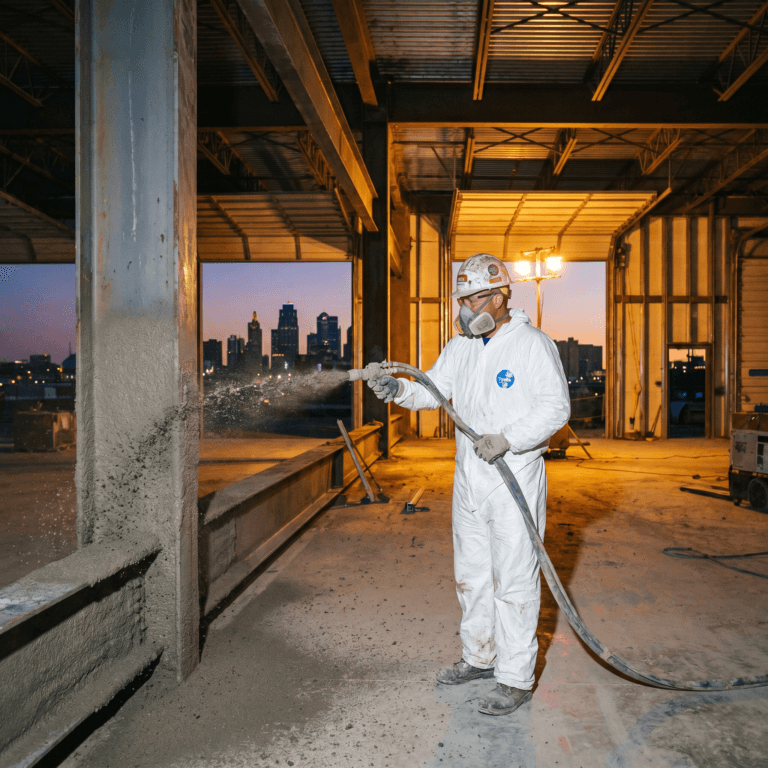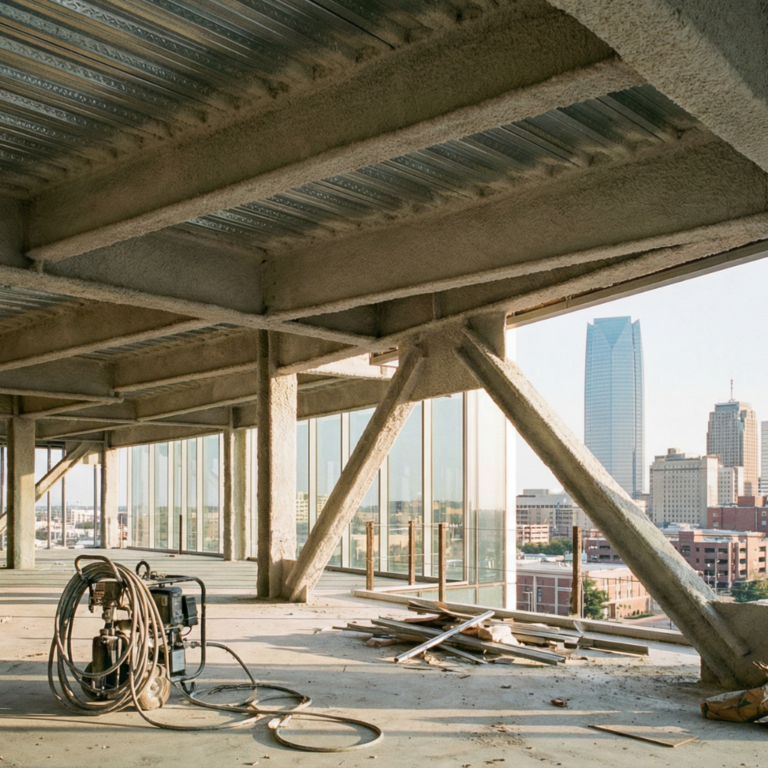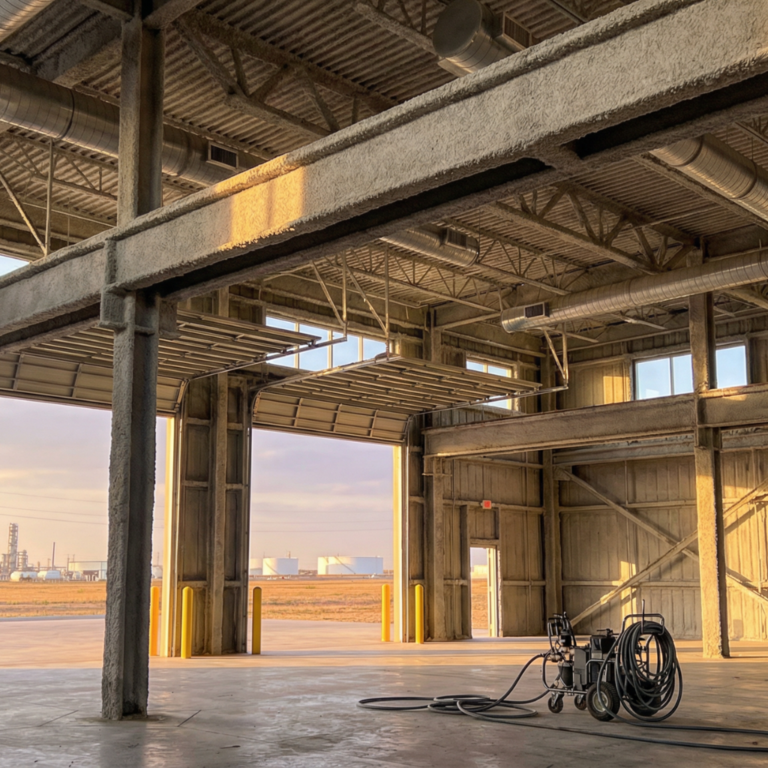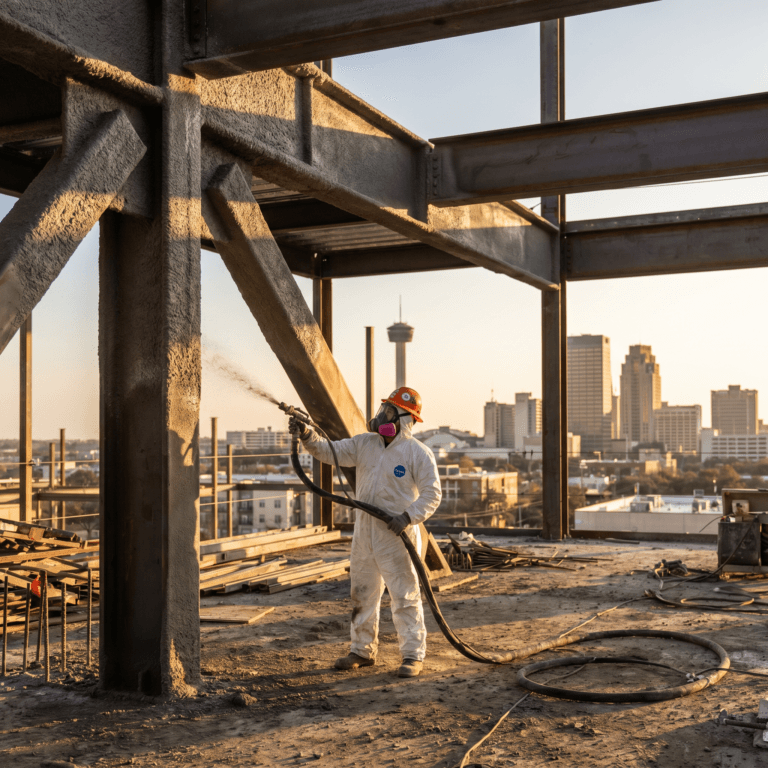
Wichita’s commercial construction market runs on aviation manufacturing, military modernization, and a growing healthcare and logistics sector. If you are a general contractor, facility manager, or building owner searching for a fireproofing contractor in Wichita KS, this guide covers why structural fireproofing matters here, what makes this market different from anywhere else in our service territory, and how Bahl Fireproofing serves South Central Kansas with the same code-compliant, field-tested approach we bring to every project.
TLDR: Wichita is Climate Zone 4A per IECC Table C301.1, the coldest market in Bahl Fireproofing’s Kansas territory. Aviation manufacturing along the K-96 corridor demands UL 1709 hydrocarbon-rated SFRM. The City of Wichita and Sedgwick County jointly enforce the 2024 IBC through MABCD, and the 40°F substrate requirement compresses the viable spray window to roughly April through October. Bahl Fireproofing brings 20+ years of commercial fireproofing experience to every Wichita project.
Wichita is the Air Capital of the World. That is not marketing language. It is the city’s official designation, earned over a century of building more general aviation aircraft than any other city on the planet. Boeing, Textron Aviation, Bombardier, and dozens of aerospace component manufacturers operate within a few miles of each other along East Wichita’s K-96 corridor.
What most people outside the industry do not realize is that aviation manufacturing creates fireproofing requirements you will not find in a typical commercial project. Jet fuel storage and handling in final assembly and MRO (maintenance, repair, overhaul) facilities trigger the same UL 1709 hydrocarbon fire rating specifications that oil refineries require. On top of that, Wichita sits in Climate Zone 4A, which gives us the shortest viable spray application window of any market we serve across Texas, Oklahoma, Kansas, Nebraska, Minnesota, and Wisconsin.
In my 20-plus years of commercial fireproofing services, I have worked in markets ranging from the Texas Gulf Coast to the Oklahoma plains. Wichita’s combination of aerospace-grade fire protection requirements and extreme freeze-thaw cycling makes it one of the most technically demanding locations in our territory. This guide explains what that means for your next project.
Why Wichita’s Commercial Fireproofing Market Is Unique
Wichita is not just another mid-market city. With a metro population of roughly 661,000, it is the largest city in Kansas and one of the most concentrated aviation manufacturing hubs in the world. More than half of all general aviation aircraft produced globally have historically come from Wichita factories. That concentration creates a commercial fireproofing market unlike anywhere else in our Texas, Kansas, and Oklahoma territory.
That concentration of aerospace activity drives a commercial construction market with fireproofing demands that differ significantly from Dallas, Houston, or Oklahoma City. Three factors define the Wichita market.
Aviation Manufacturing Creates UL 1709 Demand
The K-96 and McConnell corridor in East Wichita is home to facilities that store and handle jet fuel (Jet-A, JP-8). Boeing’s Wichita manufacturing campus, formerly Spirit AeroSystems until Boeing completed the $4.7 billion reacquisition in December 2025, produces 737 MAX fuselage components in massive structural steel buildings. Textron Aviation, the world’s largest privately held aviation manufacturer, operates its global headquarters and production lines here. Bombardier maintains its U.S. headquarters, service center, and defense operations on the former Learjet manufacturing site.
When jet fuel is present in a facility, a standard ASTM E119 cellulosic fire rating is not sufficient. Hydrocarbon pool fires burn hotter and faster than cellulosic fires. The structural steel in fuel-adjacent areas requires UL 1709-rated SFRM, which means high-density products at 40 pounds per cubic foot or greater. This is the same specification trigger we see in petroleum refinery environments. If you have worked with us on our Tulsa-area refinery and aerospace projects, the UL 1709 requirements in Wichita’s aviation corridor follow the same technical logic.
Standard commercial-density SFRM still applies to office wings, administration buildings, and non-fuel areas within these same campuses. A single aviation facility can require both UL 1709-rated high-density product and standard cementitious SFRM depending on the specific zone.
Climate Zone 4A: The Coldest Market We Serve
Wichita’s Climate Zone 4A designation under IECC Table C301.1 is the single biggest operational factor separating this market from the other Kansas, Oklahoma and Texas cities Bahl Fireproofing serves. Here is how Wichita compares.
| Market | IECC Zone | Avg. January Low | Freeze-Thaw Nights Per Year | Annual Snowfall |
|---|---|---|---|---|
| Houston | 2A | 42°F | Near zero | Less than 1 inch |
| Dallas-Fort Worth | 3A | 33°F | ~23 | 2 to 3 inches |
| Oklahoma City | 3A | 26°F | ~40 | 6 to 8 inches |
| Tulsa | 3A | 26°F | ~40 | 8 to 10 inches |
| Wichita | 4A | 18°F | 70+ | 18 to 20 inches |
Climate zones per IECC Table C301.1; zone boundaries derive from ANSI/ASHRAE Standard 169.
That data tells you everything about scheduling. SFRM application requires a minimum substrate temperature of 40°F. In Houston, that is rarely an issue. In DFW and OKC, it limits a few weeks of the year. In Wichita, December through February (and often parts of November and March) are essentially non-viable months for spray application without temporary heating and full enclosure of the work area.
This means Wichita construction schedules must build the winter application gap into the timeline as standard practice, not as a contingency. If your structural steel is going up in September and the building envelope is not closed before November, you need a plan. Temporary heating and enclosure systems add cost and complexity. The alternative is waiting until spring, which pushes your entire schedule.
In my experience, the GCs who run into trouble in Zone 4A markets are the ones who plan their fireproofing phase the same way they would in Dallas. The window is real, and it is shorter than most people expect.
Freeze-Thaw and Product Selection
Wichita’s 70-plus nights below freezing per year also affect product selection for steel that is exposed to weather before envelope closure. CAFCO BLAZE-SHIELD HP, the only medium-density SFRM product UL-classified for exterior use, is critical for any project where structural steel will be exposed to Wichita’s freeze-thaw cycling before the building envelope is sealed. Standard low-density cementitious SFRM will not survive repeated freeze-thaw cycles on exposed steel.
Wichita Building Code Environment
Kansas operates as a local-adoption state for building codes. Unlike Oklahoma, which enforces a statewide uniform code through the OUBCC, Kansas has no statewide building code mandate. Each city adopts its own code independently. This is more similar to how Texas cities operate.
Wichita currently enforces the 2024 International Building Code with local amendments for commercial construction, effective January 1, 2025. The Authority Having Jurisdiction (AHJ) for commercial building permits, plan review, inspections, and code enforcement is the Metropolitan Area Building and Construction Department (MABCD), a joint City of Wichita and Sedgwick County agency created in 2013. MABCD operates under County administrative oversight and enforces codes adopted jointly by both the City Council and the Board of County Commissioners through the Wichita-Sedgwick County Unified Building and Trade Code. The Wichita Fire Department separately enforces the fire code through its Community Risk Reduction Division.
The key IBC sections governing structural fireproofing in Wichita are the same ones that apply across our entire service territory.
IBC Table 601: Fire-Resistance Rating Requirements
IBC (2021) Table 601 establishes minimum fire-resistance ratings by construction type. Type I-A construction, common in hospitals, high-rises, and large public assembly buildings, requires 3-hour ratings for structural frames. Type I-B requires 2-hour ratings. Type II-A requires 1-hour ratings. Type II-B (the most common for single-story warehouses) has no fire-resistance requirement for structural members.
For a deeper understanding of how these ratings work in practice, our spray-applied fireproofing guide covers the full range of construction types and the SFRM products that meet each rating.
Section 403.2.3: High-Rise Requirements
Any Wichita building exceeding 75 feet in height triggers IBC high-rise provisions. Downtown Wichita’s growing mixed-use and commercial corridor includes buildings in this category. High-rise construction requires enhanced fire-resistance ratings, automatic sprinkler systems, and fire command centers.
Section 704 and Section 1705.15: Fire-Resistance and Special Inspections
IBC (2021) Section 704 governs fire-resistance-rated construction. IBC (2021) Section 1705.15 (Section 1705.14 in the 2018 and earlier editions) mandates special inspections for spray-applied fireproofing, requiring a qualified inspector to verify thickness, density, bond strength, and surface condition during and after application. These inspections are not optional. In Wichita, MABCD coordinates plan review, permitting, and inspections for commercial projects, and the special inspection requirements follow the 2024 IBC framework.
Kansas vs. Oklahoma: Code Adoption Differences
If your company works across state lines, the code adoption difference matters. Oklahoma enforces a statewide uniform code through the OUBCC. Kansas does not. Wichita, Overland Park, Kansas City KS, and Topeka each adopt their own code edition independently. Wichita and Overland Park are on the 2024 IBC, and Topeka adopted the 2024 IBC effective April 14, 2026. Verify the adopted edition and local amendments for each Kansas jurisdiction rather than assuming statewide uniformity. Note also that the building code is unified across Wichita and Sedgwick County but the fire code is not: the county adopted the 2024 IFC under Resolution 006-2025 while the City of Wichita remains on the 2018 IFC under Ordinance 51-552.
Wichita Building Types That Need Fireproofing
Aviation Manufacturing Corridor (K-96 / East Wichita)
Boeing’s Wichita manufacturing campus is the anchor of this corridor. After Boeing completed its reacquisition of Spirit AeroSystems’ commercial operations in December 2025, the Wichita facilities continue producing 737 MAX fuselage components under Boeing ownership. Spirit Defense, the former defense segment, continues operating as a separate entity.
Textron Aviation (Cessna and Beechcraft), with roughly 10,000 employees globally, operates its worldwide headquarters and primary manufacturing campus in Wichita. Bombardier maintains its U.S. headquarters, a major MRO service center, and defense operations here. Learjet production ended permanently in March 2022, but the Wichita facility remains active for service, MRO, and defense work.
Fireproofing requirements across this corridor typically include high-density SFRM (40-plus pcf) with UL 1709 hydrocarbon fire ratings for fuel-adjacent structural steel, standard commercial-density cementitious SFRM for office and administration areas, and scheduled maintenance turnarounds for existing facilities. The pattern is similar to what we see in the Tulsa refinery corridor, where periodic shutdowns create windows for fireproofing repair and re-application.
McConnell Air Force Base
McConnell AFB is home to the 22nd Air Refueling Wing, operating KC-135R Stratotankers and KC-46A Pegasus tankers, along with the 184th Intelligence, Surveillance and Reconnaissance Wing. Ongoing base modernization creates a multi-year construction pipeline for hangars, maintenance facilities, and support buildings.
Military construction at McConnell requires UL 1709 ratings for aviation fuel areas, standard SFRM for support structures, and compliance with high-security access and safety training protocols. The construction demand pattern mirrors what we see at Tinker AFB in the Oklahoma City area: steady, multi-year programs with strict specification requirements.
Healthcare Facilities
Wichita is the healthcare hub for south-central Kansas. Ascension Via Christi, the largest healthcare system in the state, operates multiple campuses. Wesley Medical Center and the Wichita VA Medical Center round out the major facilities.
Healthcare construction almost always requires Type I-A or I-B construction with 2 to 3-hour fire-resistance ratings. The MEP coordination in hospitals is among the most complex in any building type. Fireproofing crews work around mechanical, electrical, and plumbing penetrations that are far denser than a typical commercial project. After MEP trades damage SFRM during their work, patching and re-inspection add time and cost that GCs need to build into the schedule.
Downtown Wichita and Arena District
Intrust Bank Arena, a 15,000-capacity public assembly venue, is a Type I-A building requiring full structural fire protection. The Douglas Design District features adaptive reuse of historic downtown buildings, which often calls for intumescent fireproofing on exposed structural steel where aesthetics matter. If your downtown Wichita project involves exposed steel in a renovated building, understanding the comparison of intumescent and cementitious systems helps you choose the right coating for your project’s performance and aesthetic requirements.
Wichita State University’s Innovation Campus, built on the former Coleman factory site, continues expanding with commercial and technology-focused construction. The Arkansas River corridor is seeing new mixed-use development as well.
Wichita Eisenhower National Airport
An active terminal renovation began in January 2026 and is expected to continue through the end of the year. This creates direct, current demand for commercial-density SFRM in terminal renovation areas, along with potential intumescent applications in public-facing concourse spaces.
WSU and the National Institute for Aviation Research (NIAR)
NIAR is the largest aviation research center in the United States. The facility encompasses 2 million square feet of lab and office space across six Wichita locations, employs a staff of 2,000, and operates on a $400 million annual budget. Ongoing research facility construction and expansion create steady institutional fireproofing demand.
Warehouses and Distribution (I-135 / I-235 / K-96 Corridors)
Wichita’s central U.S. location puts it within 1,500 miles of 90 percent of the U.S. population, making it a natural logistics hub. Most single-story warehouses fall under Type II-B construction, which has no SFRM requirement for structural members. However, large-bay distribution centers that trigger Type II-A or higher classifications do require commercial-density SFRM on structural steel.
How Climate Zone 4A Affects Your Fireproofing Schedule
This section is worth reading carefully if you are a GC scheduling a Wichita project. The 40°F minimum substrate temperature for SFRM application is the same everywhere. What changes is how many months of the year that requirement eliminates from your viable spray window.
In Wichita, the practical spray season runs from roughly April through October. That is six to seven months. Compare that to Houston, where you can spray year-round, or DFW, where you lose maybe two to three weeks in a harsh January.
Planning Around the Winter Gap
If your steel erection finishes in late summer, you have a window to get fireproofing applied before temperatures drop. If erection wraps up in November, you are looking at one of three options.
First, temporary heating and enclosure. This is the most common approach for projects that cannot wait until spring. Propane heaters or temporary HVAC systems maintain substrate temperatures above 40°F, and the work area is enclosed with temporary walls and roofing. This adds cost, typically $2 to $5 per square foot on top of the fireproofing itself, depending on the size of the enclosure. But it keeps the project on schedule.
Second, phased application. Apply SFRM to interior steel that is already protected by the building envelope, and defer exposed exterior-facing members until temperatures allow. This works when the building shell closes in sections.
Third, spring scheduling. If the timeline allows it, push the fireproofing phase to April. This is the simplest approach, but it delays downstream trades and extends the overall project timeline.
In my experience, the GCs who manage Zone 4A projects most effectively are the ones who coordinate fireproofing scheduling during pre-construction, not as a reactive decision after steel is up. If you are bidding a Wichita project, build the winter gap into your baseline schedule. Do not treat it as a risk item. It is a certainty.
Product Selection for Exposed Steel
Any structural steel that will be exposed to weather before envelope closure in a Zone 4A market needs special product consideration. Standard low-density cementitious SFRM (10 to 14 pcf) absorbs moisture and breaks down under freeze-thaw cycling. For exposed conditions, CAFCO BLAZE-SHIELD HP is the only medium-density SFRM product UL-classified for exterior use.
Once the building envelope is sealed and interior conditions are maintained, standard-density products like CAFCO 300 or BLAZE-SHIELD II perform as specified. The product transition happens when exposure conditions change, not when the calendar changes.
What Does Commercial Fireproofing Cost in Wichita?
Cost data for Wichita commercial fireproofing follows regional trends, with some adjustments for the Zone 4A scheduling constraints and the specialized UL 1709 demand from the aviation sector.
| Product | Installed Cost Per SF | Typical Application |
|---|---|---|
| Standard Cementitious SFRM | $5 to $14 | Concealed steel, standard commercial |
| High-Density SFRM (UL 1709) | $8 to $20+ | Aviation fuel areas, hydrocarbon exposure |
| Water-Based Intumescent | $4 to $12 | Interior exposed steel, aesthetics |
| Solvent-Based Intumescent | $6 to $14 | Semi-exposed applications |
Several factors push Wichita costs toward the higher end of these ranges. Winter application with temporary heating and enclosure adds $2 to $5 per square foot. UL 1709 specifications require high-density products that cost more per unit than standard cementitious SFRM. Aviation and military projects often involve additional safety training, security clearance, and access coordination. Project size, steel complexity, and access conditions (deck height, obstructions) all affect final pricing.
For a broader view of how commercial fireproofing costs work, including material-only versus installed pricing, our guide on commercial fireproofing requirements covers what building owners need to know about IBC compliance and specification basics.
These are general ranges. Every project is different. We provide specific pricing through our estimating process based on your actual drawings and specifications.
Do You Need a Fireproofing Contractor in Wichita KS?
Structural fireproofing is required by the 2024 IBC whenever the building’s construction type mandates fire-resistance-rated structural members. In Wichita, that typically means Type I-A, I-B, and II-A construction. The AHJ for commercial construction, MABCD, reviews plans and enforces these requirements through the joint city-county permitting process.
You need a qualified fireproofing contractor if your project involves any of the following: new construction with fire-resistance-rated structural steel, renovation or adaptive reuse of an existing building requiring fire rating upgrades, aviation or industrial facilities with UL 1709 hydrocarbon fire rating requirements, healthcare facility construction or expansion, public assembly buildings (arenas, convention centers, large venues), or high-rise buildings exceeding 75 feet in height.
SFRM is not a trade that general labor can perform. Special inspections under IBC (2021) Section 1705.15 require verified thickness, density, and bond strength. A failed inspection means rework, which means schedule delays and cost overruns. Hiring a contractor with specific SFRM experience, proper equipment, and a track record of passing inspections is not an upgrade. It is a basic risk management decision.
How Bahl Fireproofing Serves as Your Wichita Fireproofing Contractor
Bahl Fireproofing is headquartered in Round Rock, Texas, and serves commercial construction projects throughout Texas, Oklahoma, Kansas, Nebraska, Minnesota, and Wisconsin. We do not have a Wichita office, but we regularly mobilize crews to Kansas service territory projects and maintain the scheduling flexibility to meet Zone 4A seasonal constraints.
Our Wichita project capabilities include cementitious SFRM for standard commercial construction (CAFCO 300, BLAZE-SHIELD II), high-density SFRM for UL 1709 hydrocarbon fire-rated applications in aviation and industrial facilities, intumescent coatings for exposed structural steel where aesthetics matter (water-based and solvent-based systems), and K-13 spray-applied insulation for thermal and acoustic applications. We handle both new construction and renovation or retrofit projects.
What separates our approach is straightforward. After 20-plus years in this trade, I know what passes inspection and what does not. I know what Zone 4A freeze-thaw does to the wrong product on exposed steel. I know how to coordinate around MEP trades in a hospital without blowing a schedule. That field knowledge drives how we estimate, how we plan, and how we execute.
Frequently Asked Questions
Q: What building code does Wichita enforce for commercial construction?
Wichita enforces the 2024 International Building Code with local amendments for commercial construction, effective January 1, 2025. Kansas is a local-adoption state, meaning each city adopts independently. The AHJ for commercial permits, plan review, and inspections is MABCD, the Metropolitan Area Building and Construction Department, a joint City of Wichita and Sedgwick County agency that enforces codes adopted by both governing bodies.
Q: What is UL 1709, and why does it matter in Wichita?
UL 1709 is a fire test standard for rapid-rise, hydrocarbon pool fires. It applies wherever jet fuel, petroleum products, or other hydrocarbons are stored or handled near structural steel. In Wichita, the aviation manufacturing corridor along K-96 includes facilities operated by Boeing, Textron Aviation, and Bombardier that store and handle jet fuel. Structural steel in those fuel-adjacent areas requires UL 1709-rated SFRM at 40 pcf or greater density, rather than standard ASTM E119 cellulosic ratings.
Q: Can you apply spray fireproofing in Wichita during winter?
SFRM requires a minimum substrate temperature of 40°F. In Wichita’s Zone 4A climate, December through February are generally non-viable without temporary heating and enclosure. Temporary climate control adds roughly $2 to $5 per square foot but keeps the project on schedule. Most Wichita GCs plan the fireproofing phase for the April-through-October window when possible.
Q: What SFRM product should I specify for steel exposed to weather in Wichita?
CAFCO BLAZE-SHIELD HP is the only medium-density SFRM product UL-classified for exterior use. Standard low-density cementitious SFRM (10 to 14 pcf) will not survive Wichita’s 70-plus annual freeze-thaw cycles. Once the building envelope is sealed, standard-density products perform as specified in controlled interior conditions.
Q: How long does spray-applied fireproofing last?
SFRM is designed to last the life of the building when properly applied and protected from physical damage. In practice, the most common failure mode is mechanical damage from MEP trades, renovation work, or impact. Periodic inspections catch damage early. When repairs are needed, qualified contractors patch and re-apply to restore the original fire-resistance rating.
Q: Does Bahl Fireproofing have a Wichita office?
No. We are headquartered in Round Rock, Texas, and serve Kansas through crew mobilization. As a fireproofing contractor serving Wichita KS, we regularly work in the Wichita, Overland Park, and Kansas City metro areas. Our scheduling accounts for Zone 4A climate constraints, and we coordinate mobilization around your project timeline.
Q: What is the difference between MABCD and the Wichita Fire Department?
MABCD (Metropolitan Area Building and Construction Department) is a joint City of Wichita and Sedgwick County agency that handles commercial building permits, plan review, inspections, and building code enforcement. The Wichita Fire Department’s Community Risk Reduction Division separately enforces the fire code through its own inspections and plan reviews. Both may be involved in a commercial construction project, but MABCD is your primary contact for building code compliance and permitting.
Q: What types of Wichita projects require fireproofing?
Any Wichita project with fire-resistance-rated construction under IBC (2021) Table 601 requires structural fireproofing. That typically includes hospitals, high-rises, large public assembly buildings, aviation and industrial facilities with UL 1709 requirements, and large-footprint distribution centers classified as Type II-A or higher. Single-story Type II-B warehouses generally do not require SFRM on structural members.
Key Takeaways
Wichita Is a Specialized Market
- The Air Capital’s aviation manufacturing corridor creates UL 1709 hydrocarbon fire rating demand that most markets do not have
- Boeing (former Spirit AeroSystems), Textron Aviation, Bombardier, and McConnell AFB all drive specialized fireproofing requirements
- Standard commercial SFRM and UL 1709-rated high-density products often coexist on the same facility
Climate Zone 4A Changes Everything About Scheduling
- Wichita averages 70-plus nights below freezing, the most in Bahl Fireproofing’s service territory
- The viable spray application window runs roughly April through October without temporary heating
- Winter application is possible with enclosure and heating ($2 to $5 per SF added cost)
- Coordinate fireproofing scheduling during pre-construction, not after steel erection
Code Compliance in Kansas Works Differently
- Kansas is a local-adoption state with no statewide building code mandate
- The City of Wichita and Sedgwick County jointly enforce the 2024 IBC through MABCD
- Verify the adopted code edition and local amendments for every Kansas jurisdiction
Product Selection Matters More in Extreme Climates
- CAFCO BLAZE-SHIELD HP is the only SFRM product UL-classified for exterior use
- Standard low-density SFRM will not survive Wichita’s freeze-thaw cycling on exposed steel
- High-density products (40-plus pcf) are required for UL 1709-rated aviation and industrial applications
Wichita’s Construction Pipeline Is Active
- Wichita Eisenhower National Airport terminal renovation (2026)
- WSU/NIAR expansion (2 million SF, $400M annual budget, largest aviation research center in the US)
- Healthcare campus construction (Ascension Via Christi, Wesley Medical Center)
- Downtown mixed-use and adaptive reuse in the Douglas Design District
Related Reading
- Choosing between cementitious and intumescent coatings for your next project? See our intumescent vs. cementitious fireproofing comparison guide for a side-by-side breakdown of cost, performance, and application.
- Need a clear overview of what the IBC requires for fire-resistance-rated construction? Read our guide on what building owners must know about commercial fireproofing requirements.
- For a comprehensive look at SFRM types, density categories, application methods, and code requirements, our spray-applied fireproofing guide covers everything from specification through inspection.
Ready to Talk About Your Wichita Project?
If you are planning a commercial construction project in Wichita, whether it is a standard commercial build, a healthcare expansion, or an aviation facility requiring UL 1709-rated fire protection, I would like to hear about it. Bahl Fireproofing serves clients throughout Texas, Oklahoma, Kansas, Nebraska, Minnesota, and Wisconsin with the same code-compliant, field-tested approach on every project. Contact Bahl Fireproofing today at 512-387-2111 or email ross@bahlfireproofing.com to schedule a consultation or request a bid.
This article provides general educational information about fireproofing and insulation services. It is not a substitute for professional engineering, architectural, or code-compliance advice. Fireproofing specifications, code requirements, and installation methods vary by project, jurisdiction, and building type. Always consult a licensed professional for project-specific guidance. Bahl Fireproofing is not responsible for decisions made based solely on the content of this article.
Code note: unless otherwise stated, code references on this page are to the 2021 International Building Code. Code adoption is state and local. Across the states we serve, adopted IBC editions currently range from the 2012 edition to the 2024 edition, some states have no statewide commercial building code, and several enforce NFPA 1 or NFPA 101 rather than the International Fire Code. Minnesota and Wisconsin publish state-amended code books whose numbering and requirements differ from the model code. This is general technical information, not a code determination for your project. Confirm the adopted edition and any local amendments with your authority having jurisdiction.