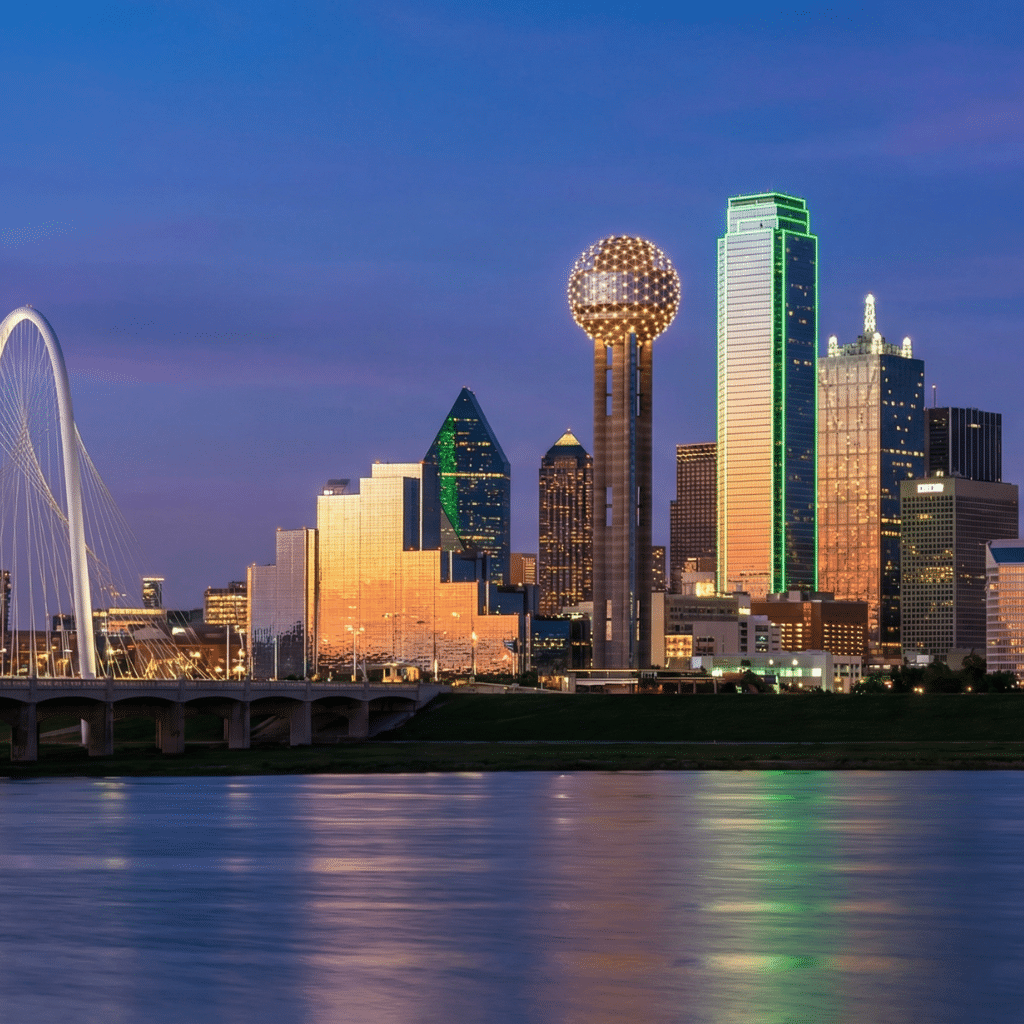
Dallas-Fort Worth is the data center capital of Texas and home to the largest office construction pipeline in the country. With tens of billions of dollars in regional infrastructure investment, one of the top three data center markets in the nation, a $9 billion DFW Airport expansion, and 7 downtown Dallas buildings exceeding the 420-foot super high-rise threshold, the DFW metroplex presents one of the most active and technically demanding commercial fireproofing markets in the United States. This guide covers what building owners, general contractors, architects, and specifiers need to know about fireproofing for DFW commercial projects.
TLDR: DFW’s construction boom spans data centers, high-rise offices, healthcare facilities, airport terminals, and industrial warehouses, each with distinct fireproofing requirements. Dallas adopted the 2021 IBC effective May 12, 2023. Fort Worth adopted the 2021 IBC effective April 1, 2022. Bahl Fireproofing serves the DFW market with SFRM, intumescent coatings, K-13 insulation, and spray foam insulation.
Every major building type in commercial construction is actively under construction somewhere in the DFW metroplex right now. What makes this market unique in my 20 years of fireproofing experience across Texas is the concentration of super high-rise buildings in downtown Dallas, the explosive growth of data center construction in the Fort Worth and Plano corridors, and the sheer volume of corporate campus and healthcare projects that require coordinated fireproofing and insulation scopes. DFW’s fireproofing demand profile is fundamentally different from Houston’s: where Houston’s complexity centers on Ship Channel petrochemical facilities requiring UL 1709 hydrocarbon fire ratings, DFW’s complexity centers on high-rise bond strength requirements and the aggressive construction schedules driven by the data center boom.
Bahl Fireproofing serves the Dallas-Fort Worth metroplex from our Texas operations, providing spray-applied fireproofing, intumescent coatings, K-13 acoustic insulation, and spray foam insulation across the full range of DFW building types. This guide shares the field experience, code knowledge, and specification guidance that contractors and building owners need to get their DFW projects right.
DFW’s Commercial Construction Landscape
The DFW metroplex is the third-fastest-growing metro area in the United States, adding nearly 500 people per day to a population exceeding 8.3 million. Over 100 corporate headquarters have relocated to DFW since 2018, more than any other US metro. That sustained population and corporate growth is driving a construction pipeline unlike anything else in Texas.
DFW is one of the top three data center markets in the country, with the market projected to double by the end of 2026. Data center net absorption reached 470.8 megawatts in 2025, a massive year-over-year increase. CyrusOne’s Fort Worth campus includes a $1 billion+ two-building complex (Building 1 at 190,000 square feet and 70 megawatts, Building 2 at 228,000+ square feet). Stack Infrastructure has four DFW projects totaling over $1.4 billion across Fort Worth, Plano, and Lancaster. Google has committed $880 million in DFW data center investment. Industry projections indicate Texas will overtake Virginia as the world’s largest data center market by 2030.
On the office and corporate campus side, the Goldman Sachs NorthEnd campus (over $700 million, 800,000 square feet, 14 stories, completion 2028) will be Goldman’s largest US campus by square footage. The recently opened Wells Fargo Las Colinas campus ($570 million, 850,000 square feet) in Irving anchors the corporate construction wave. In Uptown, 23Springs (26 stories, 625,000 square feet) opened as the tallest building in the district, and Bank of America Parkside (30 stories) is under construction with an expected 2027 opening.
DFW Airport’s $9 billion “DFW Forward” capital plan is the airport’s largest since 1974, encompassing the $3 billion Terminal C rebuild, a new Terminal F, 24 new gates, and parking garage reconstruction. The program creates sustained structural steel fireproofing demand across terminal buildings, concourses, and multi-level parking structures through 2030.
In healthcare, JPS Health Network in Fort Worth is investing $2.5 billion in a 1 million square foot hospital expansion starting spring 2026. UT Southwestern’s 505,000 square foot Behavioral Health Center (292 beds) opens summer 2026. Texas Health Resources is expanding across multiple DFW locations including a new 5-story patient tower at Texas Health Southwest in Fort Worth, a new 8-story tower at Texas Health Plano, and a brand-new hospital in Forney.
Does Your DFW Building Need Fireproofing?
Whether a DFW commercial building requires fireproofing depends on its construction type under the IBC Section 704: Fire-Resistance Rating of Structural Members. Dallas adopted the 2021 IBC effective May 12, 2023, with local amendments in Chapters 36 through 43. Fort Worth adopted the 2021 IBC effective April 1, 2022, under Ordinance 25382-03-2022. Both cities enforce the same base code for fire-resistance-rated construction, but local amendments differ, so always verify with the jurisdiction’s building department.
IBC (2021) Table 601 determines fire-resistance ratings by construction type. Here is a simplified version covering the construction types most common in DFW commercial steel projects:
Code note: unless otherwise stated, code references on this page are to the 2021 International Building Code. Code adoption is state and local. Across the states we serve, adopted IBC editions currently range from the 2012 edition to the 2024 edition, some states have no statewide commercial building code, and several enforce NFPA 1 or NFPA 101 rather than the International Fire Code. Minnesota and Wisconsin publish state-amended code books whose numbering and requirements differ from the model code. This is general technical information, not a code determination for your project. Confirm the adopted edition and any local amendments with your authority having jurisdiction.
| Construction Type | Structural Frame | Floor Construction | Roof Construction | Typical DFW Application |
|---|---|---|---|---|
| Type I-A | 3 hours | 2 hours | 1.5 hours | Hospitals (JPS, UTSW), airport terminals, downtown high-rises |
| Type I-B | 2 hours | 2 hours | 1 hour | Mid-rise offices, healthcare, mixed-use towers |
| Type II-A | 1 hour | 1 hour | 1 hour | Low-rise commercial, some warehouses |
| Type II-B | 0 hours | 0 hours | 0 hours | Single-story warehouses, distribution centers |
Type II-B is the most common construction type for single-story steel warehouses in the South Dallas industrial corridor and the Alliance/North Fort Worth logistics hub. It requires 0-hour fire-resistance ratings for the structural frame, meaning no fireproofing is required. But when building height, occupant load, or occupancy classification triggers Type II-A or higher, fire-resistance-rated construction becomes mandatory.
DFW’s high-rise landscape adds a critical code dimension that distinguishes this market from every other Texas metro. IBC (2021) Section 403.2.3 requires SFRM bond strength of 430 psf for buildings 75 to 420 feet and 1,000 psf for buildings exceeding 420 feet. Dallas has 7+ buildings above the 420-foot super high-rise threshold, more than any other Texas city:
| Building | Height | Bond Strength Required |
|---|---|---|
| Bank of America Plaza | 921 feet | 1,000 psf |
| Renaissance Tower | 886 feet | 1,000 psf |
| Comerica Bank Tower | 787 feet | 1,000 psf |
| JPMorgan Chase Tower | 738 feet | 1,000 psf |
| Fountain Place | 720 feet | 1,000 psf |
| 2001 Ross Avenue | 686 feet | 1,000 psf |
| 1700 Pacific | 655 feet | 1,000 psf |
Fort Worth’s tallest buildings (Burnett Plaza at 567 feet, D.R. Horton Tower at 547 feet) fall in the 75 to 420 foot range, requiring 430 psf. Products evaluated and classified for high-rise fire protection include CAFCO 300 HS (commercial density, bond strength exceeding 500 psf) for buildings up to 420 feet and CAFCO 3000 for super high-rise applications exceeding 420 feet. When bidding DFW high-rise projects, the first question is whether the building crosses that 420-foot threshold, because it determines whether commercial density products are sufficient or whether higher-performance products are needed.
Fireproofing Services for DFW Commercial Projects
Bahl Fireproofing provides four core services across the DFW metroplex, each specified for different applications and performance requirements.
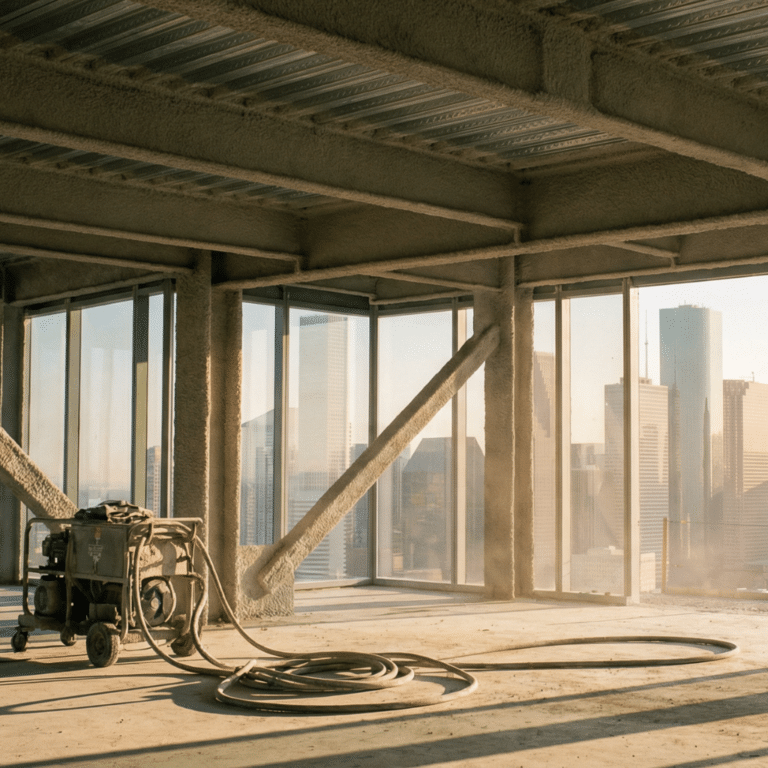
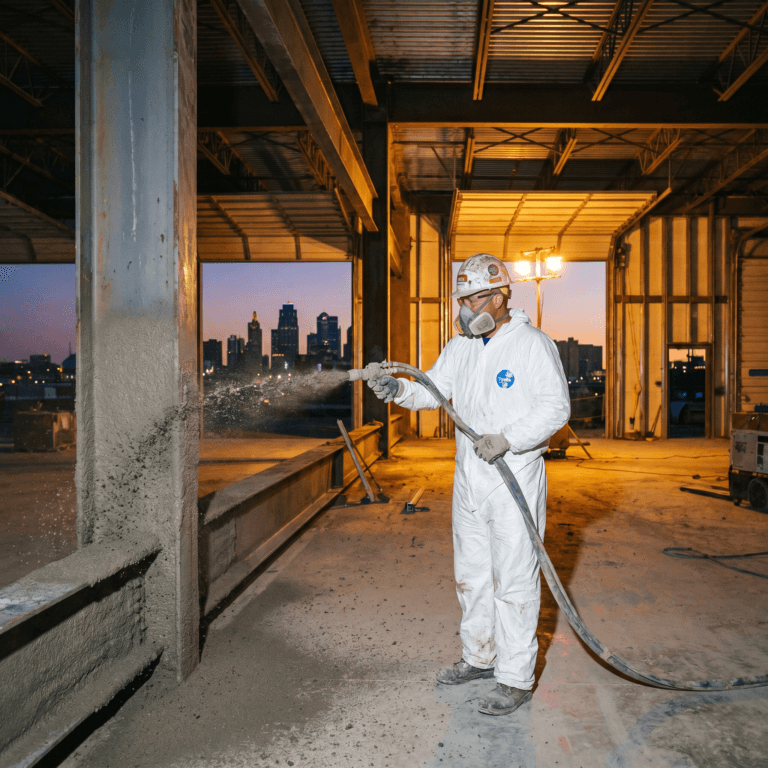
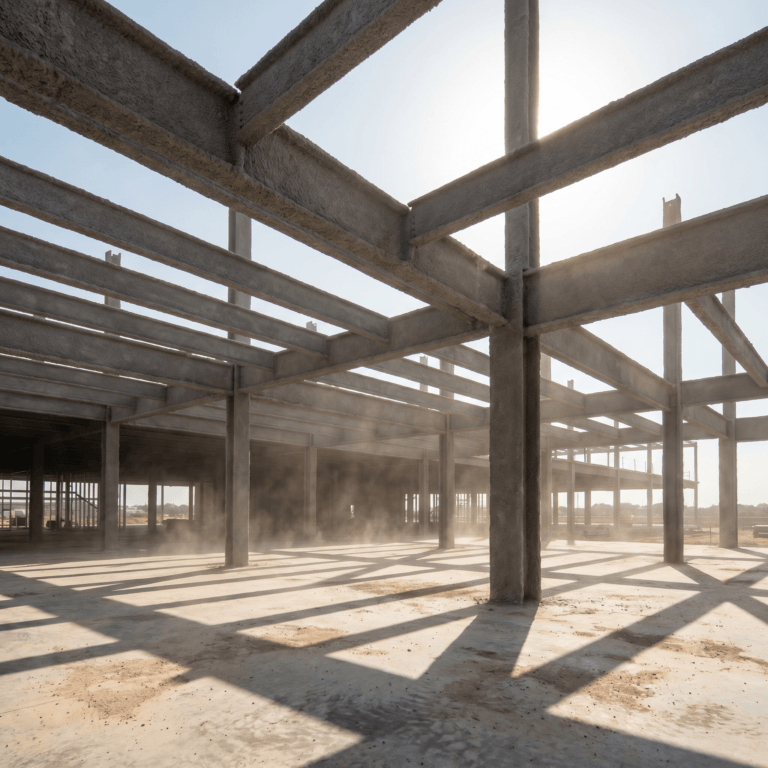
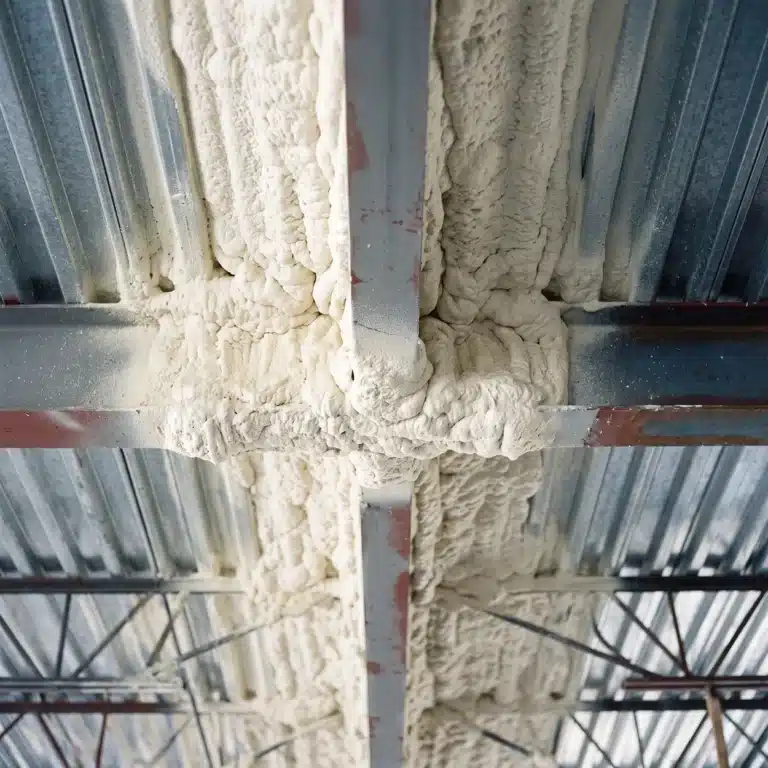
Spray-Applied Fire-Resistive Material (SFRM) is the primary passive fire protection system for concealed structural steel. SFRM is applied to columns, beams, and metal decking to achieve 1 to 4 hour fire-resistance ratings per ASTM E119 and UL 263. Three density categories serve different DFW environments: commercial density (15 to 21 pcf) for concealed applications and data centers, medium density (22 to 39 pcf) for exposed conditions and structures requiring weather protection during construction, and high density (40+ pcf) for parking garages and mechanical rooms. For a deeper look at density selection, application methods, and special inspection requirements, see our complete guide to commercial fireproofing services.
Intumescent fireproofing coatings are thin-film coatings applied to architecturally exposed structural steel (AESS). Uptown Dallas office lobbies, Victory Park and NorthEnd corporate campuses, and Las Colinas mixed-use projects frequently specify intumescent coatings when the steel will be visible in the finished building. Intumescent coatings achieve the same fire-resistance ratings as SFRM but at significantly higher installed cost, making them the specification of choice only for aesthetic applications.
K-13 spray-applied insulation provides thermal and acoustic performance for exposed ceiling and wall applications. K-13 spray-applied insulation installation is frequently specified alongside SFRM on the same DFW project: SFRM on the structural steel for fire protection and K-13 on exposed ceilings for sound absorption and thermal control. Warehouse distribution centers, school gymnasiums, and convention spaces are common K-13 applications in the DFW market.
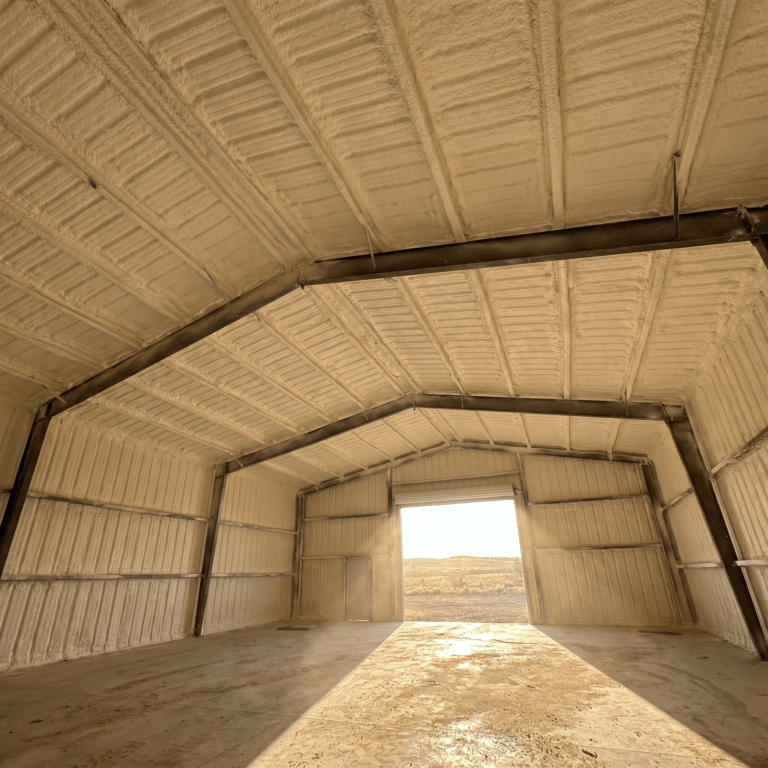
Spray foam insulation (closed-cell and open-cell) insulates the building envelope for thermal performance. In DFW’s Climate Zone 3A, closed-cell spray foam provides both thermal resistance and moisture control for exterior wall assemblies.
When a DFW project requires both structural fireproofing and building envelope insulation, our team mobilizes once for both scopes. This eliminates the duplicate mobilization, equipment setup, and coordination overhead that occurs when separate contractors handle fireproofing and insulation independently.
DFW Building Types: District-by-District Fireproofing Guide
DFW’s commercial building types vary dramatically by district, and each presents distinct fireproofing specification challenges.
Downtown Dallas High-Rise Offices
Downtown Dallas has 42 buildings over 350 feet tall, and 7+ exceed the 420-foot super high-rise threshold. Construction types are I-A (3-hour structural frame) or I-B (2-hour), and bond strength requirements are the most demanding in Texas. The active construction pipeline, including Bank of America Parkside at 30 stories in Uptown, continues adding to this super high-rise fireproofing demand. Dallas’s skyline means more projects requiring 1,000 psf bond strength specification than any other city in our service territory.
Uptown, Victory Park, and Corporate Campuses
The Goldman Sachs NorthEnd campus (over $700 million, 800,000 square feet) and projects like 23Springs (26 stories, tallest in Uptown) drive sustained mid-rise and high-rise fireproofing demand. Corporate campuses in Victory Park, Las Colinas (Irving), and Legacy West (Plano) frequently specify intumescent coatings for exposed steel in lobbies, atriums, and common areas, with SFRM on concealed structural members throughout the remainder of the building. The Wells Fargo Las Colinas campus ($570 million, 850,000 square feet) validates the scale of DFW’s corporate construction pipeline.
Data Centers (Fort Worth, Plano, Lancaster, West DFW)
Data centers are DFW’s dominant fireproofing growth sector. Commercial density SFRM (15 pcf) at one-hour fire ratings is the standard specification. The structural steel is concealed, making SFRM standard over intumescent. The critical challenge is schedule: DFW data center construction timelines are the most aggressive in Texas, and SFRM cure time (14 to 28 days) must be built into the critical path. On recent DFW data center projects, the general contractor’s schedule assumed fireproofing would be “spray and go,” but commercial density products still need 14 to 28 days to cure. Factoring cure time into the sequencing, not treating it as background activity, prevents schedule-driven quality failures.
Healthcare Facilities
Healthcare construction across DFW requires Type I-A or I-B construction with 2 to 3 hour fire-resistance ratings and complex MEP coordination. JPS Health Network’s $2.5 billion Fort Worth expansion (1 million square feet), UT Southwestern’s 505,000 square foot Behavioral Health Center, and multiple Texas Health Resources projects represent the scale of current healthcare construction. Medical gas lines, IT infrastructure, specialized HVAC, and nurse call systems all create beam clamp and penetration points through the SFRM. Our approach on DFW healthcare projects: spray first, coordinate MEP attachment points with the mechanical contractor, then schedule a dedicated patching mobilization after MEP rough-in.
DFW Airport Terminals and Parking Garages
The $9 billion “DFW Forward” capital plan creates the largest airport fireproofing program in Texas. The $3 billion Terminal C rebuild, new Terminal F, and parking garage reconstruction all require structural steel fireproofing. Airport terminal construction demands Type I-A ratings for public assembly occupancy, strict scheduling around active flight operations, and security-sensitive access protocols for construction crews. Parking structures require medium or high density SFRM for impact resistance from vehicle traffic and maintenance equipment.
South Dallas Industrial and Alliance/North Fort Worth Logistics
These corridors represent the highest-volume SFRM applications in the DFW market. With 33.8 million square feet of industrial space under construction and a normal annual delivery cycle of approximately 32 million square feet, the warehouse and distribution center pipeline is massive. Most single-story warehouses are Type II-B construction (0-hour structural frame), meaning no fireproofing is required. But projects triggering Type II-A or higher create consistent commercial density SFRM demand at competitive pricing.
DFW Climate Challenges for Fireproofing
DFW’s fireproofing challenges are distinct from Houston’s Gulf Coast humidity profile. DFW sits in Climate Zone 3A per IECC Table C301.1, with a humid subtropical climate, but the primary SFRM concerns here are extreme heat and weather variability, not constant high humidity.
Extreme Summer Heat
DFW averages 22 days per year above 100 degrees Fahrenheit and 184 days above 80 degrees. Unlike Houston where sustained high humidity extends SFRM cure times, DFW’s extreme heat causes rapid moisture loss from freshly applied SFRM, leading to surface crusting before full cure penetration through the material depth. We schedule spray application in early morning hours during June through September when ambient temperatures are lower and monitor substrate temperatures throughout the application day. This is a fundamentally different scheduling challenge than Houston’s humidity management.
Variable Humidity
DFW humidity ranges from 55 to 70 percent, meaningfully lower than Houston’s 75 to 85 percent. The challenge in DFW is variability: spring and fall humidity spikes can extend cure times unexpectedly, while dry summer periods create the opposite problem of too-rapid moisture loss. This inconsistency requires more active daily monitoring than Houston’s predictably high humidity.
Hail and Severe Storm Exposure
DFW sits in a severe weather corridor with frequent hail events during March through June. Partially enclosed structures during spring storm season face weather protection challenges for freshly applied SFRM. When structural steel will be temporarily exposed during construction, specify medium-density exterior-rated SFRM. CAFCO BLAZE-SHIELD HP (22 pcf, Portland cement binder) is the only medium-density product UL-classified for exterior use. For projects requiring high-density SFRM, the Carboline Pyrocrete product line provides the durability needed for severe exposure conditions.
Winter Freeze Risk
DFW averages 23 nights below freezing annually, with occasional Arctic air intrusions dropping temperatures 40 to 50 degrees Fahrenheit overnight. The 40 degree Fahrenheit minimum substrate temperature requirement for SFRM application means winter scheduling gaps are real in DFW, more frequent than Houston but less severe than Kansas or northern Oklahoma. Planning for these gaps in the construction schedule prevents delays.
How Much Does Fireproofing Cost in DFW?
DFW commercial construction costs range from $190 to $340 per square foot depending on building type, with fireproofing typically representing 1 to 3 percent of total project cost. On a $50 million DFW office project, fireproofing runs $500,000 to $1.5 million. That is a small percentage of total construction cost that carries outsized risk if the specification is wrong or the installation is deficient.
| Density Category | Installed Cost/SF | Typical DFW Application |
|---|---|---|
| Commercial (15 to 21 pcf) | $5 to $14 | Data centers, concealed office steel, warehouses |
| Medium (22 to 39 pcf) | $7 to $16 | Exposed conditions, high-rise, storm-season exposure |
| High (40+ pcf) | $10 to $20+ | Parking garages, mechanical rooms |
| Intumescent (comparison) | $10 to $30+ | AESS in Uptown lobbies, corporate campuses |
DFW-specific cost drivers include summer heat scheduling adjustments (morning-only spray windows during peak months), lift rental for high-bay warehouse and airport terminal applications, storm-season temporary protection for open structures, fast-track premiums for data center schedules, and the higher material cost associated with super high-rise bond strength products on downtown Dallas towers.
Most DFW commercial fireproofing is standard cellulosic rated (ASTM E119/UL 263) at commercial density. Unlike Houston, DFW has very limited demand for UL 1709 hydrocarbon fire ratings. The volume play here is data centers and office buildings, not petrochemical facilities.
Special Inspections: What DFW Building Owners Need to Know
Special inspections for spray-applied fireproofing are mandatory under IBC Chapter 17, IBC (2021) Section 1705.15 (Section 1705.14 in the 2018 and earlier editions) (2021 IBC, as adopted by both Dallas and Fort Worth). The building owner, not the fireproofing contractor, is responsible for engaging an approved special inspection agency.
The special inspector verifies five items: substrate conditions prior to application, thickness of the applied SFRM (per ASTM E605), density of material samples (per ASTM E605), bond strength and adhesion (per ASTM E736), and finished condition (visual inspection for cracks, delamination, and voids). Testing frequency requires a minimum of one sample per 2,500 square feet of sprayed area.
On a large DFW data center project, sample counts multiply quickly across expansive floor plates. On a multi-story downtown office tower, samples are required on every floor. Planning for inspection access from day one prevents the scheduling delays that occur when the special inspector needs access that was not anticipated.
Understanding the owner’s inspection responsibility before construction starts eliminates the most common source of fireproofing-related project delays in the DFW market. The fireproofing inspection process involves coordination between the building owner, the inspection agency, the fireproofing contractor, and the general contractor.
Related Reading
Explore more fireproofing resources from Bahl Fireproofing:
- Choosing between cementitious SFRM and intumescent coatings for your DFW project? Read our comparison of intumescent and cementitious fireproofing systems.
- Need to understand the IBC code requirements that apply to your building? This guide covers commercial fireproofing requirements for building owners.
- Learn how Bahl Fireproofing serves commercial projects across our full Texas, Kansas, and Oklahoma service territory.
Frequently Asked Questions
What Building Code Does Dallas Follow for Fireproofing?
Dallas adopted the 2021 International Building Code effective May 12, 2023, with local amendments in Chapters 36 through 43. Fort Worth adopted the 2021 IBC effective April 1, 2022, under Ordinance 25382-03-2022. Both cities enforce the 2021 IBC for fire-resistance-rated construction under Table 601 and Section 704, and the Texas commercial energy code minimum is the 2015 IECC, so local amendments determine which energy code edition applies. Fort Worth still uses the 2015 IECC for energy code while Dallas has adopted the 2021 IECC.
Does My DFW Building Need Fireproofing?
It depends on your construction type under IBC (2021) Table 601. Type II-B buildings (most single-story steel warehouses in South Dallas and Alliance corridors) require 0-hour structural frame ratings and no fireproofing. Type II-A requires 1-hour ratings. Type I-A (hospitals, airport terminals, high-rise offices) requires 3-hour structural frame protection. Building height triggers additional bond strength requirements per IBC (2021) Section 403.2.3.
Why Does Dallas Have More Super High-Rise Fireproofing Requirements Than Other Texas Cities?
Dallas has 7+ buildings exceeding the 420-foot super high-rise threshold, requiring 1,000 psf SFRM bond strength per IBC (2021) Section 403.2.3. This is more than any other Texas city. Houston has approximately 4 buildings above 420 feet, and Fort Worth has none. The bond strength requirement is height-based, not city-based, but Dallas’s taller skyline means more projects consistently hit the highest threshold, making it a defining characteristic of the DFW fireproofing market.
How Does DFW’s Climate Affect Fireproofing Installation?
DFW’s primary challenge is extreme summer heat (22 days above 100 degrees Fahrenheit annually), which causes rapid moisture loss and surface crusting in freshly applied SFRM. This is distinct from Houston’s constant high humidity that extends cure times. DFW also faces spring hail season (March through June) requiring weather protection for uncured SFRM on partially enclosed structures, and winter freeze risk (23 nights below freezing) creating scheduling gaps when substrate temperatures drop below the 40 degree Fahrenheit minimum for SFRM application.
How Much Does Commercial Fireproofing Cost in the DFW Area?
Installed costs range from $5 to $14 per square foot for commercial density SFRM, $7 to $16 for medium density, $10 to $20+ for high density, and $10 to $30+ for intumescent coatings. Fireproofing typically represents 1 to 3 percent of total DFW commercial construction cost ($190 to $340 per square foot). Most DFW fireproofing is standard cellulosic rated at commercial density, with the volume concentrated in data centers and office buildings.
Who Is Responsible for Fireproofing Special Inspections in DFW?
The building owner is responsible for engaging an approved special inspection agency under IBC (2021) Section 1705.15. The fireproofing contractor does not hire the inspector. The special inspector tests substrate conditions, SFRM thickness, density, bond strength, and finished condition. Testing frequency requires one sample per 2,500 square feet of sprayed area.
What Makes DFW’s Data Center Fireproofing Market Unique?
DFW is one of the top three data center markets in the United States with the market projected to double by end of 2026. Data center fireproofing is typically commercial density SFRM at one-hour fire ratings with concealed steel. The unique challenge is schedule: data center construction timelines are the most aggressive in Texas, and SFRM cure time (14 to 28 days) must be factored into the fast-track critical path, not treated as a background activity.
What Types of Fireproofing Does Bahl Provide in the DFW Area?
Bahl Fireproofing provides four services in the DFW market: cementitious spray-applied fireproofing (SFRM) for concealed structural steel, intumescent fireproofing coatings for architecturally exposed steel, K-13 spray-applied insulation for acoustic and thermal performance, and spray foam insulation for building envelope thermal control. When a project requires both fireproofing and insulation, our team handles both scopes on a single mobilization.
Key Takeaways
DFW Market Scale
- Tens of billions of dollars in regional infrastructure investment, a $9 billion DFW Airport expansion, and the nation’s largest office construction pipeline create sustained multi-year fireproofing demand
- Over 100 corporate headquarters relocated to DFW since 2018, driving sustained commercial fireproofing demand
- Fireproofing represents 1 to 3 percent of total construction cost but carries outsized risk if specified or installed incorrectly
Code Requirements
- Dallas adopted the 2021 IBC effective May 12, 2023; Fort Worth adopted the 2021 IBC effective April 1, 2022 (two different dates, same base code)
- Dallas has 7+ buildings exceeding 420 feet requiring 1,000 psf SFRM bond strength, more than any other Texas city
- IBC (2021) Table 601 determines fire-resistance ratings by construction type; most single-story warehouses (Type II-B) do not require fireproofing
DFW Climate Challenges
- Extreme summer heat (100 degrees Fahrenheit+) causes SFRM surface crusting from rapid moisture loss, distinct from Houston’s humidity challenge
- Spring hail season (March through June) requires medium-density exterior-rated products for temporarily exposed steel
- Winter freeze risk (23 nights below freezing) creates scheduling gaps when substrate temperatures drop below 40 degrees Fahrenheit
Data Center Dominance
- DFW is one of the top three US data center markets, projected to double by end of 2026
- Commercial density SFRM at one-hour fire ratings is standard for data center applications
- Aggressive construction timelines demand precise SFRM cure time management in the critical path
Whether you are building a data center campus in Fort Worth, specifying fireproofing for a super high-rise office tower in downtown Dallas, expanding a healthcare facility at JPS or UT Southwestern, or coordinating structural fire protection across DFW Airport’s $9 billion capital program, the right specification and experienced application make the difference between a project that passes inspection and one that faces costly rework. Bahl Fireproofing serves the Dallas-Fort Worth metroplex with over 20 years of commercial fireproofing experience across every building type in the market. Contact Bahl Fireproofing today at 512-387-2111 or email ross@bahlfireproofing.com to discuss your DFW project or request a detailed estimate.
This article provides general educational information about commercial fireproofing in the Dallas-Fort Worth, Texas market. It is not a substitute for project-specific engineering, design, or code analysis. Fire-resistance ratings, bond strength requirements, density specifications, and cost ranges referenced in this article are based on the 2021 International Building Code (as adopted by the City of Dallas effective May 12, 2023 and the City of Fort Worth effective April 1, 2022), manufacturer published data, standardized testing (ASTM, UL), and field experience as of early 2026. Building codes, fire ratings, and fireproofing requirements vary by jurisdiction, and local amendments may apply. Always consult a licensed professional engineer, architect, or code official for project-specific requirements. Bahl Fireproofing is a commercial fireproofing and insulation contractor, not an engineering or design firm.