Choosing between closed-cell and open-cell spray foam for a commercial building depends on far more than R-value per inch. Climate zone, vapor drive direction, fire code requirements, and building type each play a role in determining which foam chemistry belongs on your project. This guide breaks down the technical data, code requirements, and field-tested decision frameworks that contractors, architects, and specifiers need to get the specification right the first time.
TLDR: Closed-cell spray foam (2.0 pcf, R-6.0 to R-7.0 per inch) provides moisture control, structural reinforcement, and vapor retarder performance in a single application. Open-cell spray foam (0.5 pcf, R-3.5 to R-3.8 per inch) excels in interior cavity fill and sound control at lower installed cost. Both require thermal barriers per IBC (2021) Section 2603 in occupied commercial spaces.
Code note: unless otherwise stated, code references on this page are to the 2021 International Building Code. Code adoption is state and local. Across the states we serve, adopted IBC editions currently range from the 2012 edition to the 2024 edition, some states have no statewide commercial building code, and several enforce NFPA 1 or NFPA 101 rather than the International Fire Code. Minnesota and Wisconsin publish state-amended code books whose numbering and requirements differ from the model code. This is general technical information, not a code determination for your project. Confirm the adopted edition and any local amendments with your authority having jurisdiction.
Every commercial insulation project I work on in Texas, Oklahoma, Kansas, Nebraska, Minnesota, and Wisconsin starts with the same question: closed-cell or open-cell? The answer depends on where the foam is going, what the building envelope needs to accomplish, and what the code requires for that specific application. A distribution center in Houston with uncontrolled humidity demands a fundamentally different specification than an interior office partition in Wichita.
Over the past 20 years, Bahl Fireproofing has installed spray foam insulation alongside spray-applied fireproofing and K-13 acoustic insulation on hundreds of commercial projects across all three states. That combination of services gives our team a perspective that most insulation-only contractors lack: we understand how the building envelope, the fire protection system, and the insulation package work together as an integrated system. This guide shares that perspective alongside verified manufacturer data, code references from the IBC and IECC editions adopted across our service territory, and climate-zone-specific guidance.
What Is Spray Foam Insulation?
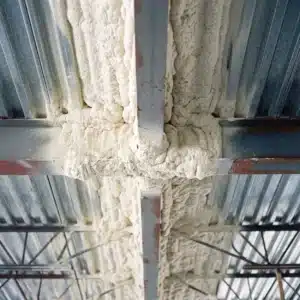
Spray polyurethane foam (SPF) insulation is a two-component reactive polymer applied on-site using specialized proportioning equipment. The “A-side” (isocyanate) and “B-side” (polyol resin blend) are heated, pressurized, and mixed at the spray gun tip, where they react exothermically and expand to fill the cavity or coat the substrate. Within seconds, the liquid components expand to 30 to 100 times their original volume (depending on formulation) and cure into a rigid or semi-rigid insulating foam.
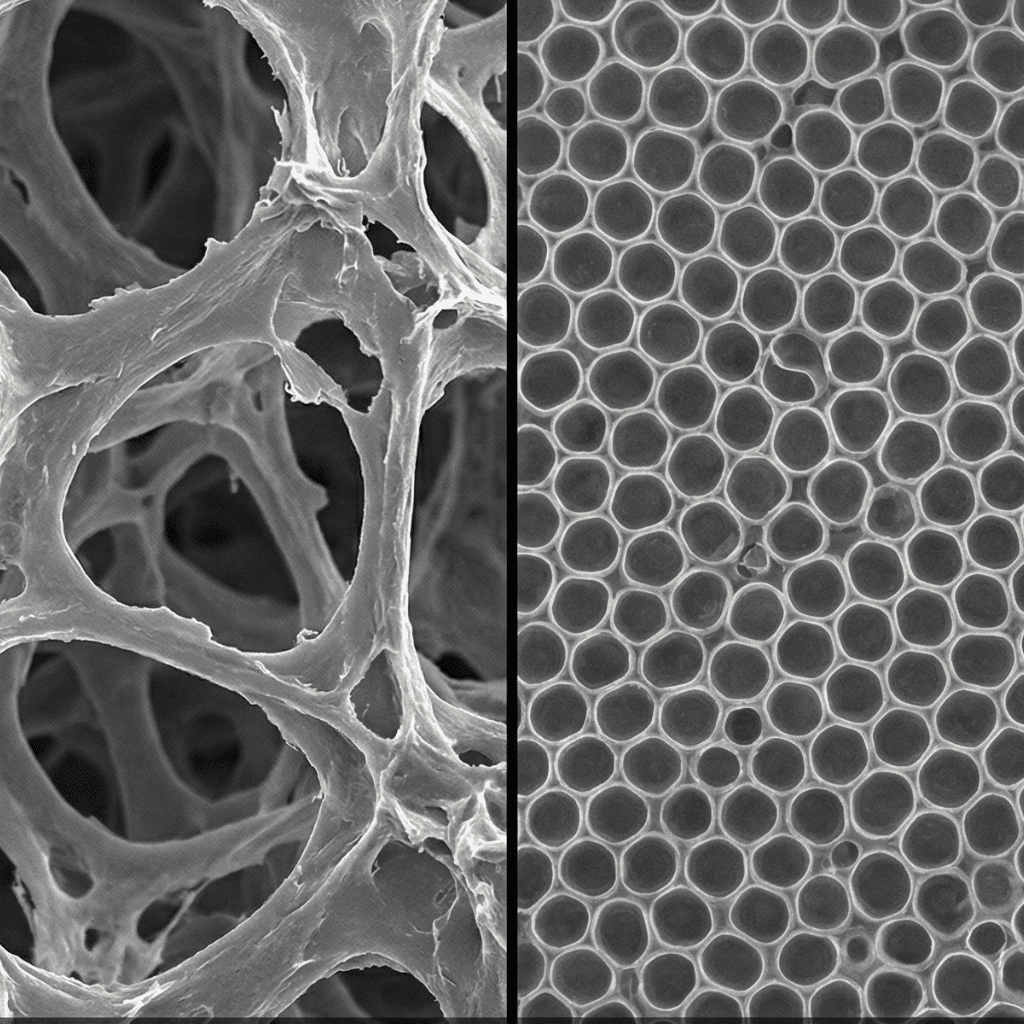
SPF is classified into two categories based on cured density. Closed-cell spray foam cures at approximately 2.0 pounds per cubic foot with a tightly packed cell structure that resists moisture and adds structural rigidity. Open-cell spray foam cures at approximately 0.5 pounds per cubic foot with an interconnected cell structure that is softer, more permeable, and less expensive per board foot. Both types bond directly to the substrate (wood, metal, concrete, or masonry) without fasteners, creating a monolithic insulation layer with no gaps, seams, or thermal bridges.
The Spray Polyurethane Foam Alliance (SPFA) is the industry trade organization that publishes application guidelines, contractor accreditation standards, and technical resources for commercial SPF installations. SPFA accreditation is a meaningful quality indicator when selecting an insulation contractor.
What Is the Difference Between Open-Cell and Closed-Cell Spray Foam?
The primary difference is density and moisture behavior. Closed-cell spray foam (2.0 pcf) provides R-6.0 to R-7.0 per inch, acts as a Class II vapor retarder, and adds structural rigidity. Open-cell spray foam (0.5 pcf) provides R-3.5 to R-3.8 per inch, is vapor permeable, and costs roughly half as much to install. Closed-cell is specified for exterior and moisture-critical applications. Open-cell is suited for interior cavities and sound control.
Closed-Cell vs. Open-Cell: How Density Affects Performance and Cost
The density difference between closed-cell and open-cell spray foam drives every downstream performance characteristic: thermal resistance, moisture behavior, structural contribution, and installed cost. This comparison table summarizes the critical specification differences.
| Performance Factor | Closed-Cell (2.0 pcf) | Open-Cell (0.5 pcf) |
|---|---|---|
| R-value per inch | R-6.0 to R-7.0 | R-3.5 to R-3.8 |
| Vapor permeance (2 inches) | Less than 1 perm (Class II vapor retarder) | Approximately 16 perms (vapor permeable) |
| Air barrier | Yes (at 1 inch minimum) | Yes (at 3.5 inches minimum) |
| Structural reinforcement | Increases wall racking strength up to 300% | None |
| Moisture resistance | Resists bulk water absorption | Absorbs water (not for wet environments) |
| Installed cost per SF | $3.00 to $5.00+ | $1.50 to $3.00 |
| Best commercial applications | Exterior walls, metal buildings, moisture-critical | Interior walls, sound control, concealed cavities |
Closed-cell foam is the default specification for any commercial application where moisture control matters. At 2 inches of closed-cell, the foam achieves less than 1 perm of vapor permeance, qualifying it as a Class II vapor retarder per the IRC and IBC. This is critical in Climate Zone 2A (Houston, DFW, San Antonio, Austin) where hot-humid conditions drive moisture vapor inward through the building envelope for most of the year. Closed-cell foam stops that vapor drive at the foam layer without requiring a separate vapor retarder membrane.
Open-cell foam fills a different role. Its lower density and cost make it effective for interior cavity fill, sound attenuation between spaces, and applications where moisture control is not the primary concern. Open-cell foam at 3 inches achieves approximately 16 perms, meaning it is vapor permeable. In Climate Zone 4A (Kansas, northern Oklahoma), open-cell foam on exterior walls requires a separate vapor retarder on the warm side to prevent condensation at the sheathing during heating season.
One of the most expensive specification mistakes I see on Texas projects is open-cell foam specified for a metal building exterior wall where closed-cell should have been used. The open-cell foam absorbs moisture from the humid air, condensation forms behind the foam at the metal surface, and within 12 to 18 months the building owner is dealing with corrosion, mold, and an insulation system that needs to be removed and replaced. The cost of that rework far exceeds the original savings from choosing open-cell over closed-cell.
R-Value, Air Sealing, and Vapor Control
These three performance characteristics work together as a system. Specifying spray foam based on R-value alone ignores the air sealing and vapor control benefits that often deliver more energy savings than the thermal resistance itself.
R-Value by Thickness
| Thickness | Closed-Cell R-Value | Open-Cell R-Value |
|---|---|---|
| 1 inch | R-6.0 to R-7.0 | R-3.5 to R-3.8 |
| 2 inches | R-12.0 to R-14.0 | R-7.0 to R-7.6 |
| 3 inches | R-18.0 to R-21.0 | R-10.5 to R-11.4 |
| 4 inches | R-24.0 to R-28.0 | R-14.0 to R-15.2 |
Next-generation HFO-blown closed-cell formulations achieve R-6.5 to R-7.0+ per inch with significantly lower global warming potential than traditional HFC-blown products. HFO blowing agents are becoming the industry standard for commercial projects, and specifying them adds sustainability value without sacrificing thermal performance.
Air Barrier Performance
Both closed-cell and open-cell spray foam qualify as air barriers per ASTM E2178 at proper thickness. 2021 IECC Section C402.5.1 requires a continuous air barrier in commercial buildings in all climate zones except 2B, and applies where a jurisdiction has adopted the 2021 edition; Texas commercial work is enforced against the 2015 IECC unless a city has amended upward. ANSI/ASHRAE/IES Standard 90.1 Section 5.4.3 sets continuous air barrier requirements, and applies where a jurisdiction adopts 90.1 or where a project elects the 90.1 compliance path. Research has demonstrated that effective air barriers can reduce air leakage by over 80 percent and cut energy consumption by up to 40 percent, making air sealing one of the highest-return-on-investment envelope improvements available.
Vapor Control and Climate Zone Selection
Vapor behavior is where closed-cell and open-cell foam diverge most significantly, and where climate zone determines which foam type belongs on the project.
In Climate Zone 2A (Houston, DFW, Austin, San Antonio), the dominant vapor drive direction is inward for most of the year: hot, humid outdoor air pushes moisture through the wall assembly toward the cooler, air-conditioned interior. Closed-cell foam on the exterior side of the wall assembly stops this inward vapor drive. Open-cell foam is acceptable for interior partitions but should not be used as the primary vapor control layer in Climate Zone 2A exterior walls.
In Climate Zone 4A (Wichita, northern Oklahoma, northern Kansas), vapor drive reverses seasonally: outward in winter (warm, moist interior air pushing toward the cold exterior) and inward in summer. Closed-cell foam handles both directions because its low permeance blocks vapor regardless of drive direction. Open-cell foam on exterior walls in Zone 4A requires careful analysis of the dew point location within the wall assembly to prevent condensation at the sheathing.
Fire Safety Requirements: IBC Section 2603
Spray foam is combustible. It achieves fire safety through code-compliant barrier systems, not through inherent fire resistance. IBC Section 2603 Foam Plastic Insulation governs foam plastic insulation in commercial buildings, and understanding these requirements is essential for every spray foam specification.
Thermal Barrier Requirement
IBC (2021) Section 2603.4 requires that foam plastic insulation be separated from the building interior by a thermal barrier of 1/2-inch gypsum wallboard, heavy timber per IBC (2021) Section 602.4, or a material meeting the acceptance criteria of both the Temperature Transmission Fire Test and the Integrity Fire Test of NFPA 275. This requirement applies to virtually all occupied commercial spaces. The thermal barrier prevents the foam from contributing fuel to a fire during the critical early minutes when occupants are evacuating.
An alternative compliance path exists through NFPA 286 (Standard Methods of Fire Tests for Evaluating Contribution of Wall and Ceiling Interior Finish to Room Fire Growth). If the spray foam assembly passes the NFPA 286 room corner test, it can be installed without a separate thermal barrier. DC315 intumescent coating is the most common alternative thermal barrier product used for this purpose.
Ignition Barrier Requirement
In limited-access spaces (attics, crawl spaces, and areas not intended for occupancy), an ignition barrier is required instead of a full thermal barrier. Ignition barriers are less stringent: 1/4-inch wood structural panel meets the requirement. This distinction matters for commercial attic insulation projects.
Surface Burning Characteristics: IBC Section 2603.3
ASTM E84 (identical to UL 723) measures Flame Spread Index (FSI) and Smoke Developed Index (SDI). IBC (2021) Section 2603.3 requires foam plastic to have a flame spread index of 75 or less and a smoke-developed index of 450 or less per ASTM E84 or UL 723, tested at the maximum thickness intended for use. Most quality spray foam insulation products test well below that and reach Class A (FSI 25 or less, SDI 450 or less), which is the interior finish threshold rather than the IBC (2021) Section 2603.3 limit. Plenum-rated applications require a more stringent 25/50 rating (FSI 25 or less, SDI 50 or less) per the International Mechanical Code.
The critical distinction between ASTM E84 and ASTM E119 matters here. ASTM E84 measures surface burning characteristics (flame spread and smoke). ASTM E119 measures structural fire resistance (how long a building assembly maintains its load-bearing capacity under fire). Spray foam insulation is tested under ASTM E84 for fire safety classification. Spray-applied fireproofing (SFRM) on structural steel is tested under ASTM E119 for fire-resistance ratings. These are different systems serving different purposes, and they should never be conflated in specifications.
Commercial Building Applications by Type
The right spray foam specification varies by building type because each presents different thermal, moisture, and code challenges.
Metal Buildings
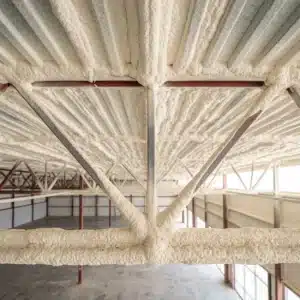
Metal building insulation is where spray foam delivers the most dramatic performance advantage over traditional systems. Closed-cell spray foam bonds directly to metal purlins and girts, eliminating the air gaps that plague fiberglass batt and rigid board installations. At 2 inches minimum, closed-cell foam provides R-12+ insulation, an air barrier, and a Class II vapor retarder in a single application. This is critical for metal buildings in Climate Zone 2A where condensation at the metal surface is the primary moisture risk. The foam also increases wall racking strength by up to 300 percent, adding structural rigidity to the metal building frame.
Warehouses and Distribution Centers
High-bay warehouses in our service territory across Texas, Oklahoma, Kansas, Nebraska, Minnesota, and Wisconsin present large surface areas with minimal conditioning requirements. Closed-cell foam on the roof deck controls condensation and reduces cooling loads. Open-cell foam can work on interior partition walls where moisture control is not critical.
Data Centers
Data centers require precise thermal control to maintain IT equipment operating temperatures. Closed-cell foam on the building envelope eliminates air infiltration that introduces uncontrolled heat and humidity. The airtightness achieved by spray foam directly reduces HVAC energy consumption, which is typically the largest operating expense in data center facilities.
Healthcare Facilities
Healthcare facilities require insulation systems that support infection control environments, indoor air quality standards, and strict fire code compliance. Spray foam’s seamless, monolithic application eliminates the gaps and seams found in batt insulation that can harbor moisture and biological growth. All spray foam in healthcare occupancies must comply with the IBC (2021) Section 2603 thermal barrier requirement without exception.
Spray Foam vs. Traditional Commercial Insulation
Understanding how spray foam compares to traditional insulation options helps specifiers justify the higher upfront cost with lifecycle performance data.
| Factor | Spray Foam (CC) | Spray Foam (OC) | Fiberglass Batts | Mineral Wool | Rigid Foam Board |
|---|---|---|---|---|---|
| R-value per inch | R-6.0 to R-7.0 | R-3.5 to R-3.8 | R-3.0 to R-3.7 | R-3.0 to R-4.2 | R-4.0 to R-6.5 |
| Air barrier | Yes | Yes | No | No | No (requires taping) |
| Vapor retarder | Yes (Class II) | No | No | No | Varies by type |
| Installed cost/SF | $3.00 to $5.00+ | $1.50 to $3.00 | $0.60 to $1.50 | $1.50 to $3.00 | $1.50 to $4.00 |
| Lifespan | 30 to 80+ years | 30 to 50+ years | 15 to 20 years (effective) | 50+ years | 30+ years |
| Settles over time | No | No | Yes | No | No |
Fiberglass batts carry manufacturer lifespan ratings of 50 to 100 years when undisturbed. However, field experience shows that effective thermal performance degrades within 15 to 20 years due to compression, moisture absorption, air washing, and settling. Spray foam does not sag, settle, or lose R-value over its service life because the cured foam maintains its cell structure permanently.
The installed cost premium for spray foam over fiberglass is significant (2x to 5x), but the DOE reports that heating and cooling account for up to 40 percent of the energy used in commercial buildings. Spray foam’s combined air sealing and insulation performance can reduce HVAC workload by up to 35 percent. Commercial installations typically achieve energy bill reductions of 20 to 50 percent, putting the payback period at 3 to 7 years depending on building size, climate zone, and local energy costs.
How Much Does Commercial Spray Foam Cost?
Installed spray foam insulation costs for commercial buildings depend on foam type, application thickness, building access conditions, and project size. Here is what commercial spray foam costs per square foot in our Texas, Kansas, and Oklahoma service territory:
| Foam Type | Cost Per Board Foot | Installed Cost Per SF (at 2″) | Best For |
|---|---|---|---|
| Open-cell (0.5 pcf) | $0.44 to $0.65 | $1.50 to $3.00 | Interior walls, sound control, concealed cavities |
| Closed-cell (2.0 pcf) | $1.00 to $1.50 | $3.00 to $5.00+ | Exterior walls, moisture control, metal buildings |
Cost drivers that most affect your commercial spray foam budget include foam type (closed-cell costs roughly 2x open-cell per board foot), total thickness required (higher R-value means more passes), building accessibility (high-bay ceilings and confined spaces add labor time), project size (larger projects achieve better per-square-foot rates), and climate zone requirements (Houston projects frequently require closed-cell where Kansas projects may allow open-cell, directly affecting material cost).
One cost factor unique to Bahl Fireproofing projects: when a building requires both spray-applied fireproofing on the structural steel and spray foam insulation on the building envelope, our team mobilizes once for both scopes. This eliminates the duplicate mobilization, equipment setup, and coordination overhead that occurs when separate contractors handle fireproofing and insulation independently.
Common Spray Foam Failures and How to Prevent Them
The most costly spray foam failures are specification errors, not installation defects. Getting the foam type, thickness, and barrier system right at the design stage prevents the problems that lead to rework.
Wrong Foam Type for the Climate
Specifying open-cell foam on exterior walls in a hot-humid climate zone (2A) where closed-cell is required for condensation control is the single most expensive mistake in commercial spray foam. The foam absorbs moisture, the wall assembly cannot dry, and within 12 to 18 months the building owner faces mold, corrosion, and a complete insulation replacement. Always match foam type to climate zone vapor drive.
Off-Ratio Application
Spray foam requires precise mixing of the A-side and B-side components at the correct temperature and pressure. Off-ratio application (too much or too little of either component) produces foam with poor cell structure, reduced R-value, and potential for odor or off-gassing. Qualified SPFA-accredited contractors use proportioning equipment with real-time ratio monitoring to prevent this.
Thermal Barrier Omission
IBC (2021) Section 2603.4 requires a thermal barrier (1/2-inch gypsum wallboard, or a material meeting the NFPA 275 acceptance criteria) in all occupied commercial spaces. Omitting this barrier is a code violation that will be caught during inspection. Budget for the thermal barrier from day one, not as an afterthought.
Insufficient Thickness
Spray foam R-value is directly proportional to thickness. Under-application means the wall assembly does not meet the specified R-value or vapor retarder performance. Closed-cell foam at less than 2 inches does not reliably achieve Class II vapor retarder performance (less than 1 perm). Thickness verification during application, not just at final inspection, prevents this.
Spray Foam and Fire Protection: An Integrated Approach
Bahl Fireproofing’s unique position as both a commercial fireproofing and insulation contractor means we frequently coordinate spray-applied fireproofing on structural steel with spray foam insulation on the building envelope on the same project. Understanding how these systems interact is critical for project scheduling and code compliance.
Spray foam insulation protects the building envelope from heat loss and air infiltration. Spray-applied fireproofing (SFRM) protects structural steel from fire. These are complementary systems governed by different code sections (IBC (2021) Section 2603 for foam plastics, IBC (2021) Section 703 for fire-resistance-rated construction). A commercial building may require SFRM on the structural frame for fire-resistance ratings and spray foam on the exterior walls for thermal performance, and the two systems do not conflict when properly specified.
Similarly, K-13 spray-applied insulation can be used on exposed ceilings and walls for acoustic and thermal performance while spray foam handles the building envelope. These combined systems leverage our team’s ability to apply multiple spray-applied products on a single mobilization, reducing coordination complexity and project cost for the building owner.
Related Reading
Explore related topics from the Bahl Fireproofing blog:
- Need to understand the differences between cementitious and intumescent fireproofing for your structural steel? Read our comparison of intumescent and cementitious systems.
- Planning fireproofing for a new commercial building? This guide covers the fireproofing code requirements building owners need to know.
- Substrate preparation matters for both spray foam and SFRM installations. See why surface preparation determines fireproofing performance.
NFPA 285: The Exterior Wall Test That Sits Outside the Thermal Barrier
Chapter 26 does not stop at the thermal barrier. A second gate opens only on exterior walls, and it is the one commercial projects most often meet late. IBC (2021) Section 2603.5 governs exterior walls containing foam plastic insulation in buildings of Type I, II, III or IV construction, of any height, together with multi-story cold storage buildings required to be of noncombustible construction. For those walls, IBC (2021) Section 2603.5.5 requires that the exterior wall assembly be tested in accordance with and comply with the acceptance criteria of NFPA 285.
There is no height threshold in that language, which surprises people. A single-story Type II-B warehouse and a twelve-story Type I-A tower are treated the same once foam plastic enters the exterior wall. Construction type drives the answer, not stories and not square footage.
An Assembly Test, Not a Product Test
NFPA 285 is the Standard Fire Test Method for Evaluation of Fire Propagation Characteristics of Exterior Wall Assemblies Containing Combustible Components, current edition 2025. The test burns a full two-story wall mockup and measures whether flame propagates beyond defined limits, vertically and laterally. Everything in that mockup is part of the tested subject: the exterior cladding, the foam, the air and water-resistive barrier, the framing, the window head. It is an assembly test, not a product test. Because it qualifies a whole system, no foam product is NFPA 285 compliant by itself, and exchanging one component for another can end the listing.
What you want in the compliance file, then, is a specific assembly listing that matches the wall on the drawings, obtained before material is ordered. Where the built wall departs from every listed assembly, two routes remain: an engineering judgment from a qualified fire protection engineer, or a test of the proposed build-up.
The Numbers That Travel With It
IBC (2021) Section 2603.3 requires foam plastic to show a flame spread index of 75 or less and a smoke-developed index of 450 or less. On Type I through IV exterior walls, IBC (2021) Section 2603.5.4 drops the flame spread ceiling to 25 or less, holds smoke developed at 450 or less, and calls for testing at the intended thickness up to 4 inches under ASTM E84 or UL 723. IBC (2021) Section 2603.4 stays its own separate requirement, satisfied by 1/2-inch gypsum wallboard, heavy timber complying with IBC (2021) Section 602.4, or a material meeting the acceptance criteria of both the Temperature Transmission Fire Test and the Integrity Fire Test of NFPA 275.
The Exemption and the Two Exceptions
- Type V construction is outside the section entirely. Only IBC (2021) Sections 2603.2, 2603.3 and 2603.4 apply to those exterior walls.
- Exception 1. One-story buildings complying with IBC (2021) Section 2603.4.1.4.
- Exception 2. Foam plastic covered on each face by not less than 1 inch of masonry or concrete, with either no airspace, or a flame spread index of 25 or less and an airspace not more than 1 inch.
Read all three narrowly. Deciding the construction type, identifying which assembly is listed, and judging whether an exception genuinely fits are matters for the architect or engineer of record and the authority having jurisdiction.
Frequently Asked Questions
What Is the Difference Between Open-Cell and Closed-Cell Spray Foam?
Closed-cell spray foam cures at 2.0 pounds per cubic foot with a rigid, closed-cell structure that provides R-6.0 to R-7.0 per inch, acts as a Class II vapor retarder at 2 inches, and adds structural rigidity. Open-cell spray foam cures at 0.5 pounds per cubic foot with a softer, permeable cell structure that provides R-3.5 to R-3.8 per inch at roughly half the installed cost. Closed-cell is specified for moisture-critical and exterior applications. Open-cell is suited for interior cavities and sound control.
Does Spray Foam Need a Thermal Barrier in Commercial Buildings?
Yes. IBC (2021) Section 2603.4 requires foam plastic insulation to be separated from the building interior by a thermal barrier (1/2-inch gypsum wallboard, or a material meeting the NFPA 275 acceptance criteria). A further path opens if the specific spray foam assembly passes the NFPA 286 room corner test, which demonstrates thermal barrier equivalence. Limited-access spaces like attics and crawl spaces require an ignition barrier (less stringent than a full thermal barrier) instead.
What R-Value Does Spray Foam Achieve Per Inch?
Closed-cell spray foam achieves R-6.0 to R-7.0 per inch at 2.0 pcf density. HFO-blown formulations reach the higher end of that range. Open-cell spray foam achieves R-3.5 to R-3.8 per inch at 0.5 pcf density. At 3 inches, closed-cell delivers R-18 to R-21 while open-cell delivers R-10.5 to R-11.4.
Is Closed-Cell Spray Foam a Vapor Barrier?
Closed-cell spray foam at 2 inches or more achieves less than 1 perm of vapor permeance, classifying it as a Class II vapor retarder (not a true vapor barrier, which is Class I at less than 0.1 perms). This distinction matters for specification accuracy. In practical terms, closed-cell foam at 2 inches provides sufficient vapor control for commercial wall assemblies in Climate Zones 2A through 4A across Texas, Kansas, and Oklahoma.
How Long Does Spray Foam Insulation Last?
Closed-cell spray foam maintains its performance for 30 to 80+ years with proper installation and no physical damage. Open-cell spray foam lasts 30 to 50+ years. Unlike fiberglass batts, spray foam does not sag, settle, compress, or absorb moisture (closed-cell), which means it maintains its rated R-value for the life of the building. Manufacturer lifespan ratings reflect the inherent stability of cured polyurethane foam.
Can Spray Foam Be Applied to Metal Buildings?
Closed-cell spray foam is the preferred insulation for commercial metal buildings. It bonds directly to metal purlins and girts without fasteners, eliminates the air gaps that reduce fiberglass batt performance, and prevents condensation at the metal surface by managing the dew point within the wall assembly. A minimum of 2 inches is recommended for adequate vapor retarder performance in humid climates like Texas Climate Zone 2A.
How Much Does Commercial Spray Foam Cost Per Square Foot?
Open-cell spray foam installs at $1.50 to $3.00 per square foot and closed-cell at $3.00 to $5.00+ per square foot for commercial projects in Texas, Oklahoma, Kansas, Nebraska, Minnesota, and Wisconsin. Cost per board foot runs $0.44 to $0.65 for open-cell and $1.00 to $1.50 for closed-cell. Project size, building access, required thickness, and climate zone all affect final installed cost.
Does Spray Foam Replace Fireproofing on Structural Steel?
No. Spray foam insulation and spray-applied fireproofing serve different purposes governed by different code sections. Spray foam (IBC (2021) Section 2603) insulates the building envelope for thermal performance. SFRM (IBC (2021) Section 703, tested per ASTM E119) protects structural steel from fire to maintain load-bearing capacity. A commercial building may require both systems, and one does not substitute for the other.
Key Takeaways
Foam Selection
- Closed-cell (2.0 pcf, R-6.0 to R-7.0 per inch) is the default for exterior walls, metal buildings, and any application requiring moisture control or vapor retarder performance
- Open-cell (0.5 pcf, R-3.5 to R-3.8 per inch) is effective for interior cavities and sound control at roughly half the installed cost
- Specifying the wrong foam type for the climate zone leads to condensation, mold, and costly rework within 12 to 18 months
Climate Zone Guidance
- Climate Zone 2A (Houston, DFW, Austin, San Antonio) requires closed-cell on exterior walls for inward vapor drive control
- Climate Zone 4A (Wichita, northern Oklahoma) benefits from closed-cell for its ability to block vapor drive in both heating and cooling seasons
- Open-cell on exterior walls in Zone 4A requires careful dew point analysis to prevent condensation at the sheathing
Fire Code Compliance
- IBC (2021) Section 2603 requires thermal barriers (1/2-inch gypsum) in all occupied commercial spaces where foam plastic is installed
- This requirement is non-negotiable and must be budgeted from the design stage
- NFPA 286 room corner testing provides an alternative compliance path; DC315 intumescent coating is the most common alternative thermal barrier
Spray Foam and Fireproofing
- Spray foam insulation (IBC (2021) Section 2603) protects the building envelope; SFRM (IBC (2021) Section 703) protects structural steel
- Both may be required on the same project under different code sections, and one does not replace the other
ROI and Payback
- Commercial payback for spray foam typically runs 3 to 7 years
- Combined air sealing and insulation performance reduces HVAC workload by up to 35 percent
- Energy bill reductions of 20 to 50 percent reported across commercial installations
Contractor Selection
- SPFA contractor accreditation is a meaningful quality indicator for commercial spray foam projects
- Off-ratio application, insufficient thickness, and wrong foam type selection are the most common causes of failure
- All three failure modes are prevented by qualified contractors using proper proportioning equipment and climate-zone-aware specifications
Whether you are specifying spray foam insulation for a new metal building, upgrading the envelope on an existing warehouse, or coordinating insulation with structural fireproofing on a commercial project, the right foam type and application approach make the difference between a building that performs for decades and one that fails within years. With over 20 years of spray-applied insulation and fireproofing experience across Texas, Kansas, and Oklahoma, Bahl Fireproofing delivers the technical knowledge and field experience to get your specification and installation right. Contact Bahl Fireproofing today at 512-387-2111 or email ross@bahlfireproofing.com to discuss your project or request a detailed estimate.
This article provides general educational information about spray foam insulation for commercial buildings. It is not a substitute for project-specific engineering, design, or code analysis. R-values, vapor permeance ratings, cost ranges, and fire safety requirements referenced in this article are based on manufacturer published data, ASTM testing standards, and field experience in the Texas, Kansas, and Oklahoma market as of early 2026. Spray foam performance varies by product formulation, application conditions, and substrate type. Building codes, energy codes, and fire safety requirements vary by jurisdiction. IBC (2021) Section 2603 thermal barrier requirements apply to virtually all occupied commercial spaces. Spray foam insulation is combustible and achieves fire safety through code-compliant barrier systems, not inherent fire resistance. Always consult a licensed professional engineer, architect, or code official for project-specific requirements. Bahl Fireproofing is a commercial fireproofing and insulation contractor, not an engineering or design firm.