From density selection and bond strength requirements to IBC code compliance, special inspections, and installed cost, this guide covers everything contractors, architects, and specifiers need to know about spray-applied fireproofing for commercial steel construction. Whether you are specifying SFRM for a high-rise office tower, a warehouse distribution center, or a hospital, this resource delivers the technical data, field insights, and decision frameworks that lead to better specifications and fewer costly surprises.
TLDR: Spray-applied fireproofing (SFRM) is the primary passive fire protection system for commercial structural steel, achieving 1 to 4 hour fire-resistance ratings per UL 263 and ASTM E119. Three density categories (commercial at 15 to 21 pcf, medium at 22 to 39 pcf, and high at 40+ pcf) serve different building environments. Bond strength runs from a 150 psf general minimum under IBC (2021) Section 1705.15.6 up to 1,000 psf for super high-rise work under IBC (2021) Table 403.2.3. Installed costs range from $5 to $20+ per square foot depending on density and application conditions.
Code note: unless otherwise stated, code references on this page are to the 2021 International Building Code. Code adoption is state and local. Across the states we serve, adopted IBC editions currently range from the 2012 edition to the 2024 edition, some states have no statewide commercial building code, and several enforce NFPA 1 or NFPA 101 rather than the International Fire Code. Minnesota and Wisconsin publish state-amended code books whose numbering and requirements differ from the model code. This is general technical information, not a code determination for your project. Confirm the adopted edition and any local amendments with your authority having jurisdiction.
Every commercial steel building project I work on in Texas, Kansas, and Oklahoma involves the same core decision: which spray-applied fireproofing system, at what density, meets the code requirement while fitting the project budget and schedule? That question sounds simple, but answering it correctly requires understanding how density categories affect both performance and cost, how bond strength requirements change with building height, what the special inspector will measure, and how field conditions in our service territory create challenges that no manufacturer data sheet addresses.
Over the past 20 years, I have applied SFRM on hundreds of commercial projects: warehouses, hospitals, data centers, parking garages, high-rise offices, and manufacturing facilities. This guide shares the practical knowledge that comes from that experience alongside verified manufacturer data, current IBC code references, and NFCA application standards so you can make confident specification and installation decisions on your next project.
What Is Spray-Applied Fireproofing (SFRM)?
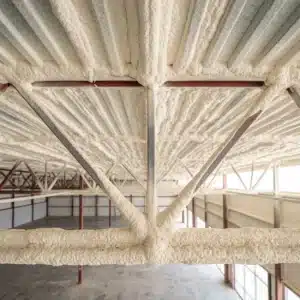
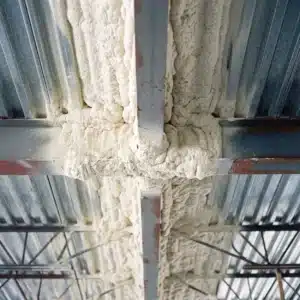
Spray-Applied Fire-Resistive Material (SFRM) is a passive fire protection coating composed of gypsum or Portland cement mixed with aggregates like mineral wool, perlite, or vermiculite. Applied wet or dry to structural steel columns, beams, and metal decking, SFRM thermally insulates building elements to maintain structural integrity during a fire for the rated time period (1, 2, 3, or 4 hours per ASTM E119 and UL 263).
SFRM works by a straightforward mechanism: when exposed to fire, the bound water within the cured material absorbs heat energy as it converts to steam. This endothermic process, combined with the insulating properties of the lightweight aggregates, slows heat transfer to the structural steel and keeps it below the critical failure temperature of approximately 1,000 degrees Fahrenheit (538 degrees Celsius). The longer the steel stays below that threshold, the more time building occupants have to evacuate and fire crews have to respond.
The distinction between SFRM and intumescent fireproofing (IFRM) matters for specification accuracy. SFRM is the thick, rough-textured material applied in inches, designed for concealed steel behind walls, above ceilings, and inside shafts. IFRM is the thin, paint-like coating applied in mils for architecturally exposed structural steel (AESS). Both achieve the same fire-resistance ratings, but they serve different visibility and aesthetic requirements. If your steel will be hidden, SFRM is almost always the right choice based on cost and application speed.
Modern SFRM formulations are asbestos-free and contain no free crystalline silica. The binder (gypsum or Portland cement) hardens as it dries, while the aggregate materials lighten the mixture and trap air for insulating performance. Chemical hardeners may be added to accelerate curing or increase final surface hardness.
How SFRM Density Affects Performance and Cost
Density is the single most consequential specification decision in any SFRM project. It determines physical durability, bond strength, applicable building environments, and installed cost. The three density categories defined by the industry serve distinctly different project requirements.
| Density Category | Range (pcf) | Binder Type | Best Applications | Key Characteristic |
|---|---|---|---|---|
| Commercial (Low) | 15 to 21 | Gypsum | Concealed areas behind ceilings, walls, shafts | Fastest coverage, lowest cost, minimal impact resistance |
| Medium | 22 to 39 | Portland cement or cement-gypsum blend | Exposed conditions, moderate-traffic areas, high-rise | Withstands air movement and minor contact |
| High | 40+ | Portland cement | Mechanical rooms, parking garages, industrial | Maximum durability, withstands significant impact |
Commercial density (15 to 21 pcf) accounts for the majority of SFRM work in our Texas, Oklahoma, Kansas, Nebraska, Minnesota, and Wisconsin projects. Products like Isolatek’s CAFCO 300 (gypsum-based, wet spray, 15 pcf) provide fire-resistance ratings up to 4 hours at the lowest material cost. Commercial density SFRM is designed for concealed applications where the material will not be exposed to foot traffic, equipment contact, or weather. If it will be behind drywall, above a ceiling grid, or inside a shaft, commercial density is typically the right specification.
Medium density (22 to 39 pcf) uses Portland cement as the primary binder, creating a harder, more durable surface. Isolatek’s CAFCO BLAZE-SHIELD HP (22 pcf, dry spray) is the only medium density product UL-classified for exterior use, making it valuable for steel that remains temporarily exposed during construction phases before the building envelope is closed. Medium density is specified for exposed commercial environments, areas with air handler equipment that creates sustained airflow, and any application requiring higher physical abuse resistance.
High density (40+ pcf) is the industrial workhorse. Carboline’s Pyrocrete product line (40 to 55 pcf) provides both cellulosic fire protection (ASTM E119) and hydrocarbon fire protection (UL 1709) for petrochemical, offshore, and heavy industrial applications. High density SFRM is specified for mechanical rooms, parking garages, and environments where the material will be subject to regular physical contact.
One of the most common density selection mistakes I encounter in the field is specifying commercial density SFRM in a parking garage or mechanical room because it costs less per square foot. Within months of occupancy, the material is damaged by maintenance carts, equipment access, and incidental contact. The rework cost (removal plus reapplication with medium or high density) far exceeds the original savings.
When Does the IBC Require Spray-Applied Fireproofing?
The International Building Code does not mandate SFRM specifically. It mandates fire-resistance ratings for structural elements based on construction type. SFRM is the most common method of achieving those ratings for concealed structural steel, but intumescent coatings, board systems, and concrete encasement are also code-compliant options.
IBC (2021) Table 601 is the starting point for every commercial fireproofing specification. It maps construction type to required fire-resistance ratings for structural frame, bearing walls, floor construction, and roof construction. IBC Section 704 governs the fire-resistance rating of structural members and the application of fire-resistive materials.
| Construction Type | Structural Frame | Floor Construction | Roof Construction |
|---|---|---|---|
| Type I-A | 3 hours | 2 hours | 1.5 hours |
| Type I-B | 2 hours | 2 hours | 1 hour |
| Type II-A | 1 hour | 1 hour | 1 hour |
| Type II-B | 0 hours | 0 hours | 0 hours |
Type II-B is the most common construction type for single-story steel warehouses in Texas, and it requires 0-hour fire-resistance ratings for the structural frame. This means many warehouses in our service territory do not require SFRM at all. But the moment building height, occupant load, or occupancy classification triggers Type II-A or higher, spray-applied fireproofing becomes mandatory.
The fire-resistance rating from IBC (2021) Table 601 determines the required SFRM thickness, which is documented in the UL Fire Resistance Directory under specific Design Assembly numbers. The thickness depends on the product, the steel member type and size (W-shape, HSS, pipe column), and whether the assembly is restrained or unrestrained per IBC (2021) Section 703.2.3. Always reference the specific UL Design Assembly number in project specifications, not a generic “2-hour fireproofing” callout.
Bond Strength Requirements for High-Rise Construction
SFRM bond strength requirements under the IBC were significantly strengthened after the September 11, 2001 World Trade Center attacks. The investigation determined that cementitious fireproofing had been dislodged from structural steel during impact, exposing unprotected steel to high-temperature fires. In response, the International Code Council introduced height-based bond strength requirements that remain in effect today under IBC (2021) Table 403.2.3. The 150 psf figure in the first row below is not from that table. It is the general minimum in IBC (2021) Section 1705.15.6, shown here for comparison.
| Building Height | Minimum SFRM Bond Strength |
|---|---|
| 0 to 75 feet (non-high-rise) | 150 psf |
| 75 to 420 feet (high-rise) | 430 psf |
| Over 420 feet (super high-rise) | 1,000 psf |
For standard commercial buildings under 75 feet (the vast majority of projects in our service territory), the 150 psf bond strength requirement is met by virtually all commercial density products. The challenge arises at the 75-foot threshold, where the code requires 430 psf. Until recently, this meant specifying medium density SFRM for all high-rise projects, which carries higher material cost and slower application rates.
However, newer commercial density products like Isolatek’s CAFCO 300 HS (15 pcf, gypsum-based) now achieve bond strengths exceeding 500 psf while maintaining commercial density characteristics. This innovation has changed the economics of high-rise fireproofing in DFW and Austin, where the Texas data center and commercial office construction boom means more projects are crossing the 75-foot threshold. If your high-rise specification still defaults to medium density for bond strength compliance, ask whether a high-strength commercial density product can meet the requirement at lower cost.
Bond strength is tested per ASTM E736 during special inspection. The test measures adhesive and cohesive strength of the applied SFRM. Consistent bond strength across a project depends on proper substrate preparation, which is why surface prep failures are among the most common inspection deficiencies I see.
Wet Spray vs. Dry Spray Application Methods
SFRM is applied using one of two spray methods, and the choice between them depends on the product formulation, environmental conditions, and project logistics.
Wet spray is the more common method for commercial density products. The SFRM is mixed with water to form a slurry, pumped through a hose, and dispersed with compressed air through a spray nozzle at the application point. In our experience, wet spray products like CAFCO 300 typically achieve faster daily coverage rates (we consistently see 10 to 15 percent more square footage per day compared to dry spray) because the material arrives at the nozzle ready to apply.
Dry spray is the standard method for medium density products like CAFCO BLAZE-SHIELD HP. The dry SFRM powder is pneumatically conveyed through a hose, and atomized water is introduced at the nozzle tip where it combines with the dry material at the point of application. Dry spray is particularly useful when environmental conditions (cold temperatures, partially enclosed buildings) make wet-mixed material more difficult to work with.
Trowel application is used for patching, completing coverage in hard-to-reach areas, and repairing damaged sections. Trowel-grade versions of major SFRM products are available for this purpose.
A typical SFRM project uses a 4-person crew and takes 8 to 10 working days for a standard commercial building, though this varies significantly with building size, density specification, and access conditions. On Texas projects during summer months, we schedule spray application in morning hours when temperatures and humidity are lower, particularly for gypsum-based products that are more sensitive to environmental conditions during the initial cure phase.
Surface Preparation and Substrate Requirements
Surface preparation is the foundation of every successful SFRM installation, and it is the step most frequently shortcut on commercial projects. The NFCA 100 Standard (Standard Practice for Application of Spray-Applied Fire Resistive Materials) and every manufacturer’s technical data sheet specify the same baseline: steel surfaces must be free of oil, grease, loose mill scale, dirt, primers, paint, and rolling compounds before SFRM application.
Pre-application requirements extend beyond the steel surface. Ambient and substrate temperature must be maintained at a minimum of 40 degrees Fahrenheit for at least 24 hours before, during, and 24 hours after application. Natural ventilation at 4 or more air changes per hour (or equivalent mechanical ventilation) must be maintained. Concrete placement on metal floor decking should be complete before applying SFRM to the underside of the deck, because deflection from wet concrete can cause delamination of freshly applied SFRM.
Primers and adhesives are applied only when required and recommended by the SFRM manufacturer. Not all products require primer, but when the specification calls for it, the primer must be the product listed in the UL Design Assembly. Substituting a different primer (a mistake I encounter frequently when the steel fabricator applies a shop primer without checking the fireproofing specification) can invalidate the entire fire-resistance rating for the assembly.
NFCA 100 recommends a mock-up section witnessed by the architect or owner’s representative before proceeding with full application. This step verifies that the application crew, equipment, material, and ambient conditions produce a result that meets the specification. Most general contractors skip this step, and it is one of the most cost-effective quality assurance measures available.
SFRM Special Inspection and Testing Requirements
Special inspections for spray-applied fireproofing are mandatory under IBC Chapter 17, IBC (2021) Section 1705.15 (Section 1705.14 in the 2018 and earlier editions) (IBC 2021 edition). The building owner is responsible for engaging an approved inspection agency, not the contractor. This is the same requirement that applies to intumescent fireproofing, and it catches building owners off guard with the same frequency.
The special inspector must verify five specific items per IBC (2021) Section 1705.15.1: substrate conditions prior to application, thickness of the applied SFRM (measured per ASTM E605), density of material samples (per ASTM E605 using the glass bead displacement method), bond strength and adhesion (per ASTM E736), and condition of the finished application (visual inspection for cracks, delamination, and voids).
Testing frequency matters for project planning. IBC requires a minimum of one density and thickness sample per 2,500 square feet of sprayed area for floor, roof, and wall assemblies. On a 50,000 square foot warehouse, that means at least 20 sample locations. Many general contractors are unaware of this testing frequency requirement, which creates scheduling delays when the special inspector needs access across the entire floor plate.
Inspections must occur during construction, with additional visual inspection after rough installation of MEP systems and suspension systems, and before concealment behind walls or ceilings. This sequencing requirement means the fireproofing schedule must coordinate with the MEP and drywall trades, not just the structural steel erection.
How Much Does Spray-Applied Fireproofing Cost?
Installed SFRM costs range from $5 to $20+ per square foot depending on density category, fire rating, and project conditions. Here is what spray applied fireproofing costs per square foot in our Texas, Kansas, and Oklahoma service territory:
| Density Category | Installed Cost/SF | Best For |
|---|---|---|
| Commercial (15 to 21 pcf) | $5 to $14 | Standard concealed steel, most commercial projects |
| Medium (22 to 39 pcf) | $7 to $16 | Exposed conditions, high-rise, exterior-during-construction |
| High (40+ pcf) | $10 to $20+ | Mechanical rooms, parking garages, industrial |
| Intumescent (for comparison) | $10 to $30+ | Architecturally exposed structural steel |
The cost drivers that most affect your project budget are density specification (the primary variable), fire rating hours (higher ratings require thicker application), building accessibility (high-bay ceilings require lifts), whether the building is framed in (partially open structures may need temporary protection for SFRM), and MEP coordination (if ductwork and piping are already installed, masking and patching add significant labor cost).
MEP coordination is the hidden cost that blindsides projects most often. Spray-applied fireproofing is installed immediately after structural steel erection and before MEP rough-in. When MEP trades install beam clamps for ductwork and piping, they inevitably chip through the SFRM. Every beam clamp location requires patching with the same or compatible material to maintain the UL Design Assembly rating. Planning for a patching mobilization from day one is not optional. It is a cost that will occur on every project. Ignoring it in the budget creates a change order later.
Common SFRM Failures and How to Prevent Them
In 20 years of spray-applied fireproofing work, I have seen the same failures repeat across projects. Understanding these failure modes before construction starts is the most effective way to prevent them.
Moisture and Water Damage
Moisture is the leading cause of SFRM degradation. SFRM is porous by design (the porosity contributes to its insulating properties), which means it absorbs water readily. Prolonged moisture exposure causes delamination, loss of bond strength, and in severe cases, mold growth within the material. This is particularly relevant for Texas Gulf Coast projects where humidity routinely exceeds 80 percent and for any project where the building envelope is not yet closed when SFRM is applied.
Freeze-Thaw Cycling
Freeze-thaw cycling affects SFRM on projects in Kansas and northern Oklahoma where temperatures fluctuate around 32 degrees Fahrenheit during construction. Absorbed water expands as it freezes, creating internal stress that cracks and weakens the material. The fix is simple but often overlooked: do not apply SFRM to steel that will be exposed to freezing temperatures before the building is enclosed, or use a medium density product rated for exterior exposure (CAFCO BLAZE-SHIELD HP is the only medium density SFRM UL-classified for this condition).
MEP Trade Damage
MEP trade damage is inevitable but manageable. Beam clamps, conduit hangers, and pipe supports all require penetrating or removing SFRM. The key is scheduling: spray first, then MEP, then patch. Trying to spray around installed MEP systems costs significantly more due to masking, cutting, and reduced spray efficiency.
Insufficient Thickness
Insufficient thickness fails inspection because the fire-resistance rating is directly tied to SFRM thickness per the UL Design Assembly. Under-application means the assembly does not meet its rated performance. Continuous thickness monitoring during application (not just at inspection) prevents this.
Premature Loading
Premature loading from construction traffic, material storage, or equipment before the SFRM has fully cured (14 to 28 days depending on conditions) damages the material during its most vulnerable phase. Protect applied SFRM areas from all traffic until the special inspector confirms the material has reached its specified density and bond strength.
Spray-Applied Fireproofing for Different Building Types
The right spray applied fireproofing specification for commercial buildings varies by building type because each presents different exposure conditions, code requirements, and practical challenges.
Warehouses and Distribution Centers
Warehouses and distribution centers are the highest-volume SFRM application in our service territory. Most are Type II-B construction (0-hour structural frame) and do not require fireproofing. When they do (Type II-A or higher), commercial density SFRM at the minimum specified thickness is typically sufficient since the steel is concealed above the roof deck.
Hospitals and Healthcare Facilities
Hospitals and healthcare facilities require higher fire-resistance ratings (typically Type I-A or I-B) and present unique scheduling challenges because fireproofing must be coordinated with complex MEP systems including medical gas, IT infrastructure, and specialized HVAC.
Data Centers
Data centers drive significant SFRM demand in the Texas market, particularly the DFW corridor. Data center steel is typically concealed, making commercial density SFRM the standard. The critical consideration is scheduling: data center construction timelines are aggressive, and SFRM cure time must be factored into the fast-track schedule.
Parking Garages
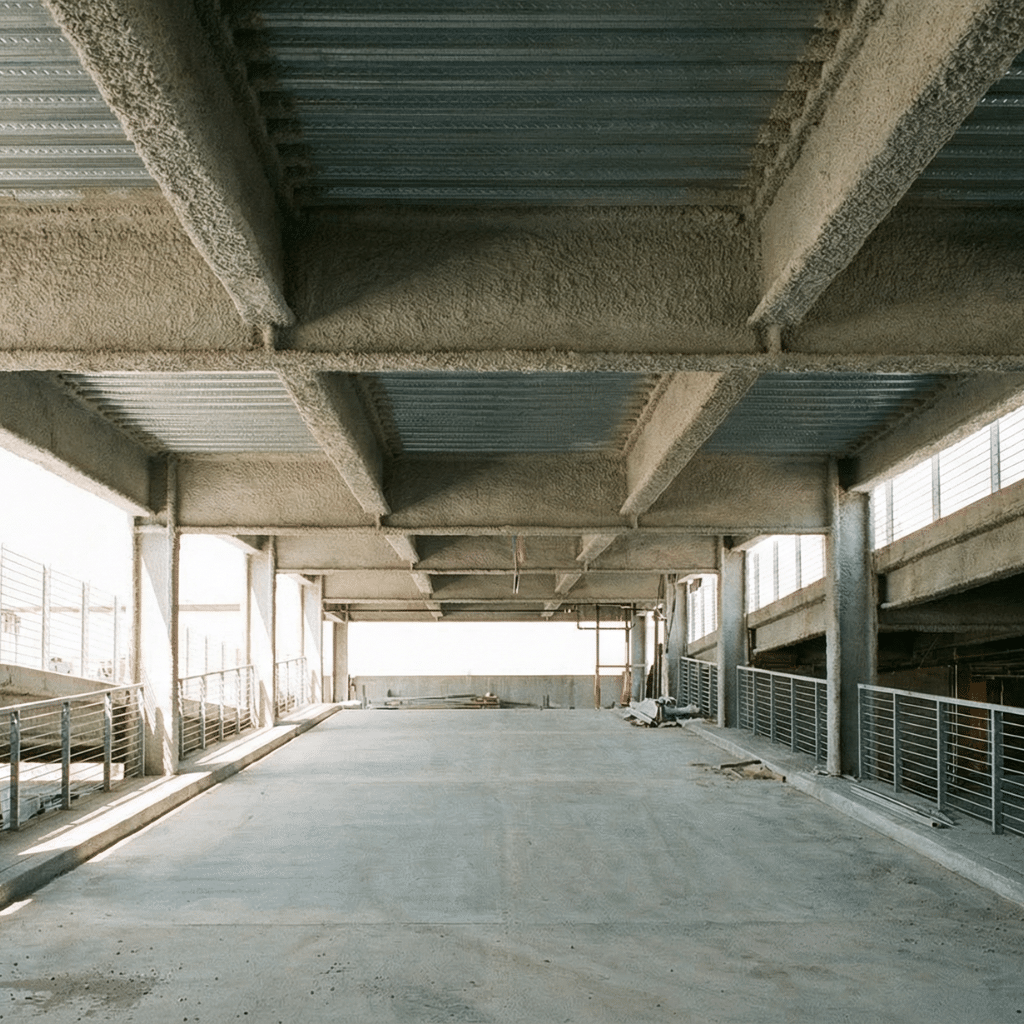
Parking garages require medium or high density SFRM because the material is exposed to vehicle traffic, weather (in open-air garages), and physical contact. Carboline’s Pyrocrete product line provides the durability and, where required, UL 1709 hydrocarbon fire ratings for this environment.
Related Reading
Explore more spray-applied fireproofing topics from Bahl Fireproofing:
- Comparing SFRM to intumescent alternatives? Read our side-by-side breakdown of intumescent vs. cementitious fireproofing.
- Need to understand what the code requires for your building type? This guide covers commercial fireproofing requirements for building owners.
- Proper substrate prep is the foundation of every successful SFRM installation. See why surface preparation matters in commercial fireproofing.
Frequently Asked Questions
What Is SFRM in Construction?
SFRM stands for Spray-Applied Fire-Resistive Material, a passive fire protection coating applied to structural steel to achieve fire-resistance ratings of 1 to 4 hours per ASTM E119 and UL 263. Composed of gypsum or Portland cement mixed with lightweight aggregates, SFRM thermally insulates steel members to prevent them from reaching the critical failure temperature of approximately 1,000 degrees Fahrenheit during a fire.
What Are the Three Density Categories of SFRM?
Commercial density (15 to 21 pcf) uses gypsum binder and is designed for concealed applications. Medium density (22 to 39 pcf) uses Portland cement and serves exposed or high-traffic environments. High density (40+ pcf) uses Portland cement and provides maximum durability for mechanical rooms, parking garages, and industrial facilities. Each category carries different bond strength, impact resistance, and cost characteristics.
When Is Spray-Applied Fireproofing Required by Code?
The IBC requires fire-resistance-rated construction based on building construction type (IBC (2021) Table 601), occupancy group, and building height. Type II-B and Type V-B buildings require 0-hour structural frame ratings (no SFRM needed). Type I-A buildings require 3-hour structural frame protection. The design team selects SFRM as the fire protection method based on whether the steel will be concealed, the required rating, and the project budget.
How Long Does SFRM Take to Cure?
SFRM requires 14 to 28 days for full cure depending on ambient temperature and humidity. During this period, the material is vulnerable to damage from construction traffic, equipment, and environmental exposure. No ductwork, piping, equipment, or framing should be positioned against freshly applied SFRM until curing is complete. In Texas summer conditions, high humidity can extend cure times beyond the typical 28-day window.
What Is the Bond Strength Requirement for High-Rise SFRM?
Two different code sections set it. IBC (2021) Section 1705.15.6 sets the general minimum at 150 psf. For high-rise buildings, IBC (2021) Table 403.2.3 raises it to 430 psf up to 420 feet and 1,000 psf above 420 feet, measured above the lowest level of fire department vehicle access. These height-based requirements were introduced after the September 11, 2001 attacks. Newer commercial density products like CAFCO 300 HS now achieve 500+ psf bond strength while maintaining lower density and cost.
How Much Does Spray-Applied Fireproofing Cost Per Square Foot?
Installed SFRM costs range from $5 to $14 per square foot for commercial density, $7 to $16 for medium density, and $10 to $20+ for high density. Cost varies by density, fire rating, building accessibility, geographic location, and MEP coordination requirements. For comparison, intumescent coatings run $10 to $30+ per square foot. SFRM is the lower-cost option for concealed steel applications.
What Does the SFRM Special Inspector Check?
Per IBC (2021) Section 1705.15, the special inspector verifies five items: substrate conditions, application thickness (ASTM E605), material density (ASTM E605), bond strength (ASTM E736), and finished condition (visual inspection for cracks, voids, and delamination). Testing requires a minimum of one sample per 2,500 square feet of sprayed area. The building owner, not the contractor, is responsible for hiring the inspection agency.
Can K-13 Insulation Be Applied Over SFRM?
Yes. K-13 spray-applied insulation is UL-approved for application over SFRM in specific UL BXUV Design Assemblies, adding thermal and acoustical performance to fire-rated structural steel assemblies. This combined system approach is a dual-benefit solution Bahl Fireproofing regularly implements, providing fire protection and insulation in a single coordinated installation.
Key Takeaways
SFRM is the primary passive fire protection system for concealed structural steel in commercial construction, achieving 1 to 4 hour fire-resistance ratings per ASTM E119 and UL 263.
Density selection is the most consequential specification decision. Commercial density (15 to 21 pcf) covers most concealed applications. Medium density (22 to 39 pcf) serves exposed environments and high-rise bond strength requirements. High density (40+ pcf) handles industrial and parking garage conditions. Specifying too low a density for the exposure condition leads to damage and costly rework.
Bond strength requirements increase with building height: 150 psf under 75 feet, 430 psf for 75 to 420 feet, and 1,000 psf above 420 feet. Newer commercial density products like CAFCO 300 HS now meet the 430 psf high-rise requirement at lower cost than traditional medium density specifications.
Special inspections under IBC (2021) Section 1705.15 are mandatory. The building owner is responsible for hiring the inspection agency. Testing requires one sample per 2,500 square feet, covering substrate conditions, thickness, density, bond strength, and finished condition.
MEP coordination is the hidden cost on every SFRM project. Beam clamps for ductwork and piping will damage SFRM at every attachment point. Budget for a patching mobilization from day one, not as a change order.
In Texas, high humidity and summer heat extend SFRM cure times beyond the standard 14 to 28 day window. In Kansas and northern Oklahoma, freeze-thaw cycling damages SFRM on steel exposed before the building envelope is closed. Specify medium density exterior-rated products (CAFCO BLAZE-SHIELD HP) when steel will be temporarily exposed.
Whether you are specifying SFRM for a new commercial project, evaluating density options for a high-rise building, or coordinating fireproofing with MEP trades on a fast-track schedule, the right specification and application approach makes the difference between a project that passes inspection on the first attempt and one that faces costly rework. With over 20 years of spray-applied fireproofing experience across Texas, Kansas, and Oklahoma, Bahl Fireproofing delivers the technical expertise and field knowledge to get your project done right the first time. Contact Bahl Fireproofing today at 512-387-2111 or email ross@bahlfireproofing.com to discuss your specification or request a detailed estimate.
This article provides general educational information about spray-applied fireproofing for commercial buildings. It is not a substitute for project-specific engineering, design, or code analysis. Fire-resistance ratings, density specifications, bond strength requirements, and cost ranges referenced in this article are based on manufacturer published data, standardized testing (ASTM, UL), and field experience in the Texas, Kansas, and Oklahoma market as of early 2026. SFRM thickness requirements are product-specific and steel-section-specific. Always reference the specific manufacturer’s loading table and UL Design Assembly data for project-specific thickness requirements. Building codes, fire ratings, and fireproofing requirements vary by jurisdiction. Always consult a licensed professional engineer, architect, or code official for project-specific requirements. Bahl Fireproofing is a commercial fireproofing and insulation contractor, not an engineering or design firm.