From coating chemistry and fire rating standards to dry film thickness requirements and real-world cost factors, this guide covers everything building owners, general contractors, architects, and engineers need to know about selecting and specifying intumescent fireproofing for commercial projects. Whether you are protecting exposed structural steel in a corporate lobby, a warehouse, or a data center, this resource provides the technical data, field insights, and decision frameworks that make intumescent fireproofing specifications more reliable.
TLDR: Intumescent fireproofing is a passive fire protection coating that expands under heat to protect structural steel for 1 to 4 hours per ASTM E119 and UL 263. Three chemistry types (water-based, solvent-based, epoxy) serve different building types and exposure conditions. Installed costs range from $2 to $12 per square foot depending on fire rating, steel type, and project scope. Read on for a building-type selection matrix, DFT guidance, and Texas-specific application insights from 20 years of field experience.
If you are specifying fire protection for exposed structural steel on a commercial project, you are likely weighing intumescent coatings against cementitious spray-applied fireproofing (SFRM). That choice comes down to one question: will the steel be visible? If the answer is yes, intumescent fireproofing is almost always the right call. It delivers code-required fire ratings in a smooth, paint-like finish that preserves the architectural intent of Architecturally Exposed Structural Steel (AESS) designs. Understanding how to select intumescent fireproofing for your specific building type, steel configuration, and environmental conditions is what separates a durable specification from a costly rework.
Over the past 20 years, I have applied intumescent coatings across hundreds of commercial projects in Texas, Kansas, and Oklahoma: corporate offices, open-ceiling restaurants, warehouse distribution centers, data centers, hospitals, and parking structures. What makes this guide different from manufacturer product literature is the contractor perspective. Manufacturers tell you what their product can do under ideal conditions. I can tell you what happens when Gulf Coast humidity exceeds 80 percent, when a project skips the topcoat specification, or when a 1-column scope blows the per-unit budget because nobody planned for the mobilization economics.
What Is Intumescent Fireproofing?
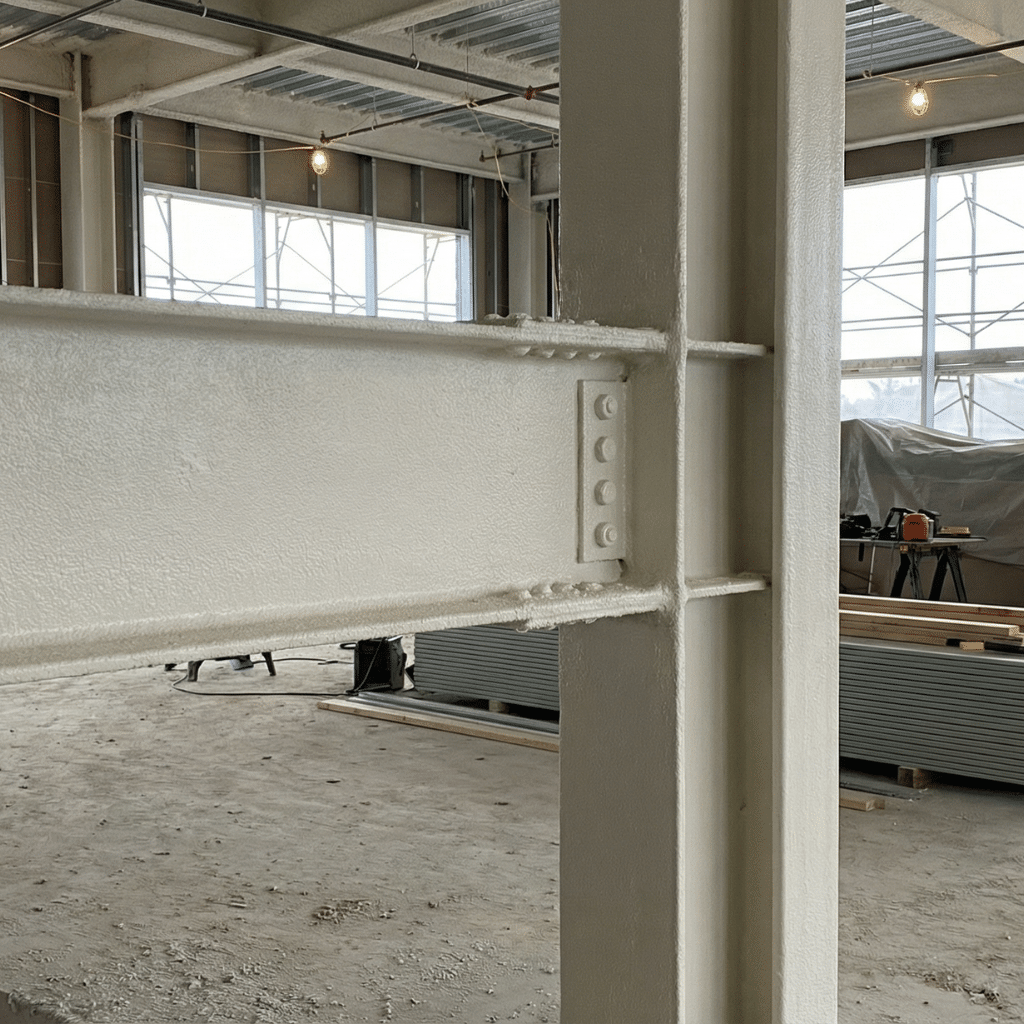
Intumescent fireproofing is a passive fire protection coating applied to structural steel that expands when exposed to heat, forming an insulating char layer that slows temperature rise and delays structural failure. Fire resistance ratings of 1 to 4 hours are achieved through specific dry film thickness applications tested per ASTM E119 and UL 263.
The word “intumescent” means “to swell,” which is exactly what happens during a fire. At approximately 300 to 400 degrees Fahrenheit, the chemical compounds in the coating activate and the dried film expands to 15 to 50 times its original thickness (some products expand up to 100 times), forming a rigid, insulating char that acts as a thermal barrier between the fire and the steel substrate.
Structural steel loses significant load-bearing capacity at approximately 1,000 degrees Fahrenheit (538 degrees Celsius). Without fire protection, exposed steel can reach that critical temperature in 15 to 20 minutes during a fully developed fire. Intumescent coatings buy time: 1, 2, 3, or 4 hours depending on the specification, allowing occupants to evacuate and fire crews to respond.
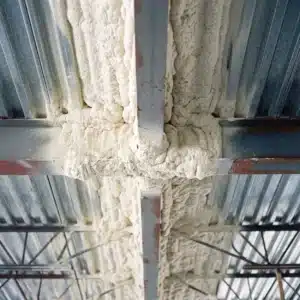
Intumescent fireproofing is classified as an Intumescent Fire-Resistive Material (IFRM), distinct from Spray-Applied Fire-Resistive Material (SFRM). SFRM refers to cementitious fireproofing, the thick, rough-textured material applied to steel behind walls and above ceilings. IFRM is the paint-like alternative for steel that remains visible. Getting this terminology right in specifications prevents confusion during bidding and inspection.
The coating is passive fire protection: no electricity, no sensors, no activation mechanism. It sits dormant as a painted finish and activates automatically when heat reaches the trigger temperature.
How Intumescent Coatings Work: The Science of Char Formation
When heat reaches the activation temperature (approximately 300 to 400 degrees Fahrenheit), intumescent coatings undergo a three-stage chemical reaction. An acid catalyst breaks down the binding resin. A carbonific compound forms a carbon char matrix. A blowing agent expands the char into a rigid, insulating foam. A coating that was 20 mils thick in its dry state may expand to 600 mils or more of protective insulation.
The fire resistance rating (1, 2, 3, or 4 hours) depends on how much coating was applied (the dry film thickness, or DFT), the steel member’s size and shape (the section factor), and the specific product’s tested performance per UL 263. Thicker coatings build thicker char, which insulates longer. Smaller, lighter steel sections require more coating than larger, heavier sections because they have more surface area relative to their mass and heat up faster. These relationships are documented in manufacturer loading tables and the UL Fire Resistance Directory.
Three Types of Intumescent Coatings
Intumescent coatings are manufactured in three chemistry families, each with distinct performance characteristics, application requirements, and ideal use cases. Selecting the right chemistry is the first and most consequential specification decision on any intumescent project.
Water-Based Intumescent produces the smoothest finish of the three types, closest to conventional paint in appearance. It has the lowest VOC emissions, making it the preferred choice for interior applications where LEED compliance and indoor air quality matter. Water-based products like CAFCO SprayFilm WB 3 (also marketed as ISOLATEK Type WB 3 by Isolatek International) can achieve fire ratings up to 4 hours per UL 263 and ASTM E119. Water-based intumescent is also the most sensitive to application conditions: temperature must stay between 50 and 100 degrees Fahrenheit, and relative humidity must remain below 80 percent. It can be topcoated to any color, making it ideal for architecturally exposed applications where the finished steel needs to match the design palette.
Solvent-Based Intumescent produces a finely textured finish (sometimes described as an orange-peel texture) and offers better resistance to moisture and temperature variations than water-based products. Products like Carboline Thermo-Sorb VOC are suitable for semi-exposed or partially conditioned environments where the building envelope is not yet fully closed during application. Solvent-based intumescent can cure during open-frame construction in cold weather, which makes it a practical choice for field application on projects where the building is only partially enclosed at the time of fireproofing. The application equipment is simpler than what epoxy products require.
Epoxy-Based Intumescent is the most durable of the three types, producing a textured, hard-shell finish that resists impact, vibration, chemicals, and exterior weather exposure. Carboline Thermo-Lag E100 is a widely specified epoxy intumescent used on high-profile projects (including the exterior columns of the Google Bayview campus). Epoxy products require specialized plural-component spray equipment and are two-component systems, which adds application complexity. However, they dry faster, require fewer coats, and provide hydrocarbon fire protection (UL 1709) in addition to cellulosic fire protection (UL 263). This makes epoxy the standard for petrochemical, offshore, parking garage, and exterior steel applications.
For our complete guide to intumescent coating types, including head-to-head product comparisons and application condition details, we will be publishing a dedicated deep-dive in this topic cluster.
Thin-Film vs. Thick-Film Intumescent
These terms describe the DFT range and intended application environment. Understanding the distinction helps you communicate clearly with manufacturers and applicators.
| Property | Thin-Film (Architectural) | Thick-Film (Industrial) |
|---|---|---|
| DFT Range | 0.3 to 2 mm (12 to 80 mils) | 2 to 10 mm (80 to 400 mils) |
| Fire Rating | 30 to 120 minutes | Up to 240 minutes |
| Substrate | Interior structural steel | Offshore, petrochemical, exterior steel |
| Finish | Decorative, architectural | Functional, industrial |
| Topcoat | Decorative polyurethane or acrylic | Epoxy or polysiloxane |
Most commercial building projects in our service territory use thin-film intumescent. Thick-film products are specified for industrial facilities, petrochemical plants, and exterior steel with hydrocarbon fire exposure risk.
Which Intumescent Chemistry Is Right for Your Building?
No competitor publishes a practical decision framework for selecting intumescent chemistry by building type. This table is based on our project experience across Texas, Kansas, and Oklahoma, applying intumescent fireproofing for commercial buildings in every category below.
| Building Type | Recommended Chemistry | Why |
|---|---|---|
| Corporate office, open ceiling | Water-based | Smoothest finish; controlled interior climate |
| Retail, restaurant, open ceiling | Water-based | Aesthetic priority; broad decorative topcoat options |
| Warehouse, distribution center | Water-based or solvent-based | Depends on climate control; solvent-based if only partially conditioned |
| Data center | Water-based | Climate-controlled environment; finish quality matters |
| Manufacturing, industrial | Solvent-based or epoxy | Semi-exposed conditions; chemical/vibration resistance needed |
| Cold storage, refrigerated | Solvent-based or epoxy | Temperature extremes; water-based requires special validation for low-temp environments |
| Parking garage | Epoxy | UV, moisture, and impact exposure; possible hydrocarbon fire risk |
| Exterior, open-air steel | Epoxy or solvent-based with tested topcoat | Full weather resistance required year-round |
In 20 years of applying intumescent coatings in Texas, the most frequent specification mistake I encounter is selecting water-based intumescent for a semi-exposed or humidity-prone environment without specifying an approved topcoat system by product name. Gulf Coast projects with sustained relative humidity above 80 percent degrade water-based intumescent performance if the topcoat system is not fully evaluated and listed for the specific intumescent product. “Approved topcoat” in the specifications is not specific enough. Name the topcoat product and reference the UL-tested assembly. That is the difference between a coating system that performs as rated and one that blisters within 18 months.
Texas summer application conditions (May through September) routinely challenge the standard temperature and humidity windows. In Houston, Corpus Christi, and other Gulf Coast markets, we schedule intumescent application during morning hours, use temporary climate-controlled enclosures on exterior steel, and monitor ambient conditions continuously during application. These field practices are standard on Bahl intumescent fireproofing projects but appear in no manufacturer data sheet and no competitor content.
Dry Film Thickness: How Fire Ratings Are Achieved
Dry Film Thickness (DFT) is the single most important number in any intumescent fireproofing specification. It determines the fire rating, drives the material quantity, and controls the application timeline. DFT is measured in mils (thousandths of an inch) after the coating has fully dried.
How thick intumescent coating needs to be depends on three variables: the product selected, the fire rating required, and the steel section factor (the W/D ratio: weight per lineal foot divided by the fire-exposed perimeter). Smaller, lighter steel members have higher section factors and require more coating.
A real-world example: a W10x39 wide-flange beam requires approximately 161 mils of DFT for a 120-minute fire rating. A similar-sized HSS column (10.0 x 10.0 x 1/4) requires approximately 309 mils for the same rating, nearly double the thickness. HSS columns are consistently the most expensive steel shapes to protect with intumescent fireproofing because of this relationship.
Maximum build per day is typically limited to approximately 50 mils DFT per coat. A 300-mil requirement takes a minimum of 6 crew-days plus primer and topcoat. For detailed guidance on dry film thickness requirements and cure time factors, we will be publishing a dedicated technical reference.
For specifiers: DFT data is product-specific and steel-section-specific. No universal table exists. Always reference the manufacturer’s loading table and the UL Design Assembly number. Specifying a generic “intumescent coating to 2-hour rating” without naming the product and assembly creates inspection risk and potential change orders.
Fire Standards and Code Requirements
Intumescent fireproofing specifications reference several overlapping standards. Understanding which applies to which aspect of the project prevents specification errors and inspection delays.
ASTM E119 and UL 263 are the primary fire resistance test standards for structural steel in North America. They are functionally equivalent: both subject a loaded assembly to the same cellulosic time-temperature curve. UL 263 is the default standard referenced in most North American commercial intumescent fireproofing specifications. For a detailed explanation of how fire-resistive coatings are tested and certified, Carboline’s technical overview covers the full testing process for both SFRM and intumescent materials.
UL 1709 is the rapid-temperature-rise (hydrocarbon fire) test, reaching 2,000 degrees Fahrenheit within 5 minutes. This applies to petrochemical and industrial facilities, not standard commercial construction. Epoxy intumescent products typically carry both UL 263 and UL 1709 ratings.
ASTM E84 (UL 723) measures flame spread index and smoke development index for interior surface finishes. Do not confuse ASTM E84 surface burning characteristics with ASTM E119 fire-resistance ratings. They test entirely different things.
IBC Section 703 establishes fire-resistance requirements for structural members. IBC Table 601 lists required fire ratings by construction type: Type I-A requires 3-hour column protection; Type II-B may require 0 hours for some elements.
Special Inspections (IBC Chapter 17) require that intumescent fireproofing installations be inspected by a qualified special inspector documenting DFT measurements, product compliance, and application conditions. This is a code requirement that building owners frequently overlook during project planning.
Intumescent vs. Cementitious Fireproofing: When to Use Each
Both intumescent (IFRM) and cementitious (SFRM) systems achieve fire ratings of 1 to 4 hours. The choice between them depends on visibility, aesthetics, environment, and budget.
| Factor | Intumescent (IFRM) | Cementitious (SFRM) |
|---|---|---|
| Appearance | Smooth, paint-like; topcoated to any color | Rough, textured; not decorative |
| Thickness | Thin (measured in mils) | Thick (measured in inches) |
| Best use case | Exposed, visible structural steel | Hidden steel behind walls and ceilings |
| Cost | $2 to $12 per sq ft installed | $1.50 to $5.00 per sq ft installed |
| Application speed | Slower (DFT build limits per day) | Faster for large coverage areas |
| Durability | Moisture-sensitive without proper topcoat | More physically robust; porous to moisture |
| Fire rating range | 1 to 4 hours | 1 to 4 hours |
The decision framework is straightforward: if the structural steel will be visible in the finished building, specify intumescent. If the steel will be hidden behind walls, above ceilings, or inside shafts, specify cementitious. The cost premium for intumescent over cementitious is justified only when aesthetics, accessibility, or architectural finish requirements make cementitious impractical.
Many projects use both systems. A typical example in our Texas and Oklahoma work: intumescent coating on exposed lobby columns and AESS connections at the building entrance, cementitious SFRM on all steel above the ceiling line and inside stairwells. This hybrid approach controls costs while meeting the architect’s design intent where it matters.
For a detailed head-to-head comparison including material costs, application timelines, and project scenarios, see our post on choosing the right commercial fireproofing system.
How Much Does Intumescent Fireproofing Cost?
Installed intumescent fireproofing costs $2 to $12 per square foot for commercial projects in our Texas, Oklahoma, Kansas, Nebraska, Minnesota, and Wisconsin market. That range is wide because cost is driven by variables that shift dramatically between projects.
Fire rating (DFT requirement) is the primary driver. A 1-hour rating on a heavy wide-flange column may require 40 mils of DFT. A 2-hour rating on an HSS column can require 309 mils: 6 to 8 times more material and multiple additional crew-days.
Steel section type compounds cost. Wide-flange beams are the most cost-efficient shapes to coat. HSS columns and tubes are the most expensive per unit.
Scope size creates the biggest budget misunderstanding. A single-column intumescent fireproofing project can cost $3,400 per column because mobilization, equipment, and crew-day costs all apply to one member. A 4-column project at the same specification might cost $1,150 per column. Understanding this mobilization economics is essential for evaluating intumescent bids.
Shop vs. field application matters. Shop-applied intumescent (coating steel at the fabricator) often costs less and provides better quality control. Field application works better for complex connection geometry.
Material cost for intumescent product runs $350 to $550 per 5-gallon pail. Primer and topcoat are additional. Always request bids that separate material, labor, primer, topcoat, and special inspection.
Application Process: What Happens on a Bahl Fireproofing Project
Every commercial intumescent fireproofing project follows a structured sequence. Interior applications require three steps; exterior projects add a fourth.
Step 1: Steel Primer. A compatible primer is applied to the prepared steel substrate. The primer must be tested and listed as part of the UL Design Assembly for the specific intumescent product. Substituting a different primer can invalidate the entire fire rating.
Step 2: Intumescent Base Coat. The fire-protective layer is sprayed, brushed, or rolled onto the primed steel in controlled passes, building to the specified DFT. For thick specifications, multiple coats are applied over multiple days with drying time between each. DFT is measured and documented at each stage.
Step 3: Decorative/Protective Topcoat. The topcoat provides the finished color and protects the reactive intumescent layer from moisture, UV, and physical damage. It must be compatible with and tested for use with the specific intumescent product. Exterior applications add a dedicated weather-seal coat between the intumescent and decorative topcoat (four-step process).
Shop vs. field application is a key specification decision. Shop application (steel coated before delivery) eliminates field masking and provides better quality control. Field application works better for complex connection-heavy assemblies. Some projects split the approach: epoxy intumescent shop-applied on large columns, water-based field-applied on interior AESS elements.
Special inspections per IBC Chapter 17 are required. The inspector verifies DFT measurements, product compliance, and ambient conditions. Planning for inspection access and scheduling is the building owner’s responsibility.
On Texas projects, we start intumescent application early in the morning before humidity peaks, monitor conditions with calibrated hygrometers, and use temporary enclosures for exterior steel during Gulf Coast summers.
How Long Does Intumescent Fireproofing Last?
In interior, climate-controlled environments, intumescent fireproofing typically delivers 15 to 20 years of service life before maintenance is needed. The actual lifespan depends on the environment, topcoat system, and physical damage exposure.
The topcoat is the key to long-term performance. The intumescent base coat is a reactive chemical system that must remain dry to perform as rated during a fire. The topcoat functions as a moisture barrier. If it cracks, peels, or sustains impact damage, moisture reaches the intumescent layer and degrades its char-forming properties. Topcoat failure is the most common cause of intumescent coating degradation in our experience. For intumescent coating inspection and maintenance intervals by environment type, we will be publishing a dedicated guide.
Budget for visual inspection every 5 to 7 years in controlled environments and every 3 to 5 years in harsh or semi-exposed conditions. Intumescent fireproofing is not “install and forget.”
Related Reading
Explore more intumescent fireproofing topics from Bahl Fireproofing:
- Want to see how intumescent coatings transform exposed steel into a design feature? Read Intumescent Fireproofing: Aesthetics and Fire Protection.
- Comparing all fireproofing system types for your project? Our guide to choosing the right commercial fireproofing system covers intumescent, cementitious, and spray foam side by side.
Frequently Asked Questions
What Is Intumescent Fireproofing?
Intumescent fireproofing is a passive fire protection coating for structural steel that expands when exposed to heat, forming an insulating char layer that delays structural failure. It achieves fire resistance ratings of 1 to 4 hours per ASTM E119 and UL 263 in a thin, paint-like finish, making it the standard choice for intumescent coating for exposed structural steel in AESS commercial designs.
How Does Intumescent Paint Work?
The coating contains chemical compounds that react to heat in three stages: an acid catalyst breaks down the resin, a carbonific compound forms a carbon char, and a blowing agent expands the char into rigid insulating foam. A 20-mil dry film can expand to 600 mils or more of insulating char, keeping steel below the 1,000 degree Fahrenheit critical failure temperature for the rated period.
How Thick Does Intumescent Coating Need to Be?
Required DFT depends on the product, fire rating, and steel section factor (W/D ratio). A W10x39 beam may need approximately 161 mils for a 2-hour rating, while an HSS 10x10x1/4 column needs approximately 309 mils for the same rating. Always reference the manufacturer’s loading table and UL Design Assembly for project-specific requirements.
What Is the Difference Between Intumescent and Cementitious Fireproofing?
Intumescent coatings are thin, paint-like finishes applied in mils for exposed steel. Cementitious fireproofing (SFRM) is thick, rough-textured material applied in inches for hidden steel. Both achieve 1 to 4 hour fire ratings. Use intumescent where steel is visible; use cementitious where steel is concealed.
Can Intumescent Coating Be Painted Over?
Yes. Intumescent coatings receive a decorative topcoat in any color. The topcoat must be tested and approved for use with the specific intumescent product and referenced in the UL Design Assembly. Manufacturers like Sherwin-Williams publish FIRETEX compatibility charts for approved topcoat systems. For how to specify intumescent fireproofing for your project, we will be publishing an architect-focused guide.
How Long Does Intumescent Fireproofing Last?
Interior climate-controlled applications typically last 15 to 20 years before maintenance is needed. Lifespan depends on topcoat condition and environmental exposure. Regular inspection every 5 to 7 years (controlled environments) or 3 to 5 years (harsh environments) is recommended.
What Fire Rating Does Intumescent Coating Provide?
Intumescent coatings achieve 1, 2, 3, or 4 hour fire ratings per UL 263 and ASTM E119, depending on product, DFT, and steel section factor. Water-based products like CAFCO SprayFilm WB 3 are listed for up to 4-hour ratings. Required ratings are determined by IBC (2021) Table 601 based on construction type.
Code note: unless otherwise stated, code references on this page are to the 2021 International Building Code. Code adoption is state and local. Across the states we serve, adopted IBC editions currently range from the 2012 edition to the 2024 edition, some states have no statewide commercial building code, and several enforce NFPA 1 or NFPA 101 rather than the International Fire Code. Minnesota and Wisconsin publish state-amended code books whose numbering and requirements differ from the model code. This is general technical information, not a code determination for your project. Confirm the adopted edition and any local amendments with your authority having jurisdiction.
Is Intumescent Fireproofing Required by Code?
The IBC does not specifically require intumescent coating. It requires structural steel to achieve a specific fire-resistance rating (IBC (2021) Section 703, IBC (2021) Table 601). Intumescent fireproofing is one code-compliant method. The design team selects between intumescent, cementitious, or other listed systems based on project requirements.
What Is AESS and Why Does It Matter for Intumescent?
AESS (Architecturally Exposed Structural Steel) refers to steel members that remain visible in the finished building. AESS elements almost always require intumescent fireproofing rather than cementitious because SFRM’s rough texture defeats the purpose of exposing the steel. When a specification calls for AESS, budget for intumescent coating.
How Much Does Intumescent Fireproofing Cost Per Square Foot?
Installed intumescent fireproofing costs $2 to $12 per square foot depending on fire rating, steel type, and scope size. Small-scope projects cost significantly more per unit: a single-column project can run $3,400 while a 4-column project at the same specification may cost $1,150 per column due to fixed mobilization and crew-day economics.
Key Takeaways
Intumescent fireproofing is a passive fire protection coating that expands under heat to form an insulating char, achieving 1 to 4 hour fire ratings per UL 263 and ASTM E119. It is the standard for architecturally exposed structural steel (AESS).
Three chemistry types serve different conditions: water-based for controlled interiors, solvent-based for semi-exposed environments, and epoxy for harsh, exterior, or industrial applications. Select chemistry based on building type, exposure, and topcoat requirements.
DFT determines the fire rating and varies by product, steel section factor, and required hours of protection. HSS columns require substantially more coating than wide-flange beams. Always reference manufacturer loading tables and UL Design Assemblies.
Texas Gulf Coast humidity degrades water-based intumescent without a properly specified topcoat. Name the topcoat product in specifications and reference the tested UL assembly.
Installed costs range from $2 to $12 per square foot. Small-scope projects cost dramatically more per unit due to fixed mobilization and DFT build-rate economics.
The topcoat protects the reactive intumescent layer from moisture. Budget for inspection every 5 to 7 years in controlled environments and every 3 to 5 years in harsh conditions.
Special inspections per IBC Chapter 17 are a code requirement for intumescent fireproofing installations. Plan for inspection costs and scheduling during project planning.
Whether you are specifying intumescent fireproofing for a new AESS design, evaluating coating chemistry for a warehouse retrofit, or comparing intumescent against cementitious for a mixed-use project, the right specification starts with understanding your building’s conditions, your steel’s section factors, and your code requirements. With over 20 years of intumescent application experience across service areas in Texas, Oklahoma, Kansas, Nebraska, Minnesota, and Wisconsin, Bahl Fireproofing delivers the field knowledge to match the right product to your project. Contact Bahl Fireproofing today at 512-387-2111 or email ross@bahlfireproofing.com to discuss your specification or request a detailed estimate.
This article provides general educational information about intumescent fireproofing for commercial buildings. It is not a substitute for project-specific engineering, design, or code analysis. Fire ratings, DFT requirements, and coating performance referenced in this article are based on manufacturer-published data and standardized testing (ASTM, UL). Actual performance depends on installation quality, product selection, substrate preparation, topcoat specification, and environmental conditions. DFT requirements are product-specific and steel-section-specific. Always consult the manufacturer’s loading table and UL Design Assembly data for project-specific thickness requirements. Building codes, fire ratings, and fire protection requirements vary by jurisdiction. Always consult a licensed professional engineer, architect, or code official for project-specific requirements. Bahl Fireproofing is a commercial fireproofing and insulation contractor, not an engineering or design firm.