Knowing what K-13 insulation costs before you request bids helps you budget accurately, compare quotes fairly, and avoid surprises that delay commercial construction projects. This guide breaks down installed pricing, cost drivers, budget examples by project size, and a side-by-side comparison against alternative insulation systems, all based on 20 years of K-13 application experience across Texas, Kansas, and Oklahoma.
TLDR: K-13 insulation typically costs $1.50 to $3.00 per square foot installed for commercial projects, with thickness and project size as the primary drivers. The Section 179D tax deduction no longer applies to new projects. It terminated for construction beginning after June 30, 2026, so plan your budget on installed cost alone unless your project broke ground before that date. Read on for budget examples, hidden cost traps, and a full comparison against spray foam, fiberglass, and acoustic ceiling systems.
For building owners, general contractors, and facility managers pricing a commercial insulation project, K-13 cost is usually the first question that comes up. It is also the question with the most incomplete answers online. Most insulation contractors either avoid publishing pricing entirely or provide ranges so broad they are useless for budgeting.
Over the past 20 years, I have installed K-13 on projects ranging from 2,000 square foot church sanctuaries to 200,000 square foot distribution centers. That experience gives me a clear picture of what drives cost, where budgets go wrong, and how to get the most value from your insulation investment. This guide shares those numbers directly, along with field insights you will not find on a manufacturer data sheet or a competitor’s website.
If you are evaluating insulation options for a commercial project and want to understand our complete K-13 insulation guide, this cost breakdown will help you make an informed decision before the first bid hits your desk.
How Much Does K-13 Insulation Cost Per Square Foot?
K-13 insulation typically costs $1.50 to $3.00 per square foot installed for commercial projects in Texas, Oklahoma, Kansas, Nebraska, Minnesota, and Wisconsin. That range includes labor by an applicator licensed by the manufacturer, International Cellulose Corporation, plus material, specialized spray equipment, and standard surface preparation. It does not include substrate priming (when required) or unusual access costs such as high-reach boom lifts.
The following table breaks down how much does K-13 insulation cost per square foot in Texas by thickness, since thickness is the single biggest cost variable:
| Thickness | R-Value | NRC (Solid Backing) | Typical Installed Cost/SF |
|---|---|---|---|
| 1″ | R-3.7 | 0.80 | $1.50 – $1.85 |
| 1.5″ | R-5.6 | 0.90 | $1.75 – $2.25 |
| 2″ | R-7.4 | 1.00 | $2.00 – $2.65 |
| 3″ | R-11.1 | 1.00 | $2.50 – $3.00+ |
These figures reflect installed pricing from an applicator licensed by International Cellulose Corporation. Unlicensed installers may quote lower, but K-13 warranties require installation by applicators trained and licensed by International Cellulose Corporation. Cutting corners on applicator credentials voids the manufacturer warranty and creates liability exposure for the building owner and general contractor.
For projects requiring thicknesses above 5 inches, ICC offers the K-13 High-R System with mechanical fasteners that supports up to 10 inches (R-37). High-R System pricing runs higher due to the fastener hardware and additional labor, typically $3.50 to $5.00+ per square foot installed.
What Drives K-13 Insulation Costs?
Six factors determine where your project falls within the $1.50 to $3.00 range. Understanding these variables before you solicit bids helps you compare quotes accurately and identify when a price looks too good (or too high) to be reasonable.
Thickness is the primary cost driver. Every additional half-inch of K-13 adds material cost and application time. A 1-inch application for basic acoustic control in a warehouse costs significantly less than a 2-inch application for a school gymnasium that needs NRC 1.00. Specify the thickness based on your NRC and R-value targets, not a generic “spray the ceiling” instruction. For K-13 NRC ratings by thickness and substrate, the performance data varies significantly between solid backing and metal deck profiles.
Project size and mobilization create the most misunderstood cost dynamic. Mobilization costs (equipment transport, crew travel, setup, and breakdown) are relatively fixed regardless of whether you are insulating 2,500 square feet or 50,000 square feet. On small projects under 2,500 square feet, mobilization can add $0.50 to $1.00+ per square foot to the effective cost. On large projects, those fixed costs spread thin. This is why K-13 insulation cost for warehouse projects at scale is almost always near the bottom of the range.
Substrate condition and preparation add cost when surfaces are not clean and ready for application. New metal deck straight from the factory needs minimal prep. Retrofit projects with painted, oily, or contaminated surfaces require cleaning and possibly priming at $0.25 to $0.75 per square foot additional. Galvanized metal always requires primer for proper adhesion.
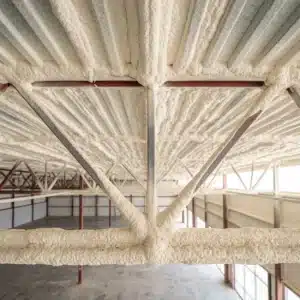
Ceiling height and access affect labor productivity directly. A 12-foot warehouse ceiling goes fast with standard scaffolding. A 40-foot high-bay distribution center requires scissor lifts or boom lifts, which slow production, add equipment rental costs, and reduce the square footage a crew can complete per shift.
Color selection has a modest impact. K-13 is available in five standard colors (Black, Gray, Light Gray, White, and Tan). Custom color matching is available at additional cost. Standard colors do not carry a premium over one another.
Geographic location within our service territory affects crew travel costs. Projects in the DFW, Houston, Austin, San Antonio, Oklahoma City, Tulsa, and Wichita metro areas typically see standard pricing. Remote locations with extended travel add modest mobilization charges.
K-13 Cost by Project Size: Budget Examples
The most useful way to think about K-13 cost is by total project budget, not just per-square-foot pricing. Here are real-world budget ranges based on our experience across hundreds of commercial projects. These assume standard 1-inch to 2-inch thickness on metal deck, typical access conditions, and no unusual substrate issues.
| Project Size (SF) | Budget Range | Notes |
|---|---|---|
| Under 2,500 | $6,250 – $7,500+ | Mobilization premium; effective cost $2.50 – $3.00+/sf |
| 5,000 | $7,500 – $15,000 | Small commercial; church, restaurant, retail |
| 10,000 | $15,000 – $30,000 | Mid-size commercial; school gym, medical office |
| 25,000 | $37,500 – $62,500 | Standard warehouse, distribution center |
| 50,000+ | $75,000 – $150,000 | Large warehouse; volume pricing available |
A few patterns worth noting. Projects under 2,500 square feet carry a disproportionate mobilization cost because the equipment, crew, and travel expenses do not scale down with the project size. If your project is small, consider whether other insulation products provide better value at that scale. For projects above 50,000 square feet, negotiate volume pricing. At that size, material and labor efficiencies create real opportunities for the applicator to offer better rates.
These budget ranges also help you spot outlier bids. If you receive a quote for a 10,000 square foot project that falls significantly below $15,000, ask what is being excluded. Low bids often omit substrate preparation, assume ideal conditions, or use unlicensed applicators.
K-13 vs. Other Insulation: Installed Cost Comparison
When building owners and architects compare insulation options, they typically focus on cost per square foot. But that comparison misses the full picture. K-13 provides thermal insulation, acoustic absorption, fire protection (Class 1, Class A per ASTM E-84), and a finished exposed ceiling appearance in a single application. Most alternatives address only one or two of those needs, requiring additional systems to match the same performance.
Here is what K-13 vs fiberglass batts cost for commercial ceilings looks like alongside other common options when you account for the complete installed system:
| System | Installed Cost/SF | R-Value/Inch | NRC | Fire Rating | Finished Appearance |
|---|---|---|---|---|---|
| K-13 (1″ – 2″) | $1.50 – $3.00 | 3.7 | 0.80 – 1.00 | Class A (FSI 5) | Yes |
| Fiberglass batts | $0.90 – $1.60 | 3.1 – 3.7 | 0.70 – 0.95 | Non-combustible | No |
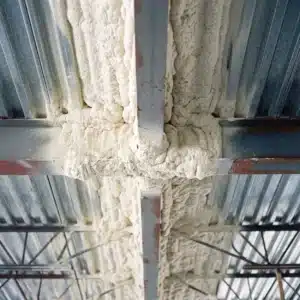
| Open-cell spray foam | $1.50 – $3.50 | 3.5 – 3.7 | 0.70 | Requires thermal barrier | No |
| Closed-cell spray foam | $3.00 – $5.00 | 6.0 – 6.5 | Low | Requires thermal barrier | No |
| Blown-in cellulose | $1.03 – $2.00 | 3.2 – 3.8 | Varies | Class I treated | No |
| Suspended ACT | $3.50 – $7.00 | Minimal | 0.55 – 0.70 | Class A typical | Yes (concealed) |
The comparison that matters most is the “all-in” system cost. Fiberglass batts at $0.90 to $1.60 per square foot look cheaper until you need acoustic performance. Adding separate acoustic panels ($1.50 to $3.00 per square foot) to achieve NRC 0.80+ brings the combined cost to $2.40 to $4.60 per square foot, which exceeds K-13’s range. And you still do not get the monolithic, gap-free coverage that K-13 provides.
Suspended acoustical ceiling tile (ACT) at $3.50 to $7.00 per square foot provides a finished ceiling and decent acoustics (NRC 0.55 to 0.70), but it conceals the deck, eliminates the exposed-structure aesthetic that architects increasingly specify, and provides minimal thermal insulation. For exposed ceiling applications where thermal, acoustic, and fire performance all matter, K-13 consistently delivers the lowest total system cost.
How K-13 compares to fiberglass batts for commercial ceilings depends on the full scope of performance requirements. For acoustic-driven specifications, the price gap between “cheap insulation + acoustic treatment” and “K-13 that handles both” usually closes or reverses entirely.
Hidden Costs and Budget Traps
In 20 years of K-13 work, I have seen the same budget mistakes repeat across projects. These hidden costs are not in any manufacturer brochure, but they will show up on your change order if you do not plan for them.
Skipped substrate priming is the most expensive mistake. When primer is required (galvanized metal, painted surfaces, certain concrete finishes) and gets skipped to save $0.25 to $0.75 per square foot, the result is adhesion failure 6 to 12 months later. Delamination means full removal and reapplication at roughly 2x the original cost, plus the disruption to an occupied building. The bond strength K-13 is rated for (greater than 150 psf per ASTM E 736) depends on proper surface preparation. No shortcuts.
MEP coordination delays add 15 to 25 percent to K-13 cost when the application happens after mechanical, electrical, and plumbing trades have already run ductwork, conduit, and piping through the ceiling cavity. The applicator must mask around penetrations, cut and patch around obstacles, and work in tight spaces that slow production significantly. The fix is simple: schedule K-13 after structural fireproofing and before MEP rough-in. Getting the sequence right is free. Getting it wrong costs real money.
Retrofit substrate contamination adds $0.25 to $0.75 per square foot for cleaning and preparation on projects involving existing buildings with oil, grease, or degraded paint on the deck surface. New construction on clean steel has minimal prep cost. Retrofit projects should budget for substrate prep as a separate line item.
Thickness under-specification creates long-term cost. Specifying 1 inch when the acoustic requirements call for 1.5 inches means the building owner will pay for a second mobilization and application pass later, which costs more than doing it right the first time. Specify to the NRC and R-value targets, not to the lowest possible thickness.
What Happened to the Section 179D Tax Deduction
Owners still ask about this one, so here is the current answer. The Section 179D tax deduction has terminated. Public Law 119-21, signed July 4, 2025, added subsection (i) to 26 U.S.C. 179D: the section does not apply to property the construction of which begins after June 30, 2026. That date has passed, so a project starting today gets nothing from it. A project that began construction on or before June 30, 2026 is still eligible and can be claimed when the property is placed in service.
For projects that began construction on or before June 30, 2026, the rates are (Rev. Proc. 2025-32):
| Pre-July-2026 Projects | Base Deduction/SF | Maximum Deduction/SF |
|---|---|---|
| Without prevailing wage/apprenticeship | $0.59 | $1.19 |
| With prevailing wage/apprenticeship | $2.97 | $5.94 |
Insulation never qualified for 179D by itself, and that is worth saying plainly because the internet still gets it wrong. The deduction required certification that the installed work was part of a plan reducing the building’s total annual energy and power costs by at least 25 percent measured against an ASHRAE 90.1 reference building. K-13 was one contributing measure inside that plan, alongside HVAC, lighting, and controls. Spraying insulation and nothing else did not get an owner there. Whole-building energy modeling by a qualified third party was what established the claim, and on a project that began before July 2026 that modeling still has to be done to support it.
Where this leaves you: If your project started before July 2026, the documentation is worth chasing now. Eligibility turns on when construction began, and there is no IRS guidance defining “beginning of construction” for 179D specifically, so how you evidence a start date is a judgment call your CPA has to make on your records, not a box we can check for you. Bahl Fireproofing is a contractor, not a tax advisor. Consult your CPA.
Section 179 expensing, which is a different provision, is still in force. For 2026 the limit is $2,560,000 with the phase-out beginning at $4,090,000 (Rev. Proc. 2025-32). Section 179(e) lists fire protection and alarm systems among the qualified real property for improvements to existing nonresidential buildings. Insulation and the building envelope are not on that list, so do not expect a K-13 scope to ride along. Whether spray-applied fireproofing on structural steel counts as a fire protection system under that provision is a real open question, and it is your CPA’s call.
Energy Savings and Return on Investment
Beyond the initial installed cost, K-13 delivers ongoing value through energy savings that compound year over year.
Facilities upgrading from minimal or no ceiling insulation to properly applied K-13 typically see energy cost reductions of 20 to 30 percent, depending on the existing building envelope, HVAC system efficiency, and climate zone. Department of Energy and NIST estimates put envelope infiltration at about 6 percent of total commercial building energy use and about 21 percent of heating and cooling energy, which is the loss that insulation and air sealing work against.
For a mid-size commercial building spending $4,000 per month on heating and cooling, a 25 percent reduction equals $12,000 per year in energy savings. Against a K-13 installation cost of $45,000 (15,000 square feet at $3.00 per square foot), the simple payback period is under 4 years. From year 5 through the product’s 75-year service life (per ICC’s Environmental Product Declaration), every dollar of energy savings goes straight to the bottom line.
Compare that payback to fiberglass batts, which carry manufacturer lifespan ratings of 50 to 100 years when undisturbed but degrade within 15 to 20 years in real-world conditions due to compression, moisture absorption, and settling. K-13’s monolithic, spray-applied coating does not compress, sag, or develop gaps over time. The R-value and NRC performance you get on day one is the performance you keep for the life of the building, which means the energy savings calculation holds steady rather than eroding year over year.
When K-13 Is (and Is Not) the Right Investment
Honest cost guidance means acknowledging when K-13 is not the right choice. Here is where the product delivers the strongest value, and where you should consider alternatives.
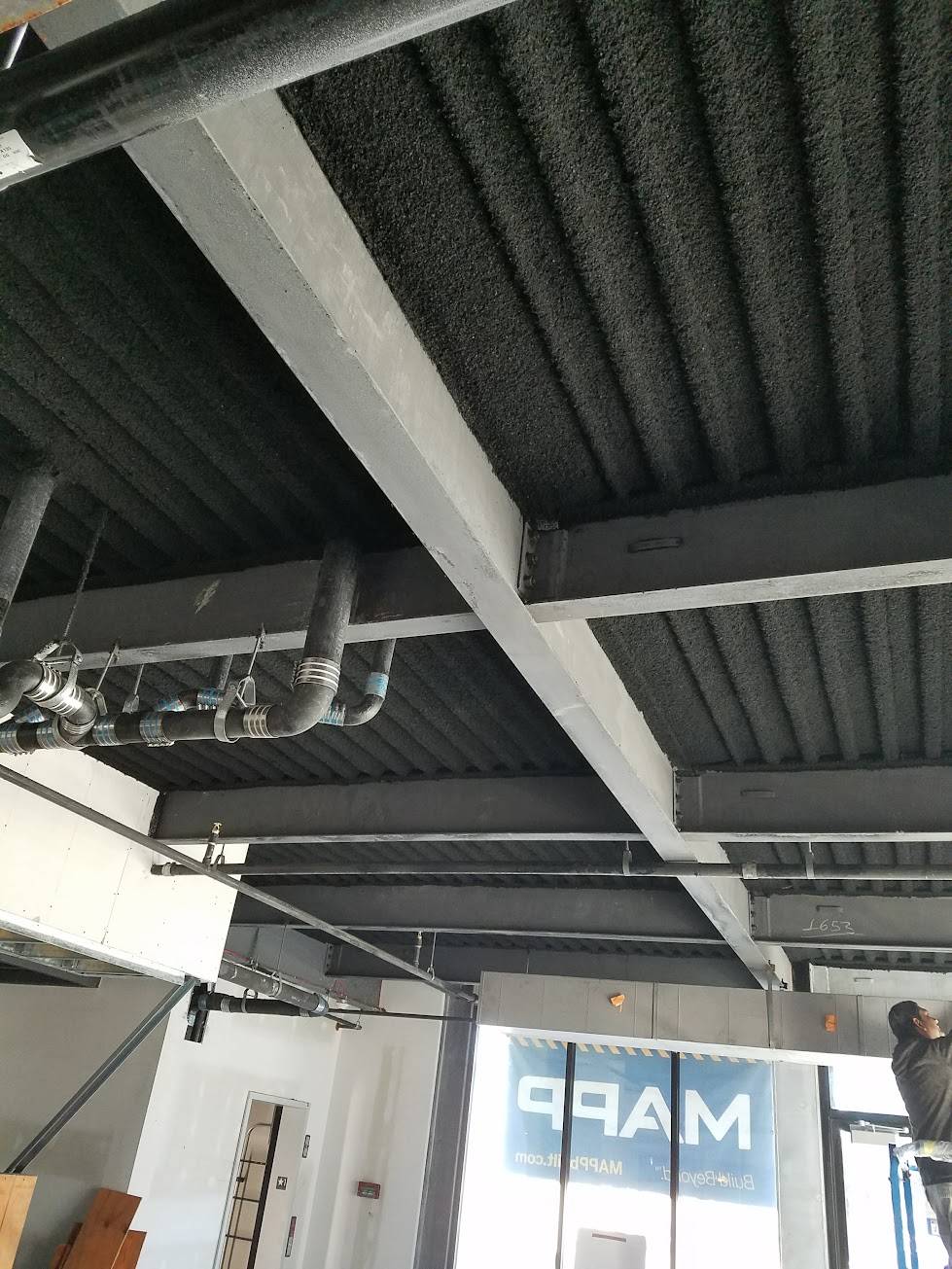
K-13 is the best investment when the project involves exposed ceiling applications on metal deck or concrete substrates, combined thermal and acoustic performance is required, the specification calls for a finished appearance without a suspended ceiling system, and the building type benefits from Class A fire-rated interior finish (warehouses, schools, hospitals, worship centers, data centers).
K-13 is not the right choice when the application is a wall cavity (spray foam insulation is designed for that), the R-value requirement exceeds R-18.5 and the High-R System with mechanical fasteners is not feasible, the owner wants a smooth, flat finished ceiling (suspended ACT is appropriate), or the project is extremely small (under 1,000 square feet) where mobilization costs make the per-square-foot math unfavorable.
K-13 is borderline when the budget is extremely tight and acoustic performance is not required. In that case, fiberglass batts at $0.90 to $1.60 per square foot provide thermal insulation at a lower cost, accepting the trade-offs in coverage quality and long-term degradation.
Being direct about these trade-offs is part of how we operate at Bahl Fireproofing. We would rather help you choose the right product for your project than sell you something that does not fit.
How to Get Accurate K-13 Pricing for Your Project
The fastest way to get an accurate quote is to provide your applicator with specific project details upfront. Here is what we need to prepare a reliable estimate:
Total square footage of the application area, deck-to-deck measurements, the deck profile type (flat concrete, 1.5-inch, 2-inch, or 3-inch ribbed metal deck), specified thickness and NRC/R-value targets, substrate condition (new steel, painted, galvanized, retrofit), ceiling height and access conditions, color selection, and project timeline. The more detail you provide, the tighter the bid.
For K-13 sprayed fiber insulation services across our service territory, we provide detailed written estimates that break out material, labor, and any substrate preparation as separate line items. No hidden costs, no surprises at completion.
Related Reading
Explore more K-13 insulation topics from Bahl Fireproofing:
- Planning a warehouse insulation project? Read K-13 warehouse insulation: acoustic control and energy savings.
- Want to understand the full application process behind these costs? See our guide to professional K-13 application methods for commercial projects.
Frequently Asked Questions
How Much Does K-13 Insulation Cost Per Square Foot?
K-13 insulation typically costs $1.50 to $3.00 per square foot installed for commercial projects, including material and labor by an applicator licensed by International Cellulose Corporation, the manufacturer. Thickness is the primary cost driver: a 1-inch application falls near the low end while a 2-inch application approaches the upper range. Substrate condition, project size, color selection, and ceiling height also affect final pricing.
Is K-13 Cheaper Than Spray Foam Insulation?
For exposed ceiling applications requiring acoustic performance, this insulation is typically less expensive than spray foam. Open-cell spray foam runs $1.50 to $3.50 per square foot, and closed-cell spray foam costs $3.00 to $5.00 per square foot. Neither provides the NRC ratings or finished appearance that K-13 delivers. Spray foam is the better choice for wall cavities and building envelope air sealing, where acoustic absorption is not a priority.
What Is the Payback Period for K-13 Insulation?
Payback on commercial K-13 work is commonly discussed in the 3 to 5 year range, but the actual figure turns on the baseline envelope, HVAC efficiency, climate zone, and energy rates, so it should be confirmed with a project-specific energy model rather than assumed. The exact payback depends on existing insulation levels, energy costs, building size, and climate zone. With a 75-year rated service life, the return on investment extends decades beyond the payback period.
Does K-13 Qualify for the 179D Tax Deduction?
No, not for any project starting now. Section 179D does not apply to property whose construction begins after June 30, 2026, and that date has passed. Even before it closed, K-13 never qualified on its own. The deduction required certification that the work was part of a plan cutting the building’s total annual energy and power costs by at least 25 percent against an ASHRAE 90.1 reference building, with insulation as one measure inside that plan. Projects that began construction on or before June 30, 2026 remain eligible and can claim it when placed in service.
How Much Does K-13 Cost for a 10,000 Square Foot Warehouse?
A 10,000 square foot warehouse K-13 project typically ranges from $15,000 to $30,000, depending on thickness, substrate condition, and ceiling height. A standard 1-inch application on clean metal deck at 20-foot height falls near the lower end. A 2-inch application with substrate preparation on a 40-foot high-bay ceiling approaches the upper range. Request a site-specific estimate for accurate budgeting.
Why Does K-13 Cost More Than Fiberglass Batts?
Fiberglass batts cost $0.90 to $1.60 per square foot installed, which is lower than K-13 on a per-square-foot basis. However, batts do not provide acoustic absorption (NRC 0.80+), a finished ceiling appearance, or monolithic coverage without gaps and compression points. When you add separate acoustic treatment ($1.50 to $3.00 per square foot) to achieve comparable NRC ratings, the combined cost exceeds K-13. Over a 20-year period, batt degradation from compression, moisture, and settling further erodes the initial cost advantage.
Are There Hidden Costs With K-13 Installation?
The most common hidden costs are substrate priming ($0.25 to $0.75 per square foot when required), MEP coordination delays (15 to 25 percent cost premium when insulation is applied after trades are already in the ceiling), and retrofit surface preparation ($0.25 to $0.75 per square foot for contaminated substrates). Request a site visit before bidding so your applicator can identify these factors upfront.
How Long Does K-13 Insulation Last?
ICC’s Environmental Product Declaration rates K-13 at a 75-year service life. The cellulose-based insulation does not compress, sag, or settle over time, and the adhesive bond (greater than 150 psf per ASTM E 736) keeps the material securely attached for the life of the building when properly applied to a prepared substrate.
Key Takeaways
K-13 insulation costs $1.50 to $3.00 per square foot installed for commercial projects in Texas, Oklahoma, Kansas, Nebraska, Minnesota, and Wisconsin, with thickness and project size as the primary cost variables.
Small projects under 2,500 square feet carry a mobilization premium that raises effective cost to $2.50 to $3.00+ per square foot. Large projects above 50,000 square feet benefit from volume pricing and lower per-square-foot rates.
The Section 179D tax deduction is terminated for construction beginning after June 30, 2026, so budget K-13 on installed cost with no tax offset assumed unless your project started before that date.
This insulation delivers the lowest total system cost for exposed ceiling applications requiring combined thermal, acoustic, and fire performance. Adding acoustic treatment to fiberglass batts typically exceeds the all-in price.
Hidden cost traps include skipped substrate priming (leading to 2x rework costs), MEP coordination delays (15 to 25 percent premium), and thickness under-specification that requires a costly second application pass.
Energy savings of 20 to 30 percent typically deliver a 3 to 5 year payback period, with value extending across the product’s 75-year rated service life.
K-13 is not the right choice for wall cavities, ultra-high R-value requirements without mechanical support, or smooth finished ceiling applications. Being honest about fit saves money and builds trust.
Whether you are budgeting a warehouse insulation project, comparing K-13 against spray foam for a school gymnasium, or working out what a job actually costs now that the 179D deduction is off the table, the right numbers make better decisions possible. With over 20 years of commercial insulation across Texas, Oklahoma, Kansas, Nebraska, Minnesota, and Wisconsin, Bahl Fireproofing provides straightforward pricing with no hidden costs and no surprises. Contact Bahl Fireproofing today at 512-387-2111 or email ross@bahlfireproofing.com to request a detailed estimate for your project.
This article provides general educational information about K-13 insulation costs for commercial buildings. It is not a substitute for project-specific engineering, design, code analysis, or tax advice. Cost ranges reflect typical installed pricing in Texas, Kansas, and Oklahoma as of early 2026 and will vary by project specifics, market conditions, and geographic location. Tax information in this article is general and historical, not advice. Section 179D is terminated for construction beginning after June 30, 2026. Consult a qualified tax professional for eligibility on any project that began before that date. Building codes, energy requirements, and insulation specifications vary by jurisdiction. Always consult a licensed professional engineer, architect, or code official for project-specific requirements. Bahl Fireproofing is a commercial insulation and fireproofing contractor, not an engineering, design, or tax advisory firm.