From thermal performance and acoustic control to fire safety and code compliance, this guide covers everything building owners, general contractors, architects, and engineers need to know about commercial K-13 spray insulation for their projects. Whether you are specifying K-13 for a new warehouse, retrofitting a school gymnasium, or evaluating insulation options for a data center, this resource breaks down the technical data, real-world costs, and installation considerations that drive better project outcomes.
TLDR: K-13 is a cellulose-based, spray-applied insulation manufactured by International Cellulose Corporation (ICC) that delivers R-3.7 per inch thermal resistance and NRC ratings up to 1.05. It carries a Class 1, Class A fire rating with a Flame Spread of just 5. Installed costs typically range from $1.50 to $3.00 per square foot. Read on for NRC data by substrate type, UL-listed combined assemblies over fireproofing, and Texas-specific climate guidance.
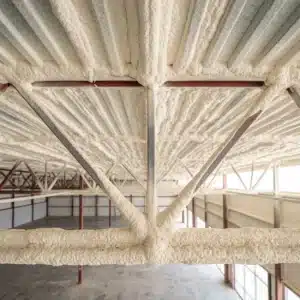
If you manage, design, or build commercial structures in Texas, Kansas, or Oklahoma, you have likely seen K-13 on exposed ceilings in warehouses, gymnasiums, and worship centers. That textured, spray-applied finish is not just decorative. It is a high-performance insulation system that controls sound, reduces energy costs, and meets strict fire safety requirements, all in a single application.
Over the past 20 years, I have applied K-13 across hundreds of commercial projects in our service territory. I have seen what works, what fails, and where specifications go wrong. This guide shares that experience alongside verified manufacturer data and current code references so you can make confident decisions on your next project.
What makes this product different from other commercial insulation options is its ability to handle three jobs at once: thermal insulation, acoustic absorption, and fire protection. Most insulation products address one or two of those needs. K-13 covers all three in a single, monolithic coating that bonds directly to the substrate. That efficiency is why it remains the commercial standard for exposed ceiling applications across the country.
What Is K-13 Spray-Applied Insulation?
K-13 is a spray-applied thermal and acoustical insulation manufactured by International Cellulose Corporation (ICC), headquartered in Houston, Texas. It is made from specially prepared cellulose fibers, sourced from 80% pre-consumer recycled content, combined with a patented water-based adhesive called SK-2000. During application, the fibers and adhesive combine to create a durable, monolithic coating that bonds directly to the substrate at a nominal density of 3.5 pcf (pounds per cubic foot).
The product provides an R-value of 3.7 per inch and Noise Reduction Coefficient (NRC) ratings up to 1.05, making it the commercial standard for exposed ceiling insulation in warehouses, schools, hospitals, and commercial buildings. It contains no silica dust, asbestos, mineral fibers, glass fibers, or PCBs.
The product is classified under CSI MasterFormat Division 7: 07 21 29 (Sprayed Insulation) and Division 9: 09 83 16 (Acoustic Ceiling Coating). This dual classification reflects K-13’s unique position as both an insulation and an acoustical finish product.
One distinction that matters in specifications: this product is not spray foam insulation, and it is not structural fireproofing. It is a cellulose-based spray-applied insulation with acoustic and thermal properties. Confusing these categories in project documents creates coordination problems and inspection delays. Getting the specification language right from the start saves time and avoids costly rework.
Thermal Performance: R-Values by Thickness
K-13 delivers consistent thermal resistance of R-3.7 per inch, tested per ASTM C 518. Because it is spray-applied, the product creates a seamless, monolithic coating with no gaps, joints, or compression points. That continuous coverage eliminates the thermal bridging and air infiltration problems common with batt and board insulation systems.
The following R-value data comes directly from ICC’s February 2025 Technical Data Sheet:
| Thickness | R-Value |
|---|---|
| 1″ | 3.7 |
| 2″ | 7.4 |
| 3″ | 11.1 |
| 4″ | 14.8 |
| 5″ | 18.5 |
| 6″ | 22.2 |
| 7″ | 25.9 |
| 8″ | 29.6 |
| 9″ | 33.3 |
| 10″ | 37.0 |
Standard K-13 can be applied up to 5 inches thick without mechanical support. For projects requiring higher R-values, ICC offers the K-13 High-R System, which uses mechanical fasteners to support thicknesses up to 10 inches (R-37).
In our experience across Texas and Oklahoma commercial projects, the monolithic nature of this insulation makes a measurable difference in real-world energy performance. Batt insulation in metal building ceilings develops gaps at laps, sags over time, and compresses at fastener points. K-13 eliminates all three problems. Facilities upgrading from minimal insulation to properly applied K-13 typically see energy cost reductions of 20 to 30 percent, depending on the building envelope and HVAC system.
For projects where you need to understand how K-13 compares to fiberglass batts for commercial ceiling applications, the thermal bridging difference alone often justifies the installed cost premium.
Acoustic Performance: NRC Ratings by Thickness and Substrate
Acoustic control is often the primary reason architects and engineers specify K-13 for commercial projects. The product absorbs sound energy across a wide frequency range, reducing reverberation and improving speech intelligibility in large open spaces.
The product’s acoustic performance varies based on two factors: applied thickness and substrate type. Metal deck substrates, because of their corrugated profile, create an air cavity behind the insulation that enhances low-frequency absorption. This is critical to understand when specifying, because the same 1-inch thickness performs differently on a solid backing versus a 2-inch metal deck.
The following NRC data is tested per ASTM C 423, sourced from ICC’s February 2025 Technical Data Sheet:
K-13 on Solid Backing:
| Thickness | NRC |
|---|---|
| 1″ | 0.80 |
| 1.5″ | 0.90 |
| 1.75″ | 1.00 |
| 2″ | 1.00 |
| 3″ | 1.00 |
K-13 on 2-Inch Metal Deck:
| Thickness | NRC |
|---|---|
| 1″ | 0.90 |
| 2″ | 1.05 |
K-13 on 3-Inch Metal Deck:
| Thickness | NRC |
|---|---|
| 1″ | 0.95 |
| 1.5″ | 1.00 |
| 2.75″ | 1.05 |
Notice how the metal deck air cavity boosts performance. One inch on a 3-inch metal deck achieves NRC 0.95, while the same thickness on a solid backing reaches only NRC 0.80. This is a specification detail that gets overlooked frequently. In 20 years of applying this insulation, one of the most common mistakes I see is architects specifying thickness based on solid-backing NRC data for a metal deck project, resulting in over-specified (and over-budget) installations.
For Sound Transmission Class (STC) performance, the product achieves STC 50 at 3-inch thickness and STC 51 at 4-inch thickness, tested per ASTM E 90.
Matching NRC to Building Type
No competitor publishes practical NRC recommendations by building type, so here is guidance based on our project experience and industry acoustic standards. For detailed NRC ratings and acoustic performance data by thickness, we will be publishing a dedicated technical reference.
| Building Type | Minimum NRC Target | Recommended K-13 Thickness (Solid Backing) |
|---|---|---|
| Warehouse / Distribution Center | 0.80 | 1″ |
| Open Office / Call Center | 0.90 | 1.5″ |
| School Gymnasium / Cafeteria | 0.95+ | 1.75″ |
| Worship Center / Church | 1.00 | 2″ |
| Hospital / Healthcare | 0.90+ | 1.5″ |
| Restaurant / Entertainment | 0.80+ | 1″ |
These recommendations assume solid backing. If your project uses metal deck, you can often achieve the same NRC at a reduced thickness, saving material cost. Always verify the specific deck profile against ICC’s published data for your assembly.
Fire Performance and Safety Ratings
K-13 carries a Class 1, Class A fire rating per ASTM E-84 and UL-723. Older data sheets also list NFPA-255 and UBC-42; both are legacy references (NFPA 255 was withdrawn in 2009 and its content moved into ASTM E84 and UL 723, and the UBC was superseded by the IBC in 2000), so current specifications should cite ASTM E84 or UL 723. The K-13 fire rating per ASTM E-84 shows a Flame Spread Index of 5 and Smoke Development Index of 5, both well below the Class A thresholds of 25 and 450 respectively. This means the product meets or exceeds the strictest IBC interior finish requirements for all occupancy groups under IBC (2021) Section 803.13.
Factory Mutual has approved K-13 across four categories, each with specific minimum thickness requirements: Category I (interior finish, minimum 1 inch), Category II (protective coating for combustible wood, minimum 1 inch), Category III (protective coating for foam plastics, minimum 1.25 inches), and Category IV (protective coating for structural steel to supplement sprinkler protection, minimum 1 inch).
The product also meets IBC 2015 Section 803.12 stability requirements for interior finish materials, and UL ER 5499 classifies it as an approved ignition barrier over foam plastics per IRC Section R316.5.3.
Fire Endurance: K-13 vs. Sprayed Fiberglass
ICC conducted a comparative ASTM E-119 full-scale fire wall test that demonstrates this insulation’s fire endurance advantage over sprayed fiberglass. This data rarely appears in competitor content, but it is significant for projects where fire performance matters:
| Metric | K-13 (Cellulose) | Sprayed Fiberglass |
|---|---|---|
| Remained on substrate | Entire 30-minute test | Gone at 17 minutes |
| Internal temp at 15 min | 221°F | 1,069°F |
| Internal temp at 30 min | 499°F | 1,542°F |
| Top-of-substrate temp at 30 min | 193°F | 560°F |
| Substrate damage | None | Extensive |
The cellulose insulation remained in place during the entire 30-minute fire test, protecting the substrate. The sprayed fiberglass was completely gone at 17 minutes, with the substrate reaching 560°F. That temperature difference (193°F versus 560°F at the substrate surface) is the difference between a structure that can be evaluated for reuse and one that requires significant repair.
K-13 Over Spray-Applied Fireproofing: Combined Systems
One of K-13’s most valuable capabilities is its UL-approved use over spray-applied fire-resistive materials (SFRM). The product is listed in six UL BXUV Guide Design Assemblies for application over SFRM, including assemblies D779, D798, D925, D985, P725, and P732, among others referenced in ICC’s product documentation.
This matters because many commercial steel buildings require both structural fireproofing on the steel and thermal/acoustic insulation on the deck. Traditionally, these are treated as two separate systems from two separate contractors. When combining K-13 insulation with spray-applied fireproofing in a single assembly, the coordination between systems is critical, and having a single contractor handle both eliminates the finger-pointing that happens when problems arise.
At Bahl Fireproofing, we apply both SFRM and K-13. That means one crew manages the surface preparation, one team understands the compatibility requirements between the fireproofing and the insulation, and one contractor takes responsibility for the final assembly performance. In our experience, this single-source approach reduces scheduling conflicts by at least a week on mid-size commercial projects and eliminates the warranty gaps that occur when two specialty contractors share an assembly.
When specifying this insulation over SFRM, always reference the specific UL Design Assembly number in your project documents. General statements like “K-13 over fireproofing” do not give inspectors what they need. Cite the assembly (for example, UL D779 or UL P725) and specify both the SFRM product and thickness along with the insulation thickness.
How K-13 Is Installed: The Application Process
K-13 installation follows a systematic process that requires applicators licensed and trained by International Cellulose Corporation. Here is what to expect on a typical commercial project:
Step 1: Substrate Inspection. Before any material goes on, the crew inspects every surface that will receive insulation. We check for oil, grease, dust, loose paint, and any contaminants that could compromise adhesion. Surfaces must be dry and free of frost.
Step 2: Surface Preparation and Priming. Some substrates require a primer or pre-treatment before application. Galvanized metal, painted surfaces, and certain concrete finishes need priming to achieve the bond strength K-13 is rated for (greater than 150 psf per ASTM E 736). Skipping this step is the single most common installation mistake I encounter on projects where another contractor started the work.
Step 3: Equipment Setup and Application. K-13 fiber and SK-2000 adhesive emulsion are simultaneously applied to the surface in separate streams through a specially designed nozzle provided by International Cellulose Corporation. The two materials combine on the substrate, not in a mixing chamber, creating the monolithic bond that gives K-13 its adhesion and durability.
Step 4: Spray Application. The applicator builds the insulation to the specified thickness in controlled passes. Experienced applicators maintain consistent thickness across the entire surface, including inside deck flutes and around penetrations. Thickness is monitored continuously during application.
Step 5: Thickness Verification. After application, thickness is measured at multiple points across the installed area per ASTM E 605 (Standard Test Methods for Thickness and Density of Sprayed Fire-Resistive Material). This verification step is documented and provided to the inspector.
Step 6: Curing and Protection. The applied insulation requires adequate drying time before other trades work in the area. Ambient temperature and humidity affect cure time directly. In Texas summer conditions (90°F+, high humidity), cure times can extend compared to manufacturer baseline recommendations. We plan for this in the project schedule.
For general contractors coordinating this work with other trades, scheduling matters. The insulation should be applied after SFRM fireproofing (if applicable) and before MEP rough-in. Once MEP trades begin running ductwork, piping, and conduit through the ceiling cavity, accessing the deck for K-13 application becomes significantly more expensive due to masking, cutting, and patching requirements. For a detailed walkthrough, see our guide to professional K-13 application methods for commercial projects.
Substrate Compatibility and Surface Preparation
The product bonds to a wide range of commercial substrates, including metal decking (1.5-inch, 2-inch, and 3-inch ribbed profiles), poured concrete, concrete T-decks, barrel vaults, gypsum board, wood, glass, urethane, and polystyrene.
Each substrate type has specific preparation requirements. Metal decking must be clean and free of mill oil. Concrete surfaces may need a bonding agent if they are sealed or extremely smooth. Painted surfaces generally require priming. Galvanized metal always requires primer.
The critical takeaway for specifiers: include substrate preparation requirements in the project specification. A common mistake is specifying thickness and color but omitting the priming requirement, leaving the decision to the field. When priming gets skipped on a substrate that needs it, the result is adhesion failure that shows up months later as delamination or sagging. Specify the primer, and your K-13 installation will deliver the bond strength (greater than 150 psf per ASTM E 736) that the product is rated for.
K-13 for Different Building Types
K-13’s combination of thermal, acoustic, and fire performance makes it effective across a wide range of commercial building types. Here is how the insulation applies to the most common project types in our Texas, Kansas, and Oklahoma service territory.
Warehouses and Distribution Centers represent the highest volume of commercial K-13 spray insulation work in our region. For K-13 insulation for warehouses in Texas, the DFW, Oklahoma City, and Wichita logistics corridors are driving new construction. The product at 1-inch thickness on metal deck provides NRC 0.90+ acoustic control while meeting energy code requirements.
Schools and Gymnasiums need high acoustic performance to support learning environments. Gymnasium ceilings with 1.75 to 2 inches of this insulation achieve NRC 1.00, bringing reverberation under control in the high-volume spaces where students spend significant time. We will be publishing dedicated guidance on K-13 acoustic solutions for school gymnasiums and cafeterias.
Hospitals and Healthcare Facilities require acoustic control for patient recovery and HIPAA speech privacy compliance. At 1.5-inch thickness, the insulation delivers NRC 0.90 on solid backing. Our hospital acoustic insulation work demonstrates how this product supports patient recovery through sound control.
Data Centers use this insulation primarily for acoustic control of server fan noise and for thermal performance in ceiling plenums. Our complete guide to K-13 insulation for data centers covers data-center-specific application guidance.
Cold Storage Facilities benefit from this insulation’s thermal performance and condensation control capabilities. The monolithic coating reduces air infiltration at the ceiling plane, helping maintain temperature zones. Our article on K-13 for cold storage facilities addresses the unique challenges of refrigerated environments.
Worship Centers and Churches are among the most acoustically demanding commercial spaces. Sermon intelligibility depends on controlling reverberation in large-volume rooms with hard surfaces. At 2 inches on solid backing (NRC 1.00) or 1.5 inches on metal deck (NRC 1.00+), this insulation transforms the acoustic environment. We will be covering K-13 for worship centers and churches in an upcoming guide.
How Much Does K-13 Insulation Cost?
K-13 insulation cost per square foot in Texas, Kansas, and Oklahoma typically ranges from $1.50 to $3.00 installed for professional K-13 sprayed fiber insulation services. Several factors drive where your project falls within that range.
Thickness is the primary cost driver. A 1-inch application at the low end of the range provides NRC 0.80 on solid backing and R-3.7. A 2-inch application near the upper end doubles both the acoustic and thermal performance.
Substrate condition affects cost when priming or special preparation is required. Projects with clean, new metal deck require minimal prep. Retrofit projects with painted, oily, or contaminated substrates add prep time and material.
Project size creates economies of scale. Mobilization costs (equipment transport, crew travel, setup) are relatively fixed, so larger projects distribute those costs across more square footage.
Color selection matters. The product comes in five standard colors (Black, Gray, Light Gray, White, and Tan) with custom color matching available at additional cost.
Access and height affect labor productivity. Ground-level applications go faster than 40-foot warehouse ceilings requiring scissor lifts or boom lifts.
For comparison, spray foam insulation ranges from $1.00 to $4.50 per square foot nationally, while fiberglass batt material (not installed) averages $0.67 to $0.72 per square foot. This insulation is typically lower in installed cost than rigid board insulation, sprayed plasters, and suspended acoustical ceiling systems that attempt to provide similar combined thermal and acoustic performance. For a comprehensive cost breakdown by project type and size, see our detailed K-13 insulation cost guide for commercial projects (coming soon).
Sustainability and Green Building Certifications
K-13 carries an extensive list of environmental certifications that support green building requirements. It contains 80% pre-consumer recycled content, carries UL GREENGUARD Gold certification for low chemical emissions, and holds Cradle to Cradle Certified Bronze (V3.1).
ICC publishes a product-specific Type III Environmental Product Declaration (EPD) per ISO 14025, a Health Product Declaration (HPD) Version 2.3, and M1 Classification as a low-emitting building material. The product’s Global Warming Potential is just 0.01 kg CO2e per square meter for modules A1 through A3, one of the lowest in the commercial insulation category.
For LEED projects, the insulation can contribute up to 17 points toward the overall rating across multiple credit categories including Low-Emitting Materials (compliant with CDHP/California Section 01350), SCAQMD Rule 1168, and regional material credits. That regional material credit is particularly relevant for our projects: K-13 is manufactured at ICC’s Houston, Texas facility, qualifying it as a regional material for projects across Texas, Oklahoma, Kansas, Nebraska, Minnesota, and Wisconsin.
K-13 Color Options and Aesthetic Considerations
The insulation is available in five standard colors: Black, Gray, Light Gray, White, and Tan. Custom color matching is available for projects where the ceiling finish needs to coordinate with the overall design.
Light reflectance values (tested per ASTM D 2244) vary by color. White provides 84+ light reflectance, Light Gray offers 73+, and Black comes in at 17+. For warehouses and distribution centers where lighting efficiency matters, White or Light Gray finishes can reduce supplemental lighting requirements by improving reflectance off the ceiling plane.
The textured, exposed finish is part of the product’s design appeal in commercial and institutional spaces. Architects increasingly specify this insulation in exposed-structure designs where the ceiling deck, ductwork, and structural elements remain visible. K-13 color options and aesthetic design applications continue to expand as more architects discover the product’s versatility.
K-13 Performance in Texas Heat and Humidity
No manufacturer data sheet addresses regional climate challenges, and no competitor content covers this topic. But for projects in Texas, Kansas, and Oklahoma, climate-specific performance matters.
Texas summer conditions (100°F+ ambient temperatures, Gulf Coast humidity levels exceeding 80% relative humidity) create condensation risk on metal deck ceilings, particularly in partially conditioned or transitional spaces. The monolithic coating reduces air infiltration at the ceiling plane, which helps control moisture migration and condensation. When combined with proper ventilation design, this insulation contributes to condensation control in facilities where humidity management is critical, including indoor pools, ice arenas, and food processing plants in humid Texas regions.
In extreme heat, the air infiltration reduction delivers measurable energy savings beyond what R-value alone predicts. A building with R-7.4 (2-inch K-13) and minimal air infiltration will outperform a building with R-13 fiberglass batts that has gaps, compressions, and air leakage paths at every seam and fastener point. The installed performance of any insulation system depends on installation quality as much as material properties.
Application timing also matters in our climate. Cure times extend in high-humidity conditions. On summer projects in Houston or the Gulf Coast region, we schedule application during morning hours when possible and ensure adequate ventilation in the work area to support proper drying. This is a coordination detail that affects the project schedule, so general contractors should discuss application timing with their commercial insulation across Texas, Oklahoma, Kansas, Nebraska, Minnesota, and Wisconsin contractor early in the planning process.
Related Reading
Explore more K-13 insulation topics from Bahl Fireproofing:
- Looking for step-by-step application details? See our guide to professional K-13 application methods for commercial projects.
- Planning a warehouse project? Read K-13 warehouse insulation: acoustic control and energy savings.
- Working on a healthcare facility? Our hospital acoustic insulation guide covers K-13 for patient recovery environments.
Frequently Asked Questions
What Is K-13 Spray-Applied Insulation?
K-13 is a spray-applied thermal and acoustical insulation made from recycled cellulose fibers combined with a patented water-based adhesive. Manufactured by International Cellulose Corporation in Houston, Texas, K-13 provides R-3.7 per inch thermal resistance and NRC ratings up to 1.05, making it the commercial standard for exposed ceiling insulation in warehouses, schools, hospitals, and commercial buildings.
What Is the R-Value of K-13 Insulation?
The product delivers R-3.7 per inch of applied thickness, tested per ASTM C 518. At 2 inches, you get R-7.4. At 5 inches (the maximum without mechanical support), you reach R-18.5. The High-R System with mechanical fasteners extends coverage up to 10 inches for R-37.
How Long Does K-13 Insulation Last?
ICC’s Environmental Product Declaration rates this insulation at a 75-year service life. Unlike fiberglass batts that compress, sag, and absorb moisture over time, the cellulose material maintains its performance characteristics without settling. The adhesive bond (greater than 150 psf per ASTM E 736) keeps the material securely attached to the substrate for the life of the building when properly applied.
Can K-13 Be Applied Over Fireproofing?
Yes. The product is UL-approved for application over spray-applied fire-resistive materials (SFRM) and is listed in six UL BXUV Guide Design Assemblies, including D779, D798, D925, D985, P725, and P732. Always reference the specific UL Design Assembly number in your project specifications.
Is K-13 Insulation Fireproof?
This insulation is not structural fireproofing, but it carries a Class 1, Class A fire rating per ASTM E-84 with a Flame Spread of 5 and Smoke Development of 5. It meets the strictest IBC interior finish requirements for all occupancy groups. Factory Mutual has approved the product across four fire protection categories. In ASTM E-119 testing, the cellulose insulation remained in place during the entire 30-minute fire test while sprayed fiberglass was gone at 17 minutes.
What Surfaces Can K-13 Be Sprayed On?
The product bonds to metal decking (1.5-inch, 2-inch, and 3-inch profiles), poured concrete, concrete T-decks, barrel vaults, gypsum board, wood, glass, urethane, and polystyrene. Some substrates require priming for proper adhesion. Always inspect and prepare surfaces before application.
How Much Does K-13 Cost Per Square Foot?
Installed pricing typically runs $1.50 to $3.00 per square foot for commercial projects. Cost varies by thickness, substrate condition, project size, color selection, and access requirements. This insulation is generally lower in installed cost than rigid board, sprayed plasters, and acoustical ceiling systems offering comparable combined performance.
Is K-13 Insulation Environmentally Friendly?
The product contains 80% pre-consumer recycled content, holds UL GREENGUARD Gold and Cradle to Cradle Bronze certifications, and can contribute up to 17 LEED points. It is manufactured in Houston, Texas, qualifying as a regional material for projects throughout Texas, Oklahoma, Kansas, Nebraska, Minnesota, and Wisconsin.
What Is the Difference Between K-13 and Spray Foam?
These are different products for different applications. K-13 is a cellulose-based, spray-applied thermal and acoustic insulation designed for exposed ceiling applications. Spray foam (polyurethane) is a chemical foam insulation used in wall cavities, rooflines, and building envelopes. The cellulose product provides superior acoustic absorption (NRC up to 1.05) and a finished appearance. Spray foam provides higher R-value per inch (R-6.5 for closed-cell) and air/moisture barrier properties. They serve different roles in the building envelope.
Does K-13 Help With Soundproofing?
This insulation is one of the most effective commercial sound absorption products available. At 2 inches on solid backing, it achieves NRC 1.00, absorbing virtually all sound energy that hits the surface. On metal deck substrates, performance is even higher due to the air cavity effect. The product reduces reverberation time, improves speech clarity, and lowers ambient noise levels in large commercial spaces.
Key Takeaways
K-13 spray-applied insulation delivers thermal resistance of R-3.7 per inch (ASTM C 518) with seamless, monolithic coverage that eliminates the gaps and compression common in batt insulation systems.
Acoustic performance reaches NRC 1.05 on metal deck substrates, but NRC varies significantly by thickness and substrate type. Always specify based on your exact deck profile and required NRC target.
Class 1, Class A fire rating (Flame Spread 5, Smoke Development 5) meets the strictest IBC interior finish requirements. The ASTM E-119 fire endurance comparison shows this cellulose insulation dramatically outperforms sprayed fiberglass under fire conditions.
The product is UL-approved for application over SFRM in six listed design assemblies. A single contractor handling both fireproofing and insulation reduces scheduling conflicts and eliminates warranty gaps.
Installed costs range from $1.50 to $3.00 per square foot in Texas, Kansas, and Oklahoma, with thickness, substrate condition, and project size as the primary cost drivers.
ICC manufactures this insulation in Houston, Texas, making it a regional material for LEED projects throughout the Bahl Fireproofing service territory. The product can contribute up to 17 LEED points across multiple credit categories.
Substrate preparation, particularly priming, is the most commonly skipped step that leads to adhesion failure. Specify it in project documents and verify it in the field.
In hot, humid Texas climates, the monolithic application controls condensation and air infiltration in ways that batt insulation cannot match, delivering real-world energy savings beyond what R-value comparisons suggest.
Whether you are specifying this insulation for a new commercial building, replacing aging ceiling insulation, or evaluating combined fireproofing and insulation systems, the right installation makes all the difference. With over 20 years of K-13 application experience across Texas, Kansas, and Oklahoma, Bahl Fireproofing delivers the technical expertise and field knowledge to get your project done right. Contact Bahl Fireproofing today at 512-387-2111 or email ross@bahlfireproofing.com to schedule a consultation or request a bid.
This article provides general educational information about K-13 spray-applied insulation for commercial buildings. It is not a substitute for project-specific engineering, design, or code analysis. Fire ratings, thermal performance, and acoustic ratings referenced in this article are based on manufacturer published data and standardized testing (ASTM, UL, FM). Actual performance depends on installation quality, substrate conditions, building design, and environmental factors. Building codes, fire ratings, and insulation requirements vary by jurisdiction. Always consult a licensed professional engineer, architect, or code official for project-specific requirements. Bahl Fireproofing is a commercial insulation and fireproofing contractor, not an engineering or design firm.